

Almost buried in an oasis of trees, the farms of Beersheba holds more secrets than its ancient gables hint at. Set in the vast open plains and hills of the eastern Free State, this French mission station is 25 kilometres from Smithfield, the third oldest village in the province.
A bloody past
But once it was at the very centre of a battle that tore apart the community that lived at Beersheba tore apart the people living around the mission and in the wider region.
It was here that a key confrontation took place between the Boer republic and the Basotho commanded by their legendary leader, Moshoeshoe.
The fighting was part of the three Basotho wars, fought between 1858 and 1868, which saw this Paris Evangelical 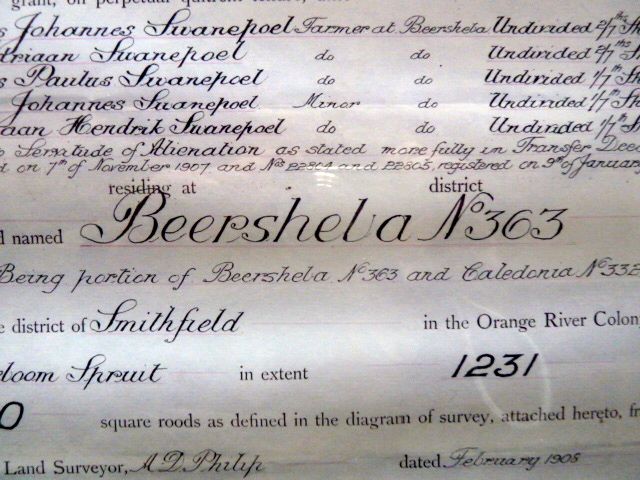 Mission station put to the torch by the Afrikaners.
In 1908 – following the end of the Anglo-Boer war, the farm was awarded to the Swanepoel family.
A farm and a home
For seven generations they lived on the farm, bearing children and making it a comfortable home.
But this early South African life was not without its hardship and the family graveyard is marked by the graves of children as well as the adults who died on the farm.
Changing hands
It was not until 2003 that the Swanepoel family found the going too hard and finally sold up and left the farm. It was bought by the present owner, Lourens van der Linde, who has spent a good deal of money restoring the farmhouse.
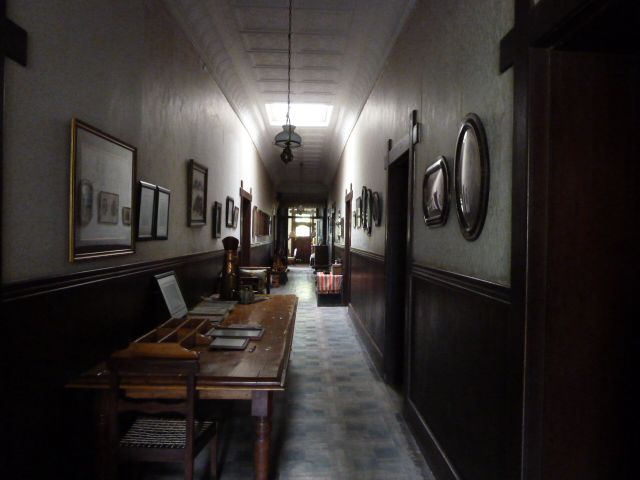 Today it is a comfortable home, its rooms decorated to reflect its long history.
On its walls still hang the photographs of the Swanepoel family, who return to the farm and their former home every year, to remember their association with the place.
New management
In October 2009 the present manager of the farm, Jaco Saaiman and his wife, Corlia took over the running of Beersheba and the neighbouring farm, Amsterdam.

They farm sheep, cattle and lucerne, but the past is never far away.
“Sometimes the history is overwhealming,” says Jaco.
“I would love to know much more about it – you cannot believe that Moshoeshoe was here and made such an oasis of it.”
Looking down its long corridor, Corlia echoes his sentiments.
“You study this history in school,” she says. “Here you see it in reality.”
A Basotho past
Jaco takes me up onto the hillside overlooking the farm.
 Here, now buried amid bushes and shrubs, are the ruins that the Basotho once made home.
Jaco estimates that around 2,000 people once lived here.
“I cannot be certain,” he says, looking at the carefully constructed walls, which still stand after all these years.
A silent school
Testament to the legacy of this former mission station is the classroom, now standing empty.

Once the French missionaries would have taught the young Basotho who came to study and learn.
Beersheba is much more than a farm – it is a listed historic monument – but it is also a testament to the bitter past that once saw war on these fertile lands.
It is a heritage that both the Free State farmers and their Basotho neighbours can share.
 Martin Plaut
Your article has been chosen by SouthWeb Editor to be ReBlogged . To see your article, visit http://www.southweb.org. Cheers & keep up the great work!
read a bit about a french missionary Eugene Cazalis in Basoetouland – Lesotho, he was also ambassador of Moshoeshoe : http://booksnow1.scholarsportal.info/ebooks/oca2/31/mylifeinbasuto00casauoft/mylifeinbasuto00casauoft.pdf
The facts stated are incorrect. J.J.J.W. bought Beersheba from the French Mission Society for 5000 pounds. Not a cent has been spent on the house since the new owner acquired the farm from me.
The Sotho war was 1858. The farm was purchased in 1860.
Pete,
The great historian, Theal, says the site of Beersheba was orignally called Zevenfontein and was the abode of a group of Christian Afrikaner families. In 1835, the Cape Governor ( Benjamin D’Urban) called them up for commando duty on the Eastern Frontier of the Cape in Hintsa’s War. When they returned to their home, the French Missionaries from Moshesh’s capital to the north had occupied the place and moved a bunch of Ba’Hurutsi and Ba’Rolong refugees from Mzilikazi there.
Read Theal HERE in his own words:
https://archive.org/details/historyofemigran00theauoft/page/56/mode/2up ( pp. 56 & 57)