
Source: Atlantic Council Digital Research Lab
Pro-Russian Telegram channel depict Niger coup as a new opening for Wagner
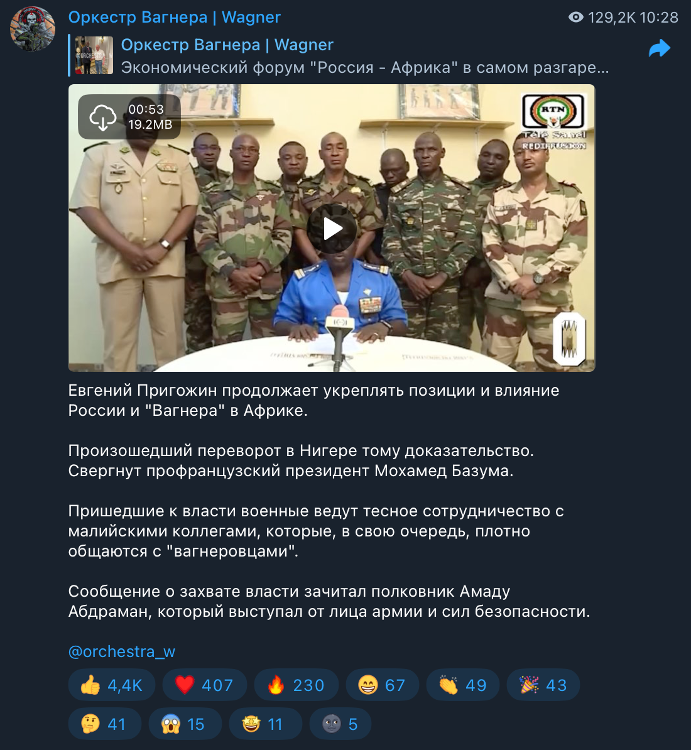
Russian Telegram channels are following events in Niger closely after Nigerien soldiers announced the removal of democratically-elected President Mohamed Bazoum on July 26. As the coup unfolded, the channels portrayed Bazoum as a vassal of the West, and Niger under Bazoum’s leadership as being “directly dependent on France” and “part of the remnants of the French neo-colonial empire.” The Telegram channels emphasized that Central African Republic, Mali, and Burkina Faso—countries in which Wagner is confirmed to be present or allegedly present—had extricated themselves from French military influence in recent years.
Some channels also claimed the coup leaders were associated with Wagner Group, alleging that Wagner supported the faction of Colonel-Major Amadou Abdramane, which seized control of the presidency. One Russian military blogger, Boris Rozhin, reported on his channel that Wagner would soon receive an invitation from a “free” Niger.
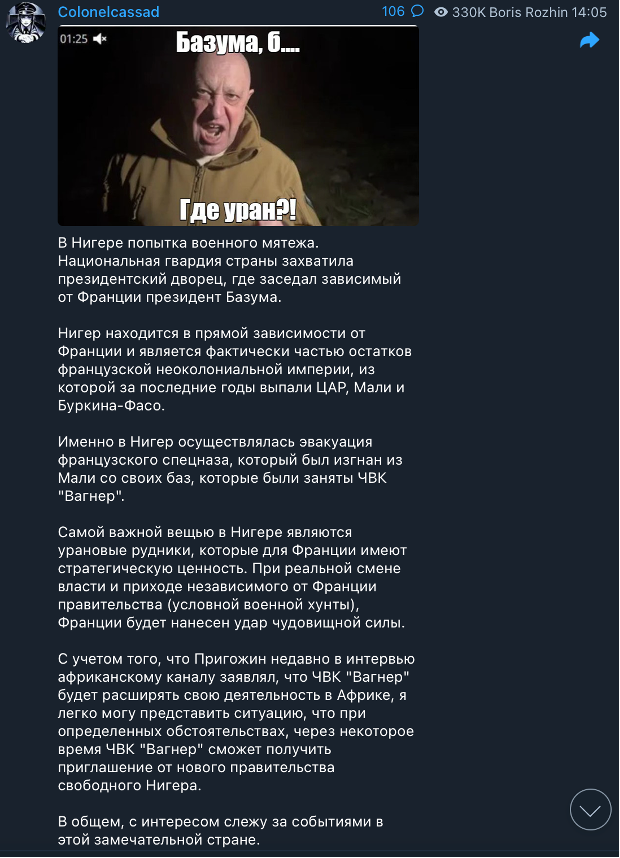
The coup is also seen as a confirmation of Prigozhin’s recent statements about expanding Wagner’s presence in Africa. The channels emphasized the importance of Niger’s uranium mines to France, possibly alluding to the fact that Wagner’s presence in African states is often linked to them receiving local mining concessions.
Bazoum insisted the day after the coup that “hard-won gains will be safeguarded.” But the coup will likely change Europe’s political calculus regarding Niger, which had become central to France and the European Union’s new approach to a region plagued by a growing Jihadist insurgency and political instability, particularly in the wake of French forces pulling out of Mali in 2022.
—Tessa Knight, research associate, London, United Kingdom
—Mattia Caniglia, associate director, Brussels, Belgium
 Martin Plaut