
In case we forget – how a British Public Relations company stirred up race hate in South Africa
Source: British Journalism Review, December 2017
By Martin Plaut
The collapse of Bell Pottinger would not have happened without the investigative zeal of a group of dedicated journalists in South Africa
On September 19, Bell Pottinger, once one of Britain’s most prestigious and powerful public relations agencies, collapsed. The firm went into receivership, with the loss of some 250 jobs. It was an ignominious end to the company, which was founded by Timothy (now Lord) Bell and played a leading role in Margaret Thatcher’s election victory in 1979, when he devised the famous “Labour isn’t working” campaign slogan.
At the height of its powers, Bell Pottinger had offices around the world and worked for some of the most questionable clients. These included Asma al-Assad, wife of the president of Syria; Alexander Lukashenko, dictator of Belarus; polluting oil company Trafigura and the Pinochet Foundation during its campaign against the former Chilean dictator’s British detention. Yet none of these relationships troubled the company or its board of directors. As Lord Bell himself put it: “My profound belief is that a small number of words, a strong visual image, can change the way people think.” At Bell Pottinger, he said: “We tell stories – I don’t mean lies. We work for people who want to tell their side of the story.”
It was to be a contract with a little-known South African company – Oakbay – that would break this PR giant. The company belonged to an Indian family: the Guptas. They arrived in South Africa in 1993, a year before the formal end of apartheid, believing they could benefit from the fresh start the country would have under the guidance of Nelson Mandela and the ANC. The Guptas – Ajay, Atul, Rajesh “Tony” Gupta and Atul Gupta’s nephew, Varun Gupta – adopted a tried and tested Indian strategy: they found an up-and-coming politician, established links with him and funded him. In return they received political cover for their business interests, which grew from a small computer company to include stakes in uranium, gold and coal mines, a luxury game lodge, an engineering company, a newspaper and a 24-hour TV news station. The family became immensely wealthy. By 2016 Atul Gupta alone was the seventh-richest person in South Africa with an estimated wealth of $773m (£600m).
The politician the family linked up with was Jacob Zuma.The first relationship is said to have been established in 2002, when Zuma had been elevated from a lowly member of the KwaZulu-Natal provincial government to become deputy president of the ruling ANC and the country. Soon the Zuma family – including some of his wives and children – were being employed directly or indirectly by the Guptas. The Zuma and Gupta clans were so tightly enmeshed that a term was coined to describe their relationship: the “Zuptas”.
Questions began to be asked about what the “Zuptas” might be up to. And here South Africans were fortunate to be able to rely on an extraordinarily able, and inquisitive, group of journalists, who came together to form a unique organisation: amaBhungane – named after the dung beetle. They were led by Sam Sole and Stefaans Brümmer, who were tough, resourceful and willing to soak up the pressure. Working with the Mail & Guardian newspaper since 2010, they unravelled the ties between the Guptas and Zuma. They wrote: “It was under the spotlight of our Zuma Inc investigation, which probed the business interests of the extended Zuma family, that we flagged the connection.” Initial reaction from readers was not supportive – “a lot of unnecessary hot air about nothing” was one reaction – but still they continued digging.
The “dung” the journalists uncovered soon grew into a vast, stinking heap. Two issues in particular added credibility to their work. The first was the revelation that in April 2013 the Guptas managed to land a planeload of 217 guests from India at the South African Air Force base at Waterkloof for the wedding of Vega Gupta to Aakash Jahajgarhia, despite the opposition of the Minister of Defence – having instead been granted permission by “Number One”. The South African public woke up to the fact that the Guptas wielded extraordinary influence.
This perception was reinforced when it was revealed that cabinet ministers had been told they would be receiving their positions not by the presidency, but at meetings conducted at the Gupta mansion at Saxonwold, in Johannesburg. ANC MP Vytjie Mentor said she was offered the key post of public enterprise minister during a meeting at Saxonwold in 2010. Deputy finance minister Mcebisi Jonas said a member of the Gupta family offered to promote him to the minister’s post in 2015. A new term gained currency in South Africa to define what had taken place as the Guptas’ power grew: state capture. The suggestion that the Gupta family might have a hand in running the country was investigated by the official public protector (a watchdog post established under the constitution). Public protector Thuli Madonsela produced a 355-page report in October 2016, which supported many of the allegations of improper influence by the Guptas.
Before this time the Guptas had become concerned that their image – and with it, the reputation of their companies – was being seriously damaged. The family decided it needed help and turned to the public relations industry. Bell Pottinger pitched for the work in early 2016. The two sides had been put in touch with each other by Christopher Geoghegan, a former defence industry executive whose 33-year-old daughter Victoria worked for Bell Pottinger in corporate communications. Lord Bell himself led the company’s delegation to meet the Guptas. The contract, signed in March 2016, was lucrative at £100,000 a month.
A dirty secret
Bell Pottinger got to work, with a key role played by Victoria Geoghegan. The strategy that she and her team devised was controversial. They aimed to deflect attention from the Guptas by pointing towards others who benefited from South Africa: the white population. The strategy was to go on the attack. Journalists at amaBhungane put it this way: the UK-based firm sought to deflect attention away from the families’ various scandals and involvement in state capture by manufacturing conspiracies and presenting the Guptas as pioneers of economic transformation. The firm allegedly aimed to shift the public’s focus to other instances of interference in the state by “white capital”.
The campaign is said to have been organised by Duduzane Zuma, who works for Oakbay, one of the Gupta companies. He and Victoria Geoghegan are reported to have met to discuss a campaign which Zuma said should be “along the lines of ‘economic emancipation or whatever’ with a ‘narrative that grabs the attention of the grassroots population who must identify with it, connect with it and feel united by it’”. A term began to be used in South African radical circles: white monopoly capital. Soon those who criticised the Guptas were being attacked as instruments of “white monopoly capital”.
Among those Bell Pottinger made links with was an apparently radical group, Black First Land First. This was founded in 2015 by Andile Mngxitama, a controversial figure who had been expelled from the radical Economic Freedom Fighters of Julius Malema. Black First Land First claimed to be Marxist-Leninist and Pan-Africanist, but it soon gained a reputation for targeting journalists – some of them black – who were critical of the Guptas. Among those who were attacked was Ferial Haffajee, editor at large for Huffington Post. Tweets from Black First Land First portrayed her in a shockingly abusive manner. Haffajee explained how she reacted: “For months, I’ve looked at them when I’m alone. Quickly, like a dirty secret. The images make me wince with their distortions and insults. I snap my phone shut and move to another screen. Or make a cup of tea. Images are powerful and the designers have very specific messages. That I am a whore, a harridan, an animal and a quisling. I feel shame, and fear that my family will see them and not understand their genesis.” A sister publication of Black First Land First accused her of “reading from a tired white script” and acting as a front for “white monopoly capital”.
At first it was not clear who was behind the campaign, which was taken up by Gupta media outlets, including television network ANN7. It might have become the dominant narrative, but at this point the Gupta empire began to leak information, as whistleblowers revealed what was actually going on. On March 19, 2017 the South African Sunday Times published a report alleging: “A document circulating in government circles, and which appears to have been compiled with the assistance of former Bell Pottinger staffers, makes startling claims about the firm’s role in a social media drive that sought to turn the tables on those accusing the Guptas of ‘state capture’.” The PR firm “sought to divert public outcry towards the Gupta family and refocus attention upon other examples of state interference and capture, notably by ‘white monopoly capital’,” the document says. “With a heavy focus upon use of social media, a series of fake bloggers, commentators and Twitter users have been launched in an effort to manipulate public opinion.”
This revelation was accompanied by a deluge of emails from within the Gupta empire. Working together, journalists from amaBhungane and the websites Daily Maverick and News24, began digesting this hoard, which were posted on online for anyone to read.
What the emails revealed was evidence that Bell Pottinger had been behind the “white monopoly campaign”. The agency had fed lines to people such as Andile Mngxitama, who had enthusiastically taken them up. The journalists summed up what they had found: “A new email has been discovered that suggests Mngxitama did more than just meet the Guptas; that he actually received instructions from the family and that his ‘free’ voice may, at least once, have been steered by London PR firm Bell Pottinger and the Guptas.”
Nor was Black First Land First the only organisation through which Bell Pottinger worked. One of the leaked emails revealed that Victoria Geoghegan supplied talking points for ANC Youth League leader Collen Maine ahead of the league’s national rally on February 7, 2016.
Stirring up racial antagonism would have been dangerous in any country; given South Africa’s history, it was toxic. Bell Pottinger’s campaign was amplified by fake social media accounts which spewed out a stream of accusations against whites, fuelling the country’s racial stereotypes. These were traced back to the Guptas and an IT expert who produced them in India. As a South African brand reputation expert, Solly Moeng explained, Bell Pottinger came close to “pushing South Africans to the edge… Racism is a weak point for South Africans, it’s the one point that could ignite South Africa. And Bell Pottinger should know that… This is an abuse of our weaknesses in our country”.
Bell tolls for Pottinger
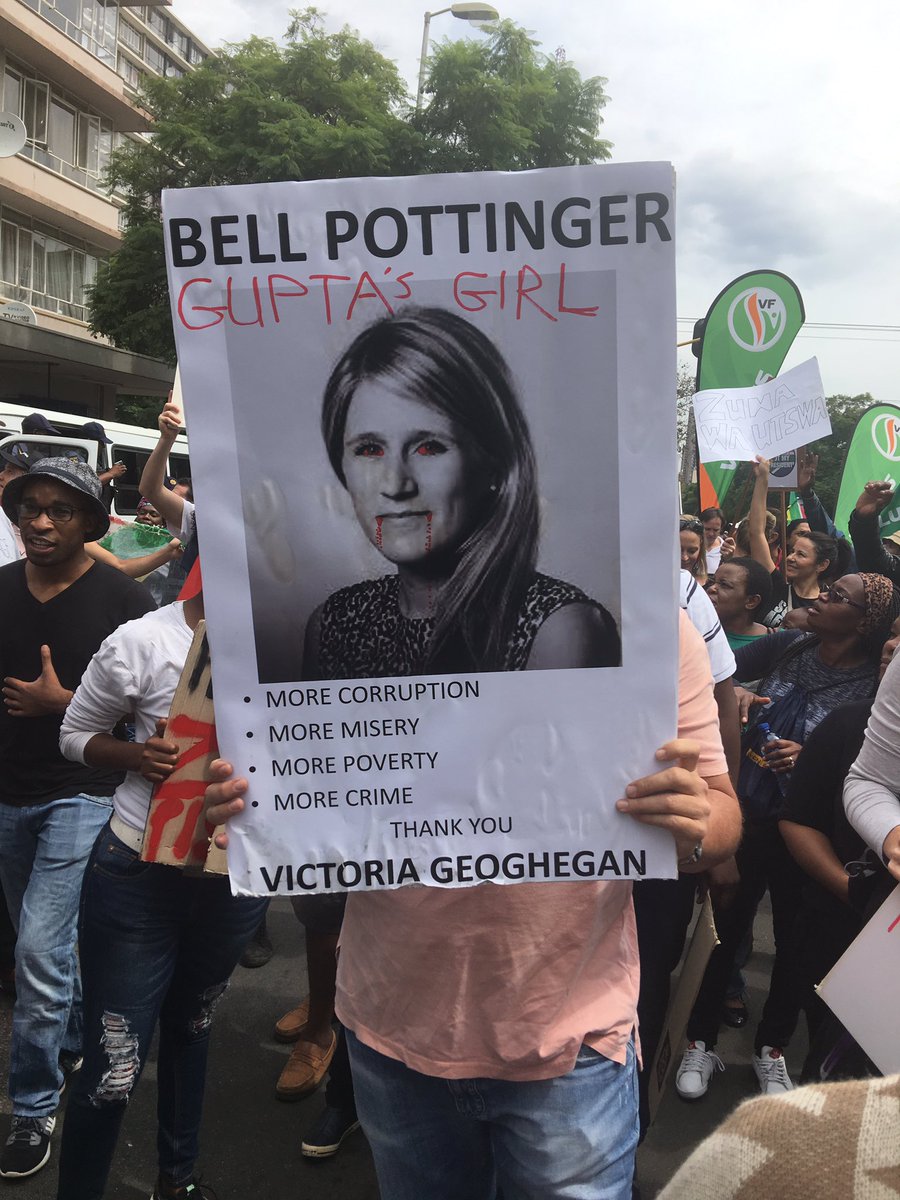
Finally, it was Bell Pottinger that fell apart. There were demonstrations on the streets of South Africa. Portraits of Victoria Geoghegan were carried aloft with the slogan: “Bell Pottinger – Gupta’s Girl. More Corruption. More Misery. More Crime. Thank you Victoria Geoghegan.” The campaign had imploded: the PR company, not the cause it served, was now centre stage.
The opposition Democratic Alliance, which had campaigned against Bell Pottinger, registered a formal complaint against the company with the UK-based Public Relations and Communications Association (PRCA), alleging it had stoked racial hatred in South Africa. The party’s communications spokeswoman Phumzile van Damme said Bell Pottinger had until July 13, 2017 to submit written observations relating to the PRCA’s professional charter and code of conduct.

The company did this, but the association ruled against the agency.
The PRCA found that its campaign for the Guptas “was by any reasonable standard of judgment likely to inflame racial discord in South Africa”. The writing was on the wall for Bell Pottinger, and the agency rapidly disintegrated. It was an extraordinary victory for all South Africans who had fought against its campaign, but particularly for the small band of journalists who had kept digging to discover the true source of this noxious brand of opinion manipulation.
But even as journalists were celebrating their victory, there was another reminder of the dangers they face as the Zuma presidency begins to unravel. Jacob Zuma’s term as president of the ANC ends this month, although he could remain president of the country until elections due in 2019. With his power waining, Zuma is determined to ensure that the myriad allegations of corruption against him do not land him in jail. He is using every ounce of his remaining power to try to have his former wife (and ex-head of the African Union) Dr Nkosazana Dlamini-Zuma replace him, to keep the judiciary off his back. His plans were dealt a blow by another investigative journalist, Jacques Pauw, who brought out a controversial book: The President’s Keepers. This reveals all Zuma’s misdeeds and how they have brought the country to the brink of a “mafia state”. The security services intervened in a manner the old apartheid state would have been proud of. They ordered that the book be withdrawn, since it contained: “unlawful publication of classified information”. The publishers have refused, and are appealing. But it is an indication of how threatened South African journalism remains, and how vital it is to the future of the country’s democracy.
The writer was Africa Editor of the BBC World Service. He is an adviser to the Foreign Office and the US State Department and senior researcher at the Institute of Commonwealth Studies. @martinplaut
 Martin Plaut