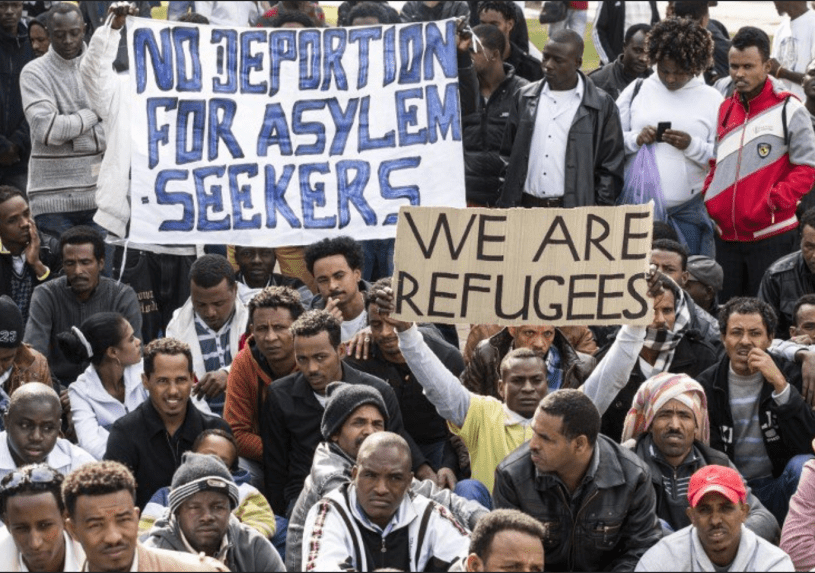
Spies from Eritrea enter Switzerland disguised as refugees. Their goal: to spy on people who think they are safe here, to threaten them and to collect taxes for the dictator back home. The Swiss authorities know about the dangers, but do not act.
Source: Tagbladtt
By Raphael Rohner
26.08.2023
She keeps glancing around nervously. Her phone is in flight mode and yet 32-year-old Kidane* regularly looks at it, unlocks the display and puts the device, on which a picture of her and her daughter briefly appears, back on the table.
The woman is sitting in a café at St.Gallen station and is nervous. Kidane fled her homeland Eritrea a few years ago and now lives in Oberthurgau. She says she comes from the Mendefera region, just a few kilometres from what is now the border with Ethiopia. Kidane had to flee there because she is a Tygrina and thus belongs to an ethnically persecuted ethnic group.
As a young woman, Kidane would also have had to join the army after completing her twelfth year of school. The conditions there alone were reason enough to leave the country: “Women are abused and used by the commanders and officers. Those who don’t do as they are asked are imprisoned, tortured or sold on the market. One has no rights.”
Kidane’s statements coincide with information from the official report of the European Asylum Support Office (EASO). According to this report, commanders would choose the best-looking women. Sexual exploitation and assault are not unusual. Children are also affected.
Among the women, the report says, it even goes so far that some of them offer sexual services of their own accord in order to protect themselves from certain unsightly tasks. For Kidane, military service was not an option: “I just had to leave my country.”
Kidane eventually fled via Sudan and had a daughter a few years ago. The two thought they were safe in Upper Thurgau: “I could move freely here, look for work and my daughter went to school. But then my past caught up with me again.” Kidane has tears in her eyes, her voice breaks. For the past few weeks, she has been getting repeated calls from suppressed phone numbers, usually with male voices on the other end, telling her in her mother tongue:
“We know where you are”
At first Kidane thinks it’s a bad joke, but then someone sends her a photo of her daughter on her way to school. The unknown person writes to her with a prepaid phone number: “We know everything. You have debts in your country!” Kidane is shocked, stays with her daughter for a few days with acquaintances and does not leave the house. “People from my home country want me to regret my flight and pay for turning my back on Eritrea.”
Kidane no longer trusts anyone. She tells her story to a few friends she has in Switzerland: “They told me that they too have had contacts with the Eritrean government and have even been visited by certain ‘representatives’. Some told me that they always had the feeling that someone was after them.” Taxes were due back home, they said. Kidane does not dare to contact the authorities – she is too afraid of getting into trouble. She doesn’t want to go to the police either: “The interpreters could give me away. That would cause even bigger problems.”
After work, the “forgotten uncle” from home was waiting
Kidane is not alone in her situation: on the contrary. Luam*, a young Eritrean currently doing a vocational apprenticeship in St.Gallen, has also had similar encounters. He himself fled Eritrea in 2015 and found a new home in Switzerland. He has also been met by compatriots after work; they wanted to have a drink with Luam in a pub and talk about politics. “At first, the man said he was a distant uncle and wanted to know if I didn’t know him anymore. At some point he talked about how I wasn’t a traitor after all and that I had to support my country financially. He also said that he knew my father from his youth, which I couldn’t believe.”
Luam remained sceptical and wanted to leave, but the man was persistent and spoke to the apprentice.”I actually wanted to go to football training and at some point I got a strange feeling. It was only when my teammate – a Swiss – drove up in his car to pick me up that the stranger let me go. It was scary!” After that, he said, he never saw the man again.Still, Luam has become more cautious:”I now only go out with work colleagues.”
Luam has also received several calls or messages calling him a traitor to his country if he does not report to the embassy and sign a statement of repentance and pay taxes.”I will definitely not do that,” says the apprentice.He has made a deal with the country and would – if he could – not only change his origin, but also his skin colour.
Switzerland finances terror regime through taxes
For Kidane and Luam, it is clear that the Eritrean government, ironically led by Isayas Afewerki since 1993, is behind the actions. According to the regime, anyone who has fled Eritrea must pay two percent of their income directly to the state as taxes.
According to the EASO (European Asylum Support Office) report and research by various aid organisations, Eritrea checks whether the person has paid their “taxes” when they return. “Those who do not pay their taxes end up directly in prison.The regime takes advantage of this fear and in fact forces people to send money from Switzerland directly to Afewerki’s terror regime – Switzerland doesn’t even notice,” says Luam.It has been proven that members of the government are collecting money in Switzerland: However, a corresponding criminal complaint by the Federal Criminal Police did not lead to a criminal investigation in 2015. According to the criminal complaint, taxes were collected or demanded from Eritrean citizens in Switzerland. The judicial authority had claimed a prohibited act on behalf of a foreign state as a possible offence, but this was rejected by the Office of the Attorney General of Switzerland due to a lack of evidence and witness statements.

This is not surprising, says the media spokesperson of the Eritrean Media Association, Okaab Tesfamariam:
“People distrust the authorities. They don’t know it any differently from their home country.”
It is not uncommon for Eritrean government officials to come as far as Oberthurgau to blackmail a mother and her child or even threaten a St.Gallen apprentice, says Tesfamariam. “Refugees are spied on and blackmailed every day! These are just two cases out of a multitude that I know of.” The spies, he says, are mostly recruited refugees who had one purpose even before their journey: to watch out for the diaspora. Several sources prove, based on their own experience and evidence, that Eritrea has a great influence on the Eritrean diaspora in Switzerland. Among other things, various festivals were held in the past to collect money for the state.
The fact that the Eritrean state collects taxes in Switzerland and even spies on and blackmails people for it makes Tesfamariam – who has had Swiss citizenship for several years – furious: “Our tax money goes directly to Eritrea, and no one stops people from doing it!”
Together with other refugees, Tesfamariam tries to inform and educate his compatriots: “People are not properly informed about their rights in Switzerland. We also try again and again to encourage people to report to the police.” But most refugees are traumatised when it comes to dealing with the authorities, he says:
“As soon as they see a uniform, they get scared. In addition, many people don’t trust interpreters, which makes things more difficult.”
Other official acts are also not without danger for refugees. Those who want to get married, for example, are forced to have their identity confirmed at the Eritrean embassy. There, they are checked again to see whether they have always paid the two per cent tax. Switzerland also passes on personal information of refugees to the Eritrean embassy if the asylum application is rejected. Tesfamariam is even angrier: “This turns people directly into potential targets of the regime! They even provide the embassy with people’s addresses.”
The lack of understanding for the influences from the former homeland is largely a political problem in Switzerland. “Many people think that the war is over and that Eritreans can simply travel back to their homeland. Who would do that? Only those who work for the state would dare to travel back to where there is fear and terror.”
* The names of all protagonists have been changed.
 Martin Plaut