Source: Swedish Radio
The government wants to stop Eritrea’s “diaspora tax”
Published Saturday 9 September at 16:37
- The Eritrean dictatorship tries to control exiled Eritreans in Sweden, among other things by forcing them to pay a so-called “diaspora tax”, approximately two percent of one’s annual income.
- Now both the government and the Social Democrats want to see an end to this, Foreign Minister Tobias Billström and the Social Democrats’ Morgan Johansson inform Ekot.
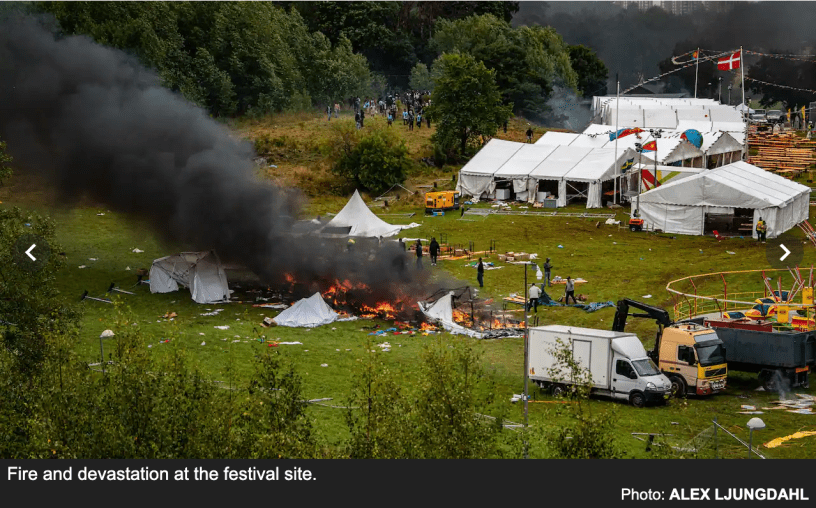
- The tax, which Eritrea claims is “voluntary”, has been criticized by several Eritreans in exile and is believed to be part of the explanation for violent riots that broke out in early August in connection with an Eritrean cultural festival in Stockholm.
Erik Norman
erik.norman@sverigesradio.se
Foreign Minister Tobias Billström speaks clearly:
– The government will act. The government has not given Eritrea permission to collect taxes in Sweden.
To Sveriges Radio, the Swedish foreign minister says that they will stop the collection of the two percent tax, which Eritreans in exile experience as pure blackmail. Billström represents the Moderates, the Swedich Right party.
Refuse to go to church services
When Eritrea became independent in 1993, the state introduced a “rehabilitation and reconstruction tax for Eritreans living outside the country”, according to Landinfo, the Norwegian Immigration Service’s professional body.
The exile tax of two percent of the annual salary is far from voluntary. Eritrean refugees in Norway tell the newspaper Vårt Land about very hard-handed collection. Two Reports from the analysis company Proba, —(Press and kontroll and Transnasjonal undertrykking) delivered by two ministries, in 2020 and 2023, confirm this:
“Norwegian-Eritreans who do not pay the two percent tax may be refused entry to meetings, religious services and cultural events (…) Norwegian-Eritreans who refrain from paying have been subject to various forms of harassment”, reports the 2020 report to the Ministry of Education .
Woman fined for hate speech
– Several so-called Eritrean refugees in Norway threaten, via social media, those of us who criticize the regime in Eritrea, Abraham Tekle tells Vårt Land.
Last autumn, an Eritrean woman was fined NOK 15,000 for violating Norwegian law on hate speech. The message was posted on the woman’s Facebook page, and the police emphasized “that the statement in the video, where she in practice calls for genocide, must be considered gross”, the police write in the case documents.
Punishing the family in Eritrea
On the homepage of Eritrea’s embassy for the Nordic countries, it is stated that anyone who wants a new passport “must fulfill all national obligations, including the 2% payment from 1992”.
Tax collection causes controversy in several countries. In the Netherlands, the Ministry of Foreign Affairs funded a study of the practice in seven countries, including Norway, «The 2% Tax for Eritreans in the diaspora».
The report states that Eritreans who do not pay the tax are denied services at Eritrean foreign missions, and the family in Eritrea may be punished.
Payment is made both in cash and by money transfer, in and outside Eritrea. The report from the Netherlands has calculated the annual value of the tax: At least 100 million dollars.Church officials and priests are important in the work of collecting the tax.
The exile tax is illegal
In Sweden, Foreign Minister Tobias Billström states that the police must stop the illegal collection of the exile tax, and adds that the government also has a number of tools in its toolbox.
Billström is supported by the Social Democrats’ Morgan Johansson, he was Minister of Justice and the Interior in Sweden until the change of government last year.
Abraham Tekle, who came to Norway in 2002, demands that Norway’s foreign minister say the same as Billström.
– The Støre government must stop tax collection, he says to Vårt Land.
Foreign Minister Anniken Huitfeldt (Ap) does not answer Vårt Lands’ questions by her herself, but gives the floor to State Secretary Andreas Kravik (Ap):
“Eritrean authorities and their representatives do not have the opportunity to collect taxes from Eritrean citizens in Norway,” he writes in an e-mail.
The government is directing the police
Kravik reports that Norway is “obliged to take measures against persons who collect taxes from Eritreans abroad through extortion, threats of violence, fraud or other illegal methods”.
But the State Secretary in the Ministry of Foreign Affairs does not announce measures from the government’s side:
“It is important that people who are exposed to illegal activities in Norway contact the police and justice authorities, who are the right authorities in this regard,” he writes.
In May, Justice Minister Emilie Mehl (Sp) also pointed at the police when the two percent tax was debated in the Storting:
“If someone in Norway feels that they are being subjected to unpleasant pressure or something that may be illegal, it is important that these people, if they wish, contact the police so that they can get help.”
Not followed up
Vårt Land (newspaper) knows that several people have reported the illegal collection of the exile tax to the police, but the cases have been dismissed.
– Thus the taxation of Norwegian-Eritreans continues, says Abraham Tekle.
Information about Eritrea:
President Isaias Afwerki has ruled Eritrea since the country broke free from Ethiopia in 1993.
Every year, thousands escape from the long, brutal community service.
Around 28,000 Eritreans live in Norway. The first came in the decades until they became independent in 1993, and many are loyal to President Isaias Afwerki
During the years 2015-2000, 15000 Eritreans have come to Norway.
This summer there have been several Eritrean claches in Norway, Danmark and Sweden.
 Martin Plaut
Not only should taxes be stopped, but those terrorists should also be sent to Eritrea, where they can feel safe with their master in his comfortable mansion. They are terrorists because they command the execution of huge groups of defenseless, unarmed civilians, as well as elderly mothers, kids, nuns, monks, and priests. This is not mere unsubstantiated rhetoric; numerous of their YouTube channels have examples of it.
According to PFDJ and fanno-ardent supporters, “a Tigrayan mother should be killed because she gave birth to TPLF fighers.”
Just recently, Shabiya supporters were giving orders to kill an Ethiopian man just because he backed those who oppose PFDJ (Higdef).
The wealthy western world is now becoming a safe haven for genociders.
Anyone not forking over the two percent is refused services of any kind.This violates the basic rights of Eritreans.