By Makeda Saba
One year since the Pretoria Ceasefire – where are we?
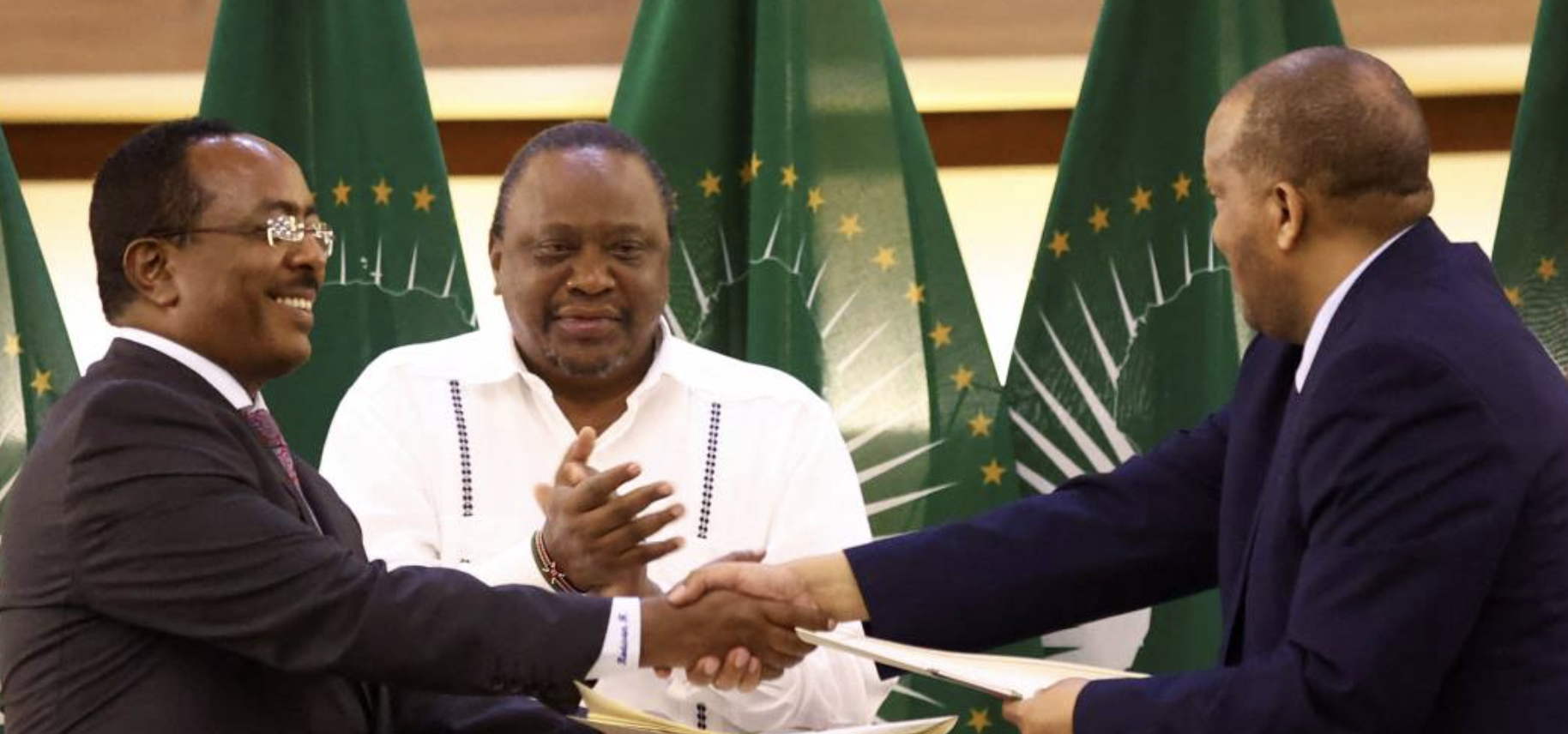
We are approaching one year since the Tigray Peoples Liberation Front (TPLF) and the Ethiopian Government signed the Pretoria Cessation of Hostilities Agreement (or “Pretoria Ceasefire” for short)[1]. While the Agreement managed to silence the guns, critical elements such as the complete withdrawal of Eritrean Defence Forces (EDF) and the Fano Amhara militia from Tigray territories, including the contested Welkait/ Western Tigray, have yet to happen.
Since the signing of the Pretoria Ceasefire, the political objectives and interests of the Ethiopian and Eritrean leaders have diverged. Hence, PM Abiy made it very clear during his interactions with investors and, more recently, in his parliamentary speech that Ethiopian direct access to the Red Sea is no longer taboo. [2]
Eritrean regime’s attitude hardens
Increasingly, the Eritrean Government is expressing its displeasure with the Pretoria Ceasefire and at the actions of the Ethiopian PM in Amhara and his references to Ethiopian access to the Red Sea. This displeasure is expressed through the extensive Eritrean Government social media accounts[3]. These accounts have changed their tone and messaging regarding PM Abiy.
Though there are no official statements, the Eritrean regime’s social media accounts have changed their style to the point of exposing issues of disagreement, such as Abiy Ahmed’s fight against the Amhara militia Fano and distorting history by describing the Amhara as friends of Eritrea as can be seen in the following Tesfanews Twitter (X) statement:
PM Abiy might have engaged in conflict with the Amhara Fano, even amidst reservations from the Eritrean government. He might also be hoping for military support akin to what he received during the conflict with the TPLF. If that is the case (big if), his out-of-the-blue “threats” over ‘historical claim’ over the Eritrean port over the Red Sea could be seen as a response to Eritrea’s perceived lack of support against the Amhara rebels.
Historically, the Amhara and Eritrean people have never been adversaries, so there is no reason for Eritrea to fight them. If the circumstances demand, the Amhara people should be provided with the necessary support to defend themselves, and I pray that to happen sooner rather than later. 9:10 PM · Oct 22, 2023, [4]
Tesfanews also clarifies that the Amhara Fano movement is:” …[a liberation front], not a political party, and it enjoys the support of the majority of the Amhara population.” Tesfanews adds: “The political wing of this armed group should expand its reach in the region and beyond. The well-being of 40 million Amhara people, amidst existential threats under PM Abiy Ahmed’s leadership, hinges on the combined military and political accomplishments of this group”.
As recently as the 6th of October 2023, Tesfanews reinforced the notion of the Eritrean Government alliance with Amhara and the Fano militia on the question of Western Trigray in this manner:
#FACT What deters TPLF from using force to retake the Amhara lands of Welkait (encompassing Tsegede & Kafta Humera) is not the anticipated resistance from federal or Amhara forces but the risk that such action could provoke the EDF, a force TPLF profoundly fears, to intervene.
Preventing TPLF from artificially expanding Tigray’s regional borders to reach Sudan is essential to dispel secessionist aspirations and maintain Ethiopian territorial unity. 9:34 AM · Oct 6, 2023. [5]
Cracks in the alliance
The goals, priorities, and political and hegemonic needs of President Isaias and PM Abiy that brought them together to wage war on Tigray and their familiar nemesis, the Tigray People’s Liberation Front (TPLF), have diverged. Abiy needs to salvage the Ethiopian economy devastated by the Tigray War and ongoing conflicts in the Oromia and Amhara regions.
To salvage the Ethiopian economy, the Prime Minister of Ethiopia needs to convince investors and institutions such as the World Bank and IMF that Ethiopia is ready for business and is a safe place. He needs the IMF to go ahead with a debt restructuring plan. He also needs a national rallying point to bolster a waning popularity. Water and water-related issues, including access and control of the Red Sea, are an emotional rallying point for all Ethiopians.
President Isaias has no such constraints; however, he does have the problem of what should be done with hundreds of thousands of veterans. His solution in 2002, after the Eritrea-Ethiopia Border War, was to create the Warsay Yiekalo National Development Plan and officially lock all conscripts into a never-ending National Service.
Since the interests of the two leaders are no longer aligned, and the borders between their respective states are closed, water, the sources of water and the access to it, along with the long-standing tropes and stereotypes associated with it, are the new battlegrounds between Ethiopia and its neighbours.
Water once united, now it divides
The water issue in dispute between Ethiopia and Eritrea is the Red Sea, specifically the control of the port of Assab. On the 13th of October 2023, PM Abiy addressed the Parliament and opened a hornet’s nest when he asserted that the natural border of Ethiopia is the sea and that Ethiopian access to the sea is vital to Ethiopia’s existence as a nation. During his speech, he said that the fact that Ethiopia has no direct access to the sea “ …. [prevents] Ethiopia from holding the place it ought to have,………..If this is not going to happen, there will be no fairness and justice; it’s a matter of time; we will fight.” Though subsequently, PM Abiy walked back the belligerent tone; there was no mistaking the hostile narrative and the implied threat. [6] The forty-five-minute parliamentary speech was about Eritrea and how denying Ethiopia access to the Red Sea is a historical injustice.
We should not forget that PM Abyi also has ambitions to restore the Ethiopian Navy because he sees it as an instrument to extend the influence and power of his country in the region. Eritreas’s independence meant that the Ethiopian Navy was scrapped. Ideally, such a Navy could be re-established with the support of Ethiopia’s neighbours. However, in the Horn of Africa, the power dynamics are such that the PM’s efforts to re-establish the Ethiopian Navy will be treated as suspect even if foreign countries such as France are willing to support the project.
France is not the only foreign power with an interest in Ethiopia’s maritime aspirations; the UAE is also actively working to secure their respective national priorities in the Red Sea, one of the world’s busiest commercial sea lanes and in particular, the Bab el Mandab strait that links the Red Sea to the Indian Ocean. Both France[7] and the UAE [8]signed maritime agreements with landlocked Ethiopia. Though the French deal was suspended[9] because of the Tigray War, the fact that there was an agreement speaks to the ambition of Ethiopia and foreign powers in the region.
In July 2018, President Isaias was received in Hawassa, Ethiopia, as part of the Ethiopia-Eritrea peace process. PM Abiy introduced the President not as the President from Asmara but as a Cousin (i.e. brother). He then linked key Ethiopian towns and cities to Eritrea, including Assab and Massawa. He implied that there would be freedom of movement between the two states. He spoke of the love the people of the Horn have for Water. Water was a critical issue even in 2018. [10]
An emotional and smiling President Isaias responded to the welcome by repeating his statement made at his reception at the Millennium Hall in Addis Ababa[11]: ” …….that whoever thinks that Eritreans and Ethiopians are two separate people does not know what they are talking about”. He added, “The love between Eritreans and Ethiopians is not new….”. While praising PM Abiy, Isaias bestows upon him the power to act on behalf of Eritrea,[12] adding that PM Abiy is free to go anywhere in Eritrea – Assab, Tessenei, etc…Both of Isaias speeches shocked Eritreans who felt betrayed and that he was dangerously toying with the idea of a new confederation with Ethiopia.
Leaders visited Eritrean ports
Soon after the above mentioned speeches, PM Abiy travelled to Massawa and Assab, and Ethiopian shipping lines started to use the ports of Massawa and Assab. [13] Hence, in September 2018, after twenty years, Ethiopian cargo ships docked in Massawa. [14] Over time, the peace negotiations between PM Abiy, President Isaias and their respective delegations became less and less transparent.
Therefore, except for the fact that it is clear that during their meetings, they plotted and prepared for the war in Tigray, it is impossible to know if they negotiated and reached any agreements regarding Ethiopia’s access/control of Assab. And if such an accord subsequently fell apart because President Isaias feels the Pretoria Ceasefire is a betrayal since, from his point of view, the original purpose of ‘Game Over TPLF’ was not achieved. Consequently, the two leaders are not talking to each other, and Eritrea and Ethiopia are again two nations with very separate interests.
We have returned to the – No War, No Peace scenario as it was before 2018 when PM Abiy agreed to fully implement the Eritrea Ethiopia Border Commission (EEBC) decision and hand over Bademe to Eritrea. However, this time, Eritrean Defence Forces (EDF) are occupying Ethiopian territory as they have not withdrawn fully from Tigray as required by the Pretoria Ceasefire, and President Isaias retains the iron fist control of Eritrea.
Meanwhile, PM Abiy Ahmed’s Ethiopia is highly fragile. The 2023 Fragile State Index classified Ethiopia as high risk. The countryis suffering from the combined effects of internal and international conflicts, all contributing to rising food prices, all impacting the Ethiopian Economy. In addition, currently, the Ethiopian control of its territory is weak due to the Tigray War and the defection and purge of Tigrayan officers from the Ethiopian National Defence Force (ENDF). The evidence of this weakness is the continued presence of the Eritrean Defence Force (EDF) in Ethiopian territory (i.e., Tigray). Also, evidence of weak territorial control is the ongoing unresolved conflicts with the Amhara and the Oromo, the Al Shabab incursions, and the failure to adequately respond to the flare-up of interethnic conflicts and displacements, such as in Beni Shangul, where the Great Renaissance Dam (GERD) is located.
The current situation between Eritrea and Ethiopia is tense. As all communication between the two States was exclusively between the two leaders, and there are no internal institutional mechanisms in place to overcome the tension and facilitate dialogue, without external mediation, it is virtually impossible to diffuse the impasse, restore the relationship and bring the parties to the negotiating table.
Peace in Jeddah
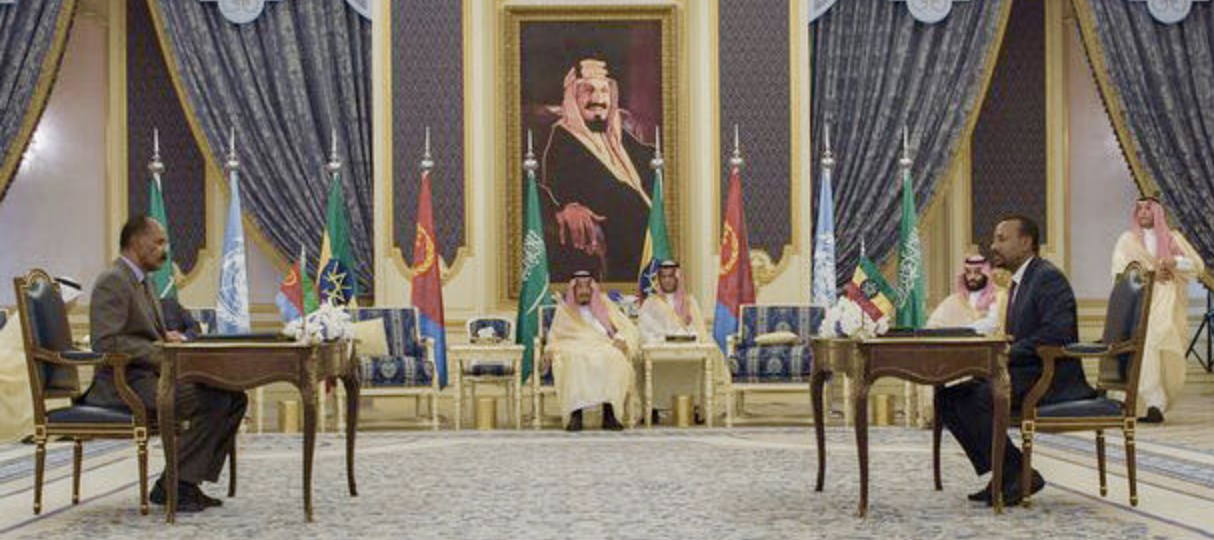
It is important to remember that the 2018 peace agreement was signed in the Saudi capital, Jeddah. The signing was witnessed by the UN Secretary General. An abbreviated version of the agreement was released, a five-point “Joint Declaration of Peace and Friendship.”
But it is important to understand that the full treaty has never been made public.
The Saudis and the Emiratis, who were critical to the 2018 peace process, have shifted their primary focus on the civil war in Sudan, the Palestine-Israeli conflict and their implications for the Red Sea Region and the Middle East. The UN, USA and the EU are likewise distracted.
Eyes of the world are elsewhere
While the world is dealing with other crises (Ukraine, Sudan, Palestine), nobody is paying attention to the Horn of Africa – Eritrea and Ethiopia. In the meantime, President Isaias continues to play the role of a spoiler of the Pretoria Ceasefire by maintaining an EDF presence in Tigray and by training and supporting the Amhara Fano militia. The militia has refused to disarm and leave Western Tigray as required by the Pretoria Ceasefire. At the same time, the Eritrean government has turned its attention to Egypt working on a joint position on the Sudan conflict.[15] A process that did not include Ethiopia. This action indicates that the Eritrean Government has again embraced Egypt’s policy position in the Horn and is distancing itself from PM Abiy and Ethiopia.
Since Eritrea is working with Egypt on the Sudan conflict, President Isaias has shifted his support in Sudan to General Burhan, whom Egypt also backs. At the same time, the Eritrean Government has frozen diplomatic exchanges with General Hamdan Degalo (Hemedti). General Berhan was in Eritrea on 11 September 2023 to discuss the Sudan conflict. [16] These are diplomatic moves designed to reinforce the Eritrean position as a critical player in the region and transmit a clear message that Assab is an inalienable part of the Eritrean territory; therefore, any attempt by Ethiopia to annex it by force is a threat to Eritrea and all states with a Red Sea coastline.
Eritrea is presently training 10,000 Somali soldiers. Recruits badly needed by a Somali state that is still fighting El Shabab. The Somali President Hassan Sheikh Mohamud, in a recent interview with the Eritrean Ministry of Information journalist, described the relationship with Eritrea as follows[17]:
Currently, Eritrea’s support for Somalia goes above and beyond what many other countries provide. The main challenge we face is security. Eritrea may not be a large or resource-rich nation, but it is a genuine country with an immaculate heart for Somalia. It has consistently shown genuine and unwavering support for Somalia, sharing its resources and assistance. Our relationship is stronger now than it has been in the 30 years since Eritrea’s independence.
The Somali Government is one of the neighbours who expressed concern with the broader implications of PM Abiy’s belligerent demand for access to the sea. Hence, it was swift to denounce PM Abiy’s Red Sea ambitions. Though Djibouti – Eritrea relations are tense because of the 2008 Eritrea – Djibouti war, it was also quick to condemn PM Abiy’s claims to the Red Sea.
Preparing for a new war
The Eritrean Government’s response to PM Abiy’s claims to a right of access to the Red Sea is not limited to diplomatic shifts; it has also reinforced its positions in Dankalia along the Eastern Eritrea-Ethiopia border—specifically, Bada and Bure.
At Bada, there is a small volcanic lake. From this position, the Eritrean Defence Force(EDF) can monitor movements in Eastern Tigray (Adigrat, Mekelle, Wukro) and the North of the Ethiopian Afar region (Berhale) all areas of intense fighting during the 2020-2022 Tigray War. Bure is located South near the Eritrea, Djibouti, Ethiopia border. From this position, the EDF can monitor the Ethiopian movement towards Assab.
The marginalised and disgruntled Eritrean Afars are the known unknown in this line-up for control of Assab and access to the Red Sea. PM Abiy Ahmed [18]is courting the Afars, hence his recent tour of the region and his framing the discourse around the access to the Red Sea as a correction of a historical wrong that has divided the Afars and deprived Ethiopia in general and in particular, the Ethiopian Afars of their rightful access to the sea.
Given that the Afar population inhabit Eritrea, Ethiopia, and Djibouti, it is possible that PM Abiy’s actions in the area are opening up yet another Horn of Africa pandora’s box. It is not clear how the Eritrean Afars will react. However, it is worthwhile to note that, generally, the Afar prefer a federal-like governance structure with regional autonomy.
The Eritrean relationship with Russia is the other known unknown. Before the Ukraine War, Russia planned to establish a naval base in the Red Sea. Since the start of the Ukraine War, the relationship between Eritrea and Ethiopia has tightened, with Eritrea consistently voting in favour of Russia at the UN and promoting the ideology of a multipolar world order.
There is also the issue of Russian mineral resource interests in Eritrea. Eurochem Pty Ltd, a company that is part of a Russian conglomerate, one of three global distributors of fertiliser worldwide, has an exclusive distribution agreement with the Eritrean potash mining company Colluli Pty Ltd. The Colluli mine is located in Dankalia, Eastern Eritrea and is estimated to have enough potash to supply the world for 200 years. Finally, a Russian naval base in Eritrean territorial waters is not new, as the USSR had a base on Dahlak Island.
Will there be another war in the Horn of Africa? The scene is set for another battle between Eritrea and Ethiopia. I can already see and hear the comments that neither country can afford a war. Neither country could afford the Tigray War, yet they both planned it and executed it because the issue was not only economic but also about power and removing threats to that power.
The two countries will fight if nothing is done to mediate, as the Saudis and the UAE did before 2018. It will be only a matter of when and their newly acquired drones will be a critical factor in any such war.
[1] Signed on the 2nd of November 2022 in Pretoria
[2] https://www.bloomberg.com/news/newsletters/2023-10-20/why-is-ethiopia-s-abiy-ahmed-demanding-access-to-the-sea#xj4y7vzkg
[3] X (Twitter), Facebook, Tik Tok etc..
[4] https://x.com/tesfanews/status/1716155189617361067?s=20
[5] https://x.com/tesfanews/status/1710181693246566585?s=20
[6] https://www.youtube.com/watch?v=yjmQvegWmLY&t=85s
[7] https://www.reuters.com/article/us-ethiopia-france-idUSKBN1QT2W3
[8] https://www.eurasiareview.com/22082023-uaes-strategic-investment-and-maritime-engagement-in-landlocked-ethiopia-vision-or-ambition-oped/?utm_source=flipboard&utm_content=EurasiaReview%2Fmagazine%2FEurasia+Review
[9] https://www.dailysabah.com/world/africa/france-suspends-military-cooperation-deal-with-ethiopia; https://factcheck.afp.com/http%253A%252F%252Fdoc.afp.com%252F9P83B2-1
[10] https://www.youtube.com/watch?v=3XJvEQ1ZiJk&t=233s
[11] https://www.youtube.com/watch?v=QKFzbEAFFHk&t=9s
[12] ወኪል – Wekil – Agent
[13] https://www.youtube.com/watch?v=5x206lbZaE4&t=16s
[14] https://www.ezega.com/News/NewsDetails/6583/Ethiopian-Prime-Minister-Makes-a-Surprise-Visit-to-Eritrea
[15] https://twitter.com/hawelti/status/1679005647801659393; https://www.dailynewsegypt.com/2023/07/13/egypts-al-sisi-eriterias-afwerki-discuss-bilateral-relations-regional-stability/
[16] https://apnews.com/article/burhan-sudan-eritrea-war-conflict-ea4dd8a7cb694611ea374d5a7d828d76
[17] https://shabait.com/2023/10/13/somalia-president-hassan-sheikh-mohamuds-interview-with-eritrean-local-media-outlets/
 Martin Plaut