
The semi-official website, Tesfanews, has published strong attacks on the UAE for its role in encouraging war with Ethiopia.
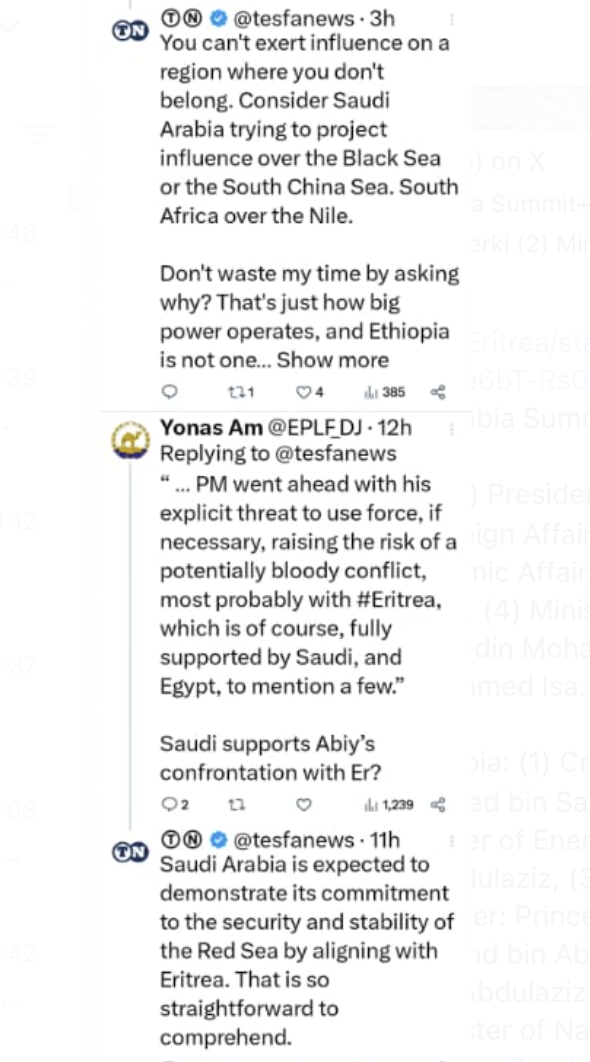
It also appeals to the Saudis to intervene, which explains why President Isaias spent such a lengthy time in Saudi Arabia talking to the leadership.
It is worth noting that until 2021 the UAE had a base in Eritrea’s port at Assab, from which it conducted its war in Yemen against the Houthis. It then decided to end its Eritrean opposition, as VOA reported.
The United Arab Emirates is dismantling parts of a military base it runs in the East African nation of Eritrea after it pulled back from the grinding war in nearby Yemen, satellite photos analyzed by The Associated Press show.
The UAE built a port and expanded an airstrip in Assab beginning in September 2015, using the facility as a base to ferry heavy weaponry and Sudanese troops into Yemen as it fought alongside a Saudi-led coalition against Iranian-backed Houthi rebels there.
Martin

Who’s Behind PM Abiy’s Red Sea Agenda?
As we all know, the Emirates is keen to establish a presence on the Red Sea, a region that its larger and more powerful rival, Saudi Arabia, regards as its exclusive sphere of influence.
To pursue this grand agenda, the UAE is currently employing a two-pronged approach, i.e. through Sudan and Ethiopia.
The Sudanese route has reached an impasse following the withdrawal of Saudi-backed government forces, led by Gen. Abdel Fattah al-Burhan, from the capital Khartoum to assert control over the Red Sea coastal city of Port Sudan.
Considering the geographical and logistical challenges faced by the UAE-backed rival forces of Gen. Mohamed Hamdan Dagalo, it’s unlikely Port Sudan to fall to RSF forces. That situation has led to the current stalemate.
Then there comes the Ethiopian route.
As anticipated, Prime Minister Abiy Ahmed suddenly introduced an agenda concerning not only ‘access’ to the sea but also asserting ‘the right to own’ a port on the Red Sea.
For obvious reasons, #Ethiopia cannot alter the geographical boundaries of its neighbors. However, the Prime Minister went ahead with his explicit threat to use force, if necessary, raising the risk of a potentially bloody conflict, most probably with #Eritrea, which is of course, fully supported by Saudi, and Egypt, to mention a few.
The dilemma with this route lies in PM Abiy’s inability to deliver what the UAE wants. Engaging in a direct conflict against Eritrea would definitely spell disaster for PM Abiy. Taking into account the dynamics of ongoing armed conflicts in the country, the economic crisis, the ethnically polarized society/army, etc. engaging in a conflict with a significant adversary could potentially result in PM Abiy’s eventual downfall.
 Martin Plaut