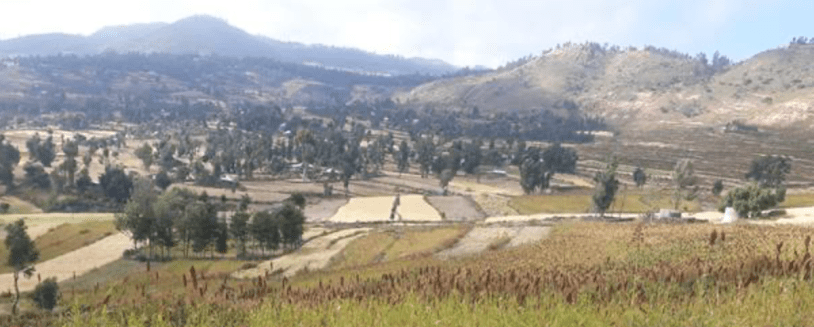
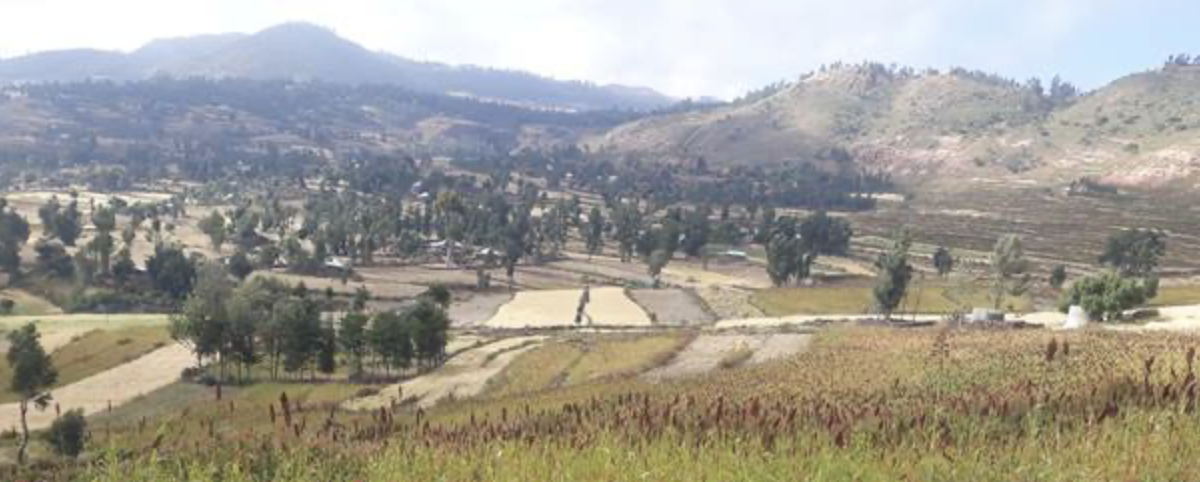
Croplands near Hagere Selam, by the end of October. The crop with reddish grains is sorghum; it performed very well because there were good spring rains, that provided sufficient soil moisture to pass the dry spells in the main kremti rainy season. The uniformly bright lands have been sown with the “new wheat” gifted by the Oromia region to the Tigray farmers; it performed well in these places because the soil is clayey, and fertilizer was used (though it was particularly expensive in 2023). In the mid-scene, soils are more sandy and stony, and (immature) crops had to be harvested early due to lack of soil moisture; there was hardly any rain in July.
Dear reader,
Unexpected rains occurred in Tigray in early November, affecting the harvest that was already poor due to missing rains in July. Elsewhere in Ethiopia, there has been severe flooding due to El Niño conditions. The improved wheat seeds, gifted by the Oromia region, are well appreciated by the farmers in Tigray, as the crop produces uniformly good stands, though with small straw harvest. This “new wheat” is a short-stemmed high-yielding variety. The advantage of short stem is lodging resistance – hence higher quality yields are ensured.
WFP food aid to Tigray is resuming too slowly. People targeted for food aid are identified by the WFP staff. A friend in May Makden (on the main road, north of Mekelle) mentioned a WFP convoy passing by, composed of dozens of lorries, and closely supervised by WFP staff. Otherwise, there is very few movement of WFP trucks, most seemed unloaded or empty. Also UN agencies (and ICRC) are cutting their operations in Tigray, rather than expanding them because of budget constraints. See also: OCHA Situation Report, 31 Oct 2023
Some hopeful perspectives are villages that have kept their forests intact, managing it according to age-old bylaws. And, despite three years without budget, another village protected the apple tree nursery; there has been no irrigation, no harrowing or pruning, but the trees have survived, indicating that the species is suitable for the highland areas of Tigray. The same village kept its five hand pumps operational. In these places people have seen no agricultural or water experts since three years, yet they continued managing their natural resources. However, the situation is not that positive in many other places. The starvation in six tabiyas of Abergele is extreme. The wereda says 95,000 out of a population of 107,000 need food. They announced 52 people died in the last weeks. It is also widely believed people are in desperate need in Dima, a woreda across the Tekezze under Tigrayan control.
In this Tigray Digest, we address the likelihood that war criminals will be tried, after the EU abandonment of the ICHREE (section 1), as well as the number of military victims of the Tigray War (section 2), the fate of the internally displaced people from Western Tigray (section 3), the brain drain from Tigray (section 4), and new scientific findings, all related to Tigray’s environment (section 5). We conclude with the perspectives for Tigray, from the point of views of the Tigrayans (section 6), and list some other news items and opinion pieces (section 7).
Further reading related to the humanitarian situation in Tigray:
- BBC, 2 November 2023: Tigray peace deal war anniversary: Humanitarian situation is ‘dire’
- WFP, 16 November 2023: WFP launches new operating model to restart food distribution to millions of vulnerable Ethiopians
- Al Jazeera, 2 November 2023: One year on, peace holds in Tigray, but Ethiopia still fractured
- Institute for Security Studies, 9 November 2023: A year after the Pretoria agreement, hard work remains for Ethiopia
- Makeda Saba: War is likely: It is just a matter of timing (Martin Plaut)
- Addis Standard, 31 October 2023: A year after Pretoria peace agreement, challenges persist in rehabilitation of Tigray’s ex-fighters
- BBC, 23 November 2023: Ethiopia drought: Fifty die of hunger in Tigray and Amhara amid aid freeze (The number mentioned regards the Abergele woreda of Tigray only, and a few people in the adjacent Agaw zone of the Amhara region)
- Addis Standard, 21 November 2023: Drought induced hunger claims dozens of lives, left millions at risk in Tigray and Amhara regions
- The Guardian, 24 November 2023: Weather tracker: Ethiopia hit by severe drought amid east Africa floods
The European Union and its members have reversed their support for continued international monitoring of Ethiopia’s human rights status at the UN Human Rights Council. Yet, people in Tigray have no confidence at all in domestic justice, carried out by the very government that sent its army for massacres and rape into Tigray. Harvard University took the lead in an Ethiopia-wide opinion poll, with a sample of >6600 adults, in June-July 2023. The results show that in Tigray, only 2% of the respondents favored domestic trials of war criminals over hybrid or international options. For the other regions of the country, the confidence was between 28% (Gambela) and 78% (Sidama).
This is particularly the case for victims of the man-made famine and of sexual violence. A survey of women in Tigray found that 8% had been raped during the Tigray War, but this is likely to be an undercount due to the stigma and because some of the areas worst impacted are still under Eritrean occupation, and were excluded from the survey. Women indeed struggle to seek help after being sexually assaulted and raped during the war, fearing ostracization. (The Washington Post, 26 November 2023: Raped during Ethiopia’s war, survivors now rejected by their families). See also the newly released documentary, “Speaking the Unspeakable: In the aftermath of weaponized rape in Tigray, North-Ethiopia” by the Norwegian social anthropologist and filmmaker Thera Mjaaland and the Tigrayan journalist Kibrom Mebrahtom.
Further reading:
- Addis Standard, 28 November 2023: Severe humanitarian crisis plagues Tigray region, with women bearing the brunt of violence and lack of support
- UN News, 13 October 2023: Ethiopia: Victims ‘left in limbo’ as rights probe mandate ends
All over Tigray, commemorative services are held for fallen TDF soldiers (Tigray Defence Forces); gradually the TDF informs the families of the fate of their missing child(ren). For each fallen soldier, relatives organize mourning ceremonies, mostly at several locations (in the home village, in the nearest town, in Mekelle). The mourning atmosphere dominates Tigray, leading almost to a collective depression. There are reportedly many whose families haven’t been notified yet. People tell me that it has become common NOT to ask the usual polite question “how are you?, how is your family?” because the answer is already known and it is painful. In a recent opinion piece, Alex De Waal mentions 51,700 fallen TDF soldiers. As the number comes from within the TDF leadership, some people in Tigray suggested that the TDF may have communicated a lower number of fallen soldiers than what it is in reality, as there is talk about another war, this time against Eritrea in alliance with Abiy Ahmed. At this stage, many of our correspondents in Tigray mention that they do not want a new war, but some also say that Tigray could be dragged into such a war, on the condition that all regions of Ethiopia take their share in the mobilization. Important to note is that, in the last year, Tigray was kept out of violent conflict – including in Amhara. A new war would be catastrophic for communities in Tigray that are barely functioning.
Reversely, people also say that the number of 52k dead TDF soldiers is realistic. In most battles, the TDF losses were minimal – “if 6 or 10 soldiers died in a battle, the leadership was severely criticized”. There were, however, huge losses of TDF soldiers during the (yet unexplained) moves of TDF far into Afar and Amhara regions in 2021, as well as during the ENDF and Eritrean offensive in Northwestern Tigray in 2022. So, people assume, the total number announced could be true.
On the other side too, information is gradually coming out. In 2022, the Ministry of Defence estimated that 238,000 ENDF soldiers lost their lives in the Tigray War. Now, this seems a serious underestimate, and the real figure may be twice that high. We heard from first-hand witnesses how, for instance, the battle of Ala’isa went (in the last days of November 2020), that is a stronghold along the road between Mekelle and Hagere Selam. The ENDF soldiers couldn’t pronounce “Ala’isa” and nicknamed the place “Bermuda”, a place from where one does not come back. Witnesses mention the awful sight of thousands of dead bodies of ENDF and Eritrean soldiers, straddled all over the place, sent in wave by wave until the pass was ultimately taken after three days. Unfortunately, war brings out the worst in people: after the battle, looters came from the surrounding area, preying on the money and (stolen) gold that the fallen soldiers were carrying on them. There is a video showing Brigadier-General Haddish Efrem (EDF) and Major-General Zewdu Belay (ENDF) directing that battle from 10-km distance.
In the war between Russia and Ukraine, the ratio of casualties between defenders and attackers is also estimated at 1:4 to 1:5.
The “agreement” has been made public time and time again: the displaced people from Western Tigray could return to their homesteads, and a referendum on the fate of this zone could be organized after a certain period of calm. Yet, in practice, Amharic fano militias and their Eritrean allies continue to make the law in Western Tigray, and nothing has changed for the displaced people.New IDPs are still being driven out of Western Tigray and Tselemti with numbers increasing in the last few weeks.
The extreme southern tip of Tigray also remains under control of the fano militias.
For these issues, the Cessation of Hostilities Agreement (i.e. return to Tigray) is simply not implemented.
Further reading:
- BBC, 7 November 2023: Ethiopia plans vote to solve Tigray-Amhara territory dispute
- Addis Standard, 2 November 2023: HRW says fighting, atrocities persist in Tigray, Amhara regions a year after peace deal
- Addis Standard, 30 October 2023: Analysis: Why over one million IDPs in Tigray still linger in camps a year after peace deal
- Mediapart, 11 October 2023: En Éthiopie, les réfugiés oubliés et affamés du Tigré [in French] (In Ethiopia, the forgotten and starved Tigrayan refugees)
An article was published by Africa Intelligence, on 29 November 2023: Tigray grapples with growing exodus of doctors. This is the summary: The Tigray interim administration is struggling to prevent medics from leaving the region due to the economic crisis caused by civil war. The unfreezing of food aid by the World Food Programme and USAID should provide some relief, but it will not stop the brain drain affecting the medical sector. The resumption of flights between Addis Ababa and Mekelle has led to a mass exodus of general practitioners, surgeons, and specialists, who prefer to try their luck abroad. The region is also facing rampant inflation and a cash shortage, with civil servants still owed two years’ arrears. The Ayder Referral Hospital in Mekelle is particularly bereft, with over half of its staff fleeing and basic operations unable to be carried out due to inadequate medical equipment. The interim administration estimates that 72% of Tigray’s health infrastructure has lost medical equipment, with almost 30% destroyed or looted during the war. Kibrom Gebreselassie, director of Ayder hospital, has written to the federal Health Minister Lia Tadesse about the situation; he did multiple visits to Addis Ababa, where Higher Education Minister Berhanu Nega refused to see him.
(Full text of the Africa Intelligence article is available upon request).
We may add that there is not only an exodus of doctors, also qualified nurses and teachers leave the region for private hospitals and schools in Addis Ababa, or other regions of the country. Many employees of the tourism sector also moved to other places. Everyone is aware of recent events involving prosecution of Tigrayans elsewhere in Ethiopia; one nurse explained her decision as follows: “We need to feed our family, and after all, many regret what they have done against us; everybody hates Abiy now, if he appears on television in Addis, people change to another broadcaster. So I feel relatively safe”.
In short: people who had never considered migrating before are now on the move or making plans to do so.
Further reading:
- Addis Standard, 16 November 2023: Rising number of Tigray youth fleeing to the Arabian Peninsula amid food security challenges, limited job prospects
- Hishe, S., Gidey, E., Zenebe, A., Bewket, W., Lyimo, J., Knight, J., & Gebretekle, T. (2023). The impacts of armed conflict on vegetation cover degradation, Tigray, northern Ethiopia. International Soil and Water Conservation Research.
- Negash, E., Birhane, E., Gebrekirstos, A., Gebremedhin, M. A., Annys, S., Rannestad, M. M., … & Nyssen, J. (2023). Remote sensing reveals how armed conflict regressed woody vegetation cover and ecosystem restoration efforts in Tigray, Ethiopia. Science of Remote Sensing, 100108.
- Advances in Earth Observation and Monitoring Environmental Impacts of Armed Conflicts, AGU fall meeting, 12 December
This private survey among friends and colleagues in Tigray indicates huge challenges. Overall and depending on their livelihood strategy, there may be different approaches. Farmers are developing new agricultural systems, gaining in autonomy. In the cities, there is tremendous unemployment, and salaries have enormously decreased in real terms. All over, there is big sorrow for the friends and relatives passed away. People fear to be dragged into a new war. Internally displaced persons make the towns overcrowded. Public services are often still dysfunctional. City dwellers and young farmers dream of internal or international migration… Everybody discusses their sorrows, leading to a very sad atmosphere. The situation is urgent and the UN and NGOs do not seem to have commensurate resources to allocate. A foreign expert with longstanding experience in Tigray (longer than me) mentions “I have never seen Tigray like this”.
Some people will say: “we think of Tigray as a country”, and mention that in Mekelle and the wider Tigray, one will only see the Tigrayan flag. And on the hotels, additionally there are the flags of the EU, UK, USA, China… But not the Ethiopian flag: “Those who came to massacre and rape us, they came under the cover of that flag…”. Many also find it hard to think of other Ethiopians, and their own place (if any) in Ethiopia, also stating “they were all united against us”. Yet, people want to be able to go elsewhere, in Ethiopia at least, and some do.
There is also a will to survive against all odds. See this exemplary success story where the Tigray authorities and universities assisted an accessible group of Tigray students prepare for final exams. Accordingly, 67% of the 9,514 Grade 12 students who took final exams in Tigray achieved a score of 50% or higher, making them eligible for university admission. This contrasts with earlier country-wide results, where only 3% of the 896,520 students who took final exams in Grade 12 achieved a score above 50%.
Addis Standard, 9 November 2023: Defiance and resilience: What explains the unexpected results for 12th-Grade exams in post-war Tigray region
- OHCHR, 17 November 2023: Ethiopia: Violence in Amhara region
- Ethio Chronicles, 22 November 2023: Addis Ababa University Declines to Investigate and Revoke Abiy Ahmed PHD [62% Plagiarism] due to Fear.
- BBC, 31 October 2023: Facebook’s algorithms ‘supercharged’ hate speech in Ethiopia’s Tigray conflict
- Alex De Waal: How the Israel-Hamas war is destabilizing the Horn of Africa (Responsible Statecraft)
(If you no longer wish to receive further e-mails regarding the humanitarian situation in Tigray, you may unsubscribe by sending an e-mail to jan.nyssen@UGent.be. It is also recommended to whitelist tigray@lists.ugent.be in order to avoid possible diversion of these emails into your spambox.)
 Martin Plaut
Many thanks, Prof for your concern and voice.