By Tom Claes . 9 January 2024. Source: Mondiaal Nieuws
In November 2022, the Ethiopian government and Tigray state reached an agreement: they would stop the war, which had been going on for two years. But how fragile is that peace? And what does the agreement mean for the population? MO* found out on the ground. This is part 1: ‘Old friends, new enemies’.
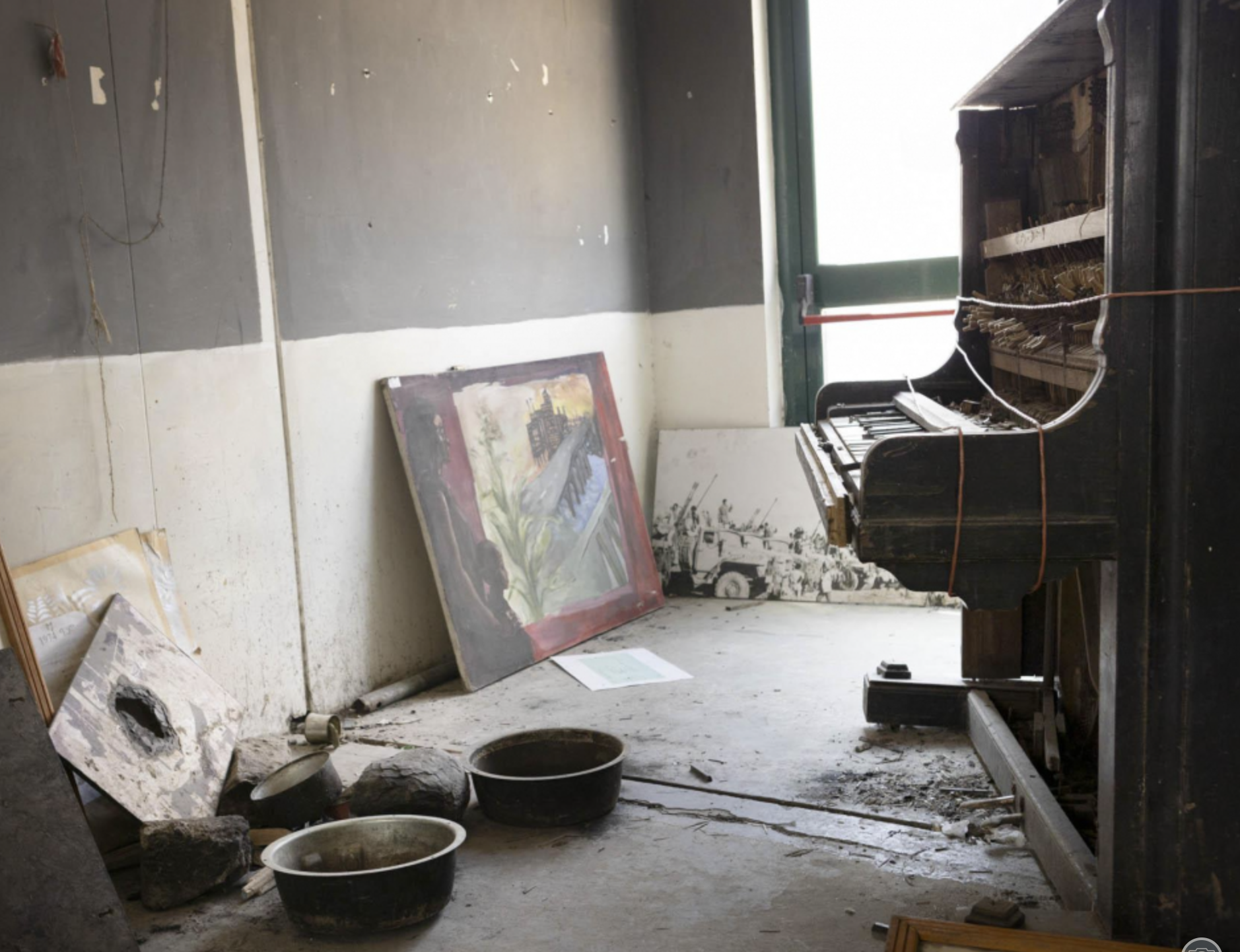
‘Nothing was spared,’ says Rezene (pseudonym, real name is known to the editor) with an uneasy grimace on his stubbled countenance. He casts a glance at a broken piano and shakes his head.
For years, the piano was one of the showpieces of the Martyrs Memorial Museum in Mekelle, the capital of Ethiopia’s Tigray state. Today, the instrument stands soulfully in a corner. The wooden frame is missing, a few black keys still swing around on the floor. ‘Unbelievable,’ Rezene mutters softly. ‘Everything is gone.’
Rezene is a guide and curator. The friendly thirty-something speaks in a controlled, soft voice. In late November 2020, he watched tanks of the national army roll into his hometown of Mekelle.
A few weeks earlier, on 4 November, Ethiopian Prime Minister Abiy Ahmed had ordered his troops to bring order to Tigray. Like many other residents, Rezene and his family sought safe shelter. First in Mekelle, later outside the city.
‘This museum is a symbolic place. That’s why it had to be razed to the ground.’
The “brief military operation”, in the prime minister’s words, was in response to an attack on a federal command post that he attributed to the Tigray People’s Liberation Front (TPLF).
But the operation would be anything but short. For two years, the government army fought an unusually bloody war with the TPLF, or rather its armed wing, the Tigray Defence Forces (TDF).
The violence killed hundreds of thousands of civilians by some estimates, countless others were cut off from food, communications and basic services. A peace agreement, signed in South Africa’s Pretoria, officially ended the bloodshed on 2 November 2022. But still people are suffering and violence could flare up again at any moment.
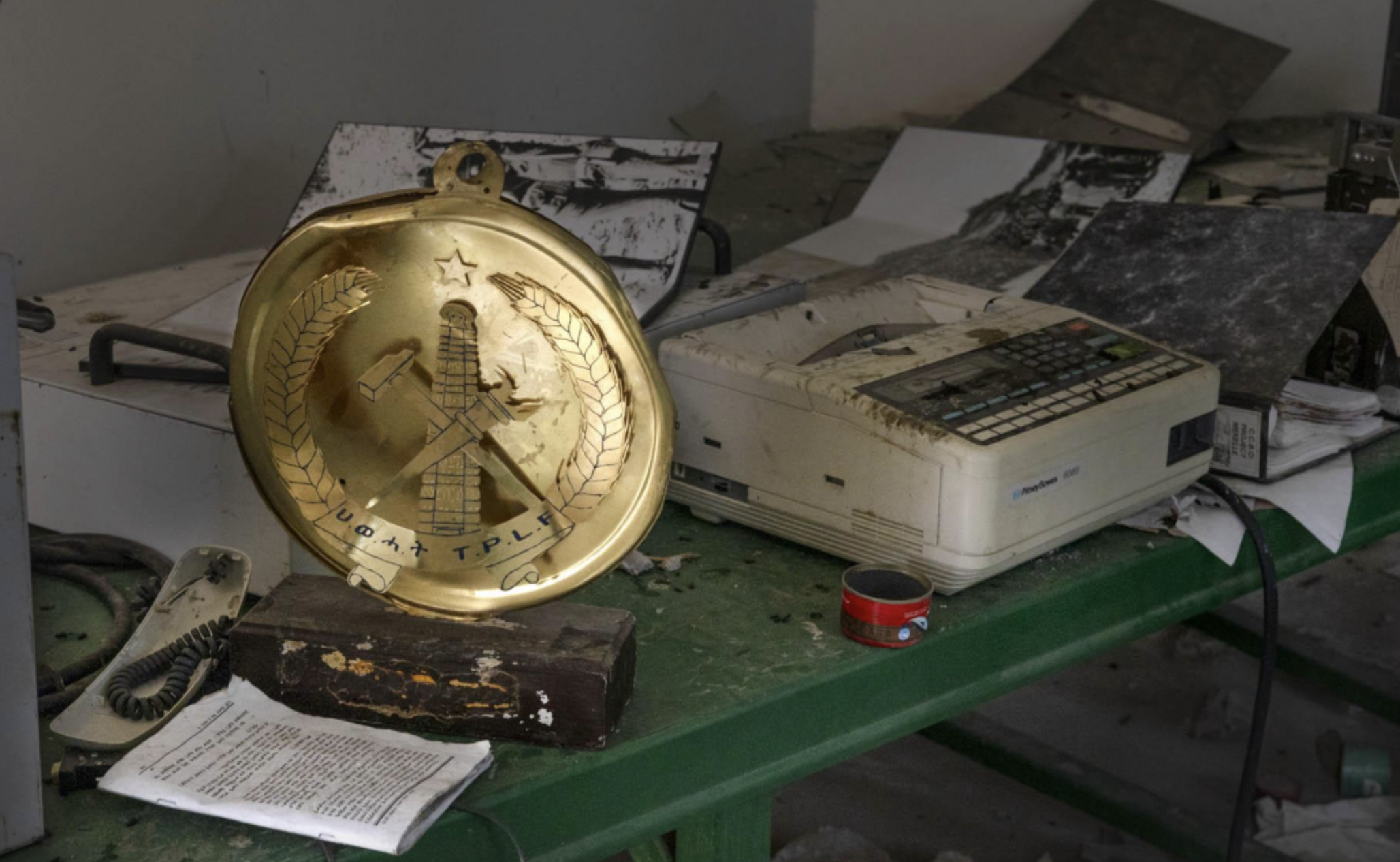
‘After the Ethiopian soldiers captured Mekelle, they used the museum as a command centre for eight months,’ says Rezene. Traces of this are still visible throughout the building. Photos, books and relics have been destroyed. Empty tin cans and blackened cooking pots lie everywhere. Near the entrance are chairs and water barrels. Next to it, on the ground, is a tangle of electric cables. All sorts of garments and bras draped over a wall also hint at the utmost horror.
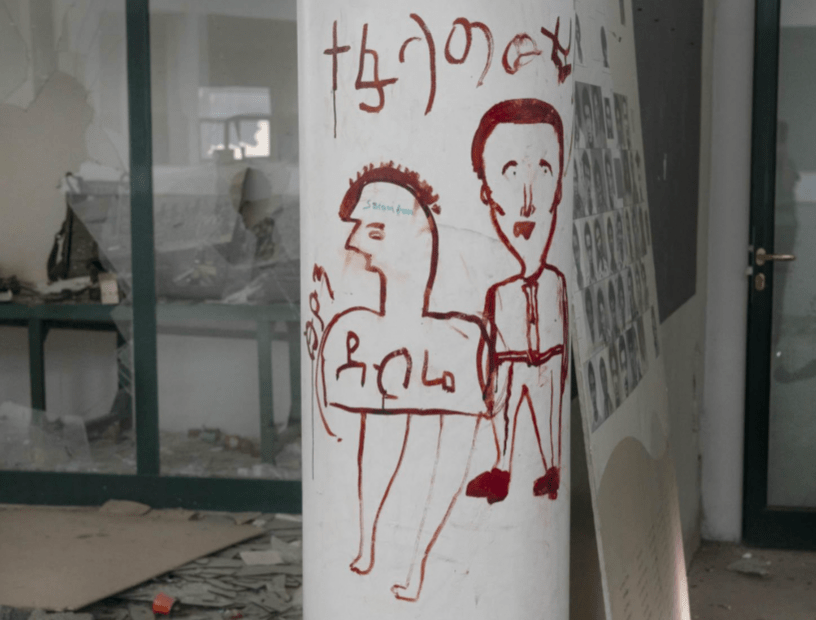
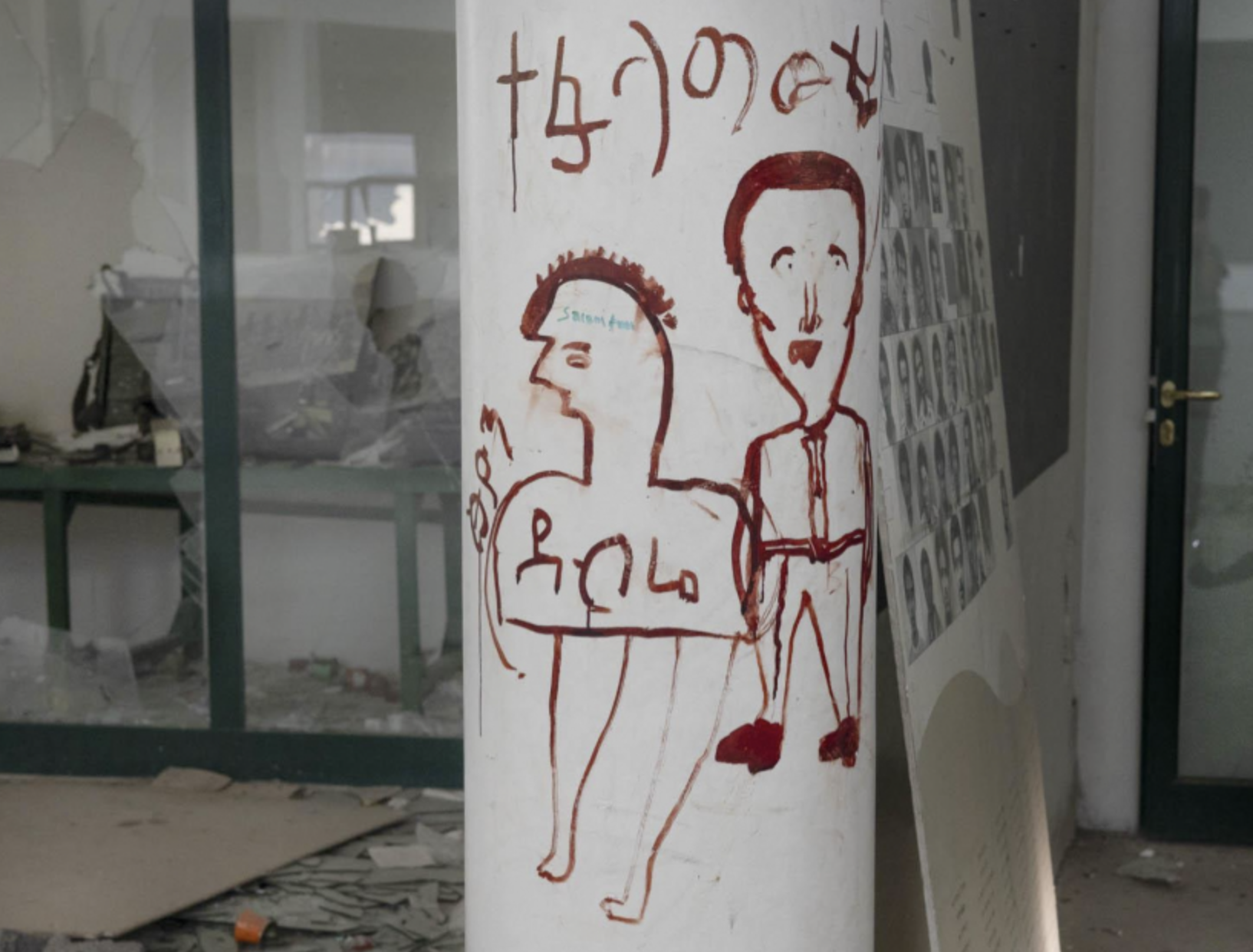
‘Look,’ says Rezene. He points to slogans painted on walls and columns, caustic texts mocking Tigreans and leaders of the TPLF. ‘This destruction is part of a campaign by the Ethiopian elite to wipe the Tigreans off the map,’ Rezene believes.
‘This museum was about sacrifice, unity, education and cooperation. It was a powerful reminder of the importance of standing up for your beliefs and striving together for a better future. It is a symbolic place. That’s why the museum had to be razed to the ground.’
Two rebel groups, two histories
Visibly affected by the devastation, Rezene leads us around the various halls. Upstairs, he shows a panel of black-and-white photographs. Groups of TPLF fighters are meeting and cooking. In other pictures, youngsters are explained how to handle a weapon.
They are scenes from the 1970s and 1980s. Back then, the TPLF fought a guerrilla war with the Provisional Military Government of Socialist Ethiopia, better known as the Derg.
Also read ‘I fear today’s Ethiopia won’t last long‘
When it was founded in 1975, the TPLF was little more than a group of rebellious students who wanted to do away with the structural backwardness of their region. It had no clear leader, nor any military experience. Moreover, especially in its early years, it was in the shadow of another rebel group: the Eritrean People’s Liberation Front (EPLF), led by Eritrea’s later president, Isaias Afewerki.
Although they fought against the same enemy, the two rebel groups differed in structure, military approach and vision. Eritrea was an Italian colony until 1941 and would then fall under British rule for a while. In 1952, it was annexed to Ethiopia: first as a federation, in 1962 as a province.
From the outset, the EPLF sought independence from Eritrea, while the TPLF worked for greater rights and political power in Ethiopia. In doing so, it wanted to include other ethnic groups.
Despite these differences, the two rebel groups would prove successful together. In the late 1980s, after numerous military defeats and the loss of important arsenals, the Derg forces were forced to withdraw from rebel-held areas. On 28 May 1991, TPLF soldiers marched into Addis Ababa, less than a week after the EPLF had liberated the Eritrean capital Asmara.
Eritrea: hopeful nation turns dictatorship
On 24 May 1993, the new flag was raised in Eritrea: the country was officially no longer part of Ethiopia. With Isaias Afewerki at the helm in Asmara and Meles Zenawi of the TPLF in Addis Ababa, the future looked hopeful.
But things already went wrong in 1998. A border dispute over agricultural areas around the town of Badme degenerated into a bloody war with trenches and tens of thousands of deaths on both sides.
‘Eritrea was never big enough for Isaias Afewerki,’ says Sarah Vaughan, African history researcher and co-author of the newly published survey work Understanding Ethiopia’s Tigray war (2023). ‘Even as tensions rose between the TPLF and the EPLF in the 1990s, after Eritrean independence, Isaias still believed he could impose his will on Ethiopia.’
‘Eritreans looked at the Tigreans with contempt. These were “Agames“, day labourers who came to do odd jobs in Asmara.’
During colonial rule, the Italians had made the small country with its strategic location on the Red Sea into the industrial centre of Italian East Africa, which also included Italian Somaliland (in present-day Somalia) and Abyssinia (Ethiopia). They built theatres and Art Deco villas there and laid picturesque alleys, parks and boulevards with coloured tiles.
Ironically, the colonial experience led to a sense of superiority among Eritreans, Vaughan explains. ‘In their eyes, Eritrea was a bastion of culture and industrialisation. They looked contemptuously at the Tigreans. These were “Agames“, day labourers who came to do odd jobs in Asmara, the sophisticated city with its great coffee, ice cream parlours and fascist buildings.’
Actually, Vaughan says, Isaias had the same attitude as the Italian coloniser: ‘Eritrea would get raw materials from Ethiopia, which it would process and export. That would be the foundation of Eritrean prosperity. So when Isaias heard that the Tigreans were starting to build their own factories, he was livid. He saw himself as the leader of the Horn of Africa, and certainly of Ethiopia.’
The 1998 border war was a sobering experience. Ethiopian forces were many times larger than Eritrean ones. When Isaias was heading for a humiliating defeat in 2000, he decided to take his chances and sign a fragile peace agreement. But in practice, the conflict was not resolved and the border remained locked.
The military humiliation would change the Eritrean leader forever. Criticism he nipped in the bud with harsh repression, the press came irrevocably under arrest. The once hopeful young nation turned into a dictatorship that fled its own subjects in unseen ways.
Ethiopia: Tigreans are head of jut
In Addis Ababa, Meles Zenawi wanted to break with the past from the start and sought a new, so-called democratic society. A government coalition was set up, with four parties, of different ethnic backgrounds. In it, all parties would be guaranteed, at least on paper, far-reaching autonomy, even the right to independence.
In practice, it turned out that within the ruling coalition, it was mainly the Tigreans who called the shots. Only: the ethnic group represents only 6% to 7% of the 120 million Ethiopians. This led to discontent, especially among the Amharic elite, who consider themselves the country’s historical leaders, and among the Oromos, who felt disadvantaged as the largest population group.
‘It was certainly not a fully democratic time. But under Meles Zenawi, Ethiopia made huge strides in poverty reduction.’
In 2018, the assumption of Prime Minister Abiy Ahmed brought an end to more than a quarter century of TPLF dominance, a period marked by economic growth but also by censorship and harsh repression.
‘It was certainly not a fully inclusive or fully democratic time,’ Vaughan analyses Meles’ rule. ‘But despite those shortcomings, there was great social and economic progress. Ethiopia made huge strides in poverty reduction. After his death, things went wrong.’
With Abiy, the country seemed to make a fresh start. He threw open the prison gates to journalists and dissident politicians, lifted censorship, formed a government composed of half female ministers and promised liberalisation of the economy. The ruling coalition was also dissolved and replaced by a unity party, the pan-Ethiopian Prosperity Party.
Most importantly, Abiy made peace with neighbouring Eritrea. That surprising demarche earned him the Nobel Peace Prize in autumn 2019.
But the cheerful mood was short-lived. Although the international community saw in him a conciliator, Abiy soon behaved like a divider at home. He bragged of “27 dark years under the previous government” and blamed the Tigreans for everything that went wrong in Ethiopia. Not only the TPLF leaders were targeted in this, but the entire Tigrean population.
Vaughan speaks of an “extremely cynical and potentially genocidal campaign by politicians who had little regard for the federal system and deliberately wanted to sow hatred”. In doing so, they found an ally in the Eritrean regime. ‘That had always disliked the Tigrean leadership because of its defeat in border war. It was quite shocking for the TPFL and for many Tigreans. They thought they were Ethiopians and discovered over the course of the war that they were not.
‘Everything was a target’
In their fight against the Tigreans, Ethiopian troops were supported by the Eritrean army and militias from the neighbouring Amhara region. These saw their chance to enforce old territorial claims by force. Due to their numerical superiority and thanks to an arsenal of drones, the military alliance initially scored one victory after another.
‘My mother-in-law went through three wars in her life, the last one broke her.’
‘Every morning we could hear drones and planes flying overhead,’ says a retired NGO worker in Mekelle. He stayed in the city when Ethiopian soldiers cleared its streets. ‘I could not leave because without medication I would die. I have hypertension, high blood pressure. But like food and water, medicines were hard to find.’
The biggest worry, says the old man, was uncertainty. ‘We lived in constant fear. You didn’t know when you would die. We were lucky that our house had a basement. Whenever we heard planes or drones, we hid there. Except for my mother-in-law. She stubbornly stayed in the living room every time. She went through three wars in her life, the last one broke her.’
The man bats his eyes and rubs his hands uncomfortably. Then he sighs, “I see no future for Tigray. Schools, hospitals and factories have been completely destroyed and looted. Precious parts and raw materials were snatched. In this war, everything was a target. Everything that held our people together is now in ruins. Even churches and mosques were not spared the violence.’
Al-Nejashimosque
Near the town of Wukro, north of Mekelle, stands the al-Nejashimosque. The iconic building dates back to the seventh century and is said to be one of the oldest mosques in Africa. In an impact, the minaret and dome were severely damaged. Inside the building, some of the debris is still not cleared.
The imam is absent, but his deputy tells how soldiers came to his village, looking for Tigrean fighters. These were reportedly digging trenches around the mosque, according to the Ethiopian government. ‘There was fighting in the area,’ the man confirms, ‘but the Tigrean fighters were not near the mosque’.
He points to a blood stain on the white marble. ‘This is where three young people were killed. They had nothing to do with the army. One of them was Muslim, the others were Christian. They were hiding in the mosque. Everyone was scared. There is a church nearby, but the mosque has an underground room.’
More than half the village had fled by then. The imam’s deputy also sent his wife and children to a nearby town because Eritrean troops had destroyed their home. He himself stayed, as he wanted to take care of the mosque.
Today, it is still operational. But the damage is extensive. ‘The Turkish ambassador to Ethiopia visited the mosque,’ says the man. ‘He promised that Turkey will restore the building. That support is welcome as we can use every penny.’
Stalemate
At the Martyrs Memorial Museum, curator Rezene breathes a deep sigh. He looks at a portrait of Meles Zenawi and frowns. The battered picture stands on a wobbly chair. A piece of the Tigrean resistance leader and former prime minister of Ethiopia’s head has been cut away. As if with it, part of the collective memory has also been erased.
‘The museum paid tribute to our struggle against the Derg,’ says Rezene. Photos, drawings and infographics from this period were brought together. The piano captured by TPLF soldiers in the early 1980s and now shattered was also given a prominent place.
‘With this place, we wanted to preserve our history for future generations. We collected every penny for this museum among the Tigreans. Even the farmers and people from the diaspora contributed.’
‘We will completely rebuild the museum.’
In June 2021, Tigrean forces regained control of Mekelle. A few months later, in November, they marched south and managed to approach to within 85 kilometres of capital Addis Ababa.
Foreign governments rushed to the aid of the Ethiopian government, especially with drones. Eventually, the Ethiopian coalition would push back the Tigreans, after which their momentum turned. A peace agreement followed on 2 November 2022.
Like 40 years ago, every Tigrean soldier felt woyane, a resistance fighter, during the war. But today the cards are different, Sarah Vaughan observes.
‘It is one thing to lose your loved ones when you emerge victorious. But it is something else when you are defeated and then told there is a peace agreement, but have no food for a year and receive nothing of support.’
Still, Rezene is not sitting on his hands. ‘We will completely rebuild the museum,’ he sounds combative. ‘This will include space for the martyrs who fell during the latest war. Maybe we will even build an additional hall.’
‘Our story is far from being written. Whether that story will take place in Ethiopia is highly questionable.’
 Martin Plaut