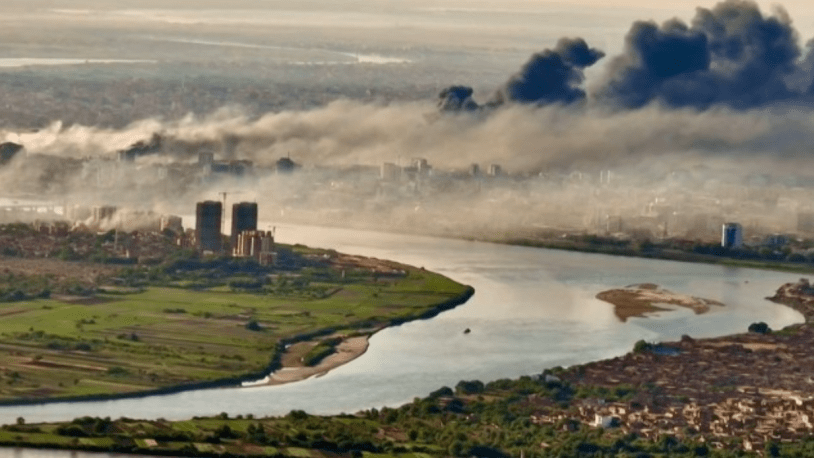
UN expert panel says claims of UAE supplying RSF ‘credible’.
“Complex financial networks established by RSF before and during the war enabled it to acquire weapons, pay salaries, fund media campaigns, lobby, and buy the support of other political and armed groups,” wrote the monitors, adding that the RSF used proceeds from its pre-war gold business to create a network of as many as 50 companies in several industries. Since the war started “most of the gold which was previously exported to UAE, was now smuggled to Egypt,” the monitors said.
Source: Bloomberg
- UN expert panel says claims of UAE supplying RSF ‘credible’
- Up to 15,000 killed in Darfur city, more than total war toll

By Simon Marks
January 21, 2024 at 11:07 AM UTC
The UN report also described as “credible” allegations that the United Arab Emirates has helped supply the RSF via neighboring Chad, citing local witnesses — something the Gulf nation denies. And it said violence by the RSF and allied militias may have killed as many as 15,000 people in one city in the Darfur region in 2023 — a figure that would outstrip the UN’s previous toll for the entire nine-month conflict.
The panel of experts report, which Bloomberg News obtained and hasn’t yet been made public, is one of the most detailed high-level accounts to date on the RSF’s activities. The paramilitary group and Sudan’s army turned on each other in April in a battle for control of the North African nation, sparking a refugee crisis and pushing the country to the verge of famine.
An RSF spokesman didn’t immediately respond to questions. The UAE’s foreign ministry said in a statement that the country “is not supplying arms and ammunition to any of the warring parties, and does not take sides in the current conflict.”
“The UAE is firmly committed to implementing UN resolutions and abiding by the UN sanctions regime on Sudan,” the ministry said.
The UAE added that it has invited UN experts to visit Amdjarass, the city in Chad where it’s set up a field hospital that’s a “critical lifeline for civilians,” and stressed its repeated calls for de-escalation and a permanent cease-fire.
The RSF, which has its roots in the janjaweed militias that Sudan’s government marshaled to crush a rebellion in Darfur in the early 2000s, has benefited from a complex web of financing and new military supply lines through eastern Chad, Libya and South Sudan, according to the UN experts. It now controls most of Darfur, a western region about the size of France.
Financial networks set up by the RSF before and during the conflict enabled it to acquire weapons, fund media campaigns, pay salaries and buy backing from political and armed groups, the experts said.
The RSF has long controlled most of Sudan’s gold trade. Despite production cuts caused by the war, the precious metal remains a source of revenue for both sides, according to the investigation.
Read More: Paramilitary Forces Defy US With Attack on Sudan Aid Hub
Giving one example, the experts said a Sudanese gold trader in Dubai associated with the RSF received 50 kilograms of gold in May — the first consignment since the war broke out. The RSF continues to mine concessions in Darfur, they said.
Fresh Weaponry
From July onward, the RSF deployed heavy and sophisticated weapons including drones, howitzers, multiple-rocket launchers and anti-aircraft weapons such as MANPADS, the experts found. The new firepower had a major impact on the balance of forces in both Darfur and the wider country, they said.
As the RSF and allied militias advanced. they targeted internally-displaced people as well as civilian neighborhoods and medical facilities, and committed sexual violence against girls and women, according to the report.
Between 10,000 and 15,000 people were killed in El-Geneina, capital of the West Darfur region, the experts said. The UN’s most recent public estimate of the death toll for the war stands at about 12,000.
International efforts to broker an end to the conflict have foundered. Warring parties’ entrenched positions, the number of mediation tracks and competing regional interests are among the reasons, the experts said.
Diplomatic Spat Erupts Over Claims UAE Shipped Weapons to Sudan
- Efforts underway to ensure two warring generals agree to meet
- African nation’s eight-month conflict has killed 12,000 people

By Simon Marks and Mohammed Alamin
December 12, 2023 at 10:03 AM UTC
Source: Bloomberg
Allegations the United Arab Emirates provided arms to a paramilitary group in Sudan have triggered a spat with the army and risk undermining a new initiative to end the African nation’s eight-month-old civil war.
Three Sudanese diplomats based in the UAE have been reported personae non grata and 15 Emirati embassy employees ordered out of Sudan over the past week in the wake of the accusations. The feud comes just as East African mediators claim a breakthrough in talks between the military and rival Rapid Support Forces to quell fighting that’s killed more than 12,000 people and sparked a refugee crisis.
Officials from Africa, the US and Saudi Arabia are racing to ensure the feud doesn’t escalate and derail what would be a landmark in-person meeting between RSF leader Mohamed Hamdan Dagalo and Sudanese army chief Abdel Fattah al-Burhan planned before the end of the year, people briefed on the matter said.

The stakes are higher than ever for Sudan, a resource-rich nation situated on the Red Sea whose deadly crisis has been recently overshadowed by the Israeli war in Gaza. The US has accused both the military and RSF of war crimes, while the United Nations is warning of a humanitarian catastrophe with some 25 million people – more than half the population — needing aid.
The diplomatic fireworks began in late November when Yasser Al-Atta, the assistant commander-in-chief of Sudan’s army, publicly accused the UAE of direct involvement in the conflict. Fighting erupted in mid-April when the military and RSF, which jointly overthrew a civilian-led government in 2021, turned on each other in a battle for sole control of the nation.
| Read more: |
|---|
| Death Toll From Violence in Sudan’s Darfur Region RisesWhat’s Behind the Fighting in Sudan and What It Means: QuickTakeBattles Erupt in Sudan as Militia Fights Army to Rule Nation |
“We have information from intelligence, military intelligence and the diplomatic circuit that the UAE sends planes to support the Janjaweed,” Al-Atta told members of Sudan’s intelligence service in televised comments, using a term for the Darfur militia from which the RSF evolved.
Officials at the UAE and Sudanese foreign ministries didn’t respond to questions seeking comment. The UAE has consistently denied any involvement in the war, saying it’s committed to de-escalation and the provision of humanitarian aid through a field hospital located in the Chadian city of Amdjarass.
Al-Atta also applauded efforts by Russia to take over the mercenary Wagner Group, which the US has said supplied weapons to the RSF.

The latest talks on Sudan were convened by the Intergovernmental Authority on Development, a bloc of East African nations, in Djibouti at the weekend and achieved limited progress, including on a possible Burhan-Dagalo meeting.
But there were disputes too, with Sudan’s foreign ministry later saying it hadn’t signed off on a final communique that included a paragraph thanking UAE foreign ministry official Sheikh Shakhboot Bin Nahyan for his input.
Djiboutian President Ismail Omar Guelleh is in direct contact with both Sudanese generals to push them to meet and discuss the terms of a lasting cease-fire, according to the people briefed, who asked not to be identified as they’re not authorized to speak publicly on the issue.
The US State Department on Sunday said it welcomed commitments from the generals “to an unconditional cease-fire and a one-to-one meeting between them.”
The UAE has long-standing plans to invest in Sudan’s coastline. Before the war, it signed a multi-billion deal to build a port and develop farmland in the country’s east that could boost its food security.
Ethnic killings in one Sudan city left up to 15,000 dead – UN report
Michelle Nichols and Maggie Michael
Updated Sat, January 20, 2024 at 2:08 PM GMT·5 min read

By Michelle Nichols and Maggie Michael
UNITED NATIONS/CAIRO (Reuters) -Between 10,000 and 15,000 people were killed in one city in Sudan’s West Darfur region last year in ethnic violence by the paramilitary Rapid Support Forces (RSF) and allied Arab militia, according to a United Nations report seen by Reuters on Friday.
In the report to the U.N. Security Council, independent U.N. sanctions monitors attributed the toll in El Geneina to intelligence sources and contrasted it with the U.N. estimate that about 12,000 people have been killed across Sudan since war erupted on April 15, 2023, between the Sudanese army and the RSF.
The monitors also described as “credible” accusations that the United Arab Emirates had provided military support to the RSF “several times per week” via Amdjarass in northern Chad. A top Sudanese general accused the UAE in November of backing the RSF war effort.
In a letter to the monitors, the UAE said 122 flights had delivered humanitarian aid to Amdjarass to help Sudanese fleeing the war. On Saturday, a UAE official told Reuters that it extended an invitation to the UN monitors to visit a field hospital in Amdjarass “to learn firsthand about the humanitarian efforts undertaken by the UAE to help alleviate suffering caused by the current conflict”.
The United Nations says about 500,000 people have fled Sudan into eastern Chad, several hundred kilometres south of Amdjarass.
Between April and June last year El Geneina experienced “intense violence,” the monitors wrote, accusing the RSF and allies of targeting the ethnic African Masalit tribe in attacks that “may amount to war crimes and crimes against humanity”.
The RSF has previously denied the accusations and said any of its soldiers found to be involved would face justice. The RSF did not immediately respond to a request for comment by Reuters.
“The attacks were planned, coordinated, and executed by RSF and their allied Arab militias,” the sanctions monitors wrote in their annual report to the 15-member Security Council.
‘SHOT TO THE HEAD’
Reuters last year chronicled the ethnically targeted violence committed in West Darfur. In hundreds of interviews with Reuters, survivors described horrific scenes of bloodletting in El Geneina and on the 30-km (18-mile) route from the city to the border with Chad as people fled.
The monitors’ report included similar accounts. They said that between June 14 and 17, some 12,000 people fled El Geneina on foot for Adre in Chad. The Masalit were the majority in El Geneina until the attacks forced their mass exodus.
“When reaching RSF checkpoints women and men were separated, harassed, searched, robbed, and physically assaulted. RSF and allied militias indiscriminately shot hundreds of people in the legs to prevent them from fleeing,” the monitors said.
“Young men were particularly targeted and interrogated about their ethnicity. If identified as Masalit, many were summarily executed with a shot to the head. Women were physically and sexually assaulted. Indiscriminate shootings also injured and killed women and children,” according to the report.
Everyone who spoke to the monitors mentioned “many dead bodies along the road, including those of women, children and young men.” The monitors also reported “widespread” conflict-related sexual violence committed by RSF and allied militia.
NEW FIREPOWER
The monitors said the RSF takeover of most of Darfur relied on three lines of support – Arab allied communities, dynamic and complex financial networks, and new military supply lines running through Chad, Libya, and South Sudan.
The U.N. missions for Chad, Libya and South Sudan did not immediately respond to a request for comment.
“Complex financial networks established by RSF before and during the war enabled it to acquire weapons, pay salaries, fund media campaigns, lobby, and buy the support of other political and armed groups,” wrote the monitors, adding that the RSF used proceeds from its pre-war gold business to create a network of as many as 50 companies in several industries.
Since the war started “most of the gold which was previously exported to UAE, was now smuggled to Egypt,” the monitors said.
The new firepower acquired by the RSF “had a massive impact on the balance of forces, both in Darfur and other regions of Sudan,” the report found.
The RSF has recently made military gains, taking control of Wad Madani, one of Sudan’s major cities, and consolidating its grip on the western region of Darfur.
On Saturday, a UAE official reiterated denials that the country has been involved in military support to any of Sudan’s rival parties.
“The UAE has stressed that it is not supplying arms and ammunition to any of the warring parties, and does not take sides in the current conflict,” the unnamed official said in a written statement to Reuters.
In December the United States formally determined that warring parties in Sudan committed war crimes and that the RSF and allied militias had also committed crimes against humanity and ethnic cleansing.
The war has left nearly half of Sudan’s 49 million people needing aid, while more than 7.5 million people have fled their homes – making Sudan the biggest displacement crisis globally – and hunger is rising.
The sanctions monitors told the U.N. Security Council that “an excess of mediation tracks, the entrenched positions of the warring parties, and competing regional interests meant that these peace efforts had yet to stop the war, bring political settlement or address the humanitarian crisis.”
(Reporting by Michelle Nichols and Maggie Michael; Editing by Don Durfee, Daniel Wallis and Giles Elgood)
 Martin Plaut