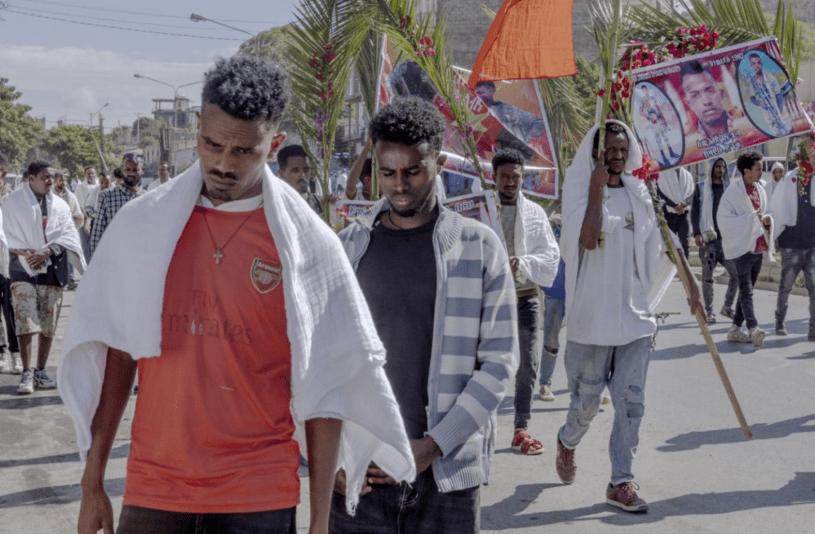
Source: Mondiaal Nieuws
‘I am ashamed of my Ethiopian passport’
TOM CLAES .IMAGE: PAULINE NIKS .FEBRUARY 8, 2024

On paper, there has been peace in the Ethiopian Tigray region for fifteen months now. The Tigreans try to resume their lives, but it is not the same anymore. Some are hopelessly looking for work, others dream of a new life abroad. ‘The region is divided, people are moving away and everyone is at a loss.’ MO* joined us in looking for future prospects.
‘WDo you like sugar in your coffee?’ Tirhas asks . It is a quarter past ten in the morning in Mekele, the capital of the Ethiopian province of Tigray. While life outside is slowly getting underway, it is still remarkably quiet in the dingy Dallas Hotel. Groups of women do the laundry in the courtyard. A supplier walks into the hotel through the large entrance gate, looks around for a while and then disappears into a back room.
In November 2022, the Ethiopian government and the state of Tigray reached an agreement: they would end the war, which had been going on for two years. But how fragile is that peace? And what does the agreement mean for the population?
Tirhas has been working since eight o’clock. The young woman gingerly carries around a tray of coffee.
“I worked as a tour guide for years and had a nice salary,” she says as she takes a seat on one of the plastic chairs that have been placed randomly in the courtyard. ‘Many tourists came to Tigray. Especially to admire the centuries-old churches and mosques. But then the Covid pandemic broke out and everyone stayed away. Suddenly I was out of work.’
And then the worst was yet to come. In early November 2020, a civil war erupted in Tigray between the regional ruling party Tigray People’s Liberation Front (TPLF) and the Ethiopian army. A few weeks later the fighting reached Wukro, Tirhas’ home city. “You could just be shot if you opened your door,” she says in a trembling voice. “We were even afraid to go to our neighbors.”
One day she heard the story of a woman who was raped by six soldiers. Her husband, who had to witness the horror, was so devastated that he hanged himself in front of her.
“It could be me the next day,” Tirhas realized. And so she fled with her three-year-old daughter. ‘We hid in the countryside for weeks. We had no food, no light, nothing.”
She still had some money in her bank account. But because the banking system was paralyzed by the war, she was unable to withdraw anything. ‘I went to the manager of the nearest bank and told him that my daughter was losing weight very quickly. He took some money out of his pocket and gave it to me. We could continue with that for a while. I was afraid I would lose my child.’
Days without food and drink
After two years of intense fighting, the TPLF and the Ethiopian government reached a peace agreement in November 2022. Tirhas moved from Wukro to the regional capital Mekele shortly afterwards. “I needed a job,” she says. ‘Of course I would much rather be a tour guide again. But do you see tourists? Today I’m doing a lot of chores at the hotel. I need the money to survive.’
Since the pandemic and the civil war, life has become unaffordable for many people. Young people spend their days on the streets or in one of the gambling dens that are springing up like mushrooms. Some are deeply in debt. Many have still not received their overdue salaries from during the war . And work is scarce in Tigray, so bills remain unpaid.
ALSO READ‘The land is dead’: why famine threatens millions of Ethiopians again“I had a good income,”
Fitsum says in flawless English. The smooth young man – cap, sneakers and hoody – worked as an IT worker in Mekele. When war broke out, the region was cut off from all communications and left without work. Because he has language skills and is easy to work with, he decided to become a journalist and fixer, an intermediary for foreign reporters.
‘I was handcuffed on the ground and given no food or drink. Nobody knew where I was.’
One of the stories he worked on as a fixer and translator was about St. Mary’s Church in Dengelat, in northern Tigray. One of the largest massacres of the war took place there.
Fitsum went there to investigate together with two foreign journalists. ‘The Tigrean authorities had called me in advance. They wanted a military convoy to escort us.” But Fitsum didn’t want to know about that. ‘I wanted to be able to do independent research.’
‘Of course the Ethiopian soldiers at the checkpoints along the way were also not happy with our presence. They wanted to stop us from talking to people so they could drive the narrative about what happened in Dengelat.”
Ultimately, the three managed to reach the church on their own. But in the meantime they had been reported to the authorities. Once he returned home to Mekele, Fitsum was taken from his bed at night by Ethiopian soldiers. He would be held for five days: three days in a military camp, two days in a civilian prison.
‘In the camp I was interrogated, insulted and threatened. They said they would kill me any moment. I was handcuffed on the ground and given no food or water. My passport and all other documents were confiscated and I would never get them back. Nobody knew where I was. Just because I helped foreign journalists.’
Not prepared
For journalist and fixer Fitsum, the war did not come out of the blue. “The Ethiopian government was surrounded by people who hated the TPLF and the Tigreans,” he said. ‘We were labeled as a cancer, as weeds or hyenas. Moreover, we were not only the target of ridicule in our own country. Neighboring country Eritrea also stirred up hatred against us.’
A brief sketch of what went before. In 1991, the Tigreans of the Tigray People’s Liberation Front (TPLF) came to power after overthrowing Marxist dictator Mengistu Haile Mariam. They were helped by rebels from Eritrea, which was then still a province of Ethiopia.
But the alliance would not last: in 1993, Eritrean rebel leader Isaias Afewerki declared Eritrea’s independence. Barely five years later, a border dispute over agricultural areas around the town of Badme turned into a bloody war with trenches and tens of thousands of deaths on both sides.
“My nephew went through ten days of military training and then went into the wilderness to fight.”
No money, no medicine, no hope in the Tigray conflict area The TPLF also faced increasing criticism in Ethiopia itself. The former rebel group gradually evolved into a real ruling party, which lost its popular support and was repeatedly accused of corruption and mismanagement.
Moreover, the Tigreans represent only 7% of the Ethiopian population. Their rule led to dissatisfaction among the Amharic elite, who considered themselves the historical leaders of the country, and among the Oromos, who, as the largest population group, felt unrepresented.
In 2018, the young Prime Minister Abiy Ahmed came to power. His father was Oromo and Muslim, his mother Amharic and Christian. He pushed aside the TPLF and founded the Prosperity Party, a centrally controlled party. And most importantly: he made peace with Eritrea. This earned him the Nobel Peace Prize in 2019.
But against Abiy’s wishes, Tigray organized its own elections in September 2020, after the planned national election was postponed due to corona. The result: a landslide victory for the TPLF. Not that the party was extremely popular, but it was simply the only one with enough military and political experience to protect the Tigreans from the increasing hatred.
Everyone in Tigray was already holding their breath, says Norwegian professor and Ethiopia expert Kjetil Tronvoll by telephone from Oslo. ‘The TPLF used the Tigrean elections to consolidate and demonstrate its power. That was the straw that broke the camel’s back in Addis Ababa. The TPLF and Abiy’s Prosperity Party can certainly be blamed for taking a path that they knew would lead to war.”
Only: Tigray was not ready for a war at all, Fitsum explains. ‘Eritrea has been a military dictatorship for thirty years. The country is trained and has enough soldiers. But us? My nephew went through ten days of military training and then went into the wilderness to fight. If you’re not prepared, don’t start or give up right away.’
Frustration with monopoly power
When Abiy Ahmed sent his army into Tigray, he quickly received support from troops from the neighboring Amhara region and from neighboring Eritrea. The violence was horrifying: looting, massacres and gang rape. Hundreds of thousands of civilians died. Millions more were cut off from food and water.
In response to the atrocities of the Ethiopian army and its allies, more and more young people joined the Tigrean resistance. The mobilization of new recruits led to the creation of a new popular fighting force: the Tigray Defense Forces (TDF). The TPLF formed the core of that army, but everyone who wanted to fight did it: students, shopkeepers, professors and even opposition members who would otherwise not spare their criticism of the TPLF.
“Haven’t we fought for justice and equality?”
The new force embodied not only the sense of belonging, but also the hope that the TPLF’s monopoly on power could be broken once the war was over.
It turned out differently. One of the conditions of the peace agreement was that an inclusive interim government would be established in Tigray, and yet the TPLF appears to be taking all the power again. “The TPLF led the TDF and mobilized the fighters,” explains Ethiopia expert Kjetil Tronvoll. ‘The party therefore believes that it can govern again.’
“But the absolute majority of recruits and young people who became TDF officers during the war are not members of the TPLF,” Tronvoll continues. ‘Their voices should therefore also be represented in the interim government of Tigray. That’s not entirely the case.’
Many Tigreans are frustrated, the Ethiopia expert sees: ‘They ask themselves a lot of questions: haven’t we fought for justice and equality? For our well-being? For a better future? The enormous sacrifices that the Tigreans made in the war made everything that the TPLF has been accused of for years come to the fore again: the monopoly of power, the corruption, the lack of accountability and accountability.’
Impunity
The Tigray People’s Liberation Front (TPLF) grew from a rebel group in the 1970s and 1980s to a real ruling party in the 1990s and 2000s. For years, there have been accusations from the entire country and from the region itself about their ‘monopoly on power’. , the corruption, the lack of accountability and responsibility’.
An example of this is a case that caused a lot of commotion on social media last year: the murder of Zewdu Haftu. On August 19, 2023, the young woman returned from a birthday party in Mekele with her friend Semhal Geberezgher. Suddenly a vehicle without a license plate stopped. A handful of men from the Tigrean security services got out and allegedly sexually intimidated the women.
When Zewdu tried to resist and shouted for help, she was dragged through the street by her hair. Ultimately, the men would crush her head under their vehicle. Semhal, who had seen everything happen, was arrested and blamed for the murder.
In the meantime, there is plenty of speculation about who the real perpetrators are. One of them may be the son of the deputy police commissioner in Tigray, but this has not been proven. What is certain is that these are not Ethiopian or Eritrean soldiers but people from the Tigrean community itself. The Tigrean authorities did little to investigate Zewdu’s death. A year after the peace agreement, impunity in Tigray continues.
“The TPLF still does not understand that it is accountable to the people,” says Ethiopia analyst Kjetil Tronvoll. ‘The criticism of the TPLF and the interim government now is: what on earth are you doing? We are hungry, why don’t you provide humanitarian aid? We have no work, why don’t you ensure development in our region? This criticism is legitimate, but of course the federal government also has enormous influence in meeting these needs.’
Young people want to leave
“I think everyone hoped for change,” says journalist/fixer Fitsum. ‘But what have our sacrifices done for us? Nothing. Even before the war the economy had collapsed, and now the situation is much worse. Most factories have been destroyed. People have no work, no prospects for the future. Leaving is the only option if you want to survive.’
“We have nothing in common with the rest of the country.”
“I now have a new passport,” he continues. ‘Thank God, because there is a major shortage of passports in the Ethiopian government. But I hate that mine says “Ethiopia.” We have nothing in common with the rest of the country. I would like to move to Canada. Would I work in IT again? Of course, being a computer scientist is the best job you can think of.’
Fitsum is not the only one who wants to leave. In an interview with the Addis Standard newspaper , Haysh Subagadis, the head of the Youth Affairs Office in Tigray, expressed concern about the growing number of young people migrating to the Arabian Peninsula and other African countries via various routes. He did not give exact figures, but he is said to have received alarming reports about this.
Tesfay (alias) is one of the young people who is increasingly thinking about leaving. However, that was once different, he explains: ‘I was always a supporter of Ethiopia. But now I think we live better together as good neighbors. Everyone is desperate. We have no salary, no medicines or other necessary things to live a normal life.’
Yet he still hesitates to pack: ‘It might be wiser to move for work or education. But if all Tigreans leave, our enemies will ultimately win. What they could not achieve with war, they have succeeded with the peace treaty: the region is divided, people are moving away and everyone is at a loss.’
War again?
‘The dire economic situation is one thing,’ says Fitsum, ‘but the security of the region is a completely different story. You never know when you will be called into arms again tomorrow. The peace agreement has not yet been fully implemented. Tigray is still not stable. There are rumors that a new war with Eritrea is brewing. So what?’
In October 2023, Prime Minister Abiy Ahmed indicated that he had set his sights on the Eritrean port city of Assab. With the split from Eritrea in 1993, Ethiopia lost its access to the sea. Abiy left no doubt: access to the sea is “existential for Ethiopia’s survival.”
“A war with Eritrea is more likely than not to break out.”
A war for Assab is off the table for the time being. In January this year, the Ethiopian government signed a memorandum of understanding with the breakaway Somali province of Somaliland, which should give Ethiopia its long-sought access to the sea through the port city of Berbera.
But this deal also creates new tensions in the already unstable Horn of Africa. Somaliland is a former British protectorate that declared independence from Somalia in 1991, but is not recognized by the international community.
The port deal with Ethiopia promises Somaliland the prospect of recognition, much to the chagrin of Somalia. It says its sovereignty has been violated and is eagerly seeking international support. In this way, Eritrea, as a possible ally, comes back into the picture.
“We see clear regional alliances in response to the port deal,” Tronvoll explains: “Somalia and Eritrea on one side, Ethiopia and Somaliland on the other. Somalia may not have the capacity to carry out many attacks, but on paper it is certainly prepared to do so.’
Eritrea could use the port deal with Somaliland to start a new war with Tigray.
Firstly, because Eritrean President Isasas Afewerki has not achieved his goal: the complete destruction of the TPLF. But also because Abiy Ahmed does not have the military strength to wage a war on several fronts and the timing could therefore be good. Because apart from the tensions with Somalia, the Ethiopian army already has its hands full with rebel uprisings in the Oromia and Amhara regions.
‘Every generation is torn apart by violence. Who knows what tragedy awaits my child?’
A new war could possibly bring everyone in torn Ethiopia in the same direction, says Tronvoll. He refers to the border war from 1998 to 2000 between Eritrea and Ethiopia. Even then, Ethiopia was hopelessly divided, but conflicts were pushed aside because everyone united in the fight against the external enemy.
I become proMO*“That could happen again, and that may be what Abiy is betting on,” Tronvoll believes. ‘Of course Tigray will then fight against Eritrea, because that is enemy number one. And then the Tigreans will have to mobilize again. That is part of the reason why there are still some 220,000 Tigrean fighters in barracks: to be prepared for the worst.”
Tronvoll leaves no doubt about it: ‘A war with Eritrea is more likely than not to break out. But much will depend on developments in the broader region: for example, the role of Egypt, how the alliance between Somalia and Eritrea plays out, the possible spillover effects of the civil war currently raging in Sudan. The entire regional security complex is so intertwined that it is not necessarily one factor that ignites the war between Eritrea and Ethiopia.”
Torn apart by violence
Lunchtime has arrived at the Dallas Hotel. Tirhas, the hotel employee, stares straight ahead, almost mechanically. Her eyes move slowly over the half-covered courtyard. “If I get the chance, I’ll go to Europe,” she says, caressing her daughter’s head.
She has tried to recapture some of her previous life, but it is no longer the same. “I’m thinking about my child, you know. My own mother lived in Tigray during the border war with Eritrea. Her mother experienced the battle against Haile Mengistu Mariam in the 1980s. And I survived the last war.’
She becomes silent for a moment. She puts the empty coffee cups on the tray and stands up. And as she takes her daughter by the hand, she whispers: ‘Every generation is torn apart by violence. Who knows what tragedy awaits my child?’
 Martin Plaut