Source: Nigritzia
From military training camps to support for armed movements, Asmara’s position alongside the Sudanese army seems clear. Equally clear is the intent to play a role in the conflict – but also at a regional level – beyond the usual diplomatic paths09 February 2024
Article by Bruna Sironi (from Nairobi)
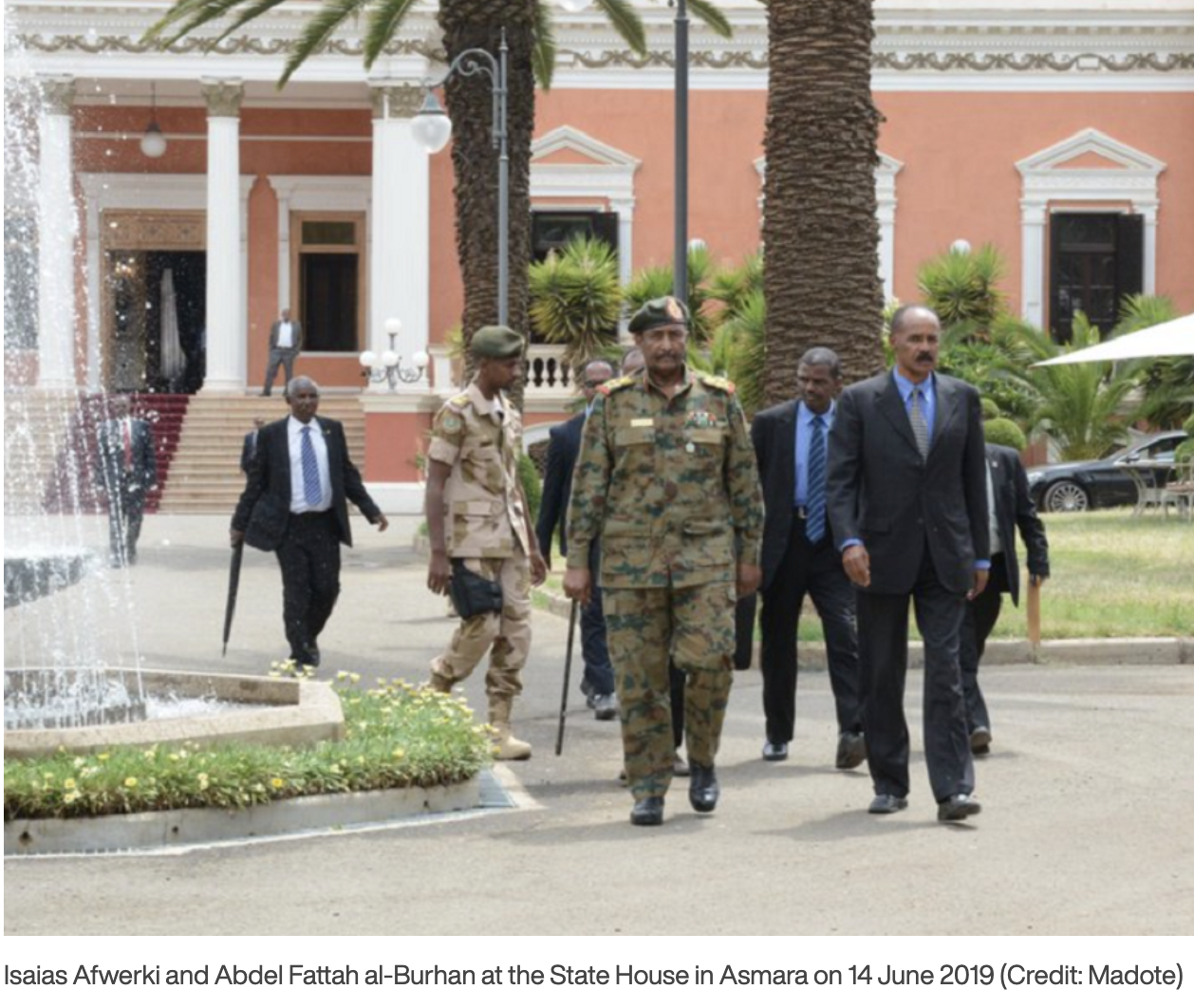
Isaias Afwerki and Abdel Fattah al-Burhan at the State House in Asmara on 14 June 2019 (Credit: Madote)
In a highly unstable area like the Horn of Africa, Eritrea has too often positioned itself as a catalyst and amplifier of tensions.
It is also happening in this period, one of the most complex and worrying in recent years for the region, characterized by a Sudan that risks imploding due to civil war , by an Ethiopia plagued by internal conflicts and entangled in difficult diplomatic relations with neighboring countries , from a still fragile Somalia, which with great difficulty is trying to emerge from a decades-long crisis.
Not to mention the influences, interference and external aims that compete for resources, but above all strategic positions from which to control the economy and stability of the planet, as demonstrated by the battle on the Red Sea in recent weeks.
In an objectively delicate situation, some news regarding Eritrea in relation to Sudan raises concern.
Training camps
According to an article published at the end of January on the website of Radio Dabanga , a Sudanese media outlet that is usually very well informed, Sudanese armed opposition movements, operating both in the east of the country and in Darfur, have training camps in Eritrea.
The article cites military sources and specifies that there are six camps located in the Gash Barka region, bordering eastern Sudan. Eleven movements would be hosted on Eritrean soil, 5 coming from eastern Sudan and 6 from Darfur.
It seems that they do it openly, at least judging by the photo in the comment on the article. The image shows hundreds of men in a desert area crouching holding weapons or sticks that would simulate rifles. Clearly this is a military training session.
The caption says that it was posted on January 14 on the Facebook page of the Eastern Sudan Liberation Forces , a movement born following the occupation of Wad Madani by the Rapid Support Forces (RSF) and that would thus announce its program to conduct military actions in Sudan.
Among others, two Beja groups, the Beja National Congress and the Beja Armed Congress, have camps in Eritrea . The Beja are the most important and composite ethnic group originating from Eastern Sudan. They generally oppose central governments by which they do not feel represented.
The low-intensity conflict, which lasted about ten years, against the Islamist regime of Omar El-Bashir was coordinated in Asmara. Military aid to the movement and humanitarian aid to the population passed from the Eritrean border. The peace agreements were also signed in Asmara in 2006 .
But the Beja soon began to contest them, so much so that they were at the forefront of the popular movement that led to the end of the regime of the deposed president El-Bashir. They also soon entered a collision course with the transitional government of Abdalla Hamdok. They blocked the port of Port Sudan and the road to Khartoum, the most important route in the country, for weeks and were instrumental in the military coup of 25 October 2021.
There were also tensions when, after the outbreak of conflict in April last year, the government was transferred to Port Sudan, which has been the de facto Sudanese capital for months.
The Beja are, in short, a group that feels peripheral and marginal compared to the central power and that does not renounce its claims to centrality in its area of origin. In this path they are often divided and easily “enlisted” by those who have an interest in destabilizing the country.
In recent years many have adhered to radical Islamic positions, so much so that the leaders of the Islamist regime of El-Bashir, freed from prison at the beginning of the conflict, found refuge and the possibility of recruitment in eastern Sudan.
Darfurian movements also have camps in Eritrea , including the faction of the Sudan Liberation Movement led by Minni Minawi, who is currently the governor of Darfur and who recently chose to deploy his men alongside the army against the Rapid Support Forces.
Even as regards Darfur, the history of Asmara’s interest in acting as a facilitator of alliances, mediations, military supplies and more has roots in the conflict of the early 2000s. Actions through which to carve out a significant, albeit surreptitious, role in regional relations.
Sudanese and non-Sudanese activists, journalists and political analysts consider the military camps in Eritrea a direct threat to the stability of eastern Sudan, the only part of the country so far only marginally affected by the conflict.
They fear that the militarization of opposition groups through military training could herald inter-ethnic clashes that are even more frequent and more serious than those that have broken out in the area in recent years.
This is underlined, speaking with Radio Dabanga , by Khaled Nour, a Sudanese activist, who adds concerns about the influence thus acquired by Asmara that could use it as a card to play in favor of its regional positioning instead of in favor of the settlement of the conflict in Sudan, as after all, it happened in the past.
Journalist Hossameldin Haidar, president of the National Press Council , thinks that the training in Eritrea could become a danger for the whole of Sudan, already on the brink of implosion.
Ballet of alliances
The Eritrean interest in having its say on what is happening in Sudan would seem to be confirmed by the frequency with which Asmara is visited by the various Sudanese actors, even if it has not had, so far at least, any “public” role and any role in the search for a solution to the Sudanese crisis.
The latest was Malik Agar , vice-president of the sovereign council, on 17 January. According to the Sudan Tribune , on the occasion there was talk of the danger for regional stability , and for that of Eritrea itself, in the event of an expansion of the territory controlled by the Rapid Support Forces in eastern Sudan.
Malik himself had also met the Eritrean president last July . At the time, Isaias Afwerki said he was against both regional and international mediations, underlining the internal significance of the conflict between the army and the RSF.
The president of the sovereign council, General Abdel Fattah al-Burhan, also saw the Eritrean president in Asmara last September.
However, since the outbreak of the conflict in Sudan, there has been no meeting with the commander of the RSF, General Mohamed Hamdan Dagalo, known as Hemeti. The latest occurred in mid-March last year, when Hemeti was still al-Burhan’s deputy in the sovereign council.
Eritrea’s position therefore seems clear alongside the national army and the more or less legitimate government of the country. The intent to play a role in the Sudanese conflict beyond and outside of the usual diplomatic paths established at a regional and international level seems equally clear.
It is probably a way of keeping one’s hands free to play one’s cards in regional relations, and not only that, thanks to the influence acquired also through the support of movements that, if necessary, could be easily maneuvered.
According to this hypothesis, the Eritrean government would continue to play the role of puppeteer pulling the strings of regional stability.
 Martin Plaut