
Eritreans do not live free lives in Norway. Mainstream society cannot accept that exiles can be harassed, persecuted and be exacted from the regime they fled from, says Venstre – the Liberal Party.
Source: Vårt land
Eritreans in Norway must be allowed to live free lives
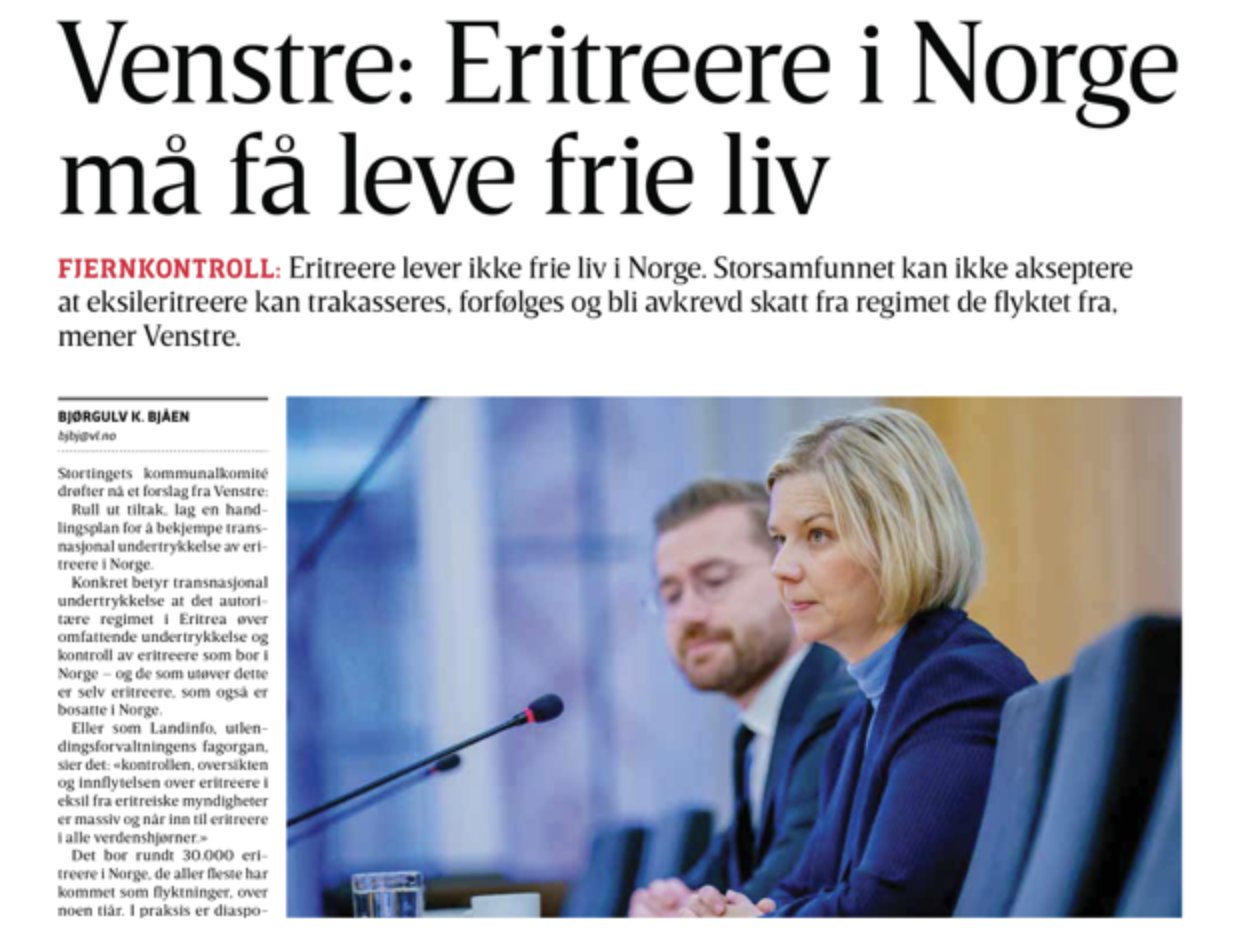
Eritreans do not live free lives in Norway. Mainstream society cannot accept that exiles can be harassed, persecuted and be exacted from the regime they fled from, says Venstre.
Bjørgulv K. Bjåenbjbj@vl.no
The Norwegian Parliament (Storting) is now discussing a proposal from the Liberal Party (Venstre):
Start up the job: Create an action plan to combat transnational oppression of Eritreans in Norway.
Concretely, transnational oppression means that the authoritarian regime in Eritrea practices extensive oppression and control of Eritreans living in Norway – and those who practice this are Eritreans themselves, who are also resident in Norway.
Or as Landinfo puts it: “the control, overview and influence over Eritreans in exile from the Eritrean authorities is massive and reaches Eritreans in all corners of the world.”
There are around 30,000 Eritreans living in Norway, the vast majority of whom have come as refugees over a few decades. In practice, the diaspora is divided into two: Those who support the domestic regime, and those who are in opposition.
A report for the government makes these allegations without mentioning the country Eritrea:
Several states map events, meetings and associations for exile communities in Norway, people report from diaspora communities.
Diaspora groups are exposed to everything from monitoring of social media to data breaches.
Information is used to threaten a person or espionage against networks.
More people will be exposed to threats and harassing behaviour, either physically or digitally.
Governments have not taken the problem seriously
Two reports, commissioned by governments, say so, mentioning Eritrea in particular:
Eritrea exerts economic, ideological, or religious pressure and control against diaspora groups, carried out by the authorities of the country of origin or persons acting on their behalf.
The latest report from Proba social analysis also states that “prevention and combating transnational oppression is – as we perceive it – not a high priority for politicians”. And further:
“It may seem as if the Norwegian authorities’ reaction to transnational oppression bears the mark of not having understood how serious the problem is”.
That is why the Liberal Party put forward a proposal in the Storting in November for a separate action plan.
Uses associations and churches
In particular, Eritrea’s tentacles in Norway reach Eritreans who are in opposition to the regime in their home country in three areas:
- Collection of the diaspora tax of two percent, it is collected from all Eritreans living abroad. Eritrea has no tax agreement with Norway, so the collection is not legal. Those who do not pay the tax experience that pressure is put on family members in Eritrea, they may lose the right to public services.
- Eritrean associations. “The Eritrean regime is behind festivals abroad to control the diaspora and collect money,” writes Venstre in the proposal.
- Churches. Eritrean congregations in Norway are used to pressure and control regime critics: “many of the Norwegian-Eritrean religious communities are perceived to be regime-friendly and politicized, in the sense that they submit to the government-appointed patriarch, and that opposition members and congregation members who fail to pay the two percent tax are frozen out”, writes Proba in the 2020 report.
Norway cannot accept persecution
The Left party believes that it is very problematic that people who emigrate from a country with an authoritarian regime continue to be subjected to oppression even after they have emigrated.
“Eritreans who are subjected to transnational oppression are deprived of the opportunity to live a free life in Norway, and thus lose full political and social rights. Norwegian society at large cannot accept that exiles can be harassed, persecuted and taxed from the regime they fled from,” write the five Storting representatives from the Liberal Party.
 Martin Plaut