This argument draws on an official report, which is available and summarised at the end.
Martin
Source: Blankspot
Debate: “Six reasons to stop support for those who cooperate with the dictatorship festival in Järva”
In a debate article, Jan Jönsson and Åsa Nilsson Söderström from the Liberals in Stockholm highlight six reasons for questioning the city’s decision to continue providing cultural support to the association Eggebygård.
By DEBATE February 23, 2024
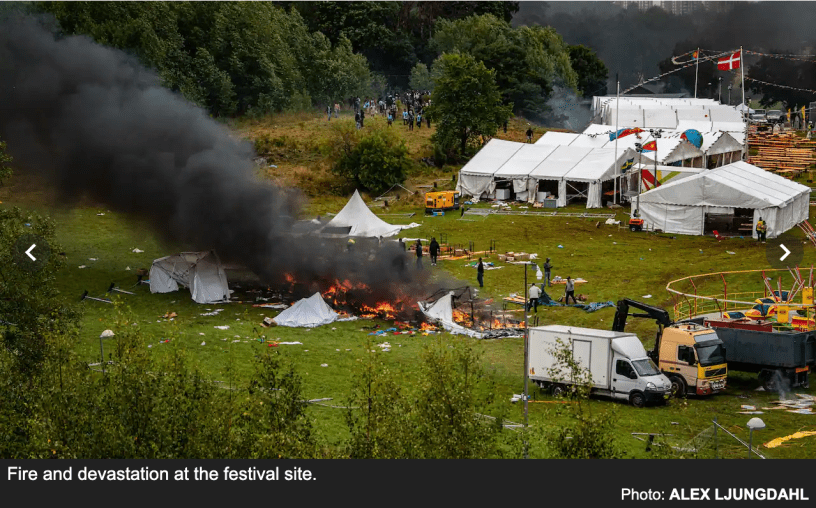
At the beginning of August, violence broke out on Järvafältet in Stockholm when around 1,000 demonstrators attacked a pro-regime Eritrean cultural festival. The problem with the loyalist festivals is well known, but now it has been shown that the red-green government still hasn’t learned from the events of the summer.
After the events, we have tried to get an answer as to why the city of Stockholm grants cultural support to the association Eggebygård, which collaborated with a festival that has well-known connections to the dictatorship in Eritrea, even though it goes completely against the democratic guidelines that exist for the city’s premises rental. At this week’s municipal council, we finally got an answer from the Social Democrats, but to our surprise, the answer was that they have investigated the issue but found no flaws in the democratic view of the organizers.
We are disappointed to say the least. The fact that in six months they do not manage to find any connections must mean that the investigation was substandard. Therefore, we publish here six clear documents that Karin Wanngård (S) and her colleagues in the red-green government should read and take to heart:
1. The poster for the cultural festival. The quickest way to form an opinion is to look at the poster for the festival. There it is stated that it is organized by the “National Holidays Coordinating Committee”, which is the name used all over the world to organize the festivals loyal to the regime. Even the slogan comes directly from the regime’s propaganda and is used internationally.
2 . Statements by supporters of the regime. You can also benefit from following Eritrean diplomats and PFDJ members in Sweden on social media. On their accounts, invitations to festivals in Sweden with more or less propagandistic content are regularly shared along with praise of the Eritrean regime. Ahead of the 2022 festival, images of large barrels of self-produced alcohol to be sold at the festival were also proudly shared.
3 . Report from FOI. For a broader picture of the Eritrean regime’s oppression of the diaspora in Sweden, we recommend the Total Defense Research Institute’s (FOI) report “Diaspora and influence from foreign power”. It specifically mentions how the regime exerts pressure on the diaspora by “appealing to patriotism through festivals”, not only in Sweden but in several places in the world. They also state that “Since 25 years ago, a festival has been held annually in northern Stockholm that collects money for the regime in Eritrea. According to media reports, the 2014 festival brought in at least two million kroner”.
4 . Statement from an expert on Eritrea. We also suggest reading the DN interview with Kjetil Tronvoll in connection with the festival. He is a professor of peace and conflict studies at Oslo Nye Høyskole and an expert on Eritrea. He says there that “The festival is a way for the regime to exercise control, create loyalty and collect money from the diaspora” and that “Often it is official representatives from Asmara who speak. It is a display of propaganda with the militarized, nationalist ideology of the regime.”
5 . Press release from the regime. If you want to know how the Eritrean regime views the festival, you should read the press release from Eritrea’s Ministry of Information. There they not only tell which governors participated, but also highlight how important Eritrean festivals are for fostering noble social values and national identity in young people and explain that the festival contains “seminars that objectively describe the situation in the country”. One really wonders why the Eritrean regime would issue a press release about the festival if it was completely independent?
6. The City of Stockholm’s own investigation. Last but not least, we would like to recommend the investigation that the city’s cultural administration did in 2009, which led to the festival losing its municipal grants. There, the organizers say that they have a close relationship with the embassy and that one purpose of the festival is to collect money for the regime.
Now we hope that both the Social Democrats in the city hall and the Järva People’s Park take part in all the evidence that exists that the Eritrean so-called cultural festival celebrates the world’s worst dictatorship and excuses its violations of human rights. The obvious conclusion for all democracy lovers should be that the city cannot rent out its premises to the festival.
Writers : Jan Jönsson (L), city councilor in the city of Stockholm and Åsa Nilsson Söderström (L), member of the Stockholm municipal council .
Source: FOI
Abstract
This report describes an era where large-scale migration combined with an increased rivalry between democratic and authoritarian states have made ”human geopolitics” take centre stage on the international arena. This is happening mainly by states actively formulating policies in relation to their diasporas, not least authoritarian states using these policies to try to influence members of the diaspora
(sometimes referred to as “extraterritorial authoritarian rule”).
In a context where a large and growing share of the populations of many countries, such as Sweden, have their roots in states of this kind, the overarching aim of the report is to add to the knowledge base necessary to best handle these influence activities. This, in order to protect the security of both the state, and of individuals residing within it.
The report is based on previous research and other sources describing different forms of influence activities from five authoritarian states: Iran, China, Eritrea, Syria, and Russia. The current state of knowledge for each of these countries is detailed, in order to describe the aims and methods for their influence activities.
These aims and methods are then analysed, and key areas for future research are identified. The conclusion is that influence activities of this kind constitute a large and growing problem, where aims and methods vary in a way that makes comparisons possible, in order to reach a deeper understanding of the phenomenon under study.
Among other findings, it is clear that while some states focus only on influencing the diaspora for internal, regime stabilising purposes, other states also aim to achieve strategic, foreign policy goals. Taken together, the development detailed in the report is a serious challenge for liberal democracies like Sweden, not least in finding a balance between protecting the security interests of the state,
while at the same time protecting the democratic rights of the individual.
 Martin Plaut