
It is hard to ignore the strains across the Horn of Africa.
Somalia
As Rashid Abdi pointed out the Somali region of Puntland has just decided to end formal links with Mogadishu, by:
- Withdrawing recognition of the Federal Government of Somalia
- Acting autonomously and independently of Somalia
- Establishing contacts with the world in pursuit of its interests.
This is just the latest evidence of disintegration of the nation-states across the entire region.
Somaliland
Ethiopian Prime Minister Abiy threw a spanner in the works when he declared that he wished to establish a naval base in Somaliland, hinting that in return Ethiopia would recognise Somaliland as an independent nation. This is still far from resolved, although efforts are being made to find a peaceful way forward.
Ethiopia
Yet Ethiopia itself is hardly stable. The map below indicates how much of the country is not at peace.
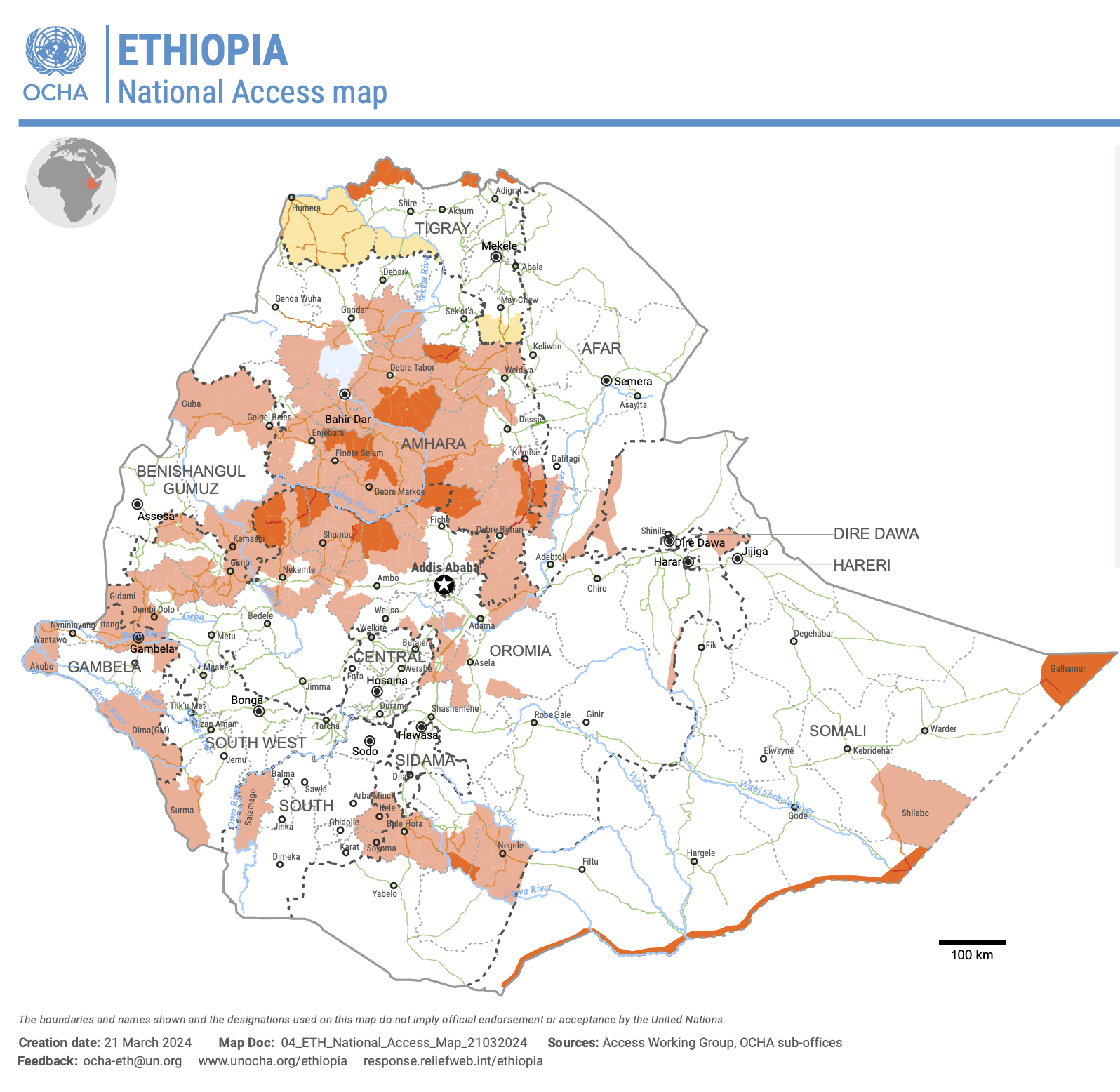
Fighting in the Amhara and Oromo regions are just part of the picture. Displacement is going on across much of the country. Conflict has been exacerbated by climate change, forcing people to flee their homes.
The Empire that Menelik II created could be on the way out.
Sudan
The Sudanese civil war has been described by the UN as the “worst hunger crisis in the world”.
Edem Wosornu, the director of humanitarian operations, told the U.N. Security Council that already one-third of Sudan’s population – 18 million people – face acute food insecurity, and catastrophic hunger levels could be reached in some areas of the western Darfur region by the time “the lean season” arrives in May.
“A recent assessment revealed that one child is dying every two hours in Zamzam camp in El Fasher, North Darfur,” she said. “Our humanitarian partners estimate that in the coming weeks and months, somewhere in the region of around 222,000 children could die from malnutrition.”
South Sudan
The South Sudanese have been in crisis almost from the moment of the nation’s birth on 9 July 2011.
Tensions between the major ethnic groups – the Dinka and Nuer were never far below the surface. The instability erupted in December 2013 on the streets of the capital, Juba, after President Salva Kiir accused his vice president Riek Machar of an attempted coup.
Fighting between two factions of government forces loyal to either of the leaders raged on displacing almost four million South Sudanese in a brutal civil war affecting the entire country.
Kenya is attempting to mediate, but the situation is made worse by the influx of refugees from Sudan’s civil war.
Eritrea and Djibouti
Eritrea remains what it has been since independence in 1993 – among the world’s most dictatorial states, hemorrhaging people determined to escape poverty and unending conscription, or ‘national service.’
Djibouti is stable, but hardly an advertisement for democracy. As Freedom House puts it:
“Djibouti is a republic ruled by a powerful president, Ismail Omar Guelleh, who has been in office since 1999 and is not subject to term limits. While Djibouti technically has a multiparty political system, the ruling Union for a Presidential Majority (UMP) uses authoritarian means to maintain its dominant position.”
Towards a re-alignment?
First a word of caution: it is easy to assume that because nations are in trouble that they will collapse.
At the start of the war in Tigray in November 2020 a group of highly respected American politicians warned that there was a danger of “the fragmentation of Ethiopia” which “would be the largest state collapse in modern history.”
As they observed that:
Ethiopia is five times the size of pre-war Syria by population, and its breakdown would lead to mass interethnic and interreligious conflict; a dangerous vulnerability to exploitation by extremists; an acceleration of illicit trafficking, including of arms; and a humanitarian and security crisis at the crossroads of Africa and the Middle East on a scale that would overshadow any existing conflict in the region, including Yemen.
https://www.usip.org/press/2020/11/statement-ethiopia-senior-study-group-peace-and-security-red-sea-arena
This did not come about.
Nation states have been remarkably durable, although this is not always true. Eritrea broke away from Ethiopia and South Sudan broke away from Sudan. So it has happened in the Horn in recent times. It could take place again.
Are we about to see a similar disintegration once more?
After all, Somalia is – even today – a state only in name, with the much power held by regional and rebel forces.
Sudan appears to be separating into two (or more) states with the Sudanese Armed Forces holding the centre and east and the Rapid Support Forces holding the West, with other groups taking what they can.
The scale of the human suffering is immense and deplorable. But in the long-run there may be few alternatives to a divided Sudan. The scale of the human suffering is currently immense and deplorable.
In the long-run there may be few alternatives to new nation states.
International examples
There are many examples of state rupture across the world. Yugoslavia fell apart in after the death of Death of Yugoslav President Josip Broz Tito in May 1980.
Today it is five separate states. And although Slovenia, Croatia, Bosnia and Herzegovina and the Republic of Macedonia interpreted the breakup as a definite replacement of the earlier Yugoslav socialist federation with new, sovereign states, the newly established FR Yugoslavia (Serbia and Montenegro) regards itself as the successor state. This is still unfinished business.
Britain has gone through many unions and devolutions.
In 1603 the kingdoms of England, Scotland and Ireland were united in a personal union when James VI, King of Scots, inherited the crowns of England and Ireland. This formally became the Kingdom of Great Britain on 1 May 1709.
Since then, there has been a gradual disintegration.
In May 1922 Ireland became a separate nation, while Northern Ireland remained in the United Kingdom.
In September 1997, referendums were held in Scotland and Wales, and a majority of voters chose to establish a Scottish Parliament and a National Assembly for Wales. In Northern Ireland, devolution was a key part of the Belfast (Good Friday) Agreement supported by voters in a referendum in May 1998.
There are powerful mayors in London, Manchester and the Birmingham area, but there is still pressure for more power to be devolved away from London. One day Scotland and Wales might vote to leave the Union.
Building on experience
There are lessons we can learn from past experience.
- The current system of governing people is only one of many. These can change, and if the pain of living together under the present system is too great, then surely this should happen.
- New nation states are no guarantee of human happiness. We need look no further than South Sudan or Eritrea.
- In the end there is only one solution: put the issue to the people. Let them choose in a credible referendum. Easy to say: difficult to achieve. Usually much pain and bloodshed takes place before any voting is held.
- We can unite and work together, even if we remain different nations. The European Union, for all its weaknesses, is an excellent example. The Germans are no less German, nor the French less French just because they fly the European flag, as well as their own. But it did take two World Wars to get to this point!
- One can only hope that the Horn of Africa can find an easier passage to a new beginning.
 Martin Plaut