Source: VG
By Professor Kjetil Tronvoll
How should we really understand the contradictions among Norwegian-Eritreans?

Yesterday at 09:13
Several hundred people of Eritrean origin demonstrated in front of the Storting (Parliament) on Friday 26 April in protest against a parliamentary decision to fight the Eritrean regime’s control and oppression of themselves.
Paradoxically, they considered this a discrimination against their rights.
Other Eritreans, on the other hand, welcome the proposal and criticize that the regime they fled may continue to monitor and oppress them in Norway.
How can we explain this contradiction among Norwegian-Eritreans?
“Don’t talk about us, talk to us!” was the main slogan of the demonstrators, who say they represent Norwegian religious associations and religious communities with several thousand members all over Norway.
They express criticism that their voices were not heard in the Storting’s consideration of Venstre’s publishing house on measures against transnational oppression of Eritreans in Norway.
The Eritrean associations carried posters and banners that claim this is an expression of “ethnic racism” and demanded “Stop making laws and rules against only Norwegian Eritreans!”
At the same time, other Eritreans have actively supported the proposal because they feel oppressed in Norway by the regime they fled from.
Over 600 consultation responses were sent to the Storting, which ended up deciding that the government should “implement measures to prevent transnational oppression of persons in Norway.”
Read also: Eritrean demonstrations at the Storting: – Prepared for what is to come
What is it that is so controversial about fighting transnational oppression, or refugee espionage that the police (PST) have described as a threat to Norwegian democratic values?
From the Eritrean environment’s point of view, this is about so much more than what happens in Norway – it interferes with Eritrean history and what Eritrean nationalism is founded on.
It is indisputably true that the Eritrean regime led by “president for life” Isaias Afwerki is one of the world’s most brutal and repressive.
The country is a one-party state, where the liberation movement (EPLF/PDFJ) has ruled the country autocratically since they militarily liberated themselves from Ethiopia in 1991 (independence was granted in 1993).
No political opposition activity is allowed, no free press or independent civil society organizations exist, and thousands of political prisoners rot in prison without law or judgement.
A UN-appointed commission of inquiry concluded in 2016 that there is reason to believe that persistent and extensive crimes against humanity have been committed in the country since liberation.
Since 1993, the Eritrean regime has also been in conflict with all its neighboring countries.
The brutal human rights situation and the “perpetual” war mobilization have meant that Eritrea is one of the countries in Africa that has produced the most refugees to Europe in both relative and absolute numbers over the past 15 years.
It is also well documented that the Eritrean regime exercises control, surveillance and political pressure on its diaspora, also in Norway .
Against this background – how is it then that many Norwegian refugees apparently continue to support this regime, both politically and materially with money transfers?
The Eritrean diaspora in Norway is diverse. Simplified, we can divide it into two main groupings, which to a certain extent highlight support for, or criticism of, the regime.
The first generation of Eritrean refugees came to Europe during the war of liberation (1961-91). They escaped Ethiopia’s brutal warfare and see the Liberation Front and its leader President Isaias Afwerki as a hero.
This generation of refugees has lived in Norway for over 35 years, and you can see that their children (and grandchildren) largely “inherit” their parents’ understanding of and support for the regime.

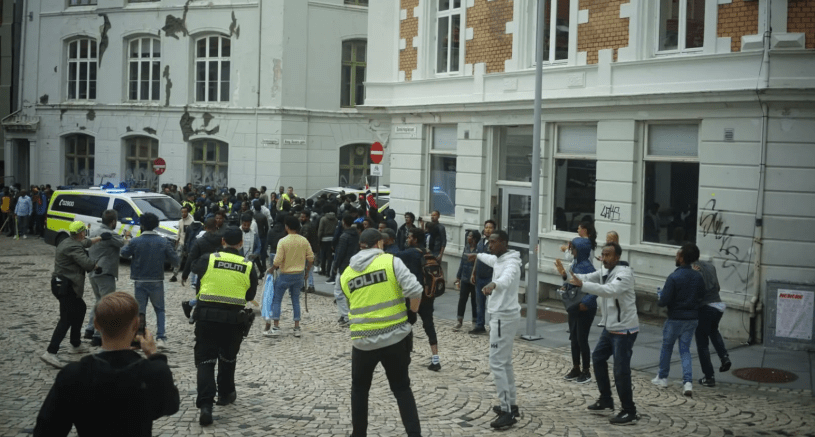
The video from the riots in the center of Bergen in September 2023.
Shows the riots in central BergenViser opptøyene i Bergen sentrum
NewsNyheter · · Sep 2 20232. sep. 20231:151:15
Second- and third-generation Eritreans raised in Europe are socialized into a loyalty to the regime, which the “cultural festivals” and the officially organized “get to know your country” tours help to create.
The second group of Eritrean refugees has flowed to Europe after 2001, when Isaias Afwerki cracked down on dissent in his own party, threw thousands into prison, shut down civil society, and ordered perpetual national service for the country’s men and women.
Many of them see Isaias Afwerki as a dictator.
But this is a schematic and simplified picture, which of course does not explain why many of the newly arrived refugees apparently continue to support the regime they fled from.
Research into this phenomenon points to a deeper understanding of identity and nationalism ideology as the cause.
Eritrea is the most isolated country on the African continent, but very little outside influence.
The opportunity for the population to travel and acquire alternative information and knowledge than that produced by the regime’s propaganda machinery is severely limited. Society is totally militarized.
In this way, over time, the regime has managed to create a holistic understanding of identity that binds the people, the nation and the political leadership together in one unit. One element cannot exist without the other two.
This means that by criticizing President Isaias Afwerki and his dictatorial rule, this is perceived as treason that endangers the entire nation.
Such an understanding of identity is reflected in the regime supporters’ slogan “he is us, we are him” ( nsu nehna, nehna NSU ).
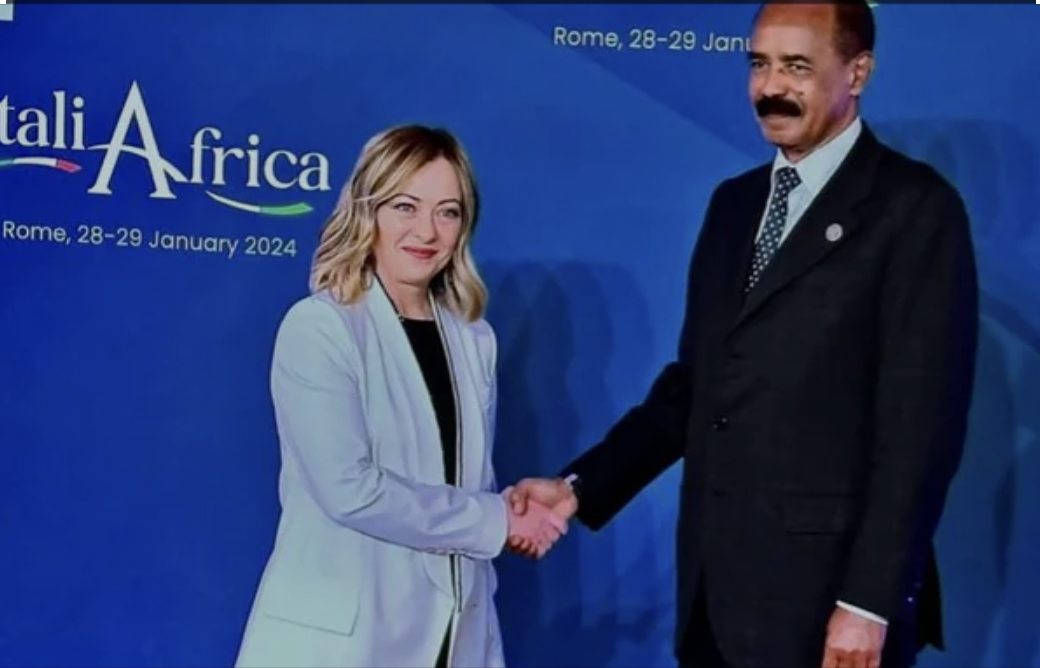
It is in such a perspective that we must understand the Norwegian critics’ criticism of the Storting as a “house of darkness” and the measures against transnational oppression as “racism”.
They do not see it as a liberating measure, but rather as an undermining of their own and the country’s identity and independence.
The demonstration in Oslo is seen as a victory by the regime’s supporters in Norway – and by the regime itself.
Information Minister Yemane Gebremeskel sends out a message of support on X (formerly Twitter) with a video of the assembly in Eidsvolls plass, where he praises “the diaspora’s unwavering devotion to their homeland”.
At the same time, the pro-regime Norway-Eritrea associations are active in accusing and delegitimizing anyone who raises questions about why they support the regime they fled from.
The emergence of a more organized opposition, which is also willing to use violence to confront regime supporters, has caused unrest in several European and American cities in the last two years – and also here in Norway.
The “blue revolution” as it is called, aims not only to stop the regime’s control over the diaspora, but to create change in the homeland.
Eritrea was liberated in 1991 from Ethiopia’s military dictatorship; now it needs to free itself from its own dictator.
 Martin Plaut