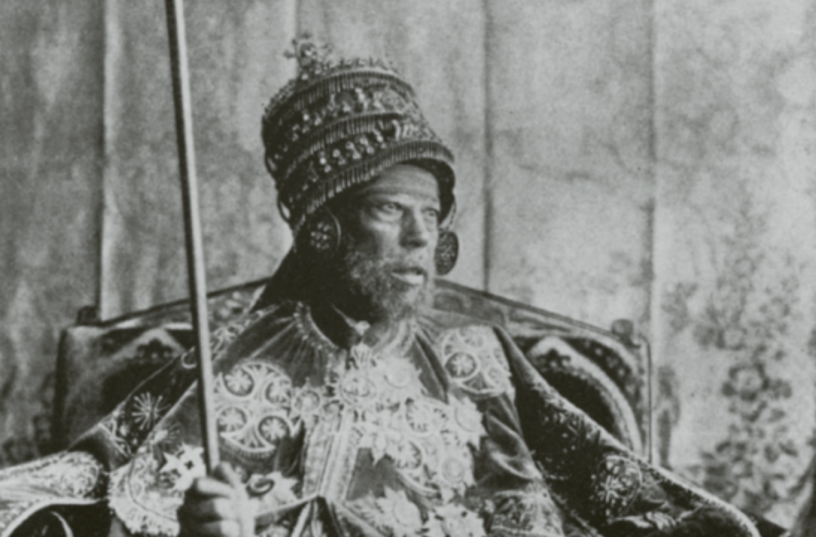
By Fesseha Giyorgis1,†, translated by Jan Nyssen2,*
1 University of Naples, Italy
2 Department of Geography, Ghent University, Belgium
* Corresponding author: jan.nyssen@ugent.be
Introductory note
In Chapter 35 of his “History of Ethiopia”, which was published in Tigrinya around 1895 [1], Fesseha Giyorgis Abyezgi wrote of warfare, massacres and starvation. The Shewan army, which pertained to central Ethiopia and was led by Emperor Menilek, swept over the northern Tigray frontiers. Fesseha Giyorgis is credited as the founder of secular, modern literature in Tigrinya language [2]. The book incorporates both the country’s ancient history including its common myths, and coeval observations by the author, including the chapter that is translated here. This translation to English was done after the original work in Tigrinya and Yaqob Beyene’s Italian translation [3]. Fesseha Giyorgis, who had left behind an Ethiopia struck by the Great Famine (1889-1892) [4], also published a brief account of his travel from Tigray to Italy in Tigrinya in 1895 [5].
Before travelling to Italy, Fesseha acted as a translator for the Ethiopian aristocracy, as he mastered Tigrinya, Amharic and French. As such, he followed Menilek on some of his expeditions and reported back in his book [3]. What Fesseha describes in this chapter is at the crux of two major catastrophes that partly superpose: (1) the Italo-Ethiopian war of 1887 to 1889 and concommittant civil war in Ethiopia, for which the Italians had provided Menilek with 5000 Remington rifles [6]; and (2) the Great Ethiopian Famine of 1888 to 1892 that followed drought years and a major rinderpest outbreak, possibly induced by cattle imported from India [4, 7].
Having worked on this translation, I feel I now have a better understanding of why the average Tigrayan dislikes “Menilek” so much, and how shocked they were to learn in 2015, that people in the Amhara region began promoting the Ethiopian flag without an insignia or “lumuts bandera”; at the time, some of my Tigrayan friends said, quite negatively, “that is Menilek’s flag”! Likewise, reading this chapter will ring many bells to anyone who have been following the Tigray tragedy (sensu Manuel Ramos [8]) since 2020.
To allow easy reading, I used a simple transliteration without diacritic markings for several words borrowed from Tigrinya, while staying phonetically as close to the Tigrinya pronunciation as possible. Lastly, I am grateful to Emnet Negash for his thorough literature research in the context of his doctoral thesis, which led me to this book, which I could eventually borrow from the Centre de Recherches africaines in Paris. Emnet also critically read this translation.
Jan Nyssen
35. The Shewan military expedition against Tigray
After spending a few days in Maq’allè, since it is a tradition for a new emperor[1] to go to Aksum to pray and to perform some rites handed down by Ebna Hakim, we set out for the said city with Emperor Menilek. There are two ways that lead there. The track through Tembien is narrow and full of stones. Ra’isi (Duke)Mengesha and his men were also in that area; every night one could see their bonfires from afar. The road through Hawzen, on the other hand, is spacious and comfortable.
(p. 134)[2]
Therefore, the latter route was chosen. On the day we left, the Shewa soldiers sacked Maq’allè and stripped it completely. Villages in the vicinity of the road were also plundered and burned. There were many deaths on both sides. They also castrated, according to the custom of their country, any man, whether fat or thin, old or young, whom they happened to meet. Commander Sebhat, seeing all this, was horrified; on the second day of our journey, he said to Menilek: “O negus, since my men are suffering damage because your Lordship’s men do not distinguish them from the other people of Tigray, allow me to encamp a little further forward.” Since the negus is good[3], he replied: “All right, do it.” Then Commander Sebhat camped a little further forward. When night came, they lit many fires, and, gathering his belongings and loading them on beasts of burden in haste, he departed for good, returning with his men to Agame. By late morning of the following day, news of Sebhat’s desertion spread. There were lots of discussions about this in the camp of the negus. Some said, “Come on! He’s a nice person who brought dagiyat[4] Mekonnen to us and accompanied him to Maq’allè. If he had held him captive or killed him, what could we have done?” However, Sebhat’s rebellion caused concern. The Shewa soldiers destroyed Inderta, making it as if it had never existed. All the people they met, if they were male, were massacred and castrated by Menilek’s army.
(p. 135)
The people of Inderta, hiding in every forest and behind every great rock, also killed many soldiers. During the journey, when there were large rocks or a forest on the side of the road, they would not stop shooting at the Shewa soldiers. As for the latter, assuming that Tigray is the country of the Maria Theresia thaler[5], they destroyed all the houses by demolishing them from their foundations in search of hidden money. When they lacked time to do this, they would move on after setting the houses on fire. They even plundered Inda Abreha Atsbeha, which is a sanctuary respected by all Ethiopians. Since ‘Ayba[6] is full of caves and stones, the natives killed many soldiers using such hiding places. As for the Amhara soldiers, as their number was as incalculable as the hairs on their heads, the death toll could not be determined more precisely.
We stayed for a few days in ‘Ayba. With one thaler you could buy a beautiful ox, a cow that had just given birth, chosen from among the survivors of cattle that had been raided and then destroyed by rinderpest. Cereals were also sold cheaply. Abandoning the journey to Aksum, we began to turn back by forced marches. We continued to Atsbi, leaving Inderta on the right. On the second day of our trip, we boarded Inda Sellase of the Dogu’a[7]. Inda Sellase is a safe sanctuary; the city is rich; it is a country of merchants. This town was also plundered. The Amhara soldiers were amazed at the amount of grain and other objects found in it.
(p. 136)
Dogu’a[8] is a very rich country. In the camp of the negus, the plundered salt slabs were common like stones, and grain common like soil. The pack animals ate as much of it as they liked. As for the people, a lot died on both sides. Because the Galla[9] soldiers are cruel, they bragged about war after emasculating any male they came across. Then the negus issued the following proclamation: “He shall be punished who boasts of war by saying, ‘I have killed!’ without apprehending that man with a weapon.” This ban, however, was proclaimed earlier on, while we were camped in ‘Ayba.
All the intelligent people were grieved by the tragedy of Tigray. The Amhara of Bagemedr were grieved greatly. In fact, a monk or a hermit prophet proclaimed a banishment by going around our camp and saying all sorts of things in a speech that never ended. The content of what he proclaimed was as follows: “Woe to you, for you are killing Christians as if that were a trivial matter.” Then the soldiers, terrified by his words, began to supplicate all together, saying, “Lord, have mercy on us.” When the negus heard this, he sent horsemen into every camp, and silenced them, saying, “O Shewa, who listen to sermons, be silent.” Then the news of Duke Mengesha’s surrender made its way. Because many predictions had been spreading, there was much joy in the camp.
(p. 137)
From here we went down to Tsera’ where there are many safe mountains. That day, though not drawn up in battle order, was no less than a battle. Among the Amhara there were many deaths. As for the Tigrayans, there is no doubt that they were exterminated even though most were old and sick.
There was a mountain that had a cave in the centre. Walls had been built at the entrance to keep it hidden. On the outer side of the walls, grain and other objects were piled up for the purpose of attracting the enemy. Inside the walls, however, there were rifles. They would let the Amhara get close to the objects, then all together they would drop a hail of bullets at very close range. In this way the Tigrayans killed many of Menilek’s soldiers in different places. Later the negus arrived with a Swiss gunner named Ilg who brought down the walls with cannons. As a result, the men surrendered and threw down their rifles. Then the negus, because he was good, stopped the fight, saying: “Stop it; don’t shoot at them.” There were only seven of them. It seems that the negus was very upset, having found that he had gone out of his way to do battle against seven men only.
(p. 138)
Above the destroyed cave, on the summit, inaccessible to both soldiers and cannons, there was a very large number of people and cattle. And being unattainable, it was abandoned. In the centre of this locality was a vast plain surrounded by high mountains on whose terraces men and cattle had taken refuge. A man, standing on one of the mountains, called out to the Shewa soldiers, saying, “You of the Shewa, you know that we know each other! Don’t think we don’t know each other! Even now we will not leave each other. Even if Emperor Yohannes is dead, do not think that we young people are dead.” The negus, having heard this, was irritated, and went to the mountain together with this European artilleryman, the Swiss Ilg. Some of the young Tigrayans saw them coming from far and came to the edge of the mountain; they shot at each other for some time, and when they could not hit each other, they returned to their mountain. Even Ilg, who was firing his cannon, couldn’t shoot anyone down. In another locality, Menilek’s soldiers also spent the day shooting at the Tigrayans who were hiding in a cave. On the second day, the leader of the latter surrendered and made peace. He had about fifteen people with him. However, the situation was difficult there. A disease also spread.
(p. 139)
After spending a few days there, we went up to Haramat. Even in the latter region there are mountains that cannot be breached with cannons. Inderta, being made up only of plains, was easy prey for the Amhara soldiers. As for Atsbi, Tsera’ and Haramat, on the other hand, as their mountains and heights are many, they presented great difficulties. Let me tell what happened in one of the Haramat mountains, where a Tigrayan officer took position. He had with him many good quality rifles. There’s water on the foot of that mountain. Its access is only on one side. They had fortified it well in time, making it unwieldy. At the entrance to it they kept hoarded objects and grain. They had also prepared large stone boulders to be rolled down. When the Amhara and Galla soldiers came running to those objects, those grain bags that they thought hidden on the mountain, the Tigrayans would roll down the boulders on them. When the soldiers saw the rocks rolling down, they fled back. So, the Tigrayans pushed the stone boulders, which they had prepared beforehand, to make them roll down on the Shewa army; with the rockfall, the soldiers disappeared into a ravine together. Those who witnessed this scene never returned. Those who heard of it, on the other hand, went there to try and conquer the mountain. It continued in this way for three whole days. In the end, the negus forbade his troops to go there.
(p. 140)
Haramat was scarce in grain, so the threat of starvation loomed over the camp. Local people were exterminated because the soldiers got into the habit of looting. Pain and sadness began to spread. As for the women of the land, they uttered all the words of curse imaginable against the Amhara soldiers. There were also those soldiers who regretted going to Tigray. For sure, there were many who had lost hope of returning to their homeland and finding back their family. Since the soldiers ate all kinds of roasted or boiled grains, gastroenteritis broke out in the camp. When, by chance, one went out of the tent at night, one would always walk into human excrement. The news spread that Menilek’s army would go to Agame and then to Aksum, destroying the villages on the way as well. To the Amhara army, going to Agame seemed a very difficult task. They cursed Tigray as if this last region had called them and prayed them to come. Similarly, for the Amhara it was annoying even to hear people speaking Tigrinya. While we were in this condition, we learned with certainty of the submission of DukeMengesha, and joy and satisfaction returned to the camp.
References
1. Fesseha Giyorgis, ታሪኽ ኢትዮጵያ [Tarik Itiyop’iya; History of Ethiopia]. approx. 1895. 167
2. Gates, H.L., E. Akyeampong, and S.J. Niven, Dictionary of African Biography. 2012: New York: Oxford University Press.
3. Yaqob Beyene, Fesseha Giyorgis. Storia d’Etiopia. 1987, Napoli: Istituto Orientale Italiano.
4. Pankhurst, R., The Great Ethiopian Famine of 1888-1892: A New Assessment. Journal of the History of Medicine and Allied Sciences, 1966. 21(2): p. 95–124.
5. Hailu Habtu, The Voyage of Däbtära Fesseha Giyorgis to Italy at the end of the 19th Century. Annales d’Éthiopie, 2000. 16(1): p. 361-368.
6. Caulk, R.A., “Between the Jaws of Hyenas”: A Diplomatic History of Ethiopia, 1876–1896. 2002, Wiesbaden: Harrassowitz Verlag.
7. Senait Fesseha. The rinderpest factor in the great famine of Ethiopia. http://www.faculty.umb.edu/peter_taylor/640-02SF.doc. 2002.
8. Ramos, M., Tigray Tragedy, a Graphic Essay. Stichproben – Vienna Journal of African Studies, 2021. 41.
[1] In chapter 33 is mentioned that the described events happened in 1882 (Ethiopian calendar); we place it in 1889 in the international calendar, as Menilek was sacred emperor in that year. (All notes by the translator.)
[2] Page numbers as used in Fesseha Giyorgis’ original book in Tigrinya are indicated throughout the translation.
[3] Fesseha Giyorgis’ work is sprinkled with appreciations, either good or bad, which we have included in the translation.
[4] Dagiyat was an administrative title in imperial Ethiopia.
[5] Fesseha Giyergis uses the Tigrinya word qershi, while Yaqob Beyene translated it into Italian as “tallero di Maria Teresa”. The Maria Theresia thalers were Austrian bullion silver coins of the mid-18th Century that continued to be used in Tigray throughout the 19th Century. As the value of this monetary unit has no common measure with the current, devaluated qershi (Ethiopian birr), we preferred the word thaler in the translation.
[6] ‘Ayba Kidan Mihret is a village some 6 km east of Hawzen, along the gorges of Suluh River. Not to be confused with the large ‘Ayba valley south of Imba Alaje.
[7] Atsbi town, named after its church Inda Sellase, and after Dogu’a (highland), as the town is located on a high plateau.
[8] Hence the plateau surrounding Atsbi, in scientific terms the “Atsbi Horst”.
[9] “Galla” is a pejorative term for Oromo, that was commonly used before the EPRDF government came to power in 1991. We reproduce it as it stands in this translation, obviously without endorsing the term.
 Martin Plaut