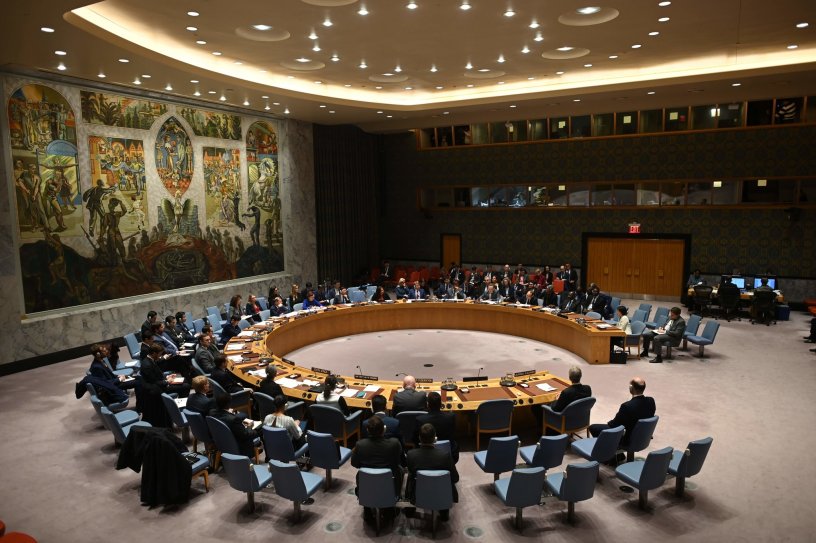
Comment: The historic African claim is for 2 permanent seats on the UN Security Council. But can anyone imagine the conflict that this would unleash if Africa was given this right?
Who would get the seats? Egypt, Ethiopia, Nigeria, Senegal, Kenya and South Africa have all laid claim to the right to have one of the 2 treasured seats. And if Africa was granted permanent seats, what about the Arab world? Or Latin America? The Security Council could burgeon until it becomes a mini General Assembly.
At present there are just five permanent members: China, France, Russian Federation, the United Kingdom, and the United States, and ten non-permanent members elected for two-year terms by the General Assembly (with end of term year):
Switzerland (2024)
Algeria (2025)
Ecuador (2024)
Guyana (2025)
Japan (2024)
Malta (2024)
Mozambique (2024)
Republic of Korea (2025)
Sierra Leone (2025)
Slovenia (2025)
Source: What’s in Blue
High-level Debate on “Addressing the historical injustice and enhancing Africa’s effective representation on the UN Security Council”
On Monday morning (12 August), the Security Council will convene for a high-level debate titled “Addressing the historical injustice and enhancing Africa’s effective representation on the UN Security Council” under the “Maintenance of international peace and security” agenda item. This is one of the signature events of Sierra Leone’s August Council presidency. Sierra Leonean President Julius Maada Bio is expected to chair the meeting. The anticipated briefers are UN Secretary-General António Guterres, President of the UN General Assembly Dennis Francis, and a representative of academia.
In addition to Council members, several member states are expected to participate in the meeting under rule 37 of the Council’s provisional rules of procedure on behalf of regional groups and interest groups in the General Assembly’s Intergovernmental Negotiations on the question of equitable representation on and increase in the membership of the Security Council and other matters related to the Council (IGN). These include:
- representatives of all countries of the African Union (AU) Committee of Ten Heads of State and Government on the Reform of the UN Security Council (C-10)—Algeria, the Republic of Congo, Equatorial Guinea, Kenya, Libya, Namibia, Senegal, Sierra Leone, Uganda, and Zambia—which advocates internationally for the Common African Position, calling for Africa to have two permanent seats with veto rights and five non-permanent seats on the Security Council;
- one representative each from the Organisation of Islamic Cooperation (OIC), the Benelux countries, the Nordic Group, the Caribbean Community (CARICOM), and the Arab Group at the UN; and
- one representative each from cross-regional interest groups on Security Council reform, including the Group of Four (G4), the L.69, and the Uniting for Consensus Group (UfC).
Kuwait, in its capacity as a co-chair of the IGN process with Austria, is also expected to take part in the meeting under rule 37.
Sierra Leone has circulated a concept note [see below] ahead of Monday’s meeting. It outlines several objectives for the debate, including to acknowledge and address the historical context of Africa’s underrepresentation in the Security Council, as well as its non-representation in the permanent category. It also seeks to bring attention to the Common African Position and to explore the potential effects of increased African representation on the Council on the organ’s legitimacy and effectiveness. The concept note encourages participants at Monday’s debate to identify potential challenges and propose solutions to the Security Council reform process towards a more equitable outcome.
The concept note also proposes a series of questions to help guide the discussion, including:
- How can the current structure of the Security Council be rectified so that the historical marginalisation of Africa is addressed?
- How has the underrepresentation of Africa in the Council hindered the continent’s ability to contribute effectively to global governance?
- What are the linkages between African underrepresentation on the Security Council and the ability of regional authorities to maintain regional peace and security?
In part, calls for Security Council reform demonstrate concerns that the Council is not effectively carrying out its mandate to maintain international peace and security, fuelled in recent years by its inability to gain traction in addressing crises in Gaza, Sudan, Ukraine and other situations on its agenda. In addition, there is a widespread perception that the Council’s composition is anachronistic, no longer reflecting the geo-political realities of international politics.
While reform negotiations (including on the structure of the Council and the use of the veto) take place at the IGN, Council members and the wider membership frequently emphasise the need for reform in meetings of the Security Council. For example, it is an often-discussed topic in the annual debates on the Council’s working methods. As well, India convened an open debate in December 2022 titled “New Orientation for Reformed Multilateralism”, in which several member states underscored the importance of Security Council reform.
More recently, in July, Algeria, Mozambique, and Sierra Leone—the current three African members of the Council—publicly championed the AU’s perspective on Council reform in a ministerial-level open debate on “Multilateral cooperation in the interest of a more just, democratic and sustainable world order”. During the meeting, Algeria and Sierra Leone referred to the “historical injustice” to Africa regarding Security Council membership, and Mozambique argued that Security Council reform process should consider the Common African Position, known as “The Ezulwini Consensus”, which is based on an AU Executive Council decision adopted in Addis Ababa in March 2005. [See relevant section below]
Echoing the common position, Sierra Leone, which currently chairs the C-10, called for increasing African representation in both permanent and elected categories, noting that much of the Council’s work focuses on the continent. In this regard, 78 of the Council’s 204 meetings in 2023 on country or region-specific situations (38.24 percent) were on African matters, more than any other region. In addition, of the 49 formal outcomes (45 resolutions and four presidential statements) that the Council adopted in 2023 focusing on country or regional issues, more than half (51.02 percent, or 22 resolutions and three presidential statements) dealt with Africa.
Widely diverging positions on Security Council reform are discussed at the IGN. This is reflected in the fact that member states have been unable to negotiate a unified text since the IGN process was launched in 2007. At Monday’s meeting, although some member states may refer favourably to Africa’s quest for one or more permanent seats on the Council, others may make more general statements in support of enhanced participation by Africa in the Council’s work.
Monday’s debate will provide participants an opportunity to highlight their views on Security Council reform in the lead-up to the Summit of the Future in September, during which an outcome document (the Pact for the Future) is expected to be adopted, in which world leaders will outline their vision for the future of multilateralism. The IGN is currently negotiating an input to the Pact. A recent iteration of this draft input calls for an enlarged Security Council comprising 21 to 27 seats, and maintains that enlargement should “redress the historical injustice against Africa as a priority and, while treating Africa as a special case, serve to improve the representation of the underrepresented and unrepresented regions and groups”.
United Nations S/2024/574
Security Council Distr.: General
31 July 2024
Original: English
24-13955 (E) 060824
2413955
Identical letters dated 30 July 2024 from the Permanent Representative of Sierra Leone to the United Nations addressed to the Secretary-General and the President of the Security Council
I am pleased to transmit for your attention the concept note for the Security Council high-level debate on “Maintenance of international peace and security: addressing the historical injustice and enhancing Africa’s effective representation on the Security Council”, to be convened on 12 August 2024 by Sierra Leone in its capacity as President of the Security Council for August 2024.
I would be grateful if the present letter and its annex could be circulated as a
document of the Security Council.
(Signed) Michael Imran Kanu
Ambassador
Permanent Representative
S/2024/574
2/4 24-13955
Annex to the identical letters dated 30 July 2024 from the Permanent Representative of Sierra Leone to the United Nations addressed to the Secretary-General and the President of the Security Council Concept note for the Security Council high-level debate on “Maintenance of international peace and security: addressing the historical injustice and enhancing Africa’s effective representation on the Security Council”, to be held on 12 August 2024
Introduction
- The current structure of the Security Council reflects the geopolitical realities of the immediate post-Second World War era. Significant changes in the global landscape however have necessitated a review of the Council’s composition to ensure its effectiveness and legitimacy in addressing contemporary global security challenges. The present concept note proposes a debate within the Security Council specifically focused on enhancing Africa’s representation, a longstanding concern with historical context.
- The Security Council as the primary body responsible for the maintenance of international peace and security is mandated by the Charter of the United Nations to take decisions on matters of international peace and security binding on States Members of the United Nations. It is in this regard that the Charter, in its article 24 (1), outlines the collective security scheme in which the States Members of the United Nations confer upon the Security Council primary responsibility for the maintenance of international peace and security, and this is to ensure prompt and effective action by the United Nations.
- Against this background, it is important to note that the continent of Africa, represented by 54 of the 193 States Members of the United Nations, accounts for 1.3 billion of the world’s population, hosts the majority of peacekeeping operations and has four of the top 10 troop-contributing countries to United Nations peacekeeping operations, 1 does not have a permanent seat on the Security Council and is grossly underrepresented in the non-permanent category. This clearly goes
against article 2 (1) of the Charter, the principle of the sovereign equality of all Member States. This historical injustice done to the continent, therefore, must be reversed and Africa must be treated as a special case. Impact of lack of representation on the maintenance of regional peace and security - Increasingly required to do more in response to new and emerging threats and toward the enforcement of regional peace and security in the region, the absence of correlating powers and lack of representation on the body with the primary responsibility on matters of peace and security has hampered Africa’s ability to effectively influence Security Council deliberations and to deliver on its mandate of maintaining peace and security on the continent. This has largely made the concept
of African solutions for African challenges, with African leadership mainly rhetorical. The effect is that decades after the end of colonization and the dismantling of apartheid, the fate of the continent continues to remain in the hands of other nations.
1 Egypt, Ethiopia, Ghana and Rwanda.
S/2024/574
24-13955 3/4
with asymmetrical decision-making powers, which often determine the direction of
the affairs of the continent.
- The 2005 World Summit Outcome Document adopted by the General Assembly in its resolution 60/1 (of 24th October 2005) reaffirmed the commitment of Member States “to early reform of the Security Council as an essential element of the overall effort to reform the United Nations in order to make it more broadly representative, efficient and transparent and enhance its effectiveness and the legitimacy and implementation of its decisions”. On 15 September 2008, the General Assembly
adopted decision 62/557 on the “Question of equitable representation on and increase in the membership of the Security Council and related matters”, with calls to commence intergovernmental negotiations on Security Council reform in informal plenary of the General Assembly during the sixty third session of the General Assembly, but no later than 28 February 2009, based on proposals by Member States, in good faith, with mutual respect and in an open, inclusive and transparent manner, on the question of equitable representation on and increase in the membership of the Security Council and other matters related to the Council, seeking a solution that can garner the widest possible political acceptance by Member States. - Since the seventy-third session of the General Assembly, during the intergovernmental negotiations on the question of equitable representation on and increase in the membership of the Security Council and other matters related to the Council, Member States, as reflected by the co-Chairs, continue to “acknowledge the legitimate aspirations of African countries to play their rightful role on the global stage including through an increased presence in the Security Council as a priority”.
In addition, in a paper presented by the co-Chairs, it was noted that the reform of the Security Council should reflect the realities of the contemporary world, especially the increased representation of developing countries, small and medium sized States. - Common African Position on Security Council reform
- The core demands of the Common African Position on Security Council reform are enunciated in the Ezulwini Consensus and Sirte Declaration, and the continent views the common position as the only viable option that reflects Africa’s legitimate right and aspiration to rectify, inter alia, the historical injustice endured by the continent. The Common African Position demands two permanent seats on the Security Council for Africa, with all the privileges and prerogatives of permanent membership including the right to veto if retained, and five non-permanent seats.
Under the Common African Position, Africa reserves the right to select the candidates
that would be considered for election by the General Assembly. The Common African
Position has gained broad support from the Member States participating in the
intergovernmental negotiations, and at the highest political level, including by
permanent members of the Council.
Objectives of debate - The objectives of the debate include:
(a) To acknowledge and address the historical context of Africa’s non-representation in the permanent category and gross underrepresentation in the Security Council. In this regard the discussions are intended to focus on equitable geographical representation and reversing the historical injustice done to Africa as pressing and key for restoring the Council’s legitimacy, credibility, and effectiveness and for reigniting the Council’s ability to deliver effectively on its mandate for preserving international peace and security;
S/2024/574 4/4 24-13955
(b) To bring attention to the Common African Position while mobilizing interest among member States to further consolidate convergences, outlining the path to treating Africa as a special case and priority in the reform process;
(c) To explore the potential impact of increased African representation on the effectiveness and legitimacy of the Security Council in addressing global security issues, particularly those concerning Africa;
(d) To identify potential challenges and propose solutions for navigating the Security Council reform process towards a more equitable outcome;
(e) To serve as a call to action to African nations and supporters of the Common African Position.
Guiding questions - The questions to guide the high-level debate include:
(a) The current structure of the Security Council reflects the historical marginalization of Africa. How can this be rectified?
(b) The lack of permanent African representation undermines the legitimacy of the Security Council on issues concerning Africa. How can this be addressed?
(c) How have the historical injustices to Africa hindered the continent’s ability to contribute effectively on the global governance stage?
(d) What are the linkages between lack of representation in the Security Council and the ability of regional authorities to maintain regional peace and security?
(e) What are the immediate steps that can be taken by member States to provide support for the common African position? How can Africa be treated as a special case and priority in the reform process?
Debate format - The format of the meeting will be a high-level debate with the participation, under rule 37 of the Security Council’s provisional rules of procedure, of States Members of the United Nations who are members of the African Union Committee of 10 Heads of State and Government on the reform of the Security Council, and one representative from each of the interest groups negotiating in the intergovernmental negotiations and each of the regional groups.
- There will be three briefers: the Secretary-General of the United Nations; the President of the General Assembly; and a civil society representative.
The Security Council On the Security Council, the African Union: Recalling that, in 1945, when the UN was being formed, most of Africa was not represented and that in 1963, when the first reform took place, Africa was represented but was not in a particularly strong position; Convinced that Africa is now in a position to influence the proposed UN reforms by maintaining her unity of purpose; Conscious of the fact that the Harare Declaration has made significant impact on the world community and has thus been fairly reflected in the proposed UN Security Council Reforms, adopted the following position:
1. Africa’s goal is to be fully represented in all the decision- making organs of the UN, particularly in the Security Council, which is the principal decision-making organ of the UN in matters relating to international peace and security.
2. Full representation of Africa in the Security Council means: i. not less than two permanent seats with all the prerogatives and privileges of permanent membership including the right of veto; ii. five non-permanent seats.
3. In that regard, even though Africa is opposed in principle to the veto, it is of the view that so long as it exists, and as a matter of common Ext/EX.CL/2 (VII) Page 10 justice, it should be made available to all permanent members of the Security Council.
4. The African Union should be responsible for the selection of Africa’s representatives in the Security Council.
5. The question of the criteria for the selection of African members of the Security Council should be a matter for the AU to determine, taking into consideration the representative nature and capacity of those chosen.
 Martin Plaut