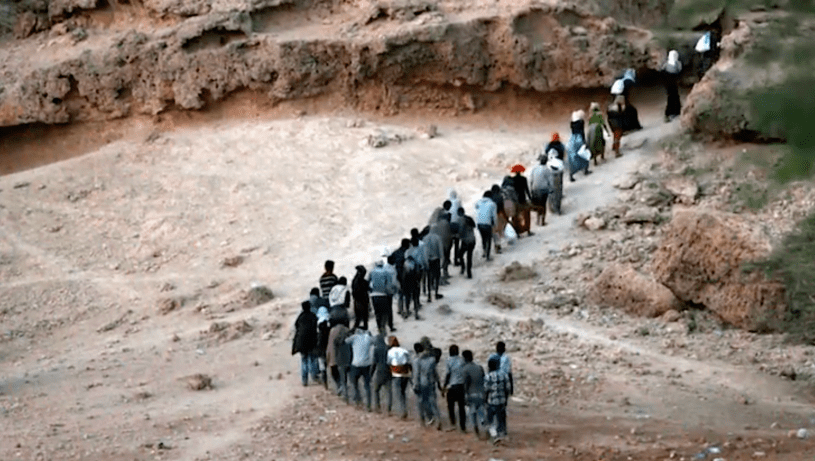
Here are two blogs about what happens to Eritreans
Martin
Forced departures from Saudi Arabia: new displacement dynamics and challenges of protection
- Source: Research and Evidence Facility
A new displacement dynamic in the Horn of Africa is emerging from the implications of forced departures from Saudi Arabia.
Hundreds of thousands of migrants from the Horn of Africa have sought and found semi-permanent work in the Gulf region, as have many migrants from South East Asia. Their socio-economic and political security is nonetheless being shaken by current shifts in the opportunities provided by the Gulf States to foreign workers, which is reflected in recent statistics of migrant departures from the region. Indirectly, it is also impacting millions of individuals in Sudan, Ethiopia, Eritrea and Somalia whose lives are intertwined with these movements.
By mid-2019, around 2 million foreign nationals were reported to have left Saudi Arabia and the number of expatriate workers had fallen by around 22 percent in the preceding two and a half years. Their departures follow from several recent initiatives designed by the Saudi authorities to reduce the number of expatriate workers in the (arguably misplaced) hope that this will reduce unemployment among its own nationals. One such initiative introduced in July 2017 is a tax requiring foreign employees to pay 100 riyals per month (approximately $27) for each dependent registered on their iqama (work permit), including children. The fee, due when their documents come up for renewal each year, has subsequently increased each July by 100 riyals per dependent. If workers fail to pay this levy, amounting to hundreds of additional dollars per month even for a small family, they cannot renew their iqama and thus lose their legal right to reside and work in Saudi Arabia. At this point people risk becoming ‘stuck’, as the Saudi authorities prevent them from leaving until these debts, which continue to mount, are paid off. While the numbers of people caught in this limbo are hard to say, among the Eritrean population in Saudi, which numbers in the tens of thousands, our interlocutors stated regretfully that “there are too many to tell who this has happened to.” The change in the country’s taxation system has thus revealed the deep vulnerability of foreigners in a country where neither citizenship nor refugee status is available to them, and this aggressive new taxation system for workers and their dependents suggests that these initiatives are specifically designed to push out those with families.
For the Eritrean population that forms the focus of this post, composed of those who left the Gulf States and have subsequently found their way to Kampala, the situation has thrown up political as well as economic challenges. Travel to the Gulf states had for a long time constituted a safety valve, allowing them to leave circumstances of conflict and repression at home. Some Eritrean families in Riyadh and Jeddah had indeed been there for two to three decades, as parents had left violence, repression and economic collapse first under the Derg and now under the country’s current ruling party. Despite having never had access to asylum in Saudi Arabia on account of the country’s absence of a domestic refugee regime, they had nonetheless managed to secure a degree of social and economic security there over the ensuing decades, and many had raised and educated children in the country. Many of the young people we interviewed had never left the Kingdom of Saudi Arabia. With the option of living and working in the Gulf now foreclosed to them, this population has been forced to encounter a new series of protection challenges in their ongoing search for a space of refuge.
We spoke with individuals who managed to exit Saudi with their families, travelling first to Eritrea and then quickly onwards from the country. As they re-entered Eritrea with the status of non-resident citizens, they were afforded the opportunity to legally leave the country again within a six-month window. This was critical: if they outstayed this duration, children would be sent to Sawa military training school and adults would be re-instated in the country’s national service programme, leaving them without the economic means to support their families. With access to labour markets in the Gulf, Israel and South Sudan largely foreclosed, however, the next move was unclear for families. Sudan and Ethiopia were seen as either too expensive or too insecure following improvements in the relationship between both their governments and the government in Asmara, and the horrific situation in Libya was lost on no-one. Families had thus congregated in Uganda where they were either pinning hopes on opportunities for moving abroad or resigning themselves to the next stage of their lives playing out in Kampala.
Most were planning on applying for asylum, despite holding out little hope that their claims would be successful. Endemic corruption within the institutions responsible for determining both refugee status and resettlement decisions meant that these options were largely unaffordable, and the authorities allegedly met their applications with scepticism if they admitted to having arrived from the Gulf. Individuals reported being told that their decision to migrate to the Gulf states however many years earlier made them labour migrants, not refugees. For the older generation amongst those we interviewed in Kampala, this dismissive attitude contributed to a sense that history was repeating itself. As one man questioned, “we went to Saudi [in the 1980s] because we could not wait as refugees in Sudan. We couldn’t wait for money – where was it going to come from?” The same question was now resurfacing in Uganda as families were taking stock of their limited options in Africa, as well as their continuing responsibility to support friends and family in Eritrea or on other journeys out of the country. The impacts of these shifts in the Gulf are thus likely to be magnified as these individuals’ transnational networks are called upon to compensate for the loss in income and remittances caused by their forced departures from the Gulf.
Though businesses in Saudi Arabia have voiced public concerns about these new policies negatively affecting the country’s economy, the Kingdom’s rulers have largely refused to compromise on this approach. The stories we gathered from Eritreans in Uganda are thus likely to continue being repeated across the Horn of Africa (as well as vast swathes of South East Asia) as migrant workers and their dependents are forced to leave through the intensification of nationalisation policies, which include the imposition of new taxation regimes such as these. Alongside its economic consequences, which will be felt much further afield than only those directly affected, this raises serious concerns for protection. Labour markets in the Gulf States had for decades provided an alternative, however imperfect, to applying for asylum in countries within the region. For many of those now being forced to depart these states, the countries or regions that they left remain unable to offer viable economic and political futures. They are left with little choice but to migrate in search of more secure alternatives, giving rise to a new dynamic of forced migration in the Horn.
Editor’s Note: From time to time we host guest contributions to our blog series. These blogs are intended to provide a diversity of perspectives and voices on issues relevant to our programme of research. Views expressed by guest bloggers are their own and do not represent the views of the Research and Evidence Facility or the EU Trust Fund for Africa.
“For now, we are still circling”: Stories of Displacement from Eritrea (April 26, 2020)
By: Dr. Georgia Cole
Monday 27th January started in typical fashion for a day of data collection in Kampala, Uganda. I was there to interview Eritreans who had travelled to Uganda from the Gulf States, where they had spent anywhere between a few months and several decades working in cities such as Riyadh, Jeddah and Dubai. The aim was to identify, through their histories of migration, what role these oil-rich states played in global networks of refuge and protection.
Around 10am, I met my research assistant at Chicken Tonight for our first interview of the day. Having been severely reprimanded by a waitress the day before for doing a 2-hour interview there off the back of purchasing only four bottles of water, we ordered chips and coke for breakfast. Two young Eritrean women arrived for our interview, and we began to slowly reconstruct an account of why their parents had left Eritrea, what it had been like growing up in Saudi Arabia, and what had changed in the last few years such that thousands of Eritreans were leaving their lives in the Gulf and heading to Egypt, Uganda, Ethiopia and Sudan.
Their story reinforced the many others we had already heard about the shifting situation within Saudi Arabia. In their efforts to boost employment of Saudi nationals, to diversify the economy away from oil, and to quell discontent amongst unemployed youth, authorities in Saudi have instigated several measures to push foreign workers out. Most crippling for these expatriate families was the introduction of a monthly tax for all foreign dependents and workers living within the country, which must be paid for parents and children alike. In the year it was introduced, 2016, the tax was 100 Riyal per dependent per month; in the second year it doubled to 200 Riyal, and, if families lasted until the third year, it increased again to 300 Riyal. For a family of six, that equated to £310 a month of additional payments. With many people already struggling to hold down employment given several other policies to get Saudis into jobs and foreigners out of them, this proved unaffordable. Many Eritreans were forced or chose to leave before they became trapped in Saudi Arabia with mounting levels of debt.
Unable to return to Eritrea permanently, the two women we were interviewing had, like many others, come to Uganda. It is a country that Eritreans can enter visa-free and where the government leaves this population relatively undisturbed. But life in Uganda has its own problems, not least high unemployment. For most of the Eritreans that we spoke to within the country, Uganda constituted a waypoint on a journey with the final destination unknown.
After rounding up the interviews for the day, I headed home on a bodaboda (a motorbike taxi) to begin transcribing my almost illegible interview notes. Fieldwork is always a reminder that it is not only undergraduates who are losing the ability to write with pen and paper. Back at the hostel, I checked my phone and unusually saw a string of messages and a missed call from a young Eritrean guy that I had played football with in the U.K. for years. “It’s been a long time without talking and seeing each other. Call me if you have free time.” We exchanged a few messages. He asked if I could book the football pitch that coming weekend for the sizable group of unaccompanied Eritreans in his town, something I used to do a few times a month but which I had struggled to do regularly since moving to Cambridge. I drop him another line, in part to apologise for the sessions having slipped.
He very quickly started to explain that things were not going well for many of his Eritrean friends, despite most of them having had their refugee status or indefinite leave to remain approved. Frustrated at their lack of English, and now left largely to their own devices as they have started to turn 18, many of them, he said, were slipping into bad habits and dangerous crowds. One of the guys we had played football with for years had apparently been sent to prison in September. Shocked, I asked what had happened, and he revealed it was a charge of murder. The young man had been sentenced to twenty years for stabbing someone who had robbed him of the crack cocaine and heroin that he was dealing around the city centre.
From my hostel bed in Kampala, I googled what had happened. Sure enough, there was our friend, in numerous articles, dressed in a grey hoodie, staring blankly at the camera.
What felt most painful about seeing that photo was the knowledge that it would not tell a thousand words. For many readers, I imagined it could be summed up in just a few: another young, violent, black African man who we welcomed in as a refugee and who showed his gratitude by spreading violence on our streets. What it could never tell is everything that he and the other boys went through to get out of Eritrea – a country where at aged 17 they would have been enrolled in indefinite national service, and where basic human rights are summarily ignored by the one ruling party – and into the U.K., experiencing ordeals that have scarred them inside and out.
During our pitch-side conversations, aspects of this trauma would sneak through. On one particularly summery morning, I asked whether the guys might like to try a sport on the river, since they’d pass by boats every time they came into town. “You know, Georgia,” one guy replied, “the water is a bit hard for us after passing through the Mediterranean.” On another occasion, I was teasing a guy for having bulked up to the point where the other guys would surrender the ball to him rather than risk a collision. He wanted to become a personal trainer, he said, but he also hadn’t been able to sleep for months. The gym was the only place nearby that was open 24/7.
I also remember the time I had to take one boy aside during a match to tell him he was on his final strike and had to find a way to control his anger on the pitch. He apologised but said that he too was frustrated; he’d been a great footballer in Eritrea, but two years of moving through Sudan and Libya, and sustaining injuries from accidents, electrocutions and beatings along the way, had led him to lose his talents. As my friend said on the phone that Monday evening, the deep damage and PTSD caused by their journeys from Eritrea continue to haunt them.
Despite these boys’ situations playing out 6,000 miles from the individuals I was interviewing in Kampala, their stories are symptoms of the same fate. Eritrea is no longer a politically or economically viable home for large numbers of its citizens, causing them to escape across the borders in search of a place where they might find security and protection. A decade ago, many started going to Israel. Israel responded by building a wall to keep them out. Others went to South Sudan or the Gulf States, hoping to find jobs. Conflict in the former, and new rules to deter foreigners in the latter, have now reduced the opportunities there. Sudan and Ethiopia remain options, though many Eritreans see Sudan as unsafe following deals between the governments in Sudan, Eritrea and the European Union to reduce their ‘irregular migration’. For those who make it to Europe, the future is not necessarily brighter. Hostile policies, including a lack of support for services that would assist with integration, make the path for newly arrived asylum-seekers, and particularly those who come on the brink of adulthood, particularly challenging.
As one of the Eritrean women we interviewed in Kampala put it, “Where do you want us to go? We are just like the birds who circle around until they find a place where they can build their nest to stay.” Even for the families who had managed to build lives in Saudi Arabia, their security was easily dismantled by a government that quickly transformed them from essential workers to unwanted foreigners. And for the Eritrean boys whose flight had brought them to the U.K, the trauma of their journeys will continue to intrude, shaking their new homes in unanticipated and violent ways. For those we were interviewing in Uganda, however, newly displaced from their temporary homes in the Gulf, the woman concluded by saying that “for now, we are just circling.”
Georgia Cole is a Research Fellow at the Margaret Anstee Centre for Global Studies at Newnham College, Cambridge. Her research in Uganda, Eritrea and the UK explores migration dynamics and diplomacy between the Horn of Africa and the Gulf States. It seeks to establish what role cities such as Riyadh and Dubai have played, and continue to play, in global systems of displacement and humanitarianism. She will soon (May 2020) be joining the University of Edinburgh to continue this work as a Chancellor’s Fellow.
 Martin Plaut
In what ways does the introduction set the tone for the article, and thus prepare the reader for the content that follows?, Greeting : Telkom University
What struck me most is how trauma follows them even after reaching safety, showing that migration is not just movement, but survival with scars that rarely heal. desain