
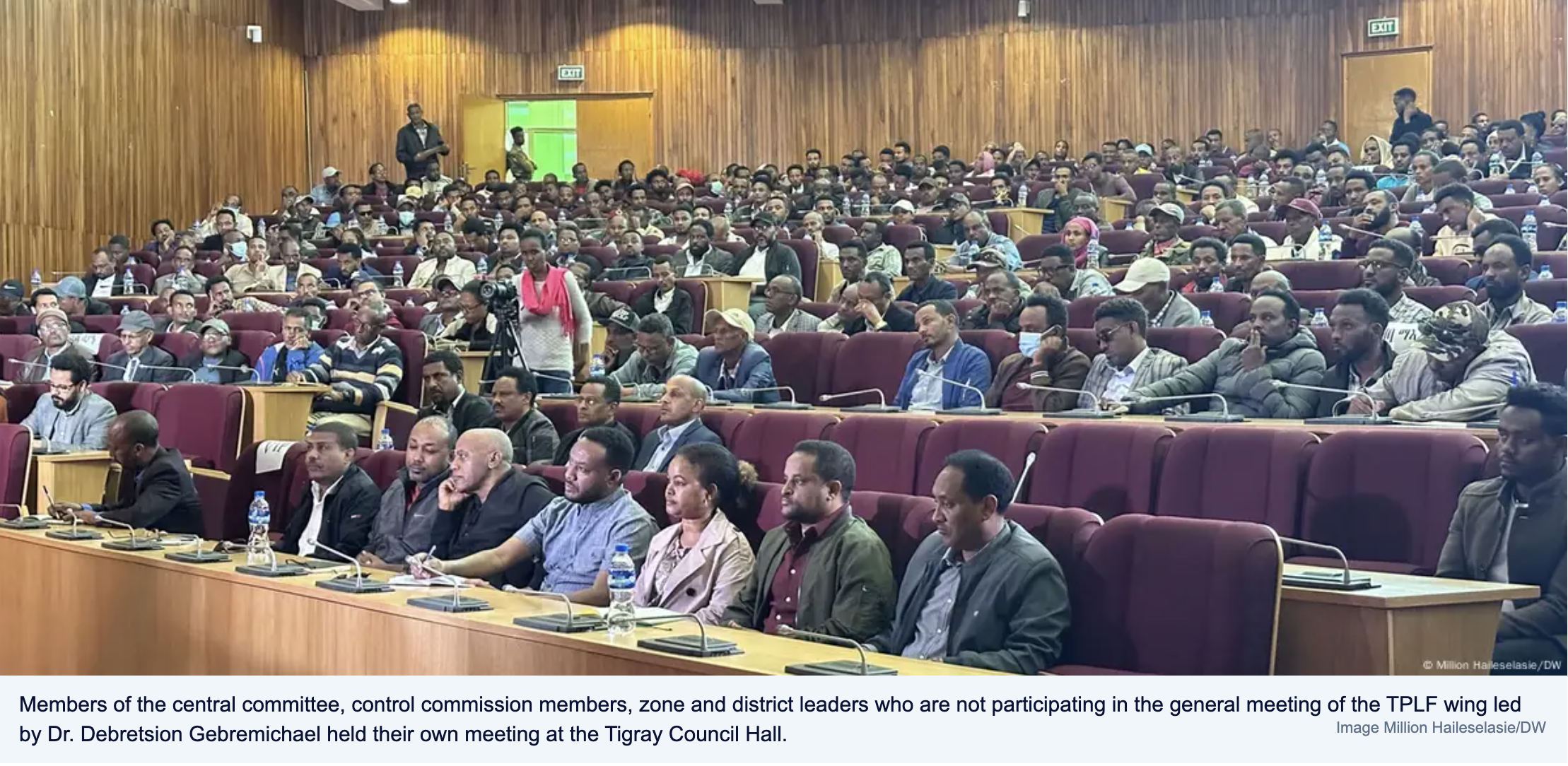
The divisions in Tigray are there for all to see. Two rival congresses were held by groups, each claiming to represent the long-standing ruling party, the Tigray People’s Liberation Front.
One faction – which claimed to be the official party – held a Congress in the traditional setting of the Martyr’s Memorial. It elected Dr. Debretsion Gebremichael as Chairman and Amanuel Assefa as Vice-Chairman. It is worth noting that the National Electoral Board of Ethiopia ruled that the congress could not take place, and that the Board would not recognise any decisions that that will be passed. The Debretsions group proceeded with the congress, neglecting the warnings of the Election board.
The other faction is led by the head of the interim administration, Getachew Reda. He was the vice chairman of TPLF before Debretsions group replaced him by Amanuel Asefa. This faction held its meeting in the Mekelle city municipal hall and also claimed that it was the rightful representative of TPLF.
The two factions have been circulating documents attacking each other.
The Debretsion faction pointed to a document suggesting that its rivals were involved in secret deals with the federal government without the knowledge of the Tigray public and the TPLF, which undermine Tigray’s claims to disputed areas.
Getachew Reda responded saying that the document was released to create ‘an agenda’ and has been a talking point on social media, but has nothing to do with the interim administration of Tigray. He denied that any such document had been signed by Tigray.
That there should be two rival TPLF congresses is unprecedented. The movement, which has dominated Tigrayan politics since the 1970’s, has traditionally used lengthy discussions to resolve its differences. These talks could take weeks to conclude, but divisions were not brought out into the open. So what is going on?
Fallout from the war
The war that Tigray fought against the Ethiopian and Eritrean governments supported by Amhara militia ended with the Pretoria agreement of 5 November 2022. The agreement not only ended the fighting, which had claimed some 600,000 lives, but was also meant to resolve the underlying political and constitutional issues.
The Tigrayan side promised to disarm and disband its armed forces, agreed to recognise the Ethiopian Constitution and to “Respect the constitutional mandate of the Federal Government to deploy the Ethiopian National Defence Force as well as federal security and law enforcement agencies to discharge their responsibilities under the Constitution, relevant laws, and regulations….recognize that the Federal Democratic Republic of Ethiopia has only one defense force.”
The Ethiopia Government was required to:
- Halt military operations targeting the TPLF combatants; Expedite and coordinate the restoration of essential services in the Tigray region within agreed timeframes;
- Facilitate the lifting of the terrorist designation of the TPLF by the House of People’s Representatives;
- Mobilize and expedite humanitarian assistance for all those in need in the Tigray Region and other affected areas, and ensure unhindered humanitarian access.
The agreement was signed by Getachew Reda, on behalf of the Tigrayan authorities, who subsequently endorsed the agreement.
Divisions over the status of the party
The Pretoria agreement has become one of many issues dividing the “Debretsion TPLF” from the “Getachew TPLF”. The former blamed Getachew for failing to ensure that the agreement restored the full legal status of their party, something that is now challenged by the Federal Authorities.
The National Electoral Board of Ethiopia has rejected the TPLF’s request to reinstate its pre-war legal status, instead granting it a certificate of legal personality as a new political party under special conditions.
Why does this matter?
Some argue that the TPLF has been part of the Ethiopian political scene since 1991, when their fighters entered Addis Ababa, and their leader, Meles Zenawi, became Prime Minister. It is a proud history that cannot be erased. But others suspect another motive.
The TPLF has very substantial assets in Ethiopia, some of which are said to have been gained through questionable government contracts, awarded to officials and party members. If the TPLF is regarded as a “new” party these assets could be seized by the Ethiopian state, since the former TPLF would no longer be seen as a legal entity. There is a great deal at stake.
Western Tigray
There is also the question of Tigrayans internally displaced within Ethiopia.
The Tigrayan region bordering on Sudan was seized by Ethiopian, Eritrean and Amhara forces during the war. While the Eritreans have withdrawn, the other forces have not. Large numbers of Tigrayans who were forced to flee west and northwards have been unable to return to their homes.
The land is claimed by the Amhara, with Amhara militias working with the government of PM Abiy. They have established an unconstitutional administration to control the area. This militia group in West Tigray have dissociated themselves from another Amhara group, the ‘Fano’ who are currently fighting the Ethiopian government.
Lieutenant General Tadesse Werede, vice president of the Tigray interim administration, recently said that the region is fully prepared to assist in the return of internally displaced persons (IDPs) in West Tigray, as well as re-establishing the pre-war constitutional administration Tigray. But he expressed concern over the lack of action from the federal government in addressing these issues.
The role of Tigray’s Security forces
The Pretoria agreement called for the Tigrayans to give up their weapons and to adopt a “demobilization and reintegration plan.”
Tigrayans handed over their heavy weapons (at least some of them) and brought their armed forces into camps, but these forces have not been disbanded.
This has left the Debretsion faction with forces that they can appeal to, but the Getachew faction does not. General Tadesse has insisted that he will not take sides between the two sides, instead of ensuring law and order as part of the leadership of the interim administration. It is unfortunate to see that General Tadesse equating a political party with the governing body of Tigray.
Getachew Reda and his administration are effectively trapped in Mekelle, unable to extend their authority across the lower administrative structures of Tigray. This is – to put it mildly – unsatisfactory. At the same time there is increasing lawlessness and banditry which is afflicting people around Mekelle and other parts of Tigray.
What about PM Abiy?
So far, the Ethiopian prime minister has appeared not to take sides between the two factions. In the past Getachew Reda has been closer to Abiy, but the prime minister is probably wary of getting involved in another conflict.
The Ethiopian government is currently fighting Amhara forces, as well as sections of the Oromo. PM Abiy appears to have lost support from Eritrea, with Isaias Afwerki much cooler towards his former Ethiopian partner.
If Ethiopia was to descend into another full-scale war, similar to the one it fought in Tigray between 2020 and 2022, it would put at risk the IMF deal that has just been signed, providing Abiy with a loan of US$3.5. This is vital if Ethiopia is to repair its finances, which were splurged on buying weapons for the Tigray war, including Turkish drones.
One further element of the IMF deal is worth noting: it required the devaluation of the Ethiopian birr. This has left property as a highly desirable asset, as currency values plunged. This includes the disputed property portfolio of the TPLF.
Abiy appears willing to allow the National Electoral Board of Ethiopia abide by its decision to recognise the TPLF as a new political party, rather than reinstate the 50-year-old party. This works in favour of his political and economic strategy.
Prime Minister Abiy is using divisions within the TPLF to his advantage, moving towards establishing interim administrations in the illegally occupied territories of Tigray.
Conclusion
The situation in Tigray is tense.
People are apprehensive, waiting to see what happens next. No-one wants what would amount to a Tigrayan civil war, but there are fears that the situation could slide in that direction, unless the differences are solved in a civilized way via dialogue within the party.
It would be advisable for Tigray’s security forces to support Tigray’s interim administration. It is the governing body established by the Pretoria agreement to work on ending the sufferings of the people of Tigray.
Where will this end – a comment from a colleague
It’s very difficult to anticipate how it will be resolved. In an interview with Reyot Media, the new deputy chairman of the Debretsion-led TPLF claimed the party is willing to negotiate with Getachew’s group. Getachew and his allies may try to appeal to the National Election Board to claim that they are the real TPLF. Interestingly, though Debretsion has publicly rejected the new registration of the TPLF—claiming that what they seek is reinstatement, not new registration—his party has yet to submit an official rejection letter to the National Election Board, meaning that technically, Debretsion’s TPLF is the one that is legally recognized.
Getachew is attempting to weaken the TPLF’s influence in the lower structures by appointing new Zonal officials and prohibiting any meetings not officially approved by the TIRA. However, the Woreda and Kebelle administrations have largely subscribed to Debretsion’s TPLF, which means Getachew may find it hard to penetrate into the lower levels. The security forces have remained neutral, and their decision in response to Debretsion’s inevitable official rescinding of Getachew and others who are in the TIRA cabinet representing the TPLF (and appointing new representatives) will be decisive.
 Martin Plaut
clear article!