In these reports the left-leaning Daily Maverick produced an in depth analysis of what has gone wrong: billions spent buying productive farms that have been left in ruins. So why have attempts to right the wrongs of apartheid by returning land to black farmers gone so badly wrong?
One word of warning: black farmers can, of course, farm as well as anyone. But their successes have come when they buy land and farm it commercially – something they have proved good at doing. This is not about race.
Martin
Source: Daily Maverick
‘We don’t have jobs’: Post-1996 farmland restitution projects sow a costly legacy of failure

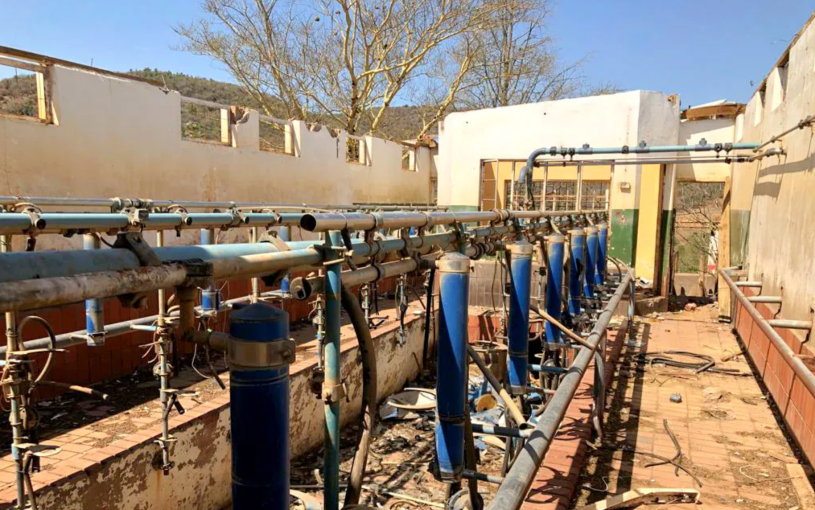
The abandoned remnants of the milking parlour at Ponderosa dairy farm near Ixopo, which was purchased as a land reform project in 2008. (Photo: Supplied)
By Tony Carnie and Naledi Sikhakhane
01 Sep 2024 3
Nearly three decades after SA’s formal land claims process began in 1996, many farmland restitution projects are floundering or have collapsed, raising questions about the extent to which the billions of rands of state expenditure has benefited the claimant communities.
Yet, nearly three decades after the formal land claims process began in 1996, many of these projects are floundering or have collapsed, raising questions about the extent to which the billions of rands of state expenditure has benefited the claimant communities.
It has also raised broader concerns about the impacts on national food security, rural jobs, animal disease control and South Africa’s agricultural economy.
In August, Daily Maverick visited land reform and restitution projects in Ixopo and Umzimkhulu, southern KwaZulu-Natal, including two former commercial farms where the land now lies mostly fallow, with little evidence that the claimant communities are reaping any significant level of benefit.

Stainless steel milking equipment that was vandalised or cut up for scrap at the former Ponderosa dairy farm in KwaZulu-Natal. (Photo: Supplied)
These two examples mirror other land restitution ventures that have failed or delivered very little — for a variety of reasons.
Daily Maverick sent a detailed list of questions to the Department of Agriculture, Land Reform and Rural Development on 14 August about the land reform process in Ixopo, mainly focused on the visible failure of two land restitution projects at Dawn Valley and Ponderosa farms. The department has not yet responded.
At Dawn Valley Farm in Ixopo (a 2,140-hectare vegetable farm and game ranch purchased by the government in 2008 for R12.8-million) there was little evidence of significant crop cultivation. Instead, large parts of this farm are reverting to indigenous thorn bush. A nearby game lodge has been burnt to the ground and most of the large antelope and other wildlife species have been hunted out.

Irrigated fields of potatoes and other vegetables at Dawn Valley farm in 2002, six years before the land claim settlement. (Source: Google Earth Pro)

A satellite image of the same fields in 2022, shows few signs of any cultivation. (Source: Google Earth Pro)
There is a similar situation at the adjoining Ponderosa Farm (a 770ha former commercial dairy and crop farm purchased by the government in 2008 for R8-million). While small patches of cabbages are still being grown, the milking sheds, main farmhouse and other buildings have been demolished and most of the former cropland area lies unused.

Green carpets of irrigated fields at Dawn Valley and Ponderosa farms in 2009, shortly after the land claim purchase. (Source Google Earth Pro)

A 2021 satellite image of the same farms just over a decade later, shows large cultivated areas lying fallow or reverting to thornveld. (Source: Google Earth Pro)
Highlands Farm
Further south, in Madakweni near Umzimkhulu, another 1,500ha of land at the old Highlands Farm is mostly unused. The land was expropriated in 1967 from farmer Rowland Strachan for inclusion in the former Transkei homeland and later fell under the control of the Eastern Cape for more than a decade before being reincorporated into KwaZulu-Natal.
After 2006, a maize milling factory was built on the land with government funding, but residents report that it was used only for a few months because insufficient maize volumes were being produced on this former commercial farm.
Thereafter, steel components from the milling equipment, silos and roofing were removed and sold as scrap metal. Today, the only evidence of this expensive state-funded milling facility is an abandoned concrete slab with remnants of the steel supporting pillars chopped off at ground level.

The new maize milling factory at Highlands farm in May 2009, protected by an electrified fence. (Photo: Supplied)

What is left of the maize mill today. (Photo: Supplied)
Dougie Strachan, whose father used to own the farm, acknowledges that this area was not part of the land reform project that began in 1996.
Nevertheless, he laments, former farmworkers and residents of Madakweni appear to have derived few lasting benefits, either from the initial expropriation or subsequent government initiatives to return the land to productivity.
“This is probably the oldest land reform project in South Africa, but the people have got nothing out of it,” said Strachan as he surveyed the extensive and fertile land.
While families at Madakweni have each been allocated plots of land of about 4ha, Strachan noted that residents did not have tractors or the financial wherewithal to cultivate the land properly. Nor was there a willingness to consolidate small individual parcels of land into larger units for more viable commercial-scale operations.
Dawn Valley Farm
At Dawn Valley Farm near Ixopo, we spoke to several women, who expressed dismay or confusion about the future of the project.

Hopes for a brighter future have dimmed for many residents after the collapse of the Dawn Valley land reform project near Ixopo in KwaZulu-Natal. They include (from left) Xolile Mhlongo, Sindisiwe Mbanjwa, Thobekile Mvemve, Gadeni Biyase, Fundeleni Langa and Theleleni Skosana. (Photo: Tony Carnie)
They reported that a “new farmer” had arrived to manage the land in 2008, but remained for only a short period.
Xolile Mhlongo, who grew up in the area, said: “Nothing is happening on this piece of land. We don’t use it now because we don’t have tools to farm, like tractors, or seeds and fertilisers. Now there are three guys who are keeping watch on the farm, living in the farmhouse.
“[Earlier], there were four guys who were selected and told us we would be partners,” said Mhlongo.
The women, employed as short-term contract workers to cut down alien plants, said they received monthly stipends of R1,000 and were among the few residents currently working.
Another resident, Thobekile Mvemve, hoped that the farm could be returned to productivity to provide more job opportunities.
“We don’t have jobs. Even this R1,000 is used on school transport for our children. That takes up around R500 because the school is very far. Ever since the old farmer left we have hoped the farm would work again,” said Mvemve.
Another Dawn Valley resident, who asked to not be named, said the community thought they would receive R9-million, a figure that was typed in documents they saw. But closer to the time of receiving the money in around 2015, that amount was “scratched out and written as R6-million with a pen.
“We received R3-million, which was the first payment of two. When half of that had been spent, the community said they are not happy with the committee. The committee went to the Maritzburg High Court to say they can continue handling the farm [and that] they are handling the money well. I can say the community was working together with Land Affairs.”
‘People could not agree’
He said the committee spent the R3-million on building a bridge, fixing tractor engines and buying fertiliser, seed and farming equipment.
“Vegetables were planted, and the farm was working a bit, but what made it fail is people couldn’t agree on what to do with the farm at the time. There was no understanding of where the money went, that’s why the community went to the high court,” he said.
“Now that everyone is seeing the poverty, the committee and community are in one voice saying the second tranche payment should come through so that we can work.”
He said a lawyer from the Department of Land Affairs came in 2020 to check where the money was spent but never reported back.
“We don’t know whether they will come back to give the second payment, or this is over.”
The resident said the court case was never concluded because the community was unable to pay a lawyer who had agreed to represent them.
“I will not share my name because people have killed each other too much because of these farms,” he said.
Ponderosa Farm
A community member from the adjacent Ponderosa Farm, Sifiso Mbhele, said the farm was leased to land claimants more than 10 years ago, but no government funding support had been received. He said the community had also received no official communication from the Department of Land Affairs since around 2020.
“The problem is that just when we think we are getting somewhere with a person from Land Affairs, another comes much later and we start all over,” said Mbhele.
“We would love for the farm to work because a lot of people in the community are unemployed. Job opportunities are few around here.”
Another concern was that the land was now being “invaded” by people from outside the community.
Dawn Valley
Former KZN premier Zweli Mkhize singled out Dawn Valley in 2011 as one of the new government-backed farming projects that could boost job creation in rural areas and increase the province’s ability to export fresh produce via the Dube Trade Port.
But that’s not how things worked out, said Don Govender, a business consultant and founder of the eManzimtoti-based Lindon Corporation. Govender was appointed managing director of the “turnaround and recapitalisation” project at Dawn Valley in late 2007.

Don Govender, head of the Lindon Corporation, which bailed out of the failed Dawn Valley land reform project. (Photo: Linkedin)
He said that when his company bailed out of the project at the end of 2013, sharp divisions had emerged among the 120 members of the farm’s communal property association (CPA), which represented local land claimants and farm tenants and held a 49% stake in a joint venture company known as Able Wise (trading as KZN Farm Estates).
Although the farm remained under the ownership of the Department of Land Affairs, the land was leased from the CPA by KZN Farm Estates, made up of three shareholders, each with a 33.3% stake (Lindon Corporation and local entrepreneurs Griffith Radebe and Thulasizwe Kubheka).
Radebe served as farm manager and Kubheka as commercial and marketing director.
Govender said he understood that departmental policy was that land restitution farms would be leased to claimants until certain conditions were met, such as claimants being able to farm productively and consistently.
Historically, the farm had produced high yields of good quality potatoes for customers such as Simba. It was also suitable for growing butternut, cabbage, tomato and sweet peppers.
“Dawn Valley was approximately 2,000 hectares, with 200 hectares of relatively flat land with deep soils in the valley suitable for crop production. The remainder (rocky, hilly ground) was untillable and was used for game ranching and hunting.”
By the time Lindon arrived on the farm, said Govender, many of the animals had been poached or escaped through broken fences and open gates.

The Nhlamvini bush lodge at Dawn Valley farm, before it was burnt down. (Photo: Watervale Safaris web page)

The gutted remains of Nhlamvini bush lodge today. (Photo: Tony Carnie)
The farm was “unproductive, unequipped and the fields had been lying fallow for about six to seven years.
“The farm needed a robust production plan, pumps, irrigation systems, tractors, ploughs, delivery vehicles, firebreaks and fences mended.
“Based on the understanding that the [department] would follow through with some of the statutory grant support and that the farm could be a productive potato farm, Lindon made a decision to invest equity into the project under certain conditions, one of which was to have proper governance and shareholding structures to protect the interests of shareholders and the CPA.”
Lindon invested about R1-million into the project, which included buying farm equipment, seeds and fertiliser and paying the salaries of farm workers and management.
“During Lindon’s involvement, we cultivated over 40 hectares of farmland with superior quality butternut, cabbage, peppers and tomato, which were supplied to Farmwise [a fresh produce distribution centre], to [Spar supermarkets], the Durban Fresh Produce Market and the Farmers Retail Market.
“During our tenure and at peak production, the farm employed over 25 people permanently, excluding the farm manager and members of the executive.”
The company secured R14-million in principal funding from the National Empowerment Fund (NEF) to develop a potato farm and buy processing equipment.
The wheels started to fall off when the proposed funding was not accepted by the CPA, apparently based on the recommendations of the Department of Land Affairs. Later, the CPA decided that it would not extend the lease with Lindon and its partners, and no alternative funding materialised.
Decisions not honoured
“The CPA trustees and CPA representatives on the Dawn Valley board changed frequently and decisions made by one set of CPA representatives were turned around or not honoured by the next set of trustees. CPA members that had left the farm reappeared as the project gained traction and showed success.”
There had also been “indiscriminate poaching of wild animals, often by members of the CPA”.

Dairy cattle graze on the rich irrigated pastures of Ponderosa farm before the 2008 land claim settlement. (Photo: Supplied)
“Given the short tenure that the Dawn Valley Farms enterprise operated for, there were no profits declared. However, income from the operations was used to recapitalise the business, cover salaries, buy seedlings and cover other operating costs of the farm.”
Why did Lindon and its partners decide to leave?
According to Govender, the plan was to turn the farm into a productive and well-managed vegetable and potato farm, with tourism, hunting, outdoor events and conferencing as an ancillary business.
“When funding was secured after much effort to build such an enterprise, which was then refused by the CPA/department, who then did not follow through with an equivalent funding or an extended lease agreement, Dawn Valley Farms Pty Ltd made a decision to pull out.
“The attitude of some members of the CPA to an external investor/management also did not engender much confidence amongst us as investors.”
Govender said he was not aware of any legal proceedings against any parties, noting that Lindon suffered the largest financial losses as it was not able to recoup its investments because the lease was terminated and the NEF funding proposal was rejected by the CPA.
“Restitution projects need good production plans, funding that flows quickly, technical support, productive labourers and a responsible CPA that has the farm’s best interest in mind at all times. If these essential requirements are not met, projects are bound to fail. Farms need to be safe for farm managers, patrons and their families.
“Dealing with many voices within CPAs, coupled with limited understanding of business, finances and markets, is also challenging.”
Lessons from the project
In Govender’s view, farms need to be purchased as productive enterprises with their financial and market track records intact.
“Farms need to be bought from experienced farmers with a condition that the farmer must remain and farm the land together with the beneficiaries and maintain production figures and customer orders until the beneficiaries have the technical expertise and marketing acumen to take over all aspects of the farming business.”
Rory Bryden, a dairy farmer from Kokstad who has been offering his experience and expertise to assist land claimant beneficiaries at a nearby farm, noted that commercial farmers could secure funding by bonding their farms.
However, where land claimants did not receive title deed ownership they were not able to raise the substantial capital needed to run a commercial farm.
He said the most viable option was for land claimants to enter into joint ventures with commercial farmers to lease land for five to 10 years, while community members gained the necessary skills to manage farms commercially.
Sadly, he noted, not all land claimant communities were amenable to such mentorship and leasing proposals. DM
Source: Daily Maverick
Inexperience, chaos, infighting lead to collapse of KZN land claims dreams

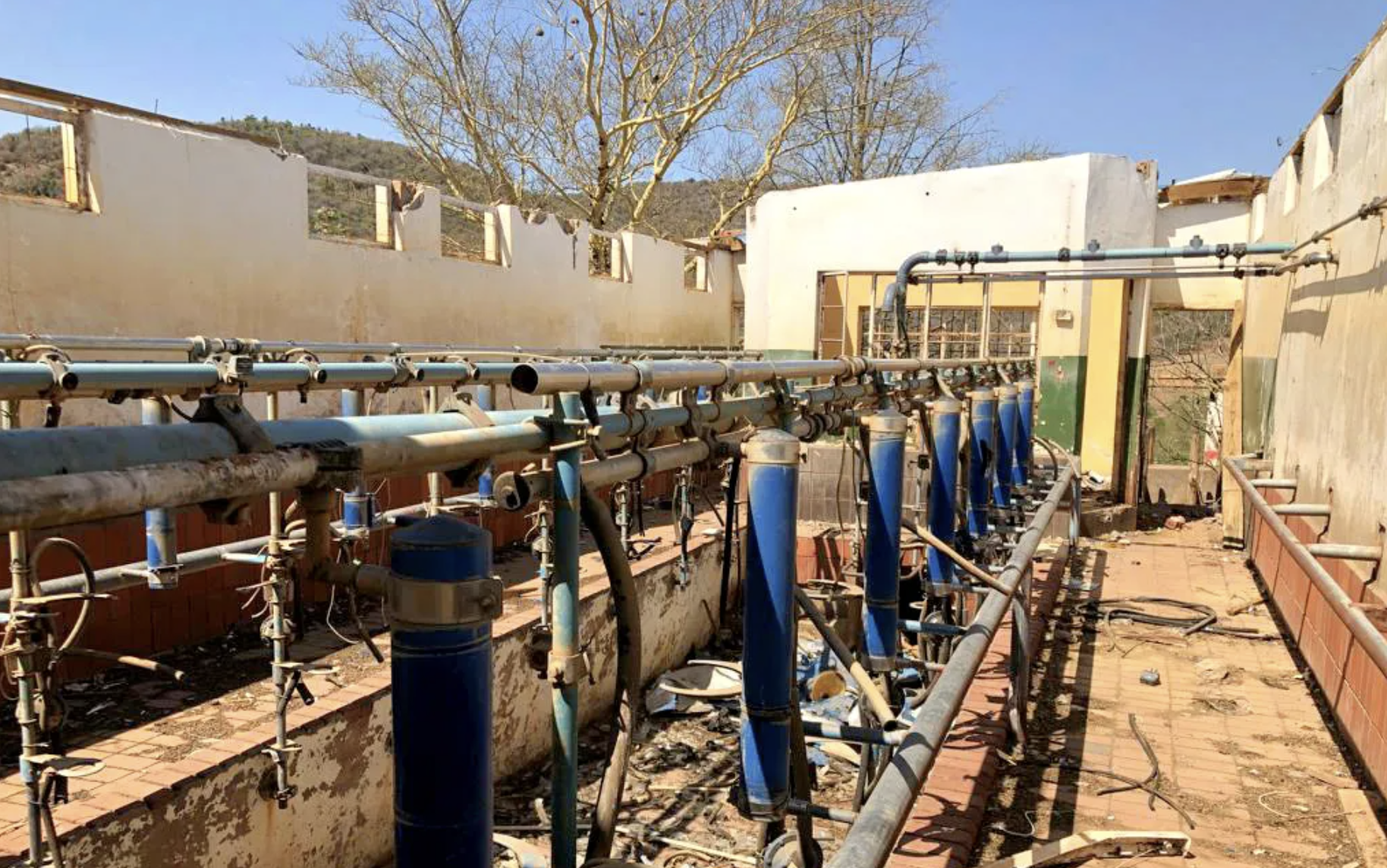
Weeds and trees have overrun the abandoned dairy sheds at Ponderosa farm near Ixopo. (Photo: Tony Carnie)
By Tony Carnie
01 Sep 2024 1
In Kwazulu-Natal, a mere 3% of Communal Property Associations – the legal bodies set up to represent land claimants – are compliant with basic legal requirements, often resulting in large swathes of formerly productive land lying unfarmed or underutilised.
There are more than 1,700 Communal Property Associations (CPAs) scattered across the country. These are the legal bodies set up to represent the interests of roughly 380,000 people and groups who have lodged land claims since 1996.
Yet only 7% of these bodies are operating lawfully following a nearly three-decades-long land restitution process that has led to about 83,000 land claims being settled nationwide at a cost of close to R58-billion
In plain language, most CPAs are in a royal mess, with many riven by infighting, legal paralysis, funding shortages and a lack of accountability to members.
The department reported that in one such case in KwaZulu-Natal, CPA members are fighting over timber plantations, crop fields, the illegal allocation of sites and the embezzlement of association funds by committee members.
Of the 1,734 CPAs nationwide, just 7% are compliant with the Communal Property Associations Act, which requires these bodies to hold annual meetings, produce yearly financial statements and keep up-to-date registers of its members and elected committee leaders.
In KZN, only 3% of CPAs meet these basic legal requirements, often resulting in large swathes of formerly productive land lying fallow or underutilised.

A farm worker ploughs a maize field on a commercial farm near Dannhauser in KwaZulu-Natal: (Photo: Tony Carnie)
Arguably, one of the biggest problems is the structure of these associations, where the sheer number of members makes it almost impossible to achieve unified decisions – even at a smaller family level.
A recent DALLRD report noted that conflict within CPAs is often exacerbated by disputes within polygamous family structures.
Such conflicts come as no surprise to veteran KZN farmer John Bredin. “There are literally hundreds of people out of work in my immediate vicinity because of land reform failures,” he says.
“When there is no money, it is inevitable that some people will resort to crime out of desperation, and the people who are suffering most are the beneficiaries. That’s the irony.”

Veteran dairy farmer John Bredin. (Photo: Tony Carnie)
Bredin (77), a dairy farmer from the Ixopo district and former chairman of the Clover dairy group, says he is not opposed to land reform, but rather how it has unfolded.
“Farms have been handed over to claimant committees with absolutely no skills,” he says, noting that CPAs are often made up of large numbers of people with different views and aspirations, and no experience of running a modern commercial farm.
“You cannot hope to run a big farm by committee, especially when it’s divided. You require a skilled and experienced leader at the top, making vital decisions on a daily basis.
“As fellow farmers, we have been offering our expertise to emerging farmers and to the government. But this is often ignored. In some cases, it’s almost as if we are the enemy – yet we have decades of skills that we can offer.”

A tractor rumbles past a line of cattle on a commercial dairy farm near Ixopo. (Photo: Tony Carnie)
Bredin and fellow farmers from the Ixopo, Highflats and Kokstad area established a non-profit organisation six years ago – Harry Gwala Agri – with the broad aim of helping to reduce rural unemployment and food insecurity by upskilling and facilitating growth among aspiring farmers.
“In our immediate area, several farms have been purchased at a cost of possibly R100-million (excluding recapitalisation grants), but the few that are working properly are mostly those where commercial farmers have leased back some of the land from communities,” Bredin says.
“We now have unemployment on a huge scale, and there are also very serious implications for food security if the new farms are not productive.
“Already we are seeing agricultural service businesses closing down around Ixopo because there are fewer and fewer active farms and hence opportunities to provide services. There is virtually nothing coming off most of these farms,” he says.

Highflats farmer Dougie Strachan (left) and Madakweni residents Thulani Dhlamini and Bernard Gcabashe demonstrate a low-cost seed planting method designed for elderly farmers. (Photo: Tony Carnie)
“I’m nearing the end of my career, but it’s still terribly sad to see a once-vibrant farming district disintegrating. I’m talking about a massive area stretching from Ixopo southwards to the sea.”
Some of Bredin’s concerns seem to have been acknowledged by the Harry Gwala District Municipality, which has an economy based largely on commercial farming and timber plantations.
In its most recent integrated development plan, the municipality reported: “Recently, there has been a slight decline in the agricultural output within the district. This may have been caused by uncertainties surrounding land reform.
“There is also an issue of lack of skills from the land reform beneficiaries and poor infrastructure, and the underdevelopment of Traditional Authority areas has also played a role in the decline of agricultural output.”
Quite apart from his concerns about food security and unemployment, Bredin is also worried about the spread of animal diseases such as foot-and-mouth disease or Bovine trichomoniasis (trich), along with uncontrolled veld fires spreading from farms that are not well managed.
“Over the last few years we have had a huge outbreak of foot-and-mouth disease in several parts of the country, because disease control is now almost non-existent. There is a disaster coming. It’s just a matter of when,” he says, noting that a large dairy firm in his district recently lost its export licence because of concerns about the spread of foot-and-mouth.
Bredin also questions the effectiveness of government support schemes for emerging farmers, citing examples of large consignments of fertiliser lying unused or sold off cheaply to third parties because the beneficiaries do not have storage space or the technical know-how to apply the fertilisers.
He says there has also been a major increase in the number of uncontrolled veld fires in the district over the winter months, because firebreaks are not being cleared regularly on poorly managed farms.
In August, one such fire very nearly burnt down his home and those of his staff.
Dave Shewan, head of the Highflats-Ixopo Farmers Association, reports that there has been a “massive surge” in illegal hunts using dogs over the past 18 months on several claimed farms, with dog owners placing bets on their packs killing the most game species.
“This has led to a lot of conflict because of the threats to endangered species, such as oribi antelope, as well as cases of commercial livestock being killed during these hunts.”
Daily Maverick sent a detailed list of questions to DALRRD on 14 August about the land reform process in the Ixopo area, mainly focused on the visible failure of two land restitution projects at Dawn Valley and Ponderosa farms (Read in Part One of this series), but the department has so far not responded.
However, the department’s own reports acknowledge a host of serious, unresolved problems with CPAs.

Thobekile Mvemve was one of the many rural residents hoping to benefit from a failed land reform project at Dawn Valley farm near Ixopo. (Photo: Tony Carnie)
Back in 2016, the then DALRRD minister, Gugile Nkwinti, observed bluntly that the first annual report on the state of CPAs had revealed a bleak picture. His officials further reported that compliance with the CPA Act and Regulations “was next to non-existent”.
According to the department, some of the worst examples involve property claims where the land contained rich mineral deposits or had good agricultural potential.
This made CPAs vulnerable to the influence of third parties such as business people and political figures.
“In most instances they induce [CPA] members to establish factions that are favourable to them.”
At that time, there were more than 350 registered CPAs in KZN, but only 19 complied with legal requirements.
Nkwinti’s department reported that it had launched a major “turn-around strategy” to remedy dysfunctional CPAs.

A land claims manual from 2014. (Source: Commission on Restitution of Land Rights)
Nearly a decade later, however, little seems to have changed.
In the latest available CPA annual report, former DALRRD minister Thoko Didiza confirmed that she held a series of meetings with CPA leaders to get a better understanding of the “governance dynamics at play”.
“With the meetings held to date, one has experienced mixed levels of accountability of these executives, with some CPAs recording excellent performance, while others performed poorly.”
She further acknowledged that in some areas, there were still tensions between CPA executives and the traditional leadership, and her department was finalising another report to resolve the continuing CPA “challenges”.
Elaborating on these challenges, her department reported that many CPA members had simply lost interest in participating in the affairs of their associations because of internal conflicts.
“This makes it difficult to update their membership after many years of the members not coming together. The committee(s) struggle to call meetings that form quorums because some members may be deceased or have relocated over the years without the committee updating their records.
“The inability to hold meetings that are quorate often leads to paralysis within CPAs, which creates opportunity for outsiders to invade CPA land.”
Another major difficulty was the continued tension between traditional authorities and CPAs.
“Most of the restitution claims that were lodged by traditional authorities on behalf of their communities were settled through the restitution of land to CPAs formed by the communities.
“This is perceived by the traditional authorities as being contrary to their expectations that land will be transferred to them. Establishment of CPAs within the traditional communities is perceived as creating two competing institutions both responsible for land administration and allocation.
“The existence of two centres of power has created a permanent power struggle. It is unfortunate that most CPA constitutions do not have clauses that provide for this eventuality.”
The lack of suitable management and administrative skills within CPAs was also a “major contributing factor to most CPAs not complying”.
“Committee members are generally elected because of popularity as opposed to competency. In some CPAs, elderly persons prefer to elect their fellow elders and are reluctant to elect young people. This is based on the perceived penchant of the youth to be rowdy and disruptive during meetings.
“The exclusion of the youth deprives CPAs the benefit of using the skills, education and knowledge of the youth to improve their administration and governance.”
The department further noted that some CPA members entered into legal agreements with third parties without a proper understanding and knowledge of the legal implications of their decisions.
This exposed CPAs to the risk of losing their assets when third parties enforced their rights. Most CPAs also lacked operating capital to engage in their chosen agricultural activities, as well as business and legal support to enter into partnerships with potential investors and partners
The government report cites several examples in KZN where property associations remain divided.

The derelict remains of a milking shed at the Ponderosa farm land reform project near Ixopo. (Photo:Tony Carnie)
In the Phakamani CPA, three families shared a single farm but were not “getting along”. One family wanted to graze livestock, the second family wanted to grow crops, and the third family was caught in the middle, resulting in some violent disputes where the police had to be called in to make arrests.
More squabbles were evident following a claim by the Thaphashiya CPA on land containing a timber plantation. Because the land was not owned legally by the community, chiefs as well as community members were demanding dividends from a large forestry company – which had now decided to withhold the money until the dispute was resolved.
In the Ekuthuleni CPA, “there is a conflict among the CPA members, as some members of the CPA are chiefs who want the land to be under the tribal authority. Several meetings have been conducted; the CPA members do not want to be under the tribal authority but when there is a meeting, they fear to be vocal about their decision as some committee members we gun down (sic).”
 Martin Plaut
Apparently their is no loyalty nor integrity among thieves. Marxism turns fools into thieves with delusional claims and once these thieves have in their possession, stolen goods or property of which they have no ability to maintain or opperate, we then see the true promise of Marxism. Taking from those who can, and giving to those who can not, results in failure and arrested development. Why not take a surgeon’s job and give it to a poor ignoramus begging on the streets in the name of Marxist equality? This is what becomes a society that is foolish enough to espouse the suicidal ideologies of the begal brothers.