The last time tensions were this bad was during the Ogaden war, which saw Soviet advisers and over 12,000 Cuban troops save Ethiopia from defeat by Siad Barre’s Somalia
Rising Somalia-Ethiopia tensions threaten Horn of Africa
Source: Simon VALMARY – AFP
Thu 26 September 2024 at 5:29 am BST·3-min read
Map showing Somalia, neighbour Ethiopia and the breakaway area of Somaliland (Paz PIZARRO) (Paz PIZARRO/AFP/AFP)
Growing tensions between Ethiopia and Somalia, heightened by arms shipments, risk destabilising the fragile Horn of Africa and creating opportunities for the Islamist insurgents of Al-Shabaab, experts say.
The region has been on alert since January when Ethiopia made the shock announcement that it would lease a stretch of coastline from Somaliland, a breakaway area of Somalia, to build a naval base and commercial port.
Landlocked Ethiopia has long sought its own sea access, but the move enraged Somalia which refuses to recognise Somaliland’s claim to independence that it first declared in 1991.
Somalia has reacted by growing closer to Ethiopia’s biggest regional rival, Egypt.
Egypt has its own bugbears with Ethiopia, particularly the vast Grand Renaissance Dam it has been building on the Nile which Cairo sees as threatening its water supply.
On August 14, Somali President Hassan Sheikh Mohamoud announced a “historic” military deal with Egypt.
Somalia has since received two arms shipments — the most recent arriving last weekend.
Analysts say that raises concerns.
“Somalia, a country already awash in arms, is currently seeing a spike in (weapons) imports amid the ongoing tensions. Given pervasive mistrust and weak controls, this is a worrying development,” said Omar Mahmood, of the International Crisis Group.
Ethiopia’s foreign ministry said Monday it was particularly concerned that weapons would end up in the hands of Al-Shabaab militants.
– ‘Fundamental breakdown’ –
Somalia has additionally threatened to boot out Ethiopian troops deployed for an African Union mission against Al-Shabaab since 2007.
The mission is due for a makeover at the end of the year and Egypt has offered to take the place of the Ethiopian troops for the first time.
Somalia may also force Ethiopia to remove the estimated 10,000 troops it has stationed along their shared border to prevent incursions by the Islamists.
Samira Gaid, a Mogadishu-based security analyst, said such threats by Somalia were a “wild card”, designed to pressure Ethiopia away from becoming the first country to recognise Somaliland.
But the potential loss of experienced Ethiopian troops has already raised fears in southwest Somalia, the area worst-affected by the Al-Shabaab insurgency.
“If Ethiopia and Somalia are not cooperating with each other, if there is a fundamental breakdown in their security relationship, Al-Shabaab is the winner… they can take advantage of the gaps,” said Mahmood.
Attempts by outside powers to turn down the temperature have made little progress.
Turkey has hosted two rounds of talks between Ethiopia and Somalia, in July and August.
But a third round expected last week in Ankara did not happen.
“It’s hard to see any progress being made because of such rising rhetoric,” said Gaid.
Analysts say full-blown armed conflict remains unlikely, but the tripwires are increasing.
Last weekend, Somalia accused Ethiopia of supplying weapons to its northeastern Puntland region, another breakaway province that unilaterally declared independence in 1998.
“This activity constitutes a grave infringement on Somalia’s sovereignty and poses serious implications for national and regional security,” the Somali foreign ministry wrote on X.
Ship carrying Egyptian arms to Somalia sailed under cloak of secrecy and tight security
A frigate escorted the Al Hurreya 2 in its 24-hour journey across dangerous Red Sea
Hamza Hendawi
Source – The National
Cairo
September 26, 2024
With a cargo of heavy weaponry and ammunition destined for Somalia in the increasingly restive Horn of Africa region, the Al Hurreya 2 faced several potential dangers in the Red Sea’s treacherous southern reaches. The stakes were considerably high.
If the mission of the Al Hurreya 2 was aborted or disrupted, the embarrassment would be significant for a country that had the region’s largest army and had purchased billions of dollars’ worth of modern weapons in the last decade alone.
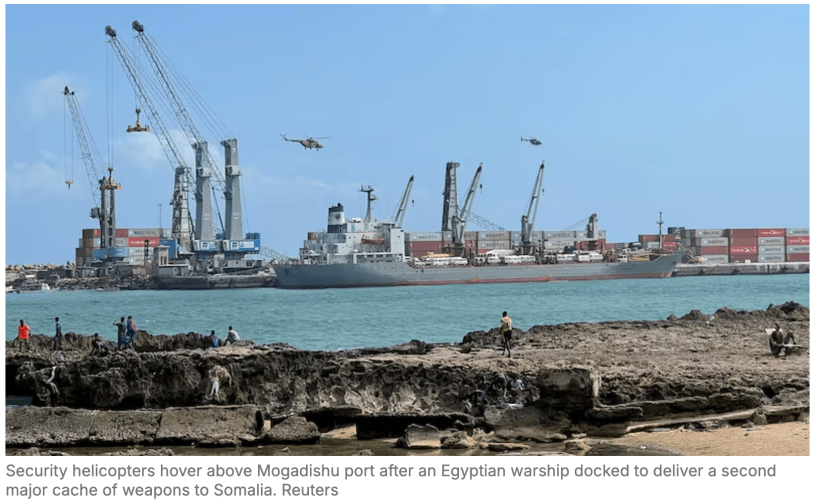
Two days after the Egyptian-flagged vessel unloaded its cargo in Mogadishu, Somalia on Monday, sources recounted to The National some of the precautionary measures put in place to ensure the cargo vessel reached its destination safely.
Yemen’s Houthis had to be briefed in advance to prevent the Al Hurreya 2 from meeting the fate of the scores of vessels the Iranian-backed rebels have attacked in solidarity with the Palestinians in Gaza. There was also the danger posed by Somali pirates in the southern part of the Red and Arabia seas.
Warships, including the locally made Gowind-class frigate in service since 2021, escorted the Al Hurreya 2 during its nearly 24-hour journey, which began in southern Egypt, the sources said. Helicopter gunships off one of the two French-made Mistral troop carriers Egypt has in its fleet took turns patrolling the skies above, according to the sources, who spoke on condition of anonymity.
Somali government troops patrol the Bondhere district of Mogadishu. AFP
The Al Hurreya 2 offloaded its cargo in Somalia’s capital which, according to the sources and media reports, included mortars, anti-aircraft guns, armoured personnel carriers, rocket launchers, ammunition and fuel.
The sources said this week’s military shipment to Somalia had long been in the planning, with Egypt discreetly and closely co-ordinating with authorities in Sudan, Eritrea and Djibouti, three countries on the Red Sea which have good relations with Egypt.
“Zero hour was a closely guarded secret,” said one of the sources. “The nature of the cargo was also a secret except to those who absolutely needed to know and could be fully trusted,” they added, citing prevailing tension in the Red Sea following the deployment of various warships to deal with Houthi attacks on shipping.
The Egyptian military also deployed special forces with counterterrorism training at the docks alongside Somali troops as the cargo was offloaded, the sources said. Somalia’s Defence Minister Abdulkadir Mohamed Nur was also present.
Second shipment
The shipment, the second in less than a month, was provided under the terms of a joint military co-operation accord signed by Egypt and Somalia last month. The provisions of the deal also stipulate for Egyptian military advisers to train Somali troops, conduct joint war drills and protect top government leaders and key installations.
As the case was with the first shipment, the second angered Ethiopia, whose relations with both Egypt and Somalia are fraught. News of the shipments also shook the established order in a Horn of Africa region scarred by civil wars, deeply rooted ethnic rivalries and terrorism.
Ethiopia’s Foreign Affairs Minister Taye Atske Selassie said he was concerned that arms from “external forces would further exacerbate the fragile security [in Somalia] and would end up in the hands of terrorists”, according to the Ethiopia News Agency. He was referring to the Al Qaeda-linked terrorist group Al Shabab.
In response, Somalia’s Foreign Minister Ahmed Moalim Fiqi said: “Ethiopia’s motivation behind these defamatory statements is its attempt to conceal the illegal smuggling of weapons across the Somali borders, which are falling into the hands of civilians and terrorists.” He did not elaborate.
The two shipments and the deployment of troops and advisers constitute the farthest-from-home military deployment by the most populous Arab nation since the Kuwait crisis in 1990-91, when Egyptian troops were part of a US-led, multinational coalition that threw the Iraqi army out of the oil-rich Gulf state.
They also underline Egypt’s growing resolve to pressure Ethiopia into entering a legally binding agreement on the operation and filling of a massive hydro dam Addis Ababa is building on the Nile that Cairo fears will reduce its vital share of the river’s water on which it depends for almost all its freshwater needs.
Unlike the case when the first arms delivery was airlifted to Mogadishu, the Egyptian government formally announced the arrival of the weapons on Monday, without giving further details.
The mammoth Grand Ethiopian Renaissance Dam (Gerd) project in Guba, Ethiopia. AFP
Historic relations
Egypt and Somalia are members of the Cairo-based Arab League and are bound by ties that date back to Pharaonic times. Somalia was one of only three Arab League members that did not sever diplomatic relations with Egypt when Cairo signed a peace treaty with Israel in 1979.
Somalia accuses landlocked Ethiopia of breaching its sovereignty when in January it agreed to lease 20km of coastline from Somaliland – a part of Somalia that claims independence and has operated with effective autonomy since 1991 – in exchange for possible recognition. In response, Somalia threatened to expel Ethiopia’s troops by the end of the year, who are there as part of a peacekeeping mission. Egypt says it will send a contingent of peacekeepers to replace the Ethiopians and that Somalia has already agreed.
In more than a decade of negotiations, Ethiopia has rejected proposals to resolve the dam dispute with downstream Egypt and Sudan, claiming at times that the construction and running of the dam is an internal matter or insisting that the dam will not hurt their interests.
What Cairo sees as Addis Ababa’s intransigence has prompted it to pursue stronger ties with Ethiopia’s neighbours and Nile basin countries. It provided them with technical assistance in various sectors, delivered humanitarian aid when necessary and concluded various levels of military co-operation accords with them.
 Martin Plaut