
Source: African History Extra
The role of firearms in African military history, and the guns of the Benin kingdom.
| ISAAC SAMUELOCT 27 |
“The Zulus appeared almost to grow out of the earth. From rock and bush on the heights above started scores of men armed, some with rifles others with shields and spears. Gradually their main body; an immense column: opened out in splendid order upon each rank and firmly encircled the camp from their heights above.”
The significance of firearms in the military systems of pre-colonial African societies has been the subject of much scholarly interest since the emergence of modern African historiography. From the collapse of medieval Songhai to the rise of the kingdoms of the Atlantic coast to the Ethiopian defeat of the Italians, firearms have acquired an outsized importance in mainstream discourse on African military history. In most popular narratives of African military history, the apparent lack (or abundance) of firearms is thought to have been decisive in the outcome of any historical battle.
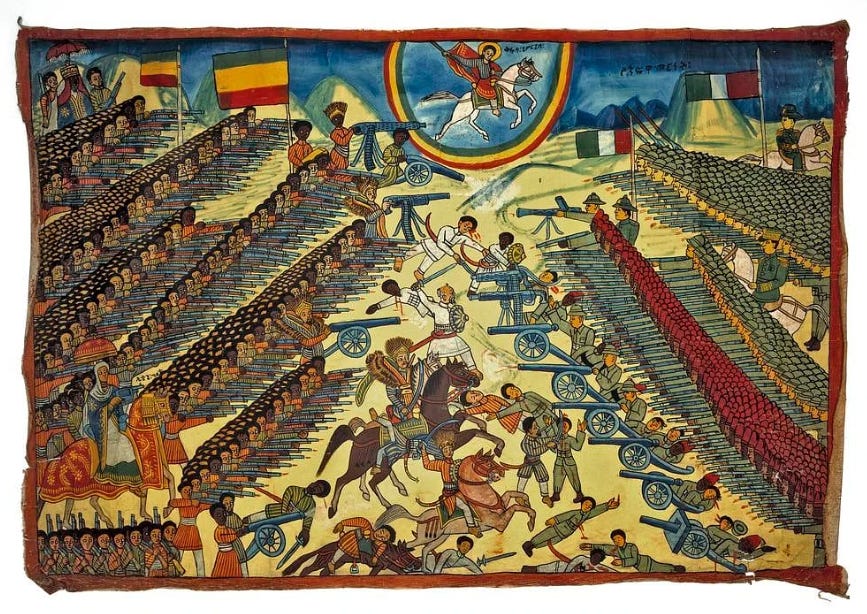
The Battle of Adwa (1896), oil on canvas painting by an Ethiopian artist, ca. 1940-1949. British Museum.
However, the history of firearms in African military history is a lot more complex than this superficial but popular view of pre-colonial war. As indicated by the above quote about the Zulu victory over the British at Insandlwana in 1879, firearms were added to the pre-existing arsenal of weapons and fighting formations whose evolution in the military history of the Zulu kingdom was determined by multiple cultural and political factors.
At Maputo Bay about 300km north of Isandlwana in 1554, another African army had defeated a band of shipwrecked Portuguese sailors in the open by “throwing so many spears that the air was darkened by a cloud of them.” A similar fighting formation was utilized further north by the Rozvi army of Changamire Dombo at the pitched battle of Mahungwe in 1684, where the Rozvi bowmen defeated the Portuguese by showering arrows at them.¹
By the 19th century, it wasn’t a hail of arrows nor a set-piece battle that the British would encounter, but a large Zulu force armed with tens of thousands of guns and spears, taking advantage of the bush cover to creep up the hill at Isandlwana before a final charge.
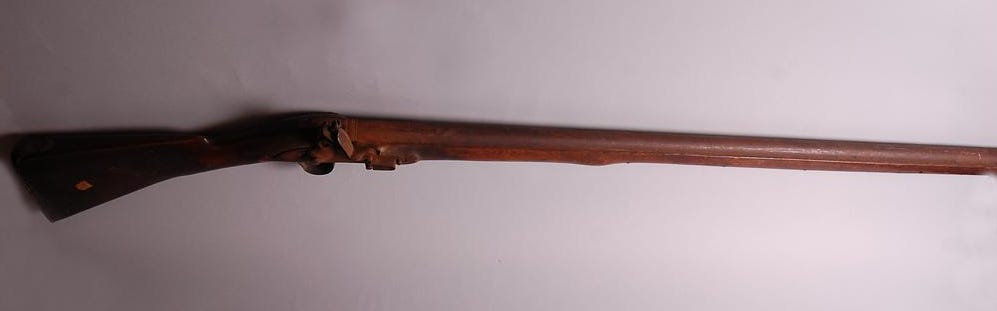
Flintlock smooth bore long-barrelled gun captured in South Africa in 1878. British Museum.
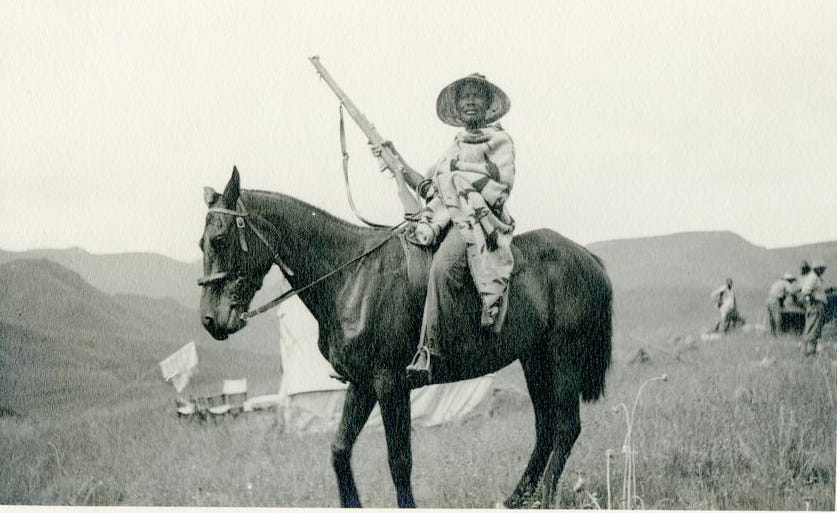
Man on horseback with a gun, Lesotho, ca. 1936. British Museum.
While firearms could sometimes decide the fate of battles, they were insufficient to win a campaign by themselves, nor were they solely decisive in influencing the evolution of African military systems.
The 16th-century account of the chronicler Ibn Furtu for example, includes descriptions of several campaigns by armies of the Bornu sultan Idris Alooma against the walled towns of the Lake Chad region in which firearms played an important role.
For example, during Bornu’s siege of the town of Amsaka, the latter’s forces “fired arrows and darts like heavy rain” and poured “pots of boiling ordure” on Bornu’s army until the latter constructed a siege platform on the town’s walls and its gunmen shot Amsaka’s archers such that the latter ran out of arrows just as Bornu’s forces were breaking through their walls. However, only four out of the dozens of battles in Ibn Furtu’s account were decided by firearms, leading one historian to conclude that Bornu’s military success “owed more to other devices than to guns.”²
This observation is corroborated in a much later account from the mid-19th century by the explorer Heinrich Barth, about Bornu soldiers opening fire against a group of island-dwelling Musgo warriors with almost no success. “It was astonishing to see that none of this small band of heroes was wounded, notwithstanding the repeated firing of a number of Kanuri people. Either the balls missed their aim entirely, or else, striking upon the shields of these poor pagans, which consisted of nothing but wicker-work, were unable to pierce this slight defence.”³
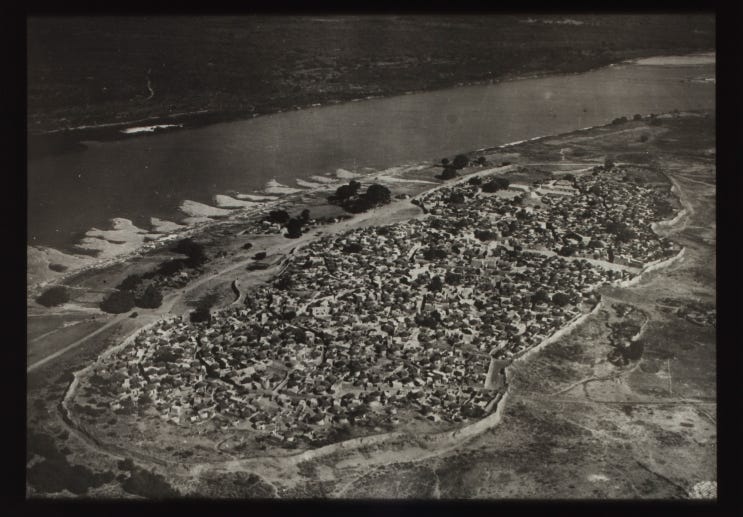
Walled town in the Lake Chad region, ca. 1936, Quai Branly.
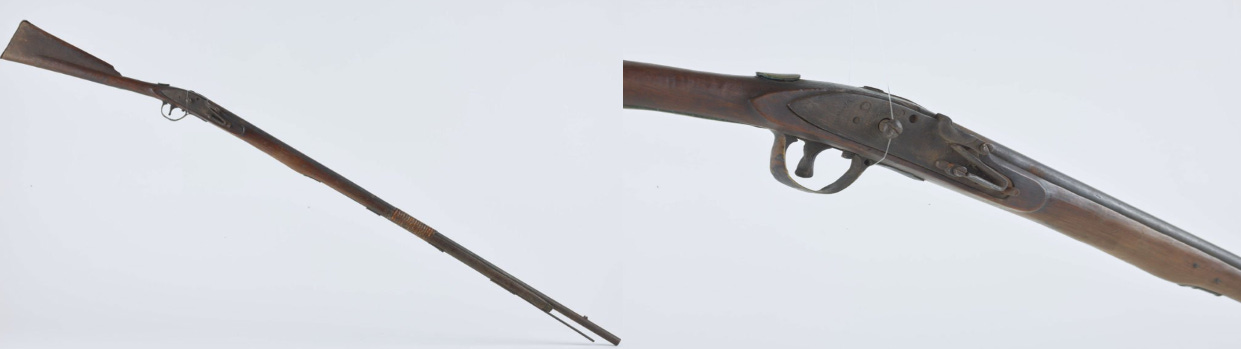
Rifle from Bornu, Nigeria, collected in 1905. American Museum of Natural History.
A brief outline overview of the history of African warfare provides several other examples of 16th-century African armies with no firearms defeating gun-wielding Portuguese armies —whether against large kingdoms like Mutapa or smaller groups like the Khoe-san warriors. At the same time, the musketeers of Bornu, Morocco, and the Portuguese were conducting successful campaigns in other parts of the continent.
Even after firearms were more widely adopted by the 19th century, with kingdoms such as Zinder making their own cannons, and Samory’s empire which manufactured modern rifles, successful campaigns were determined by multiple factors of which gun technology was only one among many, for example in the century-long Anglo-Asante wars.
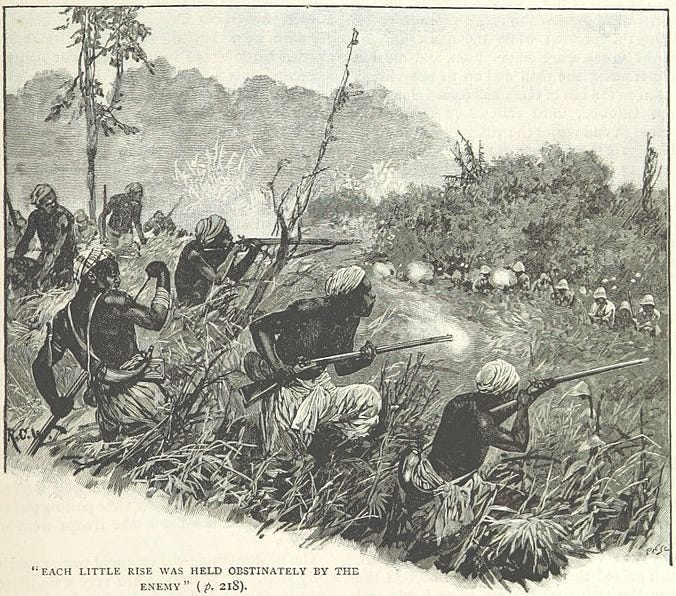
The 1874 Battle of Amoaful between the British and the Asante kingdom, British Library.
Statuette of a man aiming a musket and wearing a cartridge belt, ca. 1909, Dahomey, Benin. Smithsonian. Flintlock pistol covered with local copper alloy plates. ca. 1892 .Dahomey, Benin, Quai Branly.
The incorporation of firearms into African military systems was therefore a protracted process whose impact on the evolution of African military technologies, fighting formations, and warfare varied greatly between different societies in different time periods. Additionally, the function of firearms was at times ceremonial, they were considered a symbol of power that was displayed during important festivals, in diplomatic exchanges, and in royal iconography.
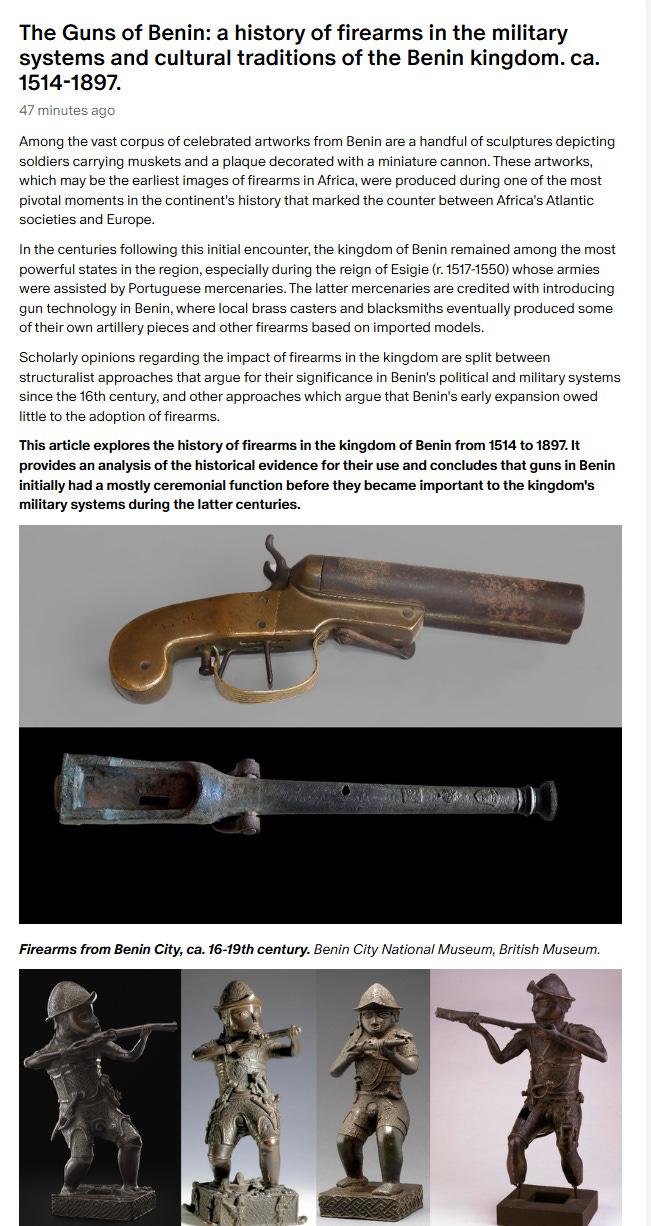
This dual function of firearms in the military and cultural spheres is best demonstrated in the West African kingdom of Benin whose armies were among the first on the continent to adopt firearms. From the manufacture of bronze cannons to the creation of artworks depicting armed soldiers to the trade in rifles, the Benin kingdom provides one of the best case studies for the evolution of firearms in pre-colonial Africa.
The history of firearms in the Benin kingdom is the subject of my latest Patreon article, please subscribe to read about it here:
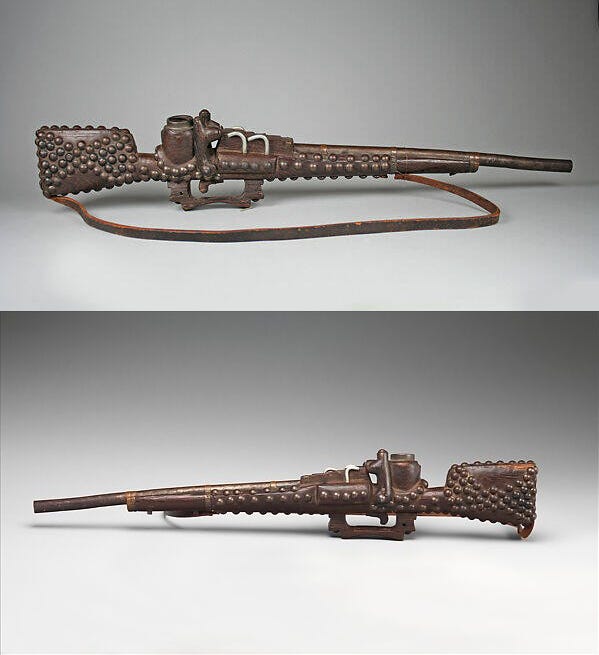
Smocking pipe in the form of a rifle covered with brass studs with a leather strap, late 19th century, Chokwe artist, Angola/D.R.Congo, Met Museum.
 Martin Plaut