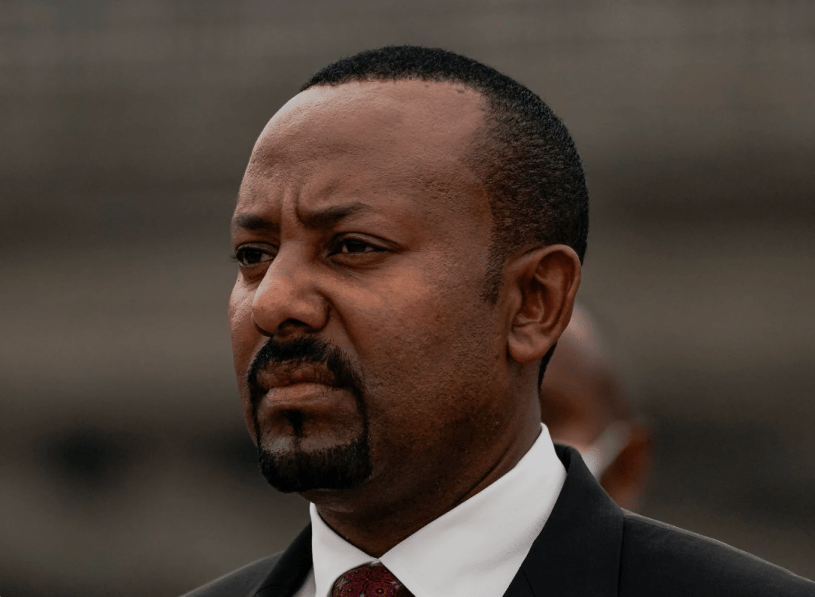
“Ethiopia has an unwavering national interest in the issue of a port; it is listening to the world’s call that it needs a peaceful strategy to acquire access to the Red Sea. But anyone who thinks we are fooling around regarding this issue or ignoring our seriousness concerning this issue is dead wrong.”
October 31
BBC Tigrinya reported that Prime Minister Abiy Ahmed of Ethiopia said that, “No one can invade Ethiopia by force, and we have enough capacity to repel any invaders”.
In his statement, he also spoke about Eritrea and Ethiopia’s need to access the Red Sea shores.
The Prime Minister said this while answering questions raised by members of the House of Peoples’ Representatives on Thursday.
Members of the House of Peoples’ Representatives who attended the conference had the opportunity to ask questions to the prime minister regarding the sensitive issue – acquiring access to Eritrea’s ports.
Furthermore, the members raised issues related to the country’s peace and security as well as economy and diplomacy.
As anticipated the prime minister chose to divide his answer and clarification into two parts.
In his response, Prime Minister Abiy gave a comprehensive security explanation, saying there were people who were concerned that “[other] countries might invade Ethiopia in its weakened state as it continues to fight off rebels in some parts of the country”.
“No one can invade Ethiopia by force today.
“Due to a gap in our defence, we have started producing our own weapons that we used to buy from abroad.
“We don’t go around provoking countries in our neighbourhood, but if they do provoke us, we will not show any mercy; we have nothing to fear,” he warned.
Although the council members did not raise any issues or express any concerns directly related to any invasion, the prime minister was heard saying, “Don’t worry, if any invader comes, we will shame him, but we will not incite any friction first.
Abiy briefed on issues related to Somalia, Eritrea and the Renaissance Dam.
“There have been accounts floating on the subject of Ethiopia agreeing to or is on the verge of appropriating land in Somaliland. FYI, we have only signed a 50-year lease. How can a 50-year lease be a land grab?” he said, scornfully.
The port acquisition agreement between Ethiopia and Somaliland last year has angered Somalia and subsequently relations between the two countries have been strained.
The tension has turned into an agenda that has dragged countries such as Egypt, which have disputes with Ethiopia, into uncalled for diplomatic wrangling.
Last month, the leaders of Egypt, Somalia and Eritrea signed a tripartite agreement in Asmara.
“We have no other agenda with Somalia. Our agenda is only to accommodate our economic growth and the increase of our people’s needs.
“The point we are making is that if Ethiopia, as big a country as it is, collapses then they will also perish. “
Prime Minister Abiy reiterated his position that “Ethiopia, since the declaration of Eritrean independence, which has been without a port for more than three decades, must have a gateway to the Red Sea.”
“Ethiopia has an unwavering national interest in the issue of a port; it is listening to the world’s call that it needs a peaceful strategy to acquire access to the Red Sea. But anyone who thinks we are fooling around regarding this issue or ignoring our seriousness concerning this issue is dead wrong,” he insisted.
Another issue raised by the Prime Minister is directly related to Eritrea.
Peace with Eritrea
“There are some rumours concerning Eritrea. We want peace. Unless something worse takes place [to provoke us], we will not do any harm against our Eritrean brothers on the basis of our own initiative,” he said.
After Abiy Ahmed came to power in the summer of 2018, a surprise peace and friendship agreement was signed in Asmara that changed the state of war between the two countries.
Two years later, both President Isaias Afewerki and Abiy Ahmed jointly fought against the TPLF during the bloody war that went on for two-years in Tigray.
However, the end of the war came with the signing of the Pretoria Agreement in early November 2022, which is said to have displeased President Isaias Afwerki of Eritrea.
In 2023, Prime Minister Abiy Ahmed’s similar statements about access to the Red Sea, which angered many Eritreans, may have complicated the relationship and obstructed progress that was expected to ensue in the region.
 Martin Plaut