
Steenhuisen is on the side of the angels when it comes to condemning Ramaphosa’s hero worship of the arch-villain in the Kremlin
31 October 2024 – 05:00
Source: Financial Mail by Chris Roper
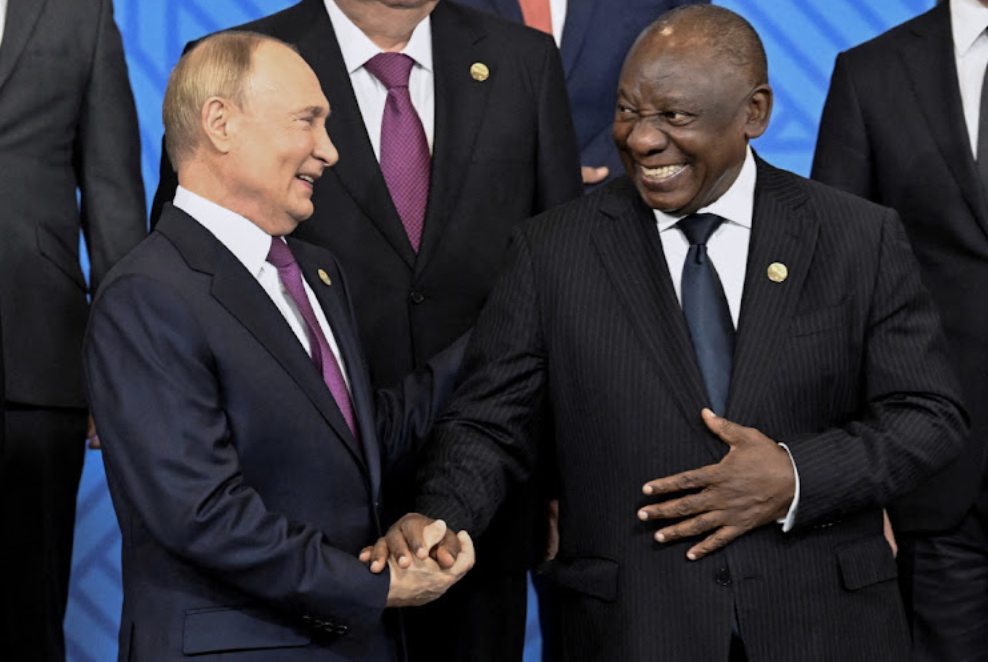
Russian President Vladimir Putin and President Cyril Ramaphosa at the Brics summit in Kazan, Russia, on October 24 2024. Picture: ALEXANDER NEMENOV/Pool via REUTERS
African countries have often been pawns in geopolitical skirmishes between the states of the Global North — the global minority, as many have taken to calling them. Which makes it mildly amusing that the ANC and the DA are trying to use Russia as a pawn in their own little hyperlocal Cold War.
Of course, there’s a very different power imbalance in this case. One doesn’t want to evoke the unlamented Orientalist past, but I can’t help remembering that old limerick about riding a tiger. It went something like this: “There was a young lady of Niger/ Who smiled as she rode on a tiger/ They returned from the ride/ With the lady inside/ And the smile on the face of the tiger.”
I remember it as a cautionary tale about thinking that you can tame a tiger. The odds are that when the ANC and the DA both have a stab at using President Vladimir Putin as a way to joust with each other, they’ll find that they’ve both been tokens in a game that will end with Putin taking advantage.
The DA at least has right on its side. The latest kerfuffle concerns statements by President Cyril Ramaphosa at a bilateral meeting ahead of the 16th Brics summit in Kazan, Russia. “We continue to see Russia as a valued ally,” he said, “as a valued friend who supported us right from the beginning, from the days of our struggle against apartheid. We are going to have important discussions here in Kazan within the Brics family.”
In response, DA leader John Steenhuisen penned one of his fulsome pieces, headlined “Putin is your ally, Mr President, not South Africa’s”. Before we discuss the merits of what he wrote, let’s take a moment to marvel at how Steenhuisen apparently thinks he has the right to speak on behalf of South Africa, at the same time as he tells Ramaphosa that he can’t do the same. But that’s the headline. The actual meat of the argument I find myself sympathetic to.
“We cannot and will not agree that South Africa should consider an authoritarian regime that is currently violating international law by waging an imperialist war of aggression against a sovereign state, as an ally.” He might have added: how can a democracy such as South Africa possibly seek common cause with a dictatorship that oppresses and kills its own citizens?
Here are some of the “highlights” of Amnesty International’s overview of Russia for 2023. Freedoms of expression, peaceful assembly and association were severely restricted, it states. “Government critics faced arbitrary prosecution, lengthy prison terms, violent attacks committed with impunity, and other reprisals. Authorities used extensive antiterrorism and anti-extremism legislation against opposition and religious groups, individual critics and lawyers. Torture and other ill-treatment in detention were widespread and largely went unpunished. Trials were unfair, especially in political cases and those involving Ukrainian prisoners of war. New transphobic legislation was adopted, and the so-called ‘LGBT movement’ was designated as ‘extremist’. Russia refused to co-operate with international human rights institutions and, after the ICC [International Criminal Court] issued an arrest warrant for Putin, criminalised assistance to it. Authorities failed to prevent antisemitic and anti-refugee violence.”
There’s a lot more like that, from the kidnapping of Ukrainian children to the poisoning of Russians in other countries. And recently, there’s Alexei Navalny, the Russian opposition leader and fierce critic of Putin, who died a desperate death in a remote penal colony north of the Arctic Circle where he was serving a long sentence. As Czech foreign minister Jan Lipavský is quoted by Al Jazeera as saying, Russia treats its citizens like it treats its foreign policy. “It has turned into a violent state that kills people who dream of a better future, like Nemtsov or now Navalny — imprisoned and tortured to death for standing up to Putin,” he said, referring to assassinated Putin critic Boris Nemtsov.
So no, Putin is not really someone you want to embrace as an ally. This doesn’t mean, as in the good ol’ days of the Cold War, that we then have to side with the US. That’s such a cliché of Putin’s influence operations (and China’s): not taking his side means that you’re automatically on the side of the West. It’s the kind of binary that the agents of misinformation thrive on, and you’ll see it play out in the political strategies of our own political parties.
It’s incredible how much adoration Survé lavishes on Putin — almost as much as he makes his poor reporters lavish on him
Ramaphosa’s characterisation of Russia as an ally in the anti-apartheid struggle conveniently elides the fact that Ukraine was part of the Soviet Union that helped in the fight against apartheid. In reaction to that, the DA has made the pointed remark that “Ukraine has always been an ally in the fight against the systemic disenfranchisement of South Africa’s black majority by the apartheid government. The move to grant visa-free access to Ukrainian diplomats, officials and servicemen and -women is a long overdue recognition of this country’s immense contribution to the fall of the apartheid state.”
Ramaphosa’s spokesperson, Vincent Magwenya, has done some nifty tap-dancing in an attempt to portray chumming up to Putin as essentially a neutral act. “In declaring President Putin and the people of Russia as ‘valuable friends and allies’, President Ramaphosa was not projecting any particular country or bloc of countries as the enemy. Similarly, as a country that has no enemies, South Africa regards the members of Brics as friends.”
But how long can you express solidarity with a dictator such as Putin before it turns to obeisance? An extreme example is the embarrassing way our favourite cartoon villain, Independent Media owner Iqbal Survé, has chosen to suck up to Putin.
In a recent puff piece headlined “Shaping Global Diplomacy: Dr Survé’s Crucial Talks with President Putin”, by one of IOL’s anonymous staff reporters (evidently too ashamed to put a name to the drivel Survé makes his editors publish), we are told about “the magnitude of Dr Survé’s influence — not just as a media owner, but as a key figure within Brics and the Global South”.
It’s all about a round-table that Putin held with Brics media representatives, and we are told that Survé’s participation “was no ordinary encounter. It was a symbol of his standing as an internationalist and a leader whose influence spans across continents. To sit across from President Putin, one of the most powerful figures in the world, is a privilege reserved for very few.”
It’s incredible how much adoration Survé lavishes on Putin — almost as much as he makes his poor reporters lavish on him. He actually compares Putin, a vicious dictator, with Nelson Mandela. “Every war must eventually end in peace. That is the lesson history teaches us. Mr President, can Brics, under your leadership, offer the world a ‘Mandela moment’ — a pivotal opportunity for reconciliation and peace, especially as conflicts around the globe intensify?”
None of this hyperbolic nonsense is true, and what we have here is a lickspittle in a baggy suit sucking up to Russia in his time off from sucking up to China. It’s illustrative of what happens when you entirely surrender to the worship of strongmen, purely because you think you’ll profit from it.
I can’t resist quoting a few more choice lines from Survé’s ridiculous attempt to hitch his malformed star to Putin.
“Just as Mandela’s legacy brought peace and reconciliation to South Africa, Brics has the opportunity to offer a new path forward for a world in turmoil. Dr Survé, with his unwavering commitment to justice and equity, is a powerful figure in this vision — a leader whose influence transcends borders, and whose presence in the Kremlin that fateful day reinforced his status as one of the most important voices in global diplomacy.”
This is cringeworthy stuff. But it’s where the path of placating evil political leaders ends up. It’s why we should react with disgust to our government’s attempts to paint the Russian invasion of Ukraine with the Trumpist “good people on both sides” brush. And why we are now looking to the DA to hold the line, even though we might suspect its reasons for doing so.
 Martin Plaut