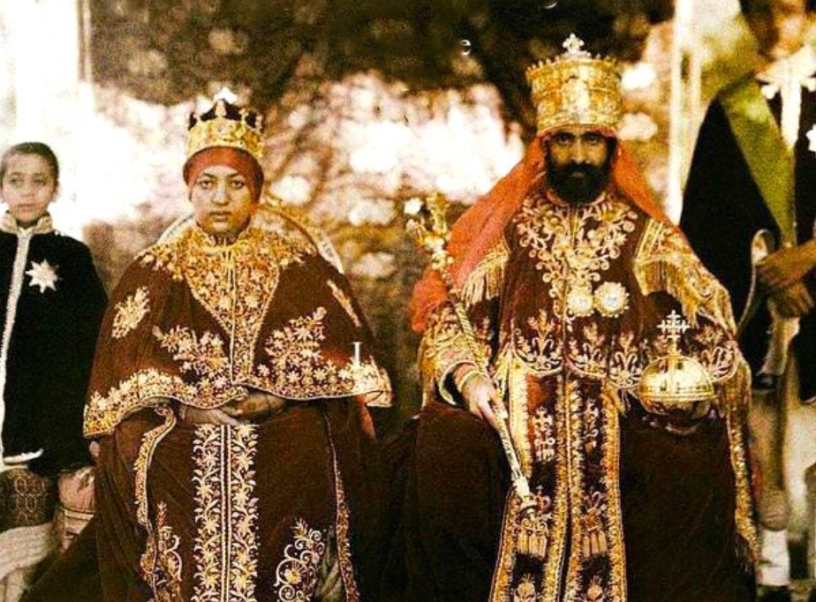
Enhancing and showcasing Ethiopia’s heritage is gratifying; one can only hope that the crown jewels and other wonders will be publicly displayed soon and won’t end up in a luxurious Gulf mansion or a Dubai foundry.
Publicising the Crown Jewels
Source: Dr. Charlotte Touati ,Sahan
On 31 October, during a parliamentary session, Ethiopia’s Prime Minister Abiy Ahmed revealed that 400 kilograms of gold from the under-renovation Jubilee Palace had been transferred to the central bank’s vaults. Beyond that brief reference, no further details were given.
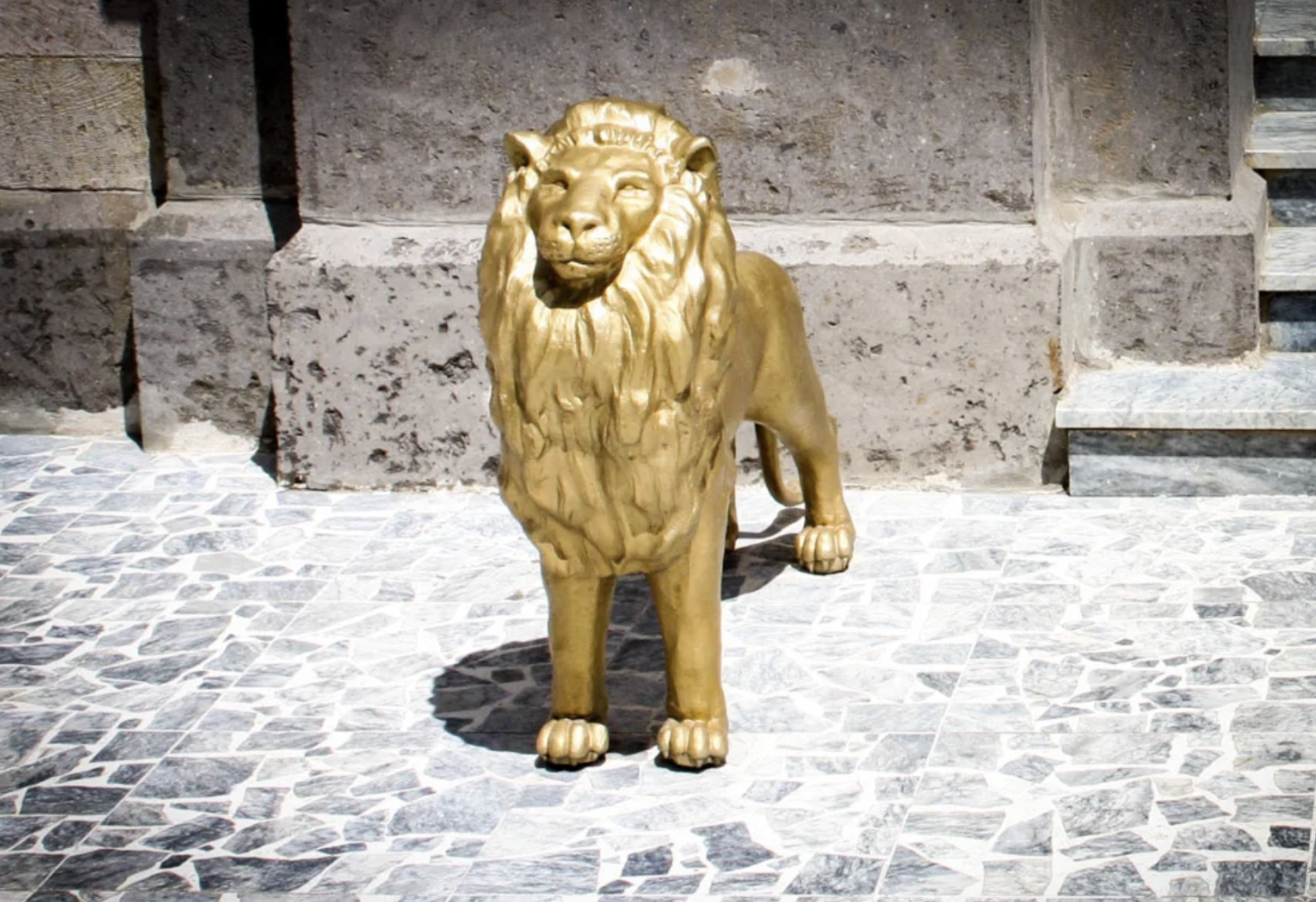
The cryptic statement raises a number of questions. First of all, the nature of the gold. Its relocation to the central bank immediately brings to mind images of vast quantities of bullion, but storing massive and non-monetisable ingots in the presidential palace makes little sense. And these ingots would have had to remain there for decades amid tumultuous changes of power and regime in Ethiopia. Instead, according to an official with ties to the Jubilee Palace, these are jewelled pieces, including candlesticks, ceremonial lighting, diplomatic gifts – anything that might add to the splendour of an imperial palace. If 400 kilograms of gold bullion is worth around USD 33 million, the same value in works of art is, strictly speaking, priceless.
Constructed in 1955 to mark Emperor Haile Selassie’s 25-year reign, the Jubilee Palace became his principal residence of imperial pomp and the setting where the ‘King of Kings’ celebrated his controversial 80th birthday in 1972. In the midst of the international elite, the festivities were said to have cost some USD 35 million while famine raged in the Wollo, mostly today’s Amhara region. The episode was never forgiven, and two years later, Haile Selassie was deposed by military officers on 12 September 1974, paving the way for the establishment of the communist Derg regime. The overthrown emperor was then held under house arrest in the renamed ‘National Palace,’ where he was most likely murdered. Haile Selassie’s body was entombed in the palace until 1995 when the emperor’s remains finally received funeral honours.
Symbols of the reviled Ethiopian empire, the numerous treasures within the palace were first neglected by the Derg, then, from 1991, by the Ethiopian People’s Revolutionary Democratic Front (EPRDF). But they were neither squandered nor sacralised, seemingly just forgotten. However, with the arrival of the incumbent PM Abiy Ahmed in 2018 and his subsequent reinvesting in Ethiopia’s imperial myth, these highly symbolic objects have been fetched out of the closets of history and put to use, for better or worse. In 2019, with international spirits still high about the transition of power from the Tigray People’s Liberation Front (TPLF), on the occasion of French President Emmanuel Macron’s visit to Ethiopia, it was decided that the Jubilee Palace would be renovated with the support of the French Development Agency (AFD). The AFD agreed to stump up a EUR 85 million sovereign loan combined with a 15 million technical assistance program to support economic reforms, which were frozen in 2021 due to the Tigray war and the risk of financial default.
The vision has been to transform the Jubilee Palace into a formidable museum akin to an Ethiopian Versailles. With this in mind, on 17 October 2024, a Council of Ministers session was exceptionally held in the Jubilee Palace, now the presidential residence, and not in the Prime Minister’s office as usual. Vintage vehicles ranging from adorned carriages to Rolls Royce’s were displayed in a dazzling museography at the meeting less than two weeks before the parliament announcement that the gold would be transferred. But the meeting at the palace was more than just a venue change; it was a signal of the usurping of Ethiopia’s Head of State by the Head of Government. The appropriation of the imperial crown jewels was regarded by the entourage of former President Sahle-Work Zewde as a personal attack, the culmination of a process that saw her ousted on 7 October and replaced by former Foreign Minister Taye Atske-Selassie from Abiy Ahmed’s inner circle.
Sahle-Work Zewde served notice of her removal with a message on X, formerly Twitter, with a quote from Mahmoud Ahmed’s song, “Silence is my answer, I tried it for a year.” Her comments have been widely interpreted as a signifying her disapproval of the warmongering policies of the Prosperity Party government in Amhara and Oromia. It’s worth noting, however, that her silence has lasted four years, as she refused to speak out about the atrocities of the Tigray war. Silent protest rarely works for a Head of State.
Nevertheless, it is pertinent to consider these events amid the brutal conflict in the Amhara region. The opening of the Jubilee Palace, the boisterous display of cars, and the appropriation of gold a few months after the destruction of the historic Piassa district in Addis can be understood as attacks on Amhara heritage, a way of capturing it to better exalt a new monarch. And this modern-day king will have his own palace, a USD 10bn complex on the heights of Yeka, overlooking an upturned capital, a sort of amusement park where visitors can tour a sanitised and polished version of Ethiopian history.
Beyond the storing of imperial gold in the national coffers, the Prosperity Party government has sought to deploy or weaponise swathes of Ethiopian history. The destruction of the Piassa and the rebuilding of a glittering new Adwa Museum nearby to commemorate the famous victory over the Italian invaders in 1896 best encapsulates this two-handed feint. While the AFD may revive its grant for restoring the palace, during the Tigray war, untold ancient manuscripts, storied monasteries, and religious figures were systematically stolen or killed by the Amhara militia, Ethiopian troops, and particularly the Eritrean army. And another troubling episode regarding gold in the capital should be brought to light, which occurred just a couple of days before the war’s end and precisely two years before the Jubilee Palace affair. On 31 October 2022, employees of the Ethiopian Central Bank went on a tour of Addis Ababa jewellers, escorted by federal police officers, to requisition gold jewellery to support the war effort.
The buildings can be renovated, and the cars put on display, but gold can be pawned. It has been apparent for some time that the aptly named Prosperity Party government has an insatiable thirst for gold and money. While the Palace’s gold was being transferred to the coffers of the National Bank of Ethiopia, the AFD announced the resumption of sovereign loans to the Ethiopian government. One just hopes for a coincidence! This gold could serve another purpose– a guarantee for the United Arab Emirates, which has invested immense sums in Ethiopia, including reportedly financing the PM’s new pharaonic palace. Dubai remains one of the key financial centres for the buying and selling of gold from dubious sources, including war-torn Sudan. Meanwhile, the Emirati money dispensed to Abiy Ahmed has been considered his slush fund to spend as he pleases.
Enhancing and showcasing Ethiopia’s heritage is gratifying; one can only hope that the crown jewels and other wonders will be publicly displayed soon and won’t end up in a luxurious Gulf mansion or a Dubai foundry. And if they are temporarily pledged, why not? The commons for the commons, but not to finance more conflict or another palace in a country where mass hunger still exists, and health and educational needs remain colossal. The shine and fall of Haile Selassie’s empire is instructive in this regard.
Dr. Charlotte Touati is an affiliate researcher with the IRSB, Christian apocryphal literature and early Christianity, Faculty of Theology and Religious Studies, University of Lausanne, Switzerland.
 Martin Plaut