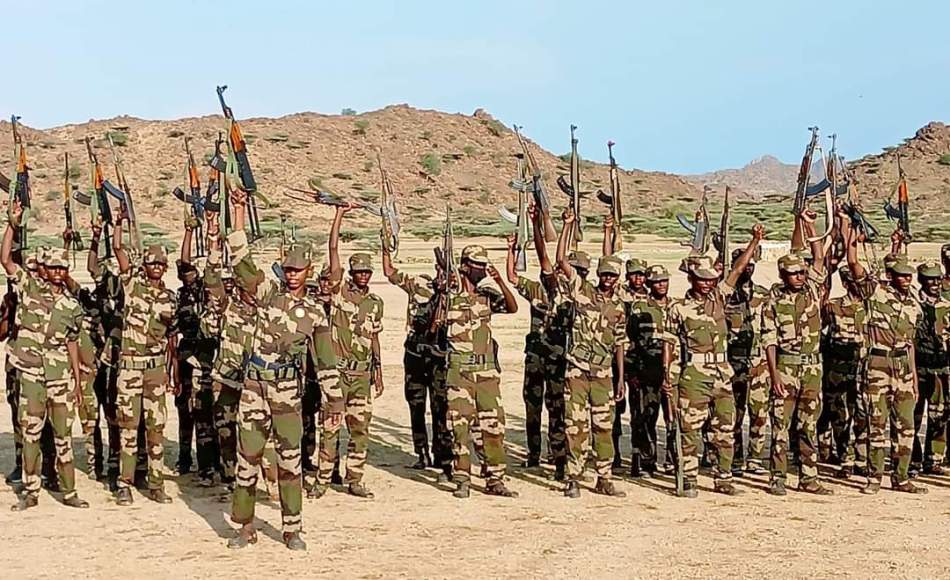
November 1, 2024 (KASSALA) – The deployment of a new armed militia in eastern Sudan is stoking fears of a broader conflict, with local tribal groups denouncing the move and threatening to escalate tensions.
The group, which calls itself the Eastern Cohort, announced on Oct. 29 that it had deployed forces to Kassala State after undergoing training at an undisclosed location. The militia is affiliated with the Popular Front for Liberation and Justice, led by Amin Daoud, a signatory to the 2020 Juba Peace Agreement.
Source: Sudan Tribune
Militia’s arrival in eastern Sudan raises fears of wider conflict
Eastern Cohort forces in in Kassala state
November 1, 2024 (KASSALA) – The deployment of a new armed militia in eastern Sudan is stoking fears of a broader conflict, with local tribal groups denouncing the move and threatening to escalate tensions.
The group, which calls itself the Eastern Cohort, announced on Oct. 29 that it had deployed forces to Kassala State after undergoing training at an undisclosed location. The militia is affiliated with the Popular Front for Liberation and Justice, led by Amin Daoud, a signatory to the 2020 Juba Peace Agreement.
“The deployment of our forces in eastern Sudan came at the request of all parties in the region,” Humad Shiblalla, assistant commander of the Eastern Cohort, told Sudan Tribune. He added that the move followed consultations with the Sudanese Armed Forces and that the militia’s forces were now integrated into the army.
Shiblalla said the deployment of thousands of troops was aimed at “protecting the land and honour” and that the soldiers had received intensive military training. He dismissed those opposing their presence as “paid voices driven by a foreign agenda.”
However, the deployment has been met with fierce resistance from the Beja people, the dominant ethnic group in eastern Sudan.
“The deployment of the Eastern Cohort forces in our lands is a declaration of war between the Beja and the remnants of what I describe as the Eritrean opposition,” Sayed Ali Abu Amina, political secretary of the High Council of Beja Nazirs and Independent Columns, told Sudan Tribune. He vowed to confront the militia and prevent it from establishing a military presence in the region.
Abu Amina warned of a looming security crisis in eastern Sudan, citing tensions between the Beja and a group he described as “naturalized,” which he accused of being allied with the Eastern Cohort. He claimed the militia had received training in Eritrea and was operating under the command of Minni Arko Minawi, leader of the Sudan Liberation Movement.
Abu Amina considers the Eastern Cohort a “foreign force” with leaders drawn from the Eritrean opposition, alleging they were integrated into Beja lands during the former regime of Omer Hassan al-Bashir and granted citizenship illegally.
He also accused Daoud of being wanted for murder and inciting strife in the Beja lands. “Now that he has been armed and mobilized in Eritrea and sent to Beja land under the cover of the joint forces, this will blow up the situation and strike the east,” Abu Amina said.
This development comes amid reports that the Sudanese army plans to deploy thousands of fighters from eastern Sudan to replace Darfuri armed movements currently securing vital sites in Port Sudan, where most government institutions have been relocated because of the ongoing conflict between the army and the Rapid Support Forces.
Eritrea’s Role in Sudan’s Conflict: a Ticking Time Bomb
August 12, 2024 | Atar Team

The international community is closely monitoring the volatile military developments in eastern Sudan following the eruption of hostilities between the Sudanese Armed Forces and the Rapid Support Forces (RSF) on April 15, 2023. Deepening anxiety is driven by the intensifying tribal militarization, significantly backed by the Eritrean government. This escalation is particularly disconcerting as the conflict has expanded beyond its initial battle zones inSudan capital and is now encroaching upon central Sudan, including Al-Jazirah State and parts of Sinnar State, edging dangerously close to the eastern territories.
This maneuver, synchronised with civilian mobilisation campaigns to counter the burgeoning influence of the militias, has garnered unequivocal support from the Sudanese Armed Forces. Observers suggest that the inception of these movements may have been orchestrated through a collaborative effort between Sudanese and Eritrean intelligence services, prompted by Eritrea’s heightened concern over the potential ramifications of the war spilling into its borders.
Reports of Sudanese armed movements establishing training camps within Eritrean territory surfaced a month after the RSF seized control of Al-Jazirah’s capital
Reports of Sudanese armed movements establishing training camps within Eritrean territory surfaced a month after the RSF seized control of Al-Jazirah’s capital, leading to the Sudanese army’s retreat and their subsequent advance toward the fringes of Al-Gedaref State by the end of December 2023.
These reports highlighted the formation of military training camps by the Sudan Liberation Movement, under the leadership of Minni Arko Minnawi, and the Popular Front for Liberation and Justice in Eastern Sudan, led by Al-Amin Daoud, within Eritrean territory, allegedly with the backing of the Sudanese Armed Forces. However, sources within Eritrean intelligence suggest that Eritrea’s strategic focus was primarily on arming tribal factions with deep-rooted cross-border connections, particularly by consolidating elements from the Beni Amer tribe into a newly formed armed force.
Subsequently, a new military entity has emerged, identified as the “Eastern Sudan Liberation Forces,” under the command of Ibrahim Dunia—a prominent figure in Kassala State. Dunia, who previously served in the Sudanese police force before migrating to Qatar and joining the Qatari police, returned to Sudan following the outbreak of the conflict.
A new military entity has emerged, identified as the “Eastern Sudan Liberation Forces,” under the command of Ibrahim Dunia—a prominent figure in Kassala State
Eritrean patronage
Under full Eritrean sponsorship, Ibrahim Dunia’s movement held its inaugural conference from May 10 to 13, 2024, at their camp near the village of Tamrat, just within Eritrean borders. The Eritrean government made a prominent appearance, along with several figures representing Sudanese political parties and armed movements, notably in the absence of any official Sudanese government representation. The “Eastern Sudan Liberation Forces” are estimated to number around 2,000 fighters, primarily drawn from the Beni Amer and Habab tribes. During the conference, Ibrahim Dunia stated that the formation of the movement was driven by the increasing violations committed by both sides of the conflict, with the goal of protecting the people of eastern Sudan and defending their land and honor.
Journalist and writer Jamal Hamad, editor-in-chief of the “Adoulis” website, explained to “Atar” that Eritrean President Isaias Afwerki has always been deeply concerned about any political or military developments in eastern Sudan, given the ethnic ties and geographical proximity to western Eritrea. Hamad highlighted that eastern Sudan played a significant role in supporting the Eritrean revolution for over three decades during the armed struggle.
Hamad further elaborated, saying, “Isaias is keen to prevent any destabilization in eastern Sudan. To this end, he supports armed movements through training and arming, especially amid internal tensions due to the lack of justice in the distribution of power and wealth in Eritrea.” He added that the realization of political rights by the people of eastern Sudan poses a constant threat to Isaias’s regime. “Afwerki thrives in an atmosphere of wars and unrest; any peace or peaceful struggle that leads to democratic governance is seen as a direct threat to his existence,” Hamad remarked.
Eritrea’s government has previously hosted Sudanese opposition groups in the 1990s, establishing camps in eastern Sudan that served as launching points for military operations against the regime of Omar al-Bashir, who was eventually ousted in April 2019 following the December revolution. Eritrean forces were the de facto support for any military operations conducted by the National Democratic Alliance forces.
Shifting Stances
The Eritrean position initially appeared to be in complete harmony with the Sudanese government, which had begun reaching out to the leadership in Asmara to collaborate against the expansion of the RSF towards the east. Eritrea’s support for the Sudanese government was motivated by concerns for its national security and its western borders. However, Eritrea quickly extended its patronage to other movements alongside the “Eastern Sudan Liberation Forces,” including the “Beja Congress Forces” led by Musa Mohamed Ahmed, primarily composed of the Beja tribes; the “Eastern Battalion Forces” under Al-Amin Daoud, comprising members of the Beni Amer tribe; and the “National Movement for Construction and Development” led by Mohamed Tahir Suleiman Betay, whose forces are drawn from the Jumayl’ab branch of the Beja tribes, based in the areas of Hamashkoreb and Telkok near the Eritrean border, maintaining ongoing contact with Eritrean authorities.
According to the Sudanese News Agency (SUNA), General Abdel Fattah al-Burhan, Chairman of the Sovereignty Council and Commander-in-Chief of the Armed Forces, visited the Hamashkoreb area in early April, urging the local population to continue “praying for the victory of the armed forces in their battle against mercenaries and rebels.”
Sources close to Eritrean intelligence told “Atar” that a significant shift has occurred in the Eritrean government’s stance on the conflict in Sudan. Eritrea has now decided to adopt an equidistant position from both the Sudanese Armed Forces and the RSF, with its next steps including the unification of the four armed factions under a single command.
Before this latest development, the sources revealed that the Eritrean Defense Forces had allocated a military unit of 5,000 soldiers to provide support should the situation on the ground in Sudan escalate and the RSF approach eastern regions. Eritrea had already dispatched an advanced reconnaissance unit earlier to assess the situation around the bridges on the Atbara River.
New Developments
The recent expulsion of the Sudanese chargé d’affaires from Eritrea At the end of last July marked a notable turning point in the relations between the two countries
The recent expulsion of the Sudanese chargé d’affaires from Eritrea At the end of last July marked a notable turning point in the relations between the two countries, particularly given the already tense regional climate. The Sudanese Foreign Ministry later confirmed the incident.
Speculation has run rampant in the wake of Asmara’s silence on the reasons behind this abrupt decision. Some analysts suggest it may be linked to rumors of Sudanese government ties with Tigrayan fighters, who are allegedly involved in the conflict alongside the Sudanese army against the RSF. Others speculate that the issue may relate to the ambassador imposing fees on Sudanese nationals in Eritrea at a time when the host country had waived all fees in solidarity with Sudan’s wartime conditions.
However, former Eritrean diplomat Fathi Osman, who resides in Paris, offered his own interpretation in a Facebook post, suggesting that there were leaks indicating the Sudanese diplomat had been recruiting informants to spy on the training of armed groups at the Sawa camp in western Eritrea. Sawa is the main training camp for the Eritrean Defense Forces. Osman noted that such actions are unacceptable to the Eritrean authorities and are considered a breach of diplomatic duties, emphasizing that diplomatic norms and practices require diplomats to observe and report any activities that may threaten their country’s security, but through proper diplomatic channels.
The expulsion of the Sudanese chargé d’affaires, with a 72-hour deadline to leave Asmara, coincided with a meeting between Eritrean President Isaias Afwerki and tribal leaders from eastern Sudan, whose forces are currently training on Eritrean soil, including Chief Mohamed Al-Amin Tirik, the paramount leader of the Hadendowa tribe.
The Armament of Eastern Sudan and its Implications
Growing anxieties are mounting over the militarisation of tribal groups in Eastern Sudan, particularly regarding the profound and long-term ramifications. Khalid Mohamed Taha, the expert on the Horn of Africa, elaborated to “Atar” that the proliferation of armed factions and the diverse array of fighters now entrenched in Eastern Sudan are merely manifestations of a much deeper crisis. This crisis is characterized by the unbridled spread of weaponry, the reckless mobilization of forces, and a stark neglect of the region’s fragile security infrastructure and the delicate social fabric that binds the various communities across the three states of Eastern Sudan. The situation threatens to escalate further with the influx of tens of thousands of displaced persons fleeing the violence in other regions of the country.
“The issue extends far beyond civilians arming themselves as a means of protection or to ward off potential threats—especially in the aftermath of targeted attacks on civilians, their properties, and their dignity in the war-torn states,” Taha articulated. “The peril truly manifests when these arms are wielded to assert dominance, engage in acts of aggression, enforce political ideologies, or impose control through sheer force.” He underscored the critical need to reassess the scale, armament, and influence of the myriad armed factions proliferating in Eastern Sudan, which currently number around 18. The majority of these groups profess allegiance to the Sudanese Armed Forces, though the veracity of such claims remains to be scrutinised.
Political activist Khalid Mohamed Nour further contextualized the armed mobilization in Eastern Sudan as an inevitable consequence of the current crisis. “It is well-known that numerous armed movements have emerged in Eastern Sudan during the ongoing conflict, with many establishing recruitment camps and graduating cadres of fighters,” Nour observed.
It is well-known that numerous armed movements have emerged in Eastern Sudan during the ongoing conflict, with many establishing recruitment camps and graduating cadres of fighters
Yet, Nour distinguished the “Eastern Sudan Liberation Movement,” which recently convened its inaugural conference, as the most promising force with the potential to effect meaningful change. He commended the movement’s incisive analysis of the fallout from the April 15 conflict, considering it a solid foundation for future engagements. However, he emphasized that the movement must now formulate a comprehensive political agenda to guide its alliances and rectify the current imbalance, where the primacy of armed struggle overshadows the need for a coherent political strategy.
Nour also pointed out that the movement’s leadership stands apart from the traditional political establishment that continues to dominate the landscape of both new and old movements in Eastern Sudan—figures such as Musa Mohamed Ahmed and Al-Amin Daoud being emblematic of this entrenched order. He stressed the paramount importance of peaceful, civilian political engagement, warning against the perils of ignoring the pervasive militarization that is currently sweeping the nation.
Jamal Hamad, however, perceived the situation in Eastern Sudan as a continuation of the tragedy that unfolded in Darfur, where legitimate grievances were co-opted by political actors and armed movements for self-serving purposes, leaving the people and ethnic communities of Darfur to bear the catastrophic consequences. Hamad cautioned that the presence of these armed movements would only exacerbate the already volatile situation in Eastern Sudan, serving as a tinderbox for further tribal and ethnic conflicts that have long plagued the region. He added that these movements reflect deep-seated divisions within the same community, often exacerbated by external influences such as those of Isaias Afwerki.
In alignment with this perspective, Khalid Taha warned that the ongoing arms race in Eastern Sudan would inevitably lead to an intensification of conflicts, regardless of any superficial semblance of unity among these groups at present. “There is indeed a necessity for armament,” Taha conceded, “but not on the basis of ethnic or regional alignments. The true imperative lies in concerted efforts to halt the war, forge a comprehensive national Sudanese project, address the critical issues of equal citizenship rights, establish a fair system for the transfer of power, build institutions of popular governance, and lay the foundation for a just social contract under a permanent democratic constitution.”
Eritrea military training camps raise concerns about security in eastern Sudan
Source: Dabanga
26/01/2024 14:16 AMSTERDAM
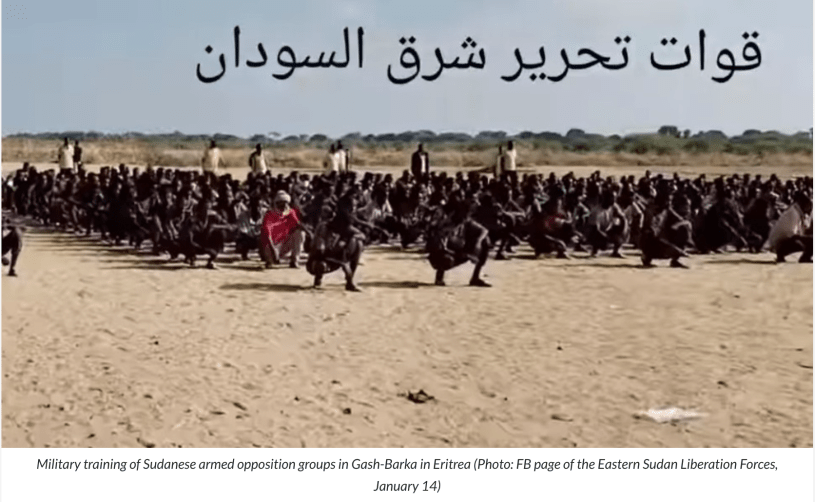
Military training of Sudanese armed opposition groups in Gash-Barka in Eritrea (Photo: FB page of the Eastern Sudan Liberation Forces, January 14)
The ongoing militarisation and increased armament of ‘popular resistance’ groups in eastern Sudan has raised fears about renewed tribal conflicts in the region. The establishment of training camps by armed movements from eastern and western Sudan in Eritrea only increases the concerns.
Military sources told Radio Dabanga yesterday that six training camps have been established in the Eritrean Gash-Barka region neighbouring Sudan, by five armed groups from eastern Sudan and a sixth from Darfur.
The groups include the recently established Eastern Sudan Liberation Forces, the United Popular Front for Liberation and Justice under the leadership of El Amin Daoud, the Beja National Congress led by Mousa Mohamed Ahmed, the Beja Armed Congress headed by Omar Taher, and the Darfuri Sudan Liberation Movement faction led by Minni Minawi (SLM-MM).
Activists, journalists, and researchers have warned of the dire consequences of setting up military training camps in neighbouring countries, as the social and political effects in eastern Sudan (Red Sea state, Kassala, and El Gedaref) may be catastrophic.
Journalist and head of the National Press Council, Hossameldin Haidar, told Radio Dabanga that he considers the training camps a threat not only to security and stability in eastern Sudan, but also to the security of the entire country in light of the ongoing war between the Sudan Armed Forces (SAF) and the Rapid Support Forces (RSF). “The ongoing militarisation could not only fuel tribal conflicts, but also lead to the disintegration of the country.”
Political activist Khaled Nour agrees with Haidar regarding the danger of tribal polarisation in eastern Sudan, and the waves of ethnically based fighting in the region has witnessed in the past few years. “Since 2019, more than 11 violent tribal clashes erupted, which claimed hundreds of lives.”
Nour also does not rule out that the groups now training in Eritrea will lose their independence. “Having camps abroad will certainly lead to the dependence of these forces on the conflicting regional axes, especially as each country has its own interests and cannot provide facilities without expecting loyalty in return.”
Abu Fatima Onur, researcher and director of the Centre for Tracking Studies, however, downplays the impact of training camps on social reality. “The tribal conflicts that took place in the region in the past few years were artificial and aimed to hinder the December Revolution. Evidence of this is that the conflicts were confined to cities and towns and did not spread to villages,” he told Radio Dabanga.
Armed groups in Eritrea
The youngest group is the Eastern Sudan Liberation Forces, established in end December, following the ‘fall of Wad Madani’, capital of central Sudan’s El Gezira, to the RSF.
The movement’s leader, Ibrahim Abdallah (better know as Ibrahim Dunya) announced in video clips in front of his forces at the time that their goal is to defend civilians in the event of an extension of the war in the East and “to deter violations similar to what happened in Wad Madani after the army’s withdrawal”.
The United People’s Front for Liberation and Justice splinter faction of the Eastern Front, led by El Amin Daoud since its formation in 2013, also established a similar camp in the Eritrean Gash Barka region and began attracting soldiers to the camp.
El Amin Daoud is a member of the Forces for Freedom and Change-Democratic Bloc, which has declared its bias towards the army since the outbreak of the war.
According to relevant sources, the list of movements with training sites in Eritrea, also includes the National Beja Congress. Headed by Mousa Mohamed Ahmed, assistant to former President Omar Al Bashir, the group is mobilising veterans to join the training.
Other groups are the military wing of the Beja Congress, a group led by Mohamed Tahir, who is close to religious leader Suleiman Beitai, head of the Hamashkoreib Quran schools, and a fifth group that does not carry a specific name and recruits most of its combatants from Red Sea state.
Hundreds of fighters of the Darfuri SLM split-off faction under the leadership of Minni Minawi, governor of the Darfur region since April 2021 are receiving “advanced training” in Eritrean camps. The SLM-MM in November announced its alignment with the SAF and its explicit opposition to the RSF, after it had been neutral for a long time.
Imminent tribal conflicts
Political activist Khaled Nour attributes the increased armament of civilians in eastern Sudan and the establishment of military camps in Eritrea not only to tribal polarisation and the threat of the RSF taking control of the region, but also to the regional interest in eastern Sudan.
“Eastern Sudan has a geostrategic importance, with its sea ports along the long coast in Red Sea state, in addition to the rich resources in the region.”
The eastern parts of the country “have not yet recovered from civil strife,” he told Radio Dabanga. “Fears of regional interventions and the increase of lethal weapons will lead to an exacerbation of tribal conflicts, especially in light of the failure to address the roots of the problem.
“Both eastern Sudanese armed movements and popular resistance groups lack consideration for the social fabric in the region. Their recruiting of tribal fighters will lead to the creation of new loyalties on an ethnic basis, which raises fears of renewed tribal conflicts and pushes other groups to intervene, especially the RSF. Inter-community conflicts in eastern Sudan could turn into a time bomb.”
He further noted that the camps have not been established inside Sudan, as “the groups prefer to remain independent, especially in light of the SAF restricting its training to its veterans, new recruits, and supporting forces, and under its supervision”.
Haidar said that “the establishment of the “Hodeida camps” in Eritrea “trigger new societal tensions and disintegration in eastern Sudan”.
Moreover, “the entry of new parties into the Sudanese war will only deepen the crisis,” he said, and also warned of “the impact on neighbouring countries, especially Ethiopia and Eritrea, in light of the crises witnessed in the Horn of Africa”.
Disciplined
According to researcher Abu Fatima Onur, most of the fighters in the training camps are former rebel combatants. “They are well-disciplined forces.”
He downplayed potential security threats for the region. “, he said that the camps are located near the border with Sudan, not in the Eritrean interior.
“Most of the participants are soldiers who were previously integrated into the security system. In addition, the training operations are not aimed at biasing towards a particular group, but rather to protect civilian lives and the stability of eastern Sudan.”
Onur believes that weapons have been widespread in eastern Sudan “since World War I and II and the Eritrean-Ethiopian war that lasted for three decades.
“This was followed by the outbreak of battles between the Salvation Government [of Omar Al Bashir] and opposition forces on the eastern front.”
On September 18 last year, a brief exchange of gunfire between the Sudan Armed Forces (SAF) and combatants loyal to Dirar Ahmed Dirar, known as Sheiba Dirar, head of the Alliance of Eastern Sudan Parties and Movements, took place in Port Sudan, capital of Red Sea state – where the de facto government has moved to since violence battles between the SAF and RSF erupted in Khartoum five months before.
Eritrea’s role
The United People’s Front for Liberation and Justice faction led by Khaled Shaweesh* described the establishment of the camps as an unfortunate development.
He said in a statement last week that that “the establishment of the camps with the knowledge and know-how of the Eritrean leadership and its official institutions fully undermines the hoped-for Eritrean role and its efforts to end the war in Sudan. It represents a great service to the supporters of the Al Bashir regime and their terrorist elements”.
Shaweesh fears that “this trend will lead to a prolongation of the war and the transformation of parts of Sudan into a regional war zone”, leading to “a war of all against all”.
Vice President of the Sovereignty Council, Malek Agar, visited the Eritrean capital of Asmara, earlier this month. He said in a post on X (formerly Twitter) that his talks with Eritrean President Isaias Afwerki dealt with the political situation and issues of concern to Sudanese internal affairs.
In the 1990s, Eritrea hosted several Sudanese armed opposition groups and allegedly provided military and logistic assistance to them and to the southern Sudan People’s Liberation Army (SPLA) headed by the late John Garang.
* The Beja National Congress signed the Eastern Sudan Peace Agreement (ESPA) with the Sudanese government in 2006, alongside the Beja Congress, under the name of the Eastern Front, headed by Amna Dirar, and the Free Lions, headed by Mabrouk Mubarak, which consists of members of the Rashaida tribe. The agreement has been considered a failure. Some 14 years later, the eastern Sudan track accord, part of the October 2020 Juba Peace Agreement, was signed by the Beja Congress in Opposition and the United People’s Front for Liberation and Justice headed by Khaled Shaweesh. The High Council of Beja Nazirs and Independent Chieftains was not involved in the Juba peace negotiations and repeatedly opposed the contents of the protocol with large protest actions in the following years.
 Martin Plaut