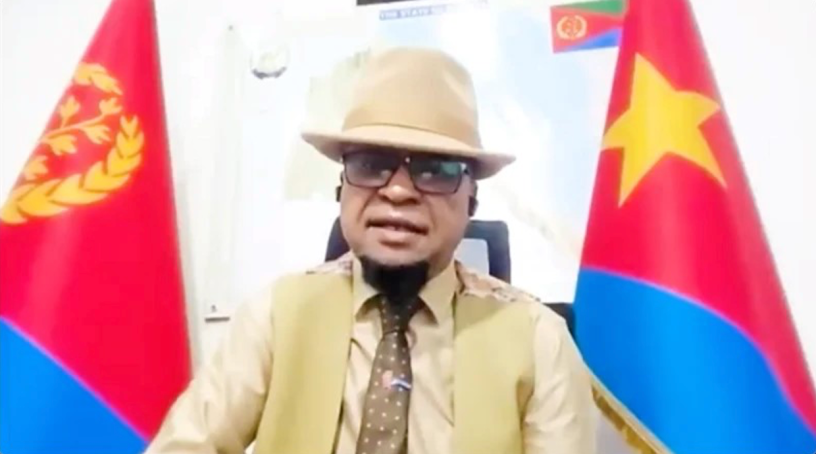
Source: BBC Tigrinya

In an interview with Embassy Media, a channel affiliated with the government of Eritrea, Eritrean Ambassador to South Sudan has referred to Prime Minister Abiy Ahmed of Ethiopia as “childish”.
The interview which was considered controversial by government standards was removed the next day from Embassy Media’s website causing more interest among the public.
According to BBC Tigrinya Service, on Tuesday, November 26, 2024, an unusual interview with Eritrean Ambassador to South Sudan, Ambassador Yohannes Teklemichael, was aired on the YouTube channel which prompted instant inquisitiveness among diasporic Eritrean and Ethiopian communities alike.
In an interview with Eritrea ‘EmbassyMedia’, a YouTube channel part of the Eritrean Embassy in London, Mr Yohannes Teklemichael covered a range of topics including diplomatic and political issues in the region, as well as other issues in the country.
In the video interview Ambassador Yohannes said relations between Eritrea and South Sudan are also in good shape, but relations with Ethiopia are not the same.
Ambassador Yohannes describes Ethiopian Prime Minister Abiy Ahmed as the “child” whom he accuses of damaging relations between Asmara and Addis Ababa.
“Now the problems created by this ‘Arat-kilo’ child (region in Addis Ababa) child are killing the relations that should exist between the peoples of Ethiopia and Eritrea,” he said.
It is to be remembered, in 2018 Prime Minister Abiy Ahmed accepted the contentious issues concerning the Algiers resolution unconditionally and signed a peace deal with President Isayas Afeworki of Eritrea to resolve the 20-year conflict peacefully.
As an appreciation of his contribution to peace, Prime Minister Abiy Ahmed was awarded the 2019 Nobel Peace Prize.
However, after the agreement, the briefly opened borders of Serha, Zalambessa, Rama and Ksad Iqan were once again and the two leaders joined forces in the war between the TPLF and the Ethiopian federal government in Tigray.
The fighting later ended under a permanent ceasefire agreement in Pretoria, although there was no official announcement by either government. However, since the 2022 Pretoria Agreement the situation got worse between Ethiopia and Eritrea.
Many Eritreans were especially unhappy when Prime Minister Abiy Ahmed began to say that his country cannot live apart from the politics of the Red Sea. “Ethiopia should play an influential and decisive role because the sea is historically, geographically and economically tied to Ethiopia”, he argued.
“The issue of non-existent dreams, dreams that cannot be realised, defunct issues that have been raging for the past 80 years, should not surface now after Eritrea’s independence,” the Eritrean ambassador to Juba slammed the Ethiopian premier.
“But on the other hand, it is my personal opinion that his defeat will be confirmed soon because he has not been able to control the situation inside Ethiopia. Because I follow the country’s politics closely, almost everything is going out of his control for Abiy. So that means Ethiopia’s situation affects the whole region accordingly.”
Referring to the support of the Eritrean People’s Liberation Front (now the PFDJ) provided to the Ethiopian opposition forces in the overthrow of the Derg regime, the ambassador said, “Our Front thinks and works more about the unity of Ethiopia than the Ethiopians themselves.
The top diplomat also expressed his views on Ethiopia’s internal affairs, stating Addis Ababa is creating instability in the Horn of Africa region.
“The kid from ‘Arat Kilo’ has ruined the region. Not only has he ruined it, he’s not there . . . in short, he’s trying to rule the country with his early morning dreams.”
‘Arat Kilo’ is the part of Addis Ababa where the office of the Prime Minister of Ethiopia is located.
“And trying to rule a country as big as Ethiopia with a dawn dream means that the result of such dreams is what we are witnessing now”.
The Horn of Africa region is currently under tension due to internal political crises and divisions between countries.
Tensions between Addis Ababa and Mogadishu have risen sky-high after Abiy Ahmed’s agreement with Somaliland to acquire a port and a military base.
According to the ambassador, Egypt’s military intervention in Somalia, as well as the tripartite agreement between Egypt, Eritrea and Somalia earlier this month, are likely taking aims at Ethiopia.
Sudan is also plunged into a bloody civil war and suffers from a severe humanitarian crisis, making the situation in the region worse.
But Eritrea’s relations with most of these countries are commendable, the ambassador said. He also expressed hope that Sudan and Djibouti would join the tripartite agreement reached in Asmara by the leaders of Egypt, Eritrea and Somalia.
“So that’s how our relations can be described in the region. Our relations with North Sudan are positive. Our relations with Kenya and Uganda are also very good,” he said.
The ambassador also spoke about the death of John Garang, a prominent leader of the South Sudan People’s Liberation Movement (SPLM), who died in a helicopter crash.
“Eritrea has come out of all the problems it has been facing and is now working on development, prosperity and other important economic developments” he said.
The ambassador, who has worked in South Sudan for more than 10 years, said there is a strong Eritrean community in the country with a “capital” of about $1.3 million and the embassy provides efficient consular services. He did not specify what kind of services the embassy provides to Eritreans in South Sudan. He also refrained from providing information on capital management.
He said there are more than 9,000 Eritreans in South Sudan who have community card membership alone, and there are plans to build a building to serve as an embassy and school. He did not specify the nature of ‘community card membership’ and the nature of relationship between the embassy and community members.
Ambassador Yohannes said that there are more than 600 students, and teachers from more than 30 different nationalities working at the school.
Many Eritreans who ran away from Eritrea have taken refuge in South Sudan. According to the ambassador these refugees are engaged in commercial activities and are somehow organised through communal activities. The ambassador insinuates the Eritrean government is providing services to Eritrean refugees without explaining how that relationship is made to function.
The candid interview, which contains many other details, has become a talking point – for providing such information from Eritrean government officials who have been criticised all along for not being transparent.
How the Eritrean regime operates within Eritrean refugee communities and the schemes it uses to collect money from them are issues of concern to diaspora communities.
Political analysts are saying the interview with ambassador Yohannes has slightly lifted the veil how the regime operates among communities living abroad.
However, the removal of the interview a day after it was posted has now elicited more inquisitiveness as to what is really taking place in Eritrean embassies all over the world. No information was given as to why the interview was removed.
Meanwhile, South Sudanese President Salva Kiir Mayardit awarded the Ethiopian Federal Police Commissioner General the Presidential Medal of Cooperation in Juba, the Ethiopian Embassy in South Sudan said.
 Martin Plaut