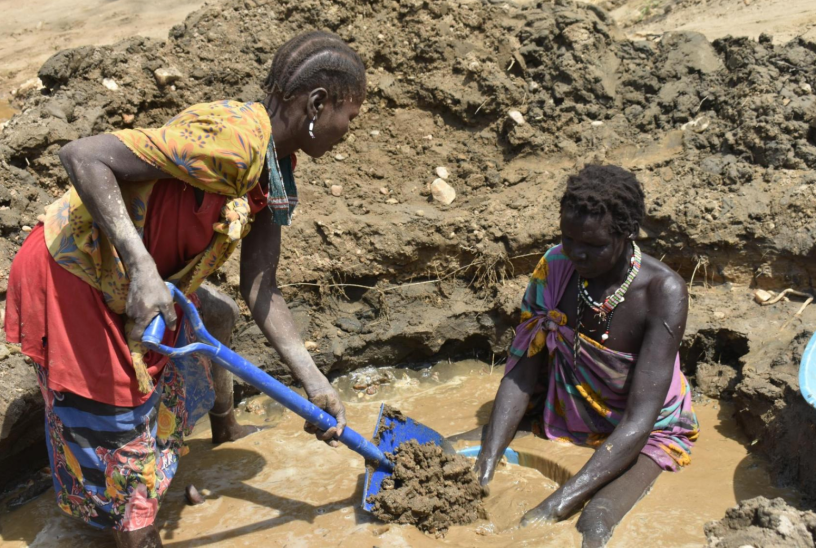
Terrorist groups are tapping into $95bn worth of gold mined by artisanal and small-scale miners, says the World Gold Council (WGC) in a report launched in November. This illegal activity, which can only be on the increase alongside a 52% improvement in the gold price, poses a major threat to global security, the council warns. The Wagner Group of mercenaries has earned about $2.5bn alone since Russia’s invasion of Ukraine. In the case of al-Qaeda in Africa, and Islamic State in the Sahel specifically, gold diverted through illegal routes is helping to restore them to the business of terrorism after setbacks in the Middle East.
Source: Financial Mail
Inside the dark world of illicit mining
A dire lack of state capacity, legislative shortcomings, corruption and sky-high unemployment and poverty levels all contribute to a thriving illicit economy
28 November 2024 – 05:00
by JANA MARAIS
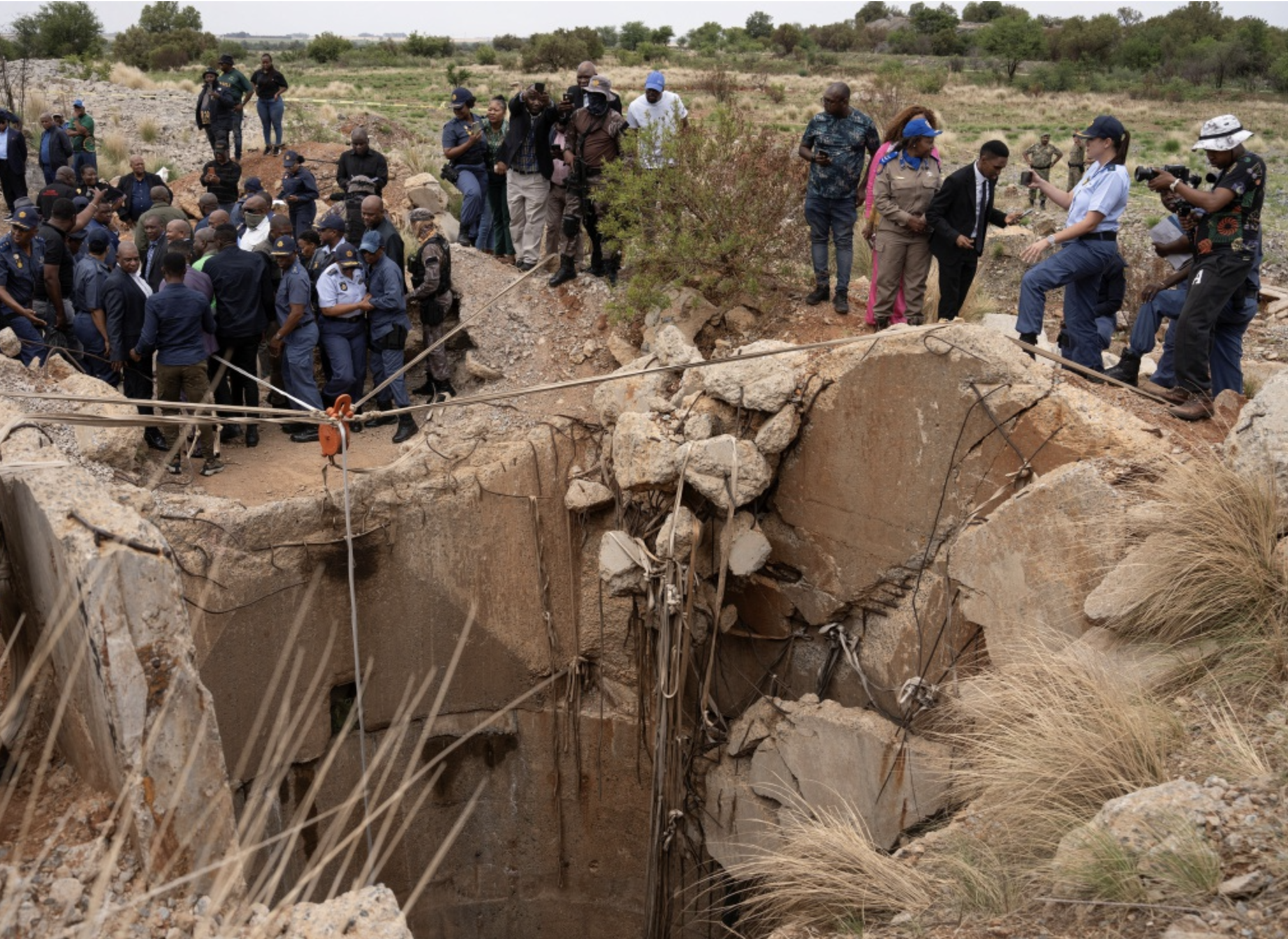
Police minister Senzo Mchunu inspects the outside the mine shaft illegal miners are hiding underground in Stilfontein, November 15 2024. Picture: REUTERS/IHSAAN HAFFEJEE
The police standoff with zama zamas at the old Stilfontein gold mine in North West is again highlighting South Africa’s uphill battle in clamping down on the crime syndicates running illicit mining operations in the country.
Illegal miners (nicknamed zama zamas in South Africa, from the Zulu term meaning “take a chance” or “try your luck”) have long been a feature of the gold industry. However, illicit gold digging — and the serious, often violent crimes associated with it — has increased significantly in South Africa in recent years, driven in part by a high gold price and by limited law enforcement.
High-profile cases include the gang rape of eight women near Krugersdorp in 2022, allegedly by illegal miners, and the murders by heavily armed zama zamas of a mine security chief at DRDGold in 2019 and an electrician at Sibanye-Stillwater in 2022. Nobody was successfully prosecuted for these killings. In the 2022 shooting near Randfontein at Sibanye’s Cooke operations, which are on care and maintenance, police were completely outgunned by the zama zamas and could take no action.
While it is hard to estimate the extent of illegal gold mining and the number of people involved, minister of mineral resources & energy Gwede Mantashe in 2019 estimated that illicit gold mining costs the fiscus more than R70bn a year. Illegal mining also affects other minerals, including coal, chrome, diamonds and sand. But gold remains the biggest headache.
“The syndicates are creaming it by exploiting extremely vulnerable people,” says a senior source in a mining industry association. “Criminal gangs are highly sophisticated and very violent. They must have protection at the highest levels [of government and law enforcement], otherwise how are they getting all this gold out of the country? It is the same as the construction mafia, the procurement mafia. How are people getting away with this kind of behaviour?”
Gwede Mantashe
At the time of writing on November 26, more than 1,200 zama zamas had surfaced at Stilfontein, where police cut off food and water supplies in late September. It is unclear how many people remain underground, but industry experts expect nothing to change once the police operation concludes and the dust settles.
Under South African law, it is hard to charge illegal miners with much more than trespassing, which carries a R300 fine. Even where more serious charges can be brought for carrying gold-bearing material, explosives or illegal firearms, bail is often paid by the syndicates and the zama zamas quickly disappear back into the mine tunnels and shafts. “I have no doubt that once the police leave Stilfontein, it will not be long before people are back underground,” says a source with extensive experience in the gold mining industry.
Risky business
At its core, illicit gold mining is a simple story of supply and demand.
First, there is the challenge of cutting down supply. South Africa, for more than a century the world’s biggest gold producer, has an estimated 6,100 ownerless and derelict mines, which are now the responsibility of the department of mineral resources & energy (DMRE).
Gold mining in South Africa has always been deep and dangerous. Now, with most old mine workings abandoned, there are no monitors of safety procedures; no checks on air quality and protective clothing; no emergency care response capacity; no cooling or pumping systems; no proper lighting; and no headgears with winding engines to bring the “skips” (lifts) of miners and material to the surface.
It is easy to get lost in the kilometres of unlit underground tunnels, and to fall into unfenced shafts. Toxic gases can surprise and kill the unwary, as can underground flooding. Mining the pillars in the underground tunnels can cause rockfalls and collapsed roofs, killing or injuring miners and often creating sinkholes on the surface.
Yet many of the old mines still contain enough gold to be attractive to zama zamas. These desperate people are willing to take serious health and safety risks to earn meagre payments.
There is also the risk, underground and on the surface, of being killed by gangs who fight each other ruthlessly for territory regarded as more lucrative than that they already control.
“The reality is the work they do is very dangerous, and many die. Unfortunately, they are easily replaceable,” says the gold industry source. “To make these deep-level underground operations safe would be extremely expensive. This is why it isn’t feasible to legalise these activities. It simply is not possible to operate these mines in a commercial way if you are complying with health and safety standards.”
Mintek, which falls under the DMRE, is tasked with closing derelict shafts, rehabilitating land and preventing water contamination. It has rehabilitated 42 abandoned mines and closed nearly 400 holes, according to the latest available statistics.
However, at many old mines zama zamas have removed the concrete seals closing off shafts to gain access, including at Stilfontein. Ways of effectively securing old mines include flooding the shafts — not always an option where there are still mines operating legally in the area — or filling them with rubble. Mining companies are also backfilling mined-out areas as a safety measure, as it provides roof support as well and reduces the storage of waste rock above ground.
Illegal miners also target surface operations, such as the reworking of old tailings dams to extract gold-bearing material that was left unexploited by older technologies.
They remain active inside legally operating mines too, posing serious safety risks to mine employees. While the industry is investing significantly in security measures and new technologies to clamp down on the theft of surface infrastructure and illegal mining inside their operations, including biometric access systems, CCTV cameras and drone monitoring, syndicates are ever inventive in finding ways of getting their teams underground.
In Barberton, Pan African Resources worked closely with police to target illegal mining at its operation, shutting down nearly 120 gold-bearing material processing plants and illicit smelting facilities, according to its 2023 annual report.
At Sibanye-Stillwater, which has been highlighting the challenges around illegal mining since 2013, protection services are focused on intelligence gathering, guarding access to operations and facilities and monitoring operations. These activities come at significant risks, with attacks recorded in the past, says spokesperson James Wellsted.
In 2023, the number of underground mining incidents at Sibanye alone increased to 459, from 363 in 2022. In total, 1,239 illegal miners were arrested, while 483 employees and contractors were charged with aiding and abetting illegal miners at the company.
Corruption is entrenched in the system, drawing in mine employees, local police and magistrates who are bribed in exchange for protection, the gold industry source says. “And where people do not want to play ball, there is always intimidation.” An Al Jazeera exposé in 2023 also highlighted the role played by corrupt bank officials in assisting with gold-related money laundering.
Illegal gold mining lends itself to other criminal activity, such as human trafficking, including children, and sexual crimes. Gangs demand steep entry and exit prices for zama zamas to enter shafts and so gain “protection”.
The allure of gold
Many zama zamas are migrants from Zimbabwe, Lesotho and Mozambique, often with some formal mining industry experience and few alternative job opportunities.
While migrant labour has been a feature of South Africa’s mining industry since the 1800s, the number of migrant workers has declined drastically over the past 20 years, from 118,500 in 2003 to only 27,000 today, according to Minerals Council South Africa data. South Africa’s porous borders, poor economic prospects in home countries and a lack of formal mining sector opportunities in South Africa all contribute to the prevalence of illegal migrants among zama zamas.
“As long as people don’t have other viable options to make a living, there will be people willing to do this work,” the gold industry source says.
In communities, illegal mining is a double-edged sword. It has created a lucrative secondary informal market supplying commodities, including food, liquor and sex workers, the Minerals Council says. On the other hand, it destroys the social fabric of mining communities, through bribery, threats of violence, prostitution, child labour and substance abuse.
While there is no shortage of people willing to risk life and limb to produce gold, demand for illicit gold also shows no sign of slowing.
For various reasons, gold is an extremely attractive tool for money launderers and terrorist financiers (see sidebar). The metal offers a highly liquid and reliable investment that is cash-intensive and traded globally (often anonymously). It is also a form of global currency that can be used as a medium of exchange in criminal transactions, says South Africa’s Financial Intelligence Centre (FIC) in a recent report.
Gold is easy to smuggle. It can be melted down, recast into another form of gold and sold for cash. As a store of value, says the FIC, it is also “regarded as a safe investment in times of unrest and uncertainty, which adds to its allure”.
For the criminal syndicates, it’s money for jam — especially at a gold price above $2,700 an ounce. The syndicates have no requirement to invest in health and safety, water pumping, or infrastructure development or maintenance. They also tightly control gold prices at the mine sites. Zama zamas often get as little as a quarter of the market price, despite delivering product with a purity of up to 90%, according to a report by the Global Initiative against Transnational Organized Crime.
Reducing both demand and supply is therefore a steep uphill battle that will require multiple stakeholders to work together — the mining industry, crime intelligence, law enforcement and regulators. While some progress is being made through bodies such as Business for South Africa and through the tightening of laws to criminalise illegal mining and limit money laundering, much work remains to be done.
For example, there are no restrictions in South Africa on the transport, sale or processing of chrome ore — making it extremely difficult to stop illegal shipments of this bulk commodity.
The DMRE says it is working on changes to key mining legislation, including the enabling of artisanal mining, which is not currently legal but could enable more effective oversight of small-scale operations (see sidebar).
Enforcement remains a major challenge. The latest available statistics from the South African Diamond & Precious Metals Regulator, for the 2021/2022 financial year, show only 458 precious metals inspections were done in the year, down from 756 in 2020/2021. The regulator, the key oversight authority of smelters, refiners and traders in the sector, had a budget of only R123m. The only reference to the curbing of illicit trading was in the context of diamonds, where 754 inspections were conducted, of which four were jointly with law enforcement agencies.
In the year to date, the South African Revenue Service (Sars) has found “no illicit minerals” passing through any land borders or harbours. “Some precious metals/stones”, worth R3.8bn, were found and confiscated at OR Tambo International Airport. This, however, “doesn’t mean they are illicit. It may be because there are some documents missing and once provided, they are released,” Sars spokesperson Siphithi Sibeko explains.
In the year to end-March, the Hawks arrested 1,312 people on charges related to illegal precious metal and diamond mining activities around the country, with 158 successful convictions for a range of crimes, including possession of gold-bearing material, possession of illegal firearms, contravention of the Immigration Act, and murder.
In many of these cases, the courts imposed lenient sentences, such as fines, suspended sentences or a few months’ jail.
“It is doubtful that harsher sentences will be more effective as the borders are so porous, which makes it possible to recruit and replace those who have been incarcerated,” says Hawks spokesperson Brig Thandi Mbambo.
Challenges with investigations include complicity of law enforcement agencies, extreme violence and porous borders, Mbambo adds.
In addition, money-laundering and racketeering cases are investigated by the Priority Crime Specialised Investigation and the Asset Forfeiture Unit, and orders are secured through the courts. “These cases take too long due to the complexity of the investigations and prosecution,” says Mbambo.
One positive is the progress made on tightening South Africa’s money-laundering laws and enforcement, and the National Treasury believes the country is on track to getting removed from the greylist of the Financial Action Task Force, a global crime watchdog, next year. Should regulators be able to enforce the stricter rules, it will be a significant positive step.
“To combat illicit mining, we need to align as stakeholders, and we are optimistic that we are seeing some proactive actions being taken to achieve this,” says Wellsted. A sustainable solution will also require giving people alternative opportunities to make a living. As a country, says Wellsted, “we need to attract investment, create jobs and grow this economy”.
But that is a task no less herculean than trying to stop the zama zamas.
How the illicit gold sector works
“Opaque” is the word most often used to describe the inner workings of the illicit gold sector. In South Africa, arrests tend to focus on the zama zamas (illegal miners) and local buyers — classified as tier 1 and 2 players in the sector by the Minerals Council South Africa — while the criminal syndicates organising and sustaining the activities appear to operate with far fewer impediments.
First tier: The zama zamas
In South Africa, illicit gold miners target surface and underground areas, including operating, closed-off and abandoned mines. Heavily armed gangs control access to many mining sites. They often use indentured or trafficked labour, including child labour, to fill a variety of roles underground, where people can stay for weeks or months at a time. Very high-grade material is processed above-ground, while some basic milling and processing activities also take place underground. Zama zamas use toxic chemicals, notably mercury and cyanide, to primitively refine the product.
Second and third tiers: Local and regional buyers
The first-level buyers often support the zama zamas with food and equipment. They then sell the gold to bigger buyers or dealers in national or regional trade hubs — the third-tier players in the value chain. Typically, the number of buyers in a supply chain is limited to one or two intermediaries. The regional bulk buyers often have permits allowing them to trade in precious metals. In terms of their licensing requirements, they are supposed to do due diligence on all customers to ensure compliance with money-laundering and terrorism financing laws.
Fourth tier: Dealers
Dealers, nationally and internationally, often hide their involvement by working through front companies, intermediaries, or legitimate exporters — who should by law be verifying the origin of any precious metals and stones. Dealers are major players and the largest buyers in the African gold supply chain.
Fifth tier: International gold hub
The top international receivers and distributors usually work through international refineries and intermediary companies. Dubai has been identified as a major player in the illicit gold market, with authorities starting to implement some reforms to combat imports and the refining of illicit gold.
Sources: Minerals Council, Global Initiative Against Transnational Crime, Sibanye-Stillwater
— Jana Marais
Extremists and mercenaries
Terrorist groups are tapping into $95bn worth of gold mined by artisanal and small-scale miners, says the World Gold Council (WGC) in a report launched in November. This illegal activity, which can only be on the increase alongside a 52% improvement in the gold price, poses a major threat to global security, the council warns.
The Wagner Group of mercenaries has earned about $2.5bn alone since Russia’s invasion of Ukraine. The WGC is now throwing the spotlight on terrorist networks, which it says feed off desperate artisanal mining communities.
From the “poor souls” panning the rivers for gold nuggets to semi-industrialised processes, artisanal mining communities are a “honeypot” for groups such as the Revolutionary Armed Forces of Colombia (Farc) guerrilla group, says Dominic Raab, former UK deputy prime minister, who authored the council’s report. A high-yielding source of revenue diversification, gold is easier for Farc to smuggle than cocaine — it’s “bread and butter” contraband.
Artisanal and small-scale miners also contend with a raft of social evils and abuses, ranging from torture to human trafficking and murder. In Peru’s La Rinconada, a high-altitude settlement known for its small-scale mining, an estimated 4,500 girls have been trafficked. “It’s horrific,” Raab says.
In the case of al-Qaeda in Africa, and Islamic State in the Sahel specifically, gold diverted through illegal routes is helping to restore them to the business of terrorism after setbacks in the Middle East.
In the context of elevated gold prices, the WGC is hoping its report can muster a high-level political response — a “G7 moment”, as CEO David Tait tells the FM. He wants the world’s leading economies to isolate terrorist groups and supplant their networks with a supply chain that works economically for communities and host nations, and chokes revenue to terrorist organisations and Russia’s war machine in particular.
He already has the support of a group of central banks including those of Ecuador, Colombia, the Philippines and Mongolia, which have signed up to the London Principles. This is a commitment to buying “responsibly sourced artisanal gold” — that is, gold produced without mercury as a reagent and not involving child labour. The central banks of Zambia, Tanzania, South Africa and Brazil are waiting in the wings. More may follow.
Once an end market is established for artisanally mined and small-scale gold, Tait plans to build refineries near artisanal sites. There are several benefits to this. Extraction rates improve to 95% for the miners, compared with the 35%-40% they normally achieve using home-grown extraction methods. This also sets the foundation for a fair commercial exchange and is certainly much better than dealing with mercenary buyers. “I plan to take that to the G7 governments and say: with the help of my political clerks in the central banks, this works, or could work,” says Tait.
But he worries about the complexity of joining up the different players — or worse, political interference. In Washington, a Donald Trump administration might undermine any plan that could isolate President Vladimir Putin.
Even as he hopes for a political response, Tait acknowledges he’s swimming upstream. “I do think we’re in a unique moment geo-economically, because the big governments, the developed governments, have never really given a toss about what’s going on in the Amazon or the Democratic Republic of Congo.”
— David McKay
Lessons from the Wild Coast
The laid-back Wild Coast beach town of Port St Johns may be as good a place as any to test solutions to South Africa’s illegal mining problem.
The number of illegal Wild Coast sand mining operations — which dig up sand for such uses as making concrete — ballooned from about 24 small quarries in 1993 to 175 a decade later, and to more than 250 sites in 2023, according to new research published in The Extractive Industries Society Journal. These numbers only include operations within 1km of the coastline and exclude the beaches.
“People don’t understand that illegal sand mining is a serious crime, and little is done by anyone to stop it,” says co-author Div de Villiers, who retired as head of the Green Scorpions in the Eastern Cape last year.
The business model is simple. Local chiefs charge “gate fees” for access to communal land, under the pretence that this money will flow to the impoverished local communities. Community members often work for a pittance digging and loading sand or as truck drivers, but the real beneficiaries are construction companies whose owners are from outside the community. Perhaps unintentionally, the government ends up as a major customer, as much of this illegally mined sand is used in public infrastructure projects such as roads, clinics, schools and hospitals.
“They are operating totally outside any existing legal framework,” says co-author Siyabu Manona, director of Phuhlisani, a nonprofit focused on land matters.
The environmental damage is immense, with no legal safeguards or oversight in place. Licensed operations can take place only in areas that have been identified as suitable for sand mining, and operators have to comply with regulations, including relocating protected plants and rehabilitating mined areas, explains De Villiers.
However, the governance structures meant to regulate sand mining and enforce compliance are simply not functioning along the Wild Coast.
First, it’s almost impossible to get a permit, given the sheer volume of regulatory and legal requirements. In addition to national, provincial and local government legislation and policies relating to the management of environmental resources, sand now being extracted in the Wild Coast falls under six local municipalities, which also overlap with rural chieftaincy jurisdictions in terms of land governance.
Since the dawn of democracy in 1994, only one mining permit has been awarded along the Wild Coast, about 10km from the coastline. There are two other permits for mining sand from the Umzimvubu River, inland of Port St Johns.
Ironically, unlike deep-level gold mining, sand mining is particularly well suited for community-owned and artisanal operations, due to its relatively low capital requirements and easy access to the resource. This could be a great opportunity to grant licences to local communities, who bear the brunt of environmental degradation but see little benefit. In addition, locals might then be incentivised to practise sustainable mining to help protect the area’s ecotourism industry.
Second, enforcement in this part of the country, where state capacity is already extremely limited, is simply nonexistent.
The police and local magistrates have little understanding about the illegality of sand mining activities and its environmental impact, Manona explains.
The department of mineral resources & energy (DMRE), the regulator of all mining activities, does not have sufficient inspectors. Further complicating matters is that environmental oversight for mining operations sits with the DMRE, rather than the department of forestry, fisheries & the environment, often leading to conflict between the departments.
“This makes it impossible for people to work in a unified, aligned manner,” says Manona.
In any event, the scale of the problem along the Wild Coast is now so extensive that enforcement on its own can no longer be seen as a solution, De Villiers says.
“To fix the problem, the government needs to identify suitable areas from an environmental perspective that can be rehabilitated, and then ensure we have legal, authorised mining operations in those areas that are done in a sustainable manner. But a proper enforcement mechanism must be in place,” he says.
– Jana Marais
 Martin Plaut