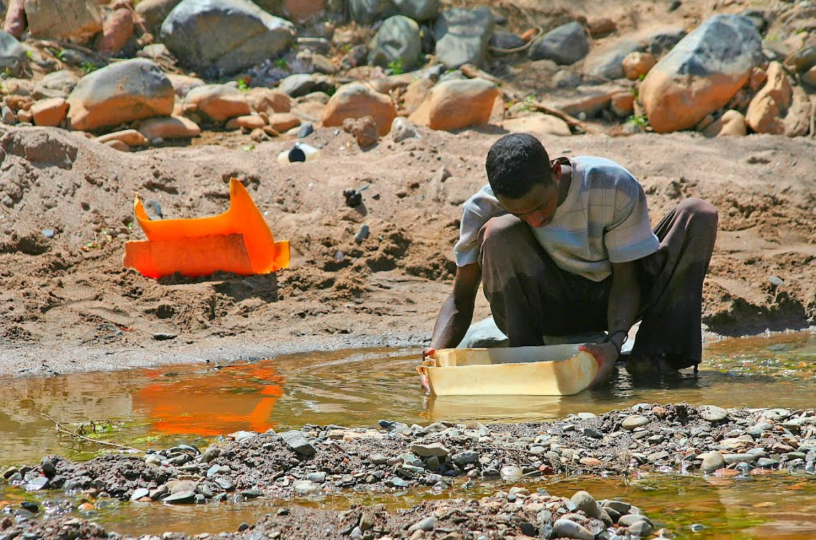
Cyanide and mercury have both been used during the mining process in Tigray, according to multiple interviews.
Certainly, food and petroleum products are being smuggled into Eritrea and vice versa, but it is difficult to say that gold is flown into Eritrea from Tigray. The possibility is high but the claims require further investigation. But, as long as there is cross-border trading, one can assume there is a gold trade also.
The gold extracted from Tigray is smuggled through a network of well-established routes. One major pathway passes through Adiabo and Badme, crossing the Mereb River into Eritrea before heading to Dubai.
Tigray leader says region losing gold without benefit
December 31, 2024 11:23 PM
Source: VOA
Ethiopia’s prime minister recently touted the country’s mining resources and said the industry could achieve a historic milestone by generating up to $2 billion in gold revenue this year. He made the comment while inaugurating a gold exploration and mining factory in the Gambella Region.
On Dec. 10, Abiy Ahmed reported that Ethiopia’s economy is “one of the fastest-growing economies in Africa and a beacon of opportunity on the continent.”
“Among its many thriving sectors, the gold mining industry stands out as a significant driver of growth, presenting immense potential for both local and international investment,” he said on social media.
But officials in Tigray, one of the richest gold mining regions in Ethiopia, say they are losing resources without benefit for their region at a time when Tigray is trying to recover from two years of brutal war between local rebels and the federal government.
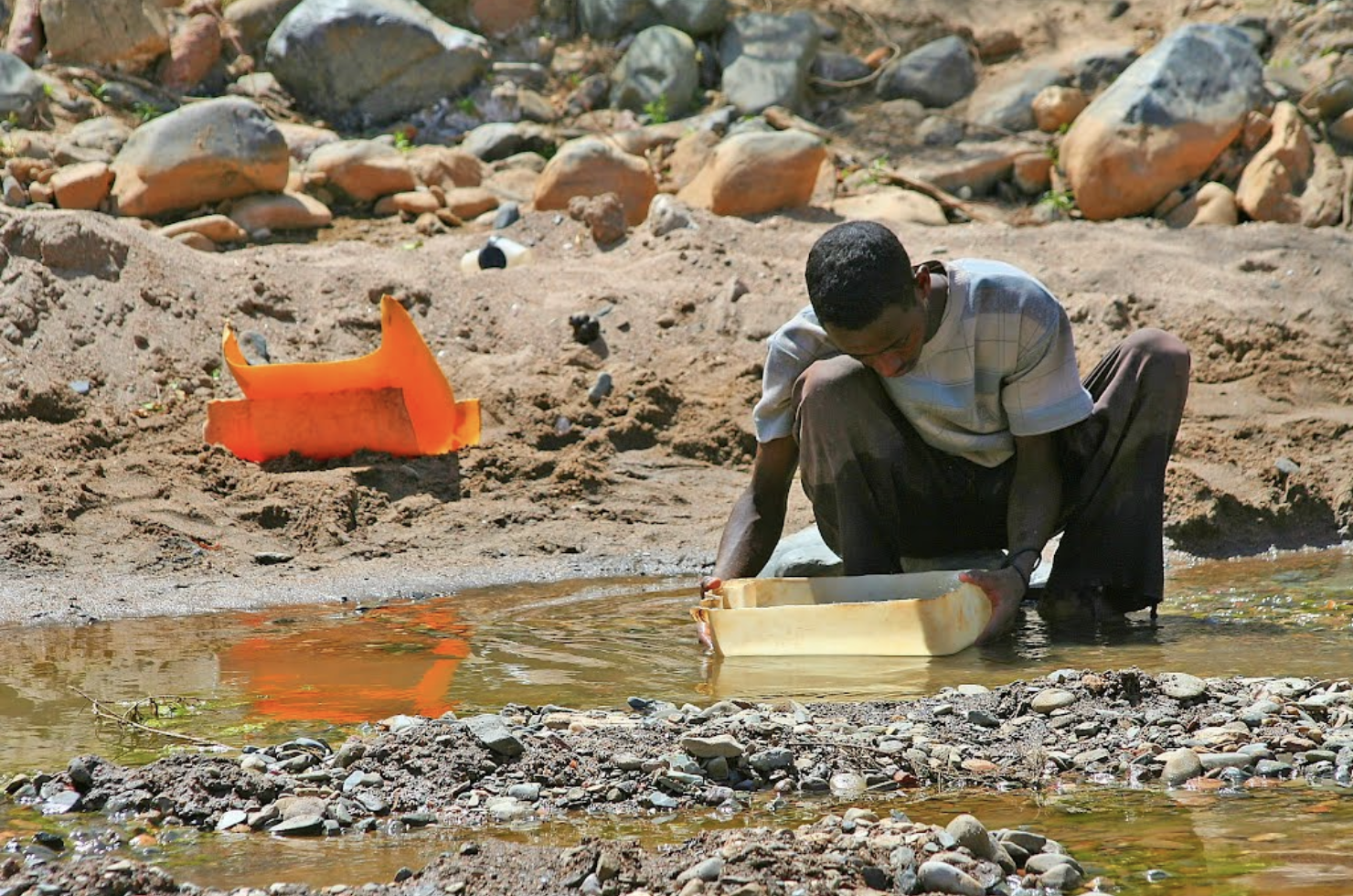
The interim president of Tigray, Getachew Reda, speaking on Nov 15 said during the three and half months prior (August, September and October) “28.25 quintals of Gold entered into the Federal Government.” “The government has not received a single penny,” he said.
Ethiopia’s Commercial Bank, through its branch in Shire Inda Selasse, the hub of the gold in Tigray, recently bought $132 million worth of gold in just three months, according to branch manager Tekie Giday. The Tigray region’s entire budget for this year is nearly $100 million.
Officials in Tigray said the region is struggling with budget shortfalls as it attempts to bring back services discontinued or destroyed during the war.
Environmental fears
In addition to lack of economic benefits, officials in Tigray reported that gold mining has exposed some of the region’s residents to dangerous chemicals like mercury and cyanide, which are used for extracting gold.
Residents living close to the mining fields say the chemicals have been harmful to humans and livestock, with reports of deformed skin on cows and degraded farmland, witnesses and officials said.
Some residents in Tigray’s Northwest region have gone to the courts seeking justice, to get judges to act against goldminers, who they accuse of polluting the environment and causing ill health to their children.
The president of the High Court of the Northwest, Judge Mengistu Teklay, told VOA that chemicals used by miners are becoming the source of health, security and stability concerns.
“Utilizations of natural resources must be governed by law and order. It shouldn’t benefit the few individuals,” Mengistu said. “Those individuals who benefit from these resources should not be allowed to bring safety concerns, existential threats, and health concerns to the unbenefited public.”
Cyanide and mercury have both been used during the mining process in Tigray, according to multiple interviews conducted by VOA’s Horn of Africa Service. The World Health Organization identifies mercury as one of the top 10 chemicals or chemical groups posing public health concerns.
Alarmed by the use of the chemicals, Ethiopia’s Bureau of Innovation and Technology, a government body tasked with overseeing the country’s science and technological development, asked Tigrayan regional government institutions to take action to prevent unsafe use of the chemicals.
Gizachew Weldetsadik Beyene is director of the Radiation and Nuclear Safety Department in Tigray’s Bureau of Innovation and Technology. He said a team from the bureau posing as traditional miners traveled to the mining areas and saw what he called a “sad” situation.
“It is so scary,” Gizachew said, sharing a video of a cow affected by the chemicals, and pictures of women washing the soil using chemicals in search of gold without safety protocols and with their bare hands.
“We’ve seen the damage to animals, to the land, the soil, to people who use running water and suffer, with their skin damaged, the animals which are drinking that water and exposed to dangerous diseases,” Gizachew said.
Action taken
The Tigray region’s Cabinet this week called for a halt to goldmining. The announcement was made by the deputy president of Tigray’s interim administration, Lieutenant General Tsadkan Gebretinsae. He did not elaborate about when the suspension will start and how the measure will be implemented.
Prior to that, the Tigray Communication Affairs Bureau said in a statement that action was taken against people who were using illegal dangerous chemicals to process gold in Tahtay Koraro district near a dam that is a source of potable water for the city of Shire Inda Selasse.
No details were given about the actions and the type of chemicals used.
A security source who requested anonymity as he is not authorized to speak to the media alleged that foreign companies are working with Ezana Mining Development, a local mining company.
The head of Ezana company, Tesfatsion Desta, did not initially respond to VOA calls.
After a VOA Tigrigna Service radio report aired, Ezana put out a statement saying it was not asked to comment on the story, which it called “distorted.”
In the statement, Ezana said it worked with foreign companies before the Tigray war. The statement continued that because of insecurity and instability, however, these companies did not come back after the war.
The company said the gold factory located in Northwest Tigray’s Asgede district, in the Tabia Lemat area, is free from pollution, waste and environmental distraction.
Without naming a specific country, Tigray President Getachew told the region’s diaspora community in a Zoom meeting that he believes more gold than reported is smuggled out of Ethiopia.
Getachew said what is happening in Tigray is becoming “a crime.”
“It is a very serious problem. It is not just robbery. People are losing their animals because of the dangerous chemical used by the miners. There are people who are known to participate in this network from top to bottom among government and security officials.”
VOA’s repeated attempts to get comment from the Tigray Bureau of Land and Mining and the Mining Ministry, as well as the National Bank of Ethiopia, were unsuccessful.
Digging deep: how illicit is ‘illicit mining’ in Tigray?
Source: The Reporter By Staff Reporter
In the two years following the end of the northern war, Tigray has been the setting for a slew of disputes, controversies, and questions involving mining. The region, which is still struggling to get back on its feet, is home to vast mineral resources, particularly gold.
Reports over the past couple of years indicate that large-scale mining firms licensed by the federal government have been unable to access project sites in Tigray, partly due to stiff objections from regional officials. Meanwhile, there has been a boom in artisanal mining in the region as landholders, mainly farmers, turn towards mineral resources in the face of economic stagnation and soaring unemployment. This boom comes with reports of foreign involvement, extensive smuggling networks, environmental hazards, and violence over the rights to extract Tigray’s minerals. The region’s political problems, and doubts about the efficacy of the Tigray Interim Administration, as well as a lack of clarity on federal involvement, raise questions about who is licensed to mine in Tigray.
Asmerom Te’ame is a geologist based in the region, and has been actively involved in mineral exploration and targeting in Tigray for more than a decade. The Reporter caught up with him to get a nuanced look at the state of mining in Tigray. He spoke about the legality of the operations springing up in the region, the reasons why large-scale and foreign mining firms are only a small part of the equation, and the opportunities and challenges posed by the mineral rush in post-conflict Tigray. EXCERPTS:
The Reporter: Reports and statements, including those from regional officials, indicate widespread illicit mining activities in post-conflict Tigray. What are your observations on the matter?
Asmerom Te’ame: When we look at current mining activities in Tigray from the perspective of the Ministry of Mines [and federal law], there is a context in which they could be considered illegal. But, the mining actors now operating in Tigray do have written permits from regional mining agencies and mining bureaus in woredas and local government in Tigray. This includes plots registered using GPS, and production permits.
Are these concessions and permits granted by the regional mining bureau?
Not all, but there are few. The regional mining bureau is not the same as it was in the past. Before the war, there was a mining bureau in Tigray that was directly accountable to the federal Ministry of Mines. But since the war, the bureau has merged with land [management], and is now called the Tigray Land and Mining Development Bureau. Land is accountable to the regional government, while Mining is accountable to the federal government. The current Bureau is not under the Mines Ministry, but the region.
The relationship between the mining agency and local government is not like it used to be. Kebeles and woredas actively grant permission [to mine] to people who are engaged in illicit activity and people who are well-known in their communities. They could include unemployed youth, farmers, military, or anyone.
The so-called illegal miners are not aliens who came from other places, but members of local communities. So, conversely, if we look at it from the point of view of the country’s mining laws, one could say they are illegal. But, in reality, with no formal government in the region, these people have received permission from woredas and kebeles. There is confusion. But, according to the country’s laws, it is illegal mining.
Small-scale mining operations and special small scale are licensed by regional administrations, while large-scale and foreign operators are under the purview of the federal Ministry of Mines. But there are indications that foreign companies are operating, both formally and illegally, in Tigray.
How are foreign mining operators granted concessions and licenses in Tigray?
The companies who secured their licenses from the Ministry of Mines and continue to operate in Tigray even after being instructed otherwise and to renew their permits are able to do so because of the war-torn environment. The regional mining bureau used to be governed by the Ministry but, following the war, it went under the regional administration. In a sense, it is disconnected from the formal legal structure and all budgetary and management affairs are under the regional Land Administration Bureau. This highlights the failed or ineffective implementation of the Pretoria Agreement and it could be due to the late transformation of the Interim Administration into a formal government body or the inefficacy of the Interim Administration.
Some companies; I can’t say all; but some began working following intense discussions. Adding to the point of foreign companies operating illegally in the region, I don’t believe they are because they need permission. They can’t [gain permission] but, currently in Tigray, illicit mining is led and conducted actively by groups who have mining experience outside Tigray, in other parts of the country. I am not denying that there could be individuals with foreign connections and experiences who are linked with local, illicit community actors in illegal mining production in Tigray in the form of informal collaborations.
Where in Tigray is illicit mining taking place?
Most illicit mining activity occurs in northwestern Tigray, specifically in the Central Adiabo, Laelay Adiabo, Tahtay Adiabo, Asgede, and Tsembla woredas due to their advantageous geography and rich gold and base metal resources. Moreover, the land belongs to farmers, who look only at the price of gold and do not consider the environmental hazards [of mining operations] due to a lack of awareness. They are also in a post-conflict zone.
How are transactions for the products of illicit mining in Tigray conducted? What are the income and profit margins? How are minerals smuggled out?
It would require research and data to identify the transaction mechanisms and smuggling routes. The amount presented by commercial banks purchase from the illicit gold is not very believable since there is a lack of legal receipts and other trade documents showcasing volumes and amounts.
Some have recently claimed that gold is being flown out of Tigray to Eritrea or into Sudan. Is there any truth to these claims?
It is difficult to say. Certainly, food and petroleum products are being smuggled into Eritrea and vice versa, but it is difficult to say that gold is flown into Eritrea from Tigray. The possibility is high but the claims require further investigation. But, as long as there is cross-border trading, one can assume there is a gold trade also.
As a professional geologist, what is your estimation as to the volume of gold deposits in Tigray? How can the region and country better benefit from the resource? And what are possible solutions for curbing illicit mining in the region?
The solutions begin from woredas, kebeles, and farmers. They must stop leasing land to illicit and unlicensed mining companies. Second, the production and exploitation of base metal and precious metals is a destructive process. The regional mining agency and ministry of mines has to conduct research on how to operate mining gold and base metals, process and rehab the environment first or the mining permit has to pass through this at regional state levels.
Who are the actors involved in illicit mining and how much are they contributing?
I don’t think mining companies are directly participating in illegal mining in Tigray. Generally, companies’ exploration capacities and the steps they take in exploration are slow. What is happening now is due to factors such as the war itself, the depleted post-conflict economy, and rampant unemployment. The local people small companies and different small associations are much interested in the mining activities. The mining sector’s performance is declining gradually nationwide. Big mining companies were conducting huge exploration works in 2000 E.C., but afterwards their engagement began to decrease. In that decade, there were relatively able large-scale companies willing to invest both in exploration and mining stages, and to do real mining jobs.
Nowadays, almost all large-scale mining companies, both local and foreign, aim for huge concessions and land and sit idle. They are scrambling to get as many concessions across Ethiopia and then wait until their licenses expire. Until then, they raise funds from abroad, publishing rosy reports and telling their shareholders that projects in Ethiopia are making great progress. But the truth is otherwise. Once their licenses expire, they extend them using security issues as an excuse, or through bribery.
Today, the companies do not want to spend money. Their interest is in holding land despite having the resources and equipment needed to explore and dig for minerals. Meanwhile, local communities have grown more eager to work in mining due to economic troubles and high unemployment rates.
Why do you think companies’ interest in exploration and extraction is declining?
Still this needs research and could be money reason. Exploration by nature is very costly, peace and security of the country and having poor follow up and supervision for the companies.
Many of the foreign mining companies licensed in Ethiopia lack capacity, and there are problems with corruption in the licensing process. What is the best way to attract legitimate firms and allow them to work here?
Most companies contract geologists and lobbyists, and with their presence on the ground, they expand the exploration ground and sell them to other, larger companies.
Most companies in Ethiopia today do not want to spend money on real work. Most of them lack the capacity. They are often intermediaries. They secure licensing and project sites, then they search for real mining firms who can do the job. This has become the nature of the business. This is partly because the government, mining institutions, and officials overseeing the sector are unable to find and attract genuine and capable investors from around the world.
Illicit mining operations are common not only in Ethiopia but in other African countries, whose resources are traded outside the scope of the formal international market. Some argue that conflicts in countries like DRC, Uganda, and Sudan are purposely instigated specifically as cover for the extraction of resources. Do you think the same is true for Tigray?
Many people think that way, but I don’t agree. This is because the market and the people involved are still the same. Newcomers also have mining experience in other regions and better access to markets. However, if the current trend does not change, things will move towards that route.
Illicit mining operators who used to work in other parts of Ethiopia, be it Oromia, Benishangul, or elsewhere, have come to Tigray following the political change in Ethiopia and start of the war in Tigray. They shifted to Tigray because they have experience in mining gold. Farmers in Tigray do not have that experience but have gold deposits under their farms. So, the farmers provide their land, and those operators offer their skill. The foreigners provide money for machinery and working capital. Gold is mined through this kind of informal collaboration. Even this mechanism of working is very small in number when you compare with the whole artisanal mining activity in the region.
How does the regional government interact with actors who are supplying capital and machinery?
The regional authorities are taking measures by writing letters informing legal companies to start their operations and warning illegal companies to stop their wrongdoing. But the big problem is, I think the regional government has lost its power and influence due to a variety of factors including post-war trauma and economic decline. Things will remain very difficult unless the community can return to production, education, trade, and agriculture. It requires deep involvement from the Ministry.
Are the people of Tigray benefiting from the illicit mining? If not, who is?
The question needs more study but the people are working; the community is benefiting and that is why it is difficult to stop illicit mining. Is it informal? Yes. But, the people are benefiting. If it were only the companies, it would have been easy to stop them.
I believe local communities are benefiting from leasing their land. But, there needs to be more research to see who is really benefiting.
There is also gold being smuggled from other markets into Tigray. This gold comes from places including Addis Ababa. It is low-grade gold. It is mixed with high-grade gold from Tigray so it will fetch a better price. This is what happening.
The government says the central bank is receiving billions of birr’s worth of gold from Tigray, but I don’t believe the reports.
The issue of mining’s environmental impacts is critical. How much risk does it carry?
It is very risky. For example, cyanide and mercury are being used. The issues lie not only in the volume used, but also in its distribution. It is affecting women and children.
Who is importing these chemicals into the country?
I am not sure but there are rumors they are being sold in Addis and Shire. Mercury is prohibited in mining. I believe these chemicals are imported by large companies and retailed to small-scale miners. It is a very alarming hazard now.
As a geologist, how are you affected by illicit mining practices in the region?
The big problem is that legal operators are unable to access their project sites because they are occupied by locals, be they jobless youth, newly mobilized TDF combatants, former combatants and refugees. And the working environment is not safe and promising to work professionally.
Can the income generated by mining operations be put towards the region’s post-war reconstruction and rehabilitation?
It will require great effort and work but we need to formalize the mining operations to generate revenue and rehabilitate Tigray.
Source: Addis Standard
From Tigray to Dubai: Dark trails of illegal gold mining as illicit trade spirals out of control
December 14, 2024
By Batseba Kasahun
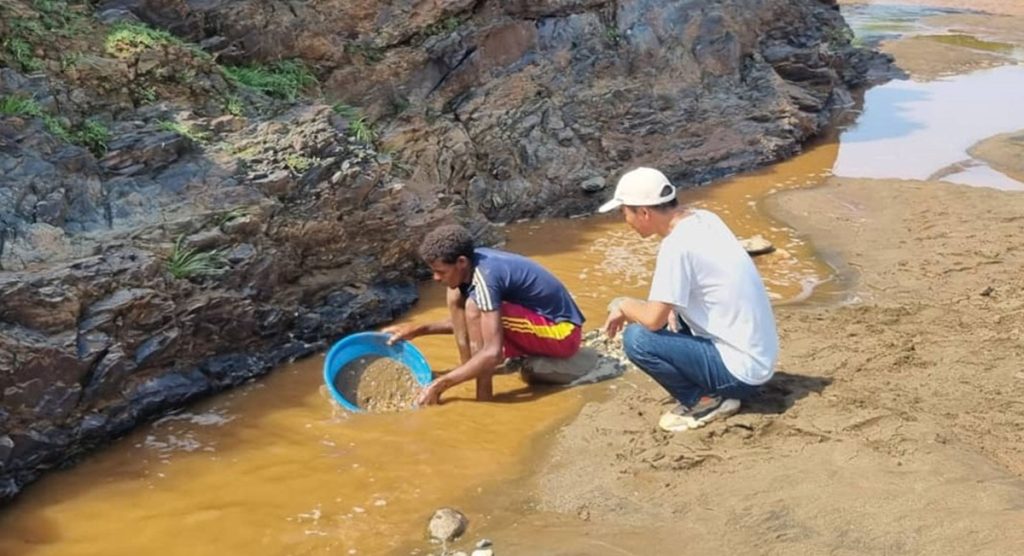
Addis Abeba – The illegal gold trade in Tigray has grown into a highly militarized, violent, and exploitative enterprise with far-reaching consequences. This trade involves a complex network of local and international actors, whose activities have not only devastated the region’s environment and economy but also fueled conflicts and regional instability. Recent investigations reveal that the impact of this trade extends far beyond Ethiopia’s borders, with Dubai emerging as a key hub for smuggled Tigrayan gold.
A Gold Rush Fueled by Violence
Tigray’s gold-rich landscapes have become centers of chaos and lawlessness. Mining sites across the region have turned into battlegrounds for control, with deadly clashes regularly erupting. Since April, many have died in violent altercations tied to the mining activities.
A particularly gruesome incident near the Weri River highlighted the escalating instability in the region, with fatalities underscoring the high stakes and pervasive lawlessness. The conflict involved a diverse group of participants: former combatants in Tigray, local youth, internally displaced persons (IDPs), refugees, and foreign nationals.
The Rahwa mine, renowned for its substantial gold reserves, has drawn comparisons to the “blood diamond” mines of the Congo. An anonymous official from Tigray’s Mining Bureau described the site as heavily militarized, with generals and armed groups exploiting advanced machinery to dominate the illegal trade.
Foreign Involvement Escalates the Crisis
Foreign nationals, particularly Chinese miners, have been implicated in the illegal mining operations. Operating without proper licenses, these foreign actors often collaborate with local armed groups and military leaders, heightening tensions with the local population.
One of such violent incidents occurred at the Hintsat gold mine, where disputes over ownership led to a deadly clash that claimed over two dozen lives. Local workers, frustrated by their exclusion from profits generated by advanced mining equipment, demanded a share of the wealth. The foreign operators refused, treating them as mere laborers. This escalated into clashes.
Smuggling Routes and Global Impact
The gold extracted from Tigray is smuggled through a network of well-established routes. One major pathway passes through Adiabo and Badme, crossing the Mereb River into Eritrea before heading to Dubai.
Another route involves vehicles disguised with the insignia of international organizations, enabling smuggling from Shire to Addis Ababa via Mekelle. Additional routes link Tigray to Somaliland, Kenya, and Uganda, with Dubai acting as the central hub for this illicit trade.
Shire, strategically located near major mining sites, has become the epicenter of Tigray’s black-market gold trade. The town serves as a collection and distribution point, with cartels coordinating the movement of contraband gold. These routes eventually lead to Dubai, leading to rational questions: At the end, why did Dubai support the war on Tigray? Was it to appropriate Tigray’s resources? Upon further and independent international investigations, this could be answered in the affirmative. Estimates suggest that Tigray produces around 20 quintals of gold annually, yet none of this wealth benefits the region’s people.
Environmental and Social Devastation
The unregulated mining practices have unleashed significant environmental and social destruction. Foreign miners use hazardous chemicals such as cyanide and mercury to extract gold, contaminating soil and water supplies. These toxins pose long-term health risks to local communities, exacerbating the already dire humanitarian conditions in Tigray.
Farmlands and other unauthorized areas are often excavated, displacing local populations and depriving them of their livelihoods. Meanwhile, the influx of armed groups and militarized operations has disrupted the social fabric, leaving many communities in turmoil.
Challenges to Resolution
Efforts to address the illegal mining crisis are underway. The Tigray Interim Administration has established a task force to regain control of the mining sector. However, systemic issues, such as entrenched smuggling networks and non-competitive pricing by the central bank, hinder progress.
Fisseha Miresa, head of the Tigray Mining Bureau, emphasized the need for the Ethiopian central bank to offer competitive rates for gold purchases to dissuade miners from turning to the black market. The majority of the revenues should also go to Tigray.
Further, as outlined above, independent, international investigations should be conducted of Dubai’s involvement in the war in Tigray and the association of this with illegal gold mining with a final destination to Dubai. Without meaningful reform, the region’s gold resources will continue to enrich a select few while leaving the people of Tigray impoverished.
Broader Implications
The stakes are immense. Tigray’s illegal gold trade not only threatens the region’s social and environmental stability but also has broader implications for the global gold market. As Tigray grapples with the aftermath of the war and the chaos of a gold rush, the region’s future hangs precariously in the balance. Resolving this crisis will require a multifaceted approach, including stronger governance, economic reforms, and international cooperation to dismantle smuggling networks.
Further independent, international investigations are also needed to gain insight and require accountability regarding collaborations between Ethiopia and Dubai as to gold smuggling since Dubai was a major aid to Ethiopia during its war on Tigray. Without swift and decisive action, the illegal gold trade will continue to devastate Tigray, perpetuating cycles of violence, exploitation, and environmental destruction. AS
Batseba Kassahun holds a Master of Public Administration from New York University and is currently pursuing a PhD in Public Administration and Policy. With over a decade of experience in public service, she has led the Black Students Union at North Seattle College, designed and implemented e-learning programs focused on Peace and Security in Africa, and served as a Country Manager for an Irish social enterprise.
 Martin Plaut