
By Gry Winsløw: Anthropologist, teacher and writer. Visited Eritrea in 2002 to study pedagogy and the lives of teachers and students. Published the novel Exit Eritrea in 2017 about young refugees based on her impressions from her stay and interviews with language students from Eritrea in Denmark.

A Nursing Student, a Slaughterhouse Worker, an high school Student, and a Technical Draftsman – What Do They Have in Common?
They are refugees from Eritrea striving to be visible to Danes.

On a Saturday in October, a new cultural association for Eritrean exiles was launched. I was invited and felt transported back to Eritrea, so many years after my visit to the country. After speaking on stage and sharing photos—especially of schoolchildren in the African nation—I was asked how Eritreans could be recognized by Danes. Specifically, how to be seen as living, individual people. Many feel invisible or experience fear from ethnic Danes. The answer, perhaps, lies in the locals’ willingness to open their eyes. Join me at the conference!
People with roots in Eritrea from across Denmark were invited to the event. Two prominent speakers traveled from Stockholm and Norway, joined by a civil rights advocate from the USA.
Throughout the day, attendance grew to 500. Many young people arrived later, drawn by the evening’s promise of beer and dancing to live music. Traditional festive attire was widely worn.

The association, called The Eritrean Cultural Community, chose as its theme: “Fostering a Strong and Healthy Community Ensures Well-Secured Futures.”
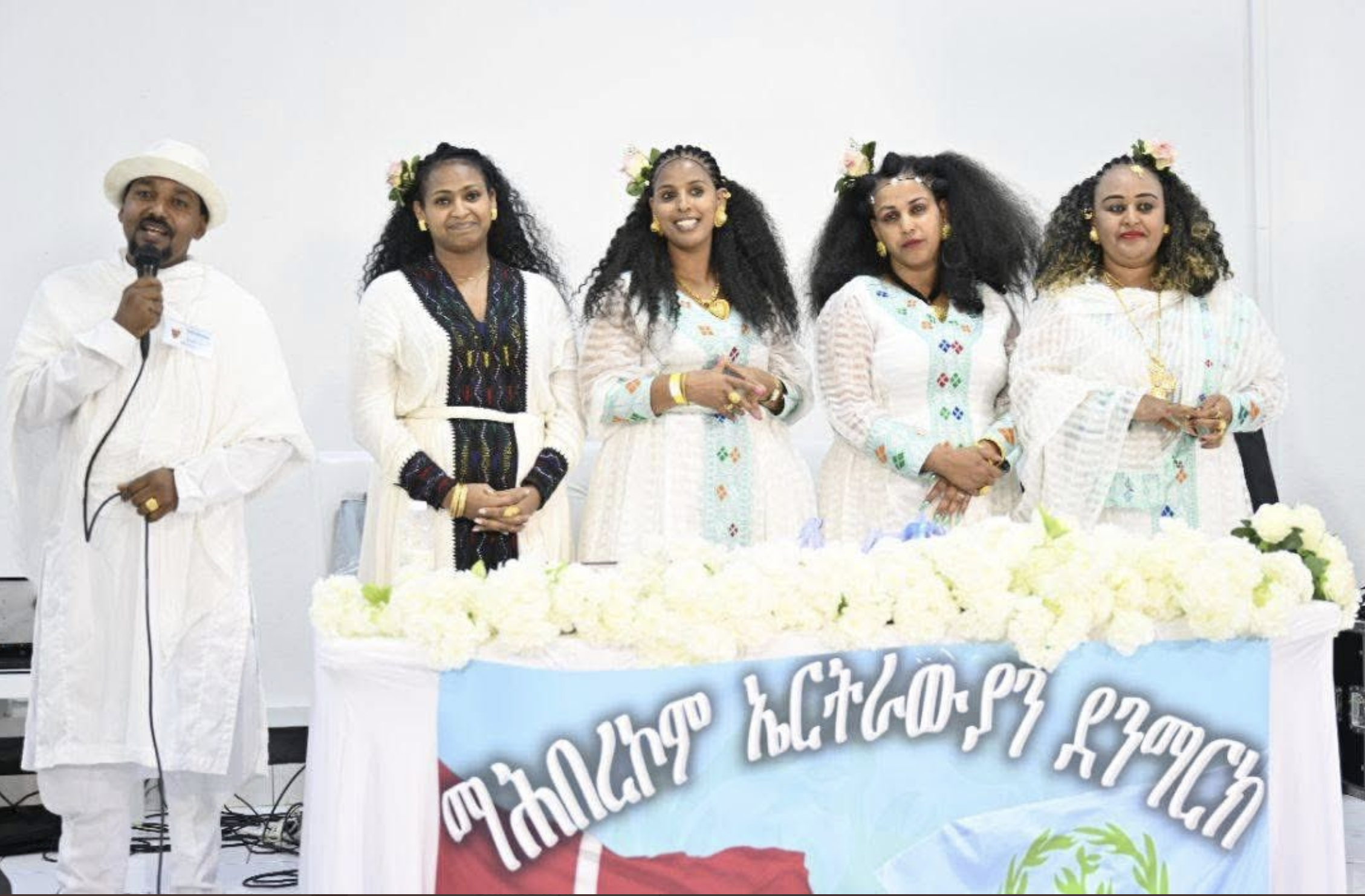
On stage, a banner displayed the association’s name in Danish and Tigrinya, the most widely spoken language in Eritrea. Beneath it hung the Danish flag and a sky-blue flag with a green olive wreath, representing Eritrea from 1952 to 1962. This was before Eritrea became, against many citizens’ will, a province of Ethiopia. The association deliberately avoids Eritrea’s current flag of green, red, and blue. Much of the Eritrean diaspora has adopted the historical flag as a symbol of resistance to the regime led by President Isaias Afwerki. Thousands have fled. In 2018, Human Rights Watch estimated that 12% of Eritrea’s population had escaped. A large group arrived in Denmark in 2015. Including family reunifications, there are now over 8,000 people of Eritrean origin living in Denmark, according to Statistics Denmark.
The diaspora is deeply divided. The conference and celebration were organized by those critical of Eritrea’s regime—a critique echoed by human rights organizations and Western governments. In contrast, another faction in exile supports the regime, and the two groups are not on speaking terms. At the event, I met attendees who had protested publicly against events held by the opposing faction.
A tapestry depicting a traditional village wedding hung behind Tsega, who was seated on a stool brewing coffee in a long-necked clay pot. On two low, decorated coffee tables were small cups and a burner. Eritrean coffee culture includes popcorn, which spilled decoratively from a basket onto the floor. Tall, geometrically patterned baskets completed the scene.
Isaac Abraham, one of the organizers, explained that many take joy in seeing images and artifacts from their traditional culture. One aim of the new association is to celebrate and preserve the culture that Eritrea’s communist military regime has suppressed.
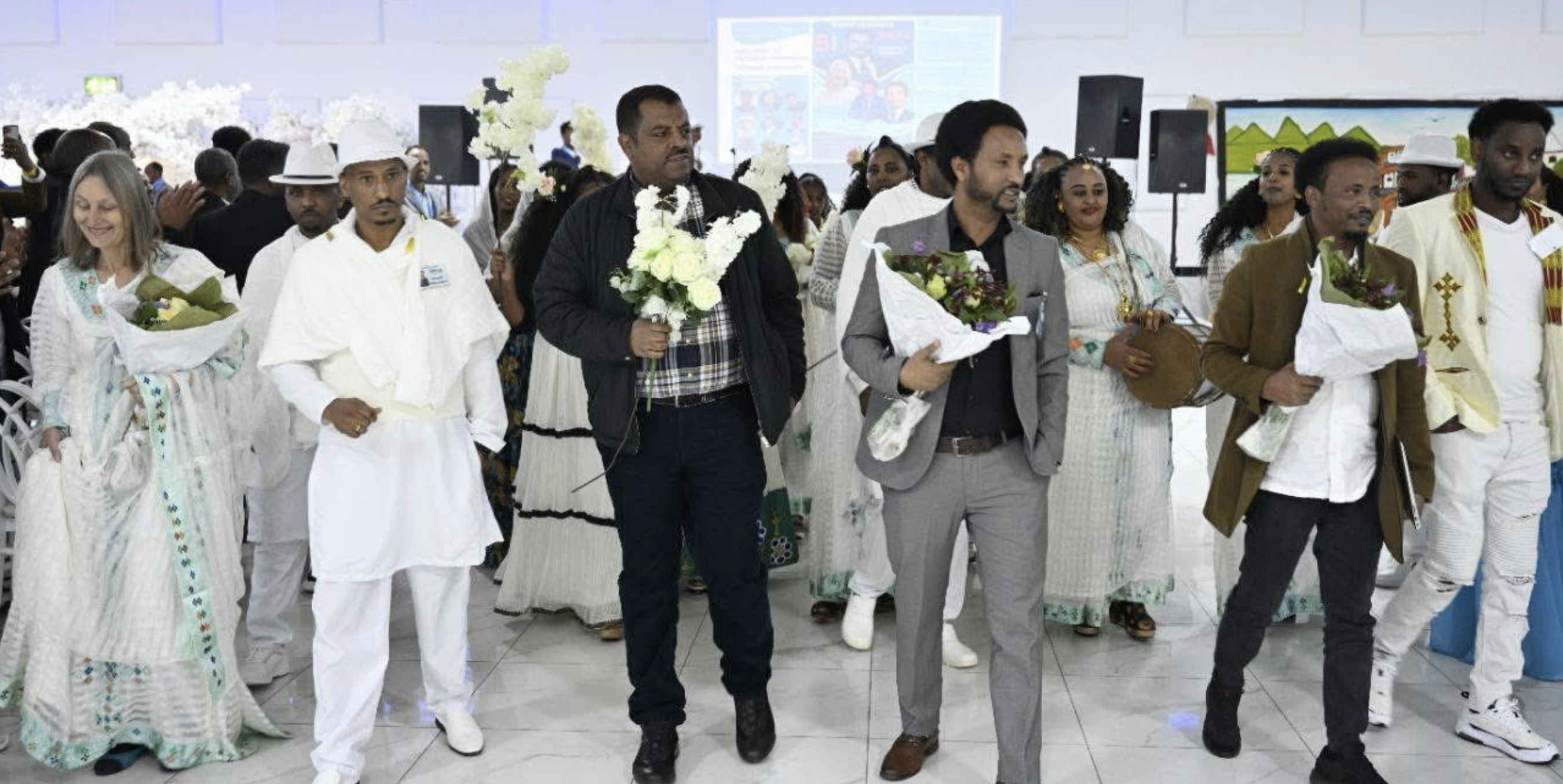
The time came for a cultural performance. Kibron sang a ballad traditionally performed in villages during communal work gatherings. The atmosphere was lively; organizers squatted around him, cheering as he delivered the lyrics with passion and drama. The men wore white trousers and tunics, with traditional white shawls and small white hats. Their short, checkered sticks added to their attire. The women wore long, flowing dresses with wide embroidered necklines and borders running down the front. For the occasion, I was gifted a traditional dress and scarf, draped over one shoulder. Managing the unfamiliar outfit required some effort. While white was the dominant color, the sky-blue from the historical flag also stood out.
Khaled Abdu from Stockholm took the stage. With over 25,000 followers, he is known for his YouTube videos aimed at inspiring young members of the diaspora to focus on personal empowerment.
The event was conducted in Tigrinya, and Helen Habtay came over to translate for me. As time passed, we began chatting, and fragments of her story emerged. At 13, she was imprisoned after being accused of planning to flee Eritrea. The experience was so harrowing that she left the country upon her release, fleeing alone as a teenager. Her journey was fraught with terror: she witnessed a pregnant mother beaten to death, was detained in one of Libya’s notorious detention centers, and crossed the Mediterranean in a rickety, overcrowded boat. At 16, she reached Denmark, where her life changed dramatically. She was placed with a supportive foster family, received help from DIGNITY the Danish Center for Torture Victims, attended school, and is now studying nursing.
In the rows ahead of us, many young men in their twenties sat quietly, listening intently. “They’ve experienced equally horrifying things,” Helen said, “but they don’t talk about it.”

Khaled Abdu spoke about self-trust and setting realistic personal goals. Later, Beyne Gerezgiher addressed the crowd. With 86,000 Facebook followers, he captivated the audience just as much as the previous speaker. He urged the diaspora to foster unity through positive communication and conflict-free interactions.
Isaac, who balanced his work as a technical draftsman with organizing the conference, emphasized another reason for establishing the association. Many in the diaspora suffer from PTSD or stress. They have nightmares about the abuses endured in Eritrea and their perilous escape. Adjusting to Danish society, so vastly different from their own, adds further stress and confusion. The association aims to provide self-help support for these challenges.
At the book table, I chatted with Berhane, who had brought three books written in fidâl, the script used for Eritrean (and Ethiopian) languages. The cover of one featured a heart engulfed in flames. Relationships among refugees are often fraught; some marriages end in divorce. In his book, a divorced woman chooses another man from the diaspora. Conference attendees also stopped by the table to buy my novel, Exit Eritrea. Many are now proficient enough in Danish to read a story reminiscent of their own.
Berhane worked for six years at Danish Crown and is currently unemployed, hoping to further his education, perhaps with a master’s in biology. Previously, he spent three years as a high school teacher in Sawa, the notorious military camp where all third-year high school students must complete their final year. Human rights organizations have documented harsh conditions there: violence, torture, and rape are common, food rations are insufficient, and students lack access to medical care. Teaching in Sawa was not voluntary for Berhane; it was part of Eritrea’s Civilian National Service, a system requiring young people not conscripted into the military to serve, often indefinitely. His pay was so meager that even buying soap was a luxury.
During summer breaks, he traveled across the country to supplement his income by importing and selling mobile phones in Asmara. This raised suspicions with authorities, who accused him of planning to flee and imprisoned him for two years. He later attempted to escape to Ethiopia but was caught and jailed for another year. In 2014, he successfully left Eritrea, arriving in Denmark in 2015.
Selam did not wear traditional attire, though her festive spirit was evident. She considered herself lucky; she had avoided the dangerous Mediterranean crossing by reuniting with her father through family reunification. She is now studying individual HF courses.
The entire event was livestreamed on three YouTube channels, including ERIPM, run by exiled Eritreans. During the day (and night), up to 1,300 viewers followed the proceedings, and the new association gained 300 members that day.
 Martin Plaut