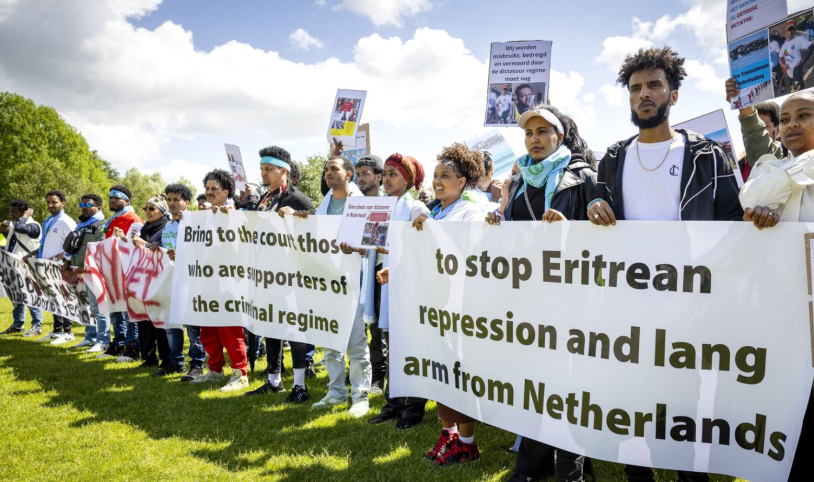
Source: NOS
A group of Eritrean people smugglers, who partly operated from the Netherlands, have been guilty of human trafficking, violence and other atrocities against migrants on a large scale. This is evident from research by the National Rapporteur on Human Trafficking. They studied 124 witness statements in an international criminal investigation by the Public Prosecution Service into the criminal organisation.
In almost all cases, the witnesses were Eritrean refugees who had paid the smugglers to transport them to the Netherlands, but they became victims of human trafficking in Libya.
“They flee their country and travel to a place with opportunities for the future,” says National Rapporteur on Human Trafficking Conny Rijken. “They cannot travel legally because they do not have travel documents and they use human smugglers.”
Locked in warehouses
The refugees were locked up in warehouses with too many people in too small a space. They were given too little food and drink, and there were no sanitary facilities. They were also forced to call family members to transfer more money and were subjected to physical and verbal abuse, the investigation found.
The suspected human traffickers are seven men. Two of them ran reception camps in Libya. One of them is Walid, who is currently on trial in the Netherlands. The other main suspect , Kidane, will soon be extradited by the United Arab Emirates, the Public Prosecution Service announced.
The five others are suspected of having organised the extortion and money flows in the Netherlands. Many of the victims already had family in the Netherlands. The suspects visited them at home to extort money from them.
Kidnapped and resold
“We think this research is important because it now makes clear what people experience during a journey and in the asylum chain,” says Rijken. Victims of human trafficking have the right to protection and help, she says. “Their experiences can be taken into account when receiving them.”
Some people had to do work in the warehouses for the smugglers, ranging from preparing food to abusing other migrants. A number of people were kidnapped and/or resold during their stay in Libya (sometimes multiple times), after which they had to pay (again) for their release.
Left behind in the desert
According to Rijken, a lot of physical violence was used. “Some victims were beaten with garden hoses. These hoses were made wet, which is more painful. There are also witnesses who state that people were injured and left in the desert and died.” It is unknown how many victims died.
It has been known for some time that serious human rights violations are taking place in large reception camps in Libya, but it is the first time that a human trafficking network with so many victims has been dismantled in the Netherlands, the Public Prosecution Service says.
 Martin Plaut
Dear Mr. Plaut, On behalf of my people Eritreans & Ethiopians, I like to thank you for your relentless fight for civil rights and humanity. You have the Mandela’s touch. WE RESPECT YOU & WE LOVE YOU!! LONG LIFE TO BIRGED NIHAMEDU. S
To be sure, 90% of genuine Eritreans return to Eritrea after they have been granted nationality or permanent residency i abroad . Even the people who were extremely against the Eritrean government return and enjoy themselves in Asmara. I am from Eritrea. I want my Eritrea to be a Democratic country. but NONE of what is written has correct and most of the information is wrong. Eritrea is the most stable country compared to all neighboring countries. see for example, Ethiopia, Sudan, Somalia Yemen etc.
Not sure why you want to pretend, I am sure you don’t think so when you talk to your conscience or behind closed doors.