
President Trump made an offer to the Afrikaner community of South Africa: “the United States shall promote the resettlement of Afrikaner refugees escaping government-sponsored race-based discrimination, including racially discriminatory property confiscation.”
This is from an official, White House announcement.
The reaction in South Africa has been generally negative, bordering on disbelief. Even the Afrikaner community has said “no”. The Chief Executive of AfriForum, an Afrikaner pressure group, Kallie Kriel said that his organisation remained committed to South Africa and its future.
“We do see the future of Afrikaners in Africa as a people. We were formed in Africa, and the price to leave the country would be too high. We remain committed to the country and its future.”
Trump probably assumes that Afrikaans speakers are white. This is not the case.
According to the 2011 census, 3.4 million Coloured (or mixed race) South Africans, 600,000 black Africans and 59,000 Indians speak Afrikaans as their first language. This is total of just over 4 million South Africans of colour. By comparison just 2.7 million whites have Afrikaans as their first language.
Who’s driving Trump’s agenda?
There is an element of truth to Trump’s allegations.
There have been brutal killings of Afrikaners on their farms for years; Afrikaans as a language is under siege at top universities; racial classification of South Africa’s population still exist, with whites excluded from top jobs and the governing African National Congress frequently applauds the actions of America’s rivals – Russia, China and Iran. Indeed, ANC cadre are sent to Tanzania for training by the Chinese Communist Party.
But this does not explain Trump’s attention to South Africa, which is influenced by those who are nearest to him: his advisers and golf buddies.
Source: News24
South Africans who have Donald Trump’s ear – the PayPal mafia, golfers and an alt-right editor
Kyle Cowan
- A number of South African businessmen and sports personalities have fostered close ties with Donald Trump.
- South Africa is increasingly on Trump’s radar, driving intense speculation over his reasons for focusing on the country.
- Among the reasons put forward is South Africa’s legal action against Israel over the destruction in Gaza – but, increasingly, Trump is being linked with South African personalities.
- For secure, anonymous communication with News24’s Investigations team, click here.
US President Donald Trump’s recent increased focus on South Africa has coincided with a notable rise in the number of businessmen, golfers and entrepreneurs from the country who appear to have swelled the ranks of his inner circle.
On Friday, Trump signed an executive order cutting off aid to South Africa claiming that the country had taken aggressive positions towards the US and its allies including the ICJ case of genocide against Israel and accusing the country of “reinvigorating its relations with Iran to develop commercial, military and nuclear arrangements. The order also claims falsely, that the government had enacted the Expropriation Act to “seize ethnic minority Afrikaners’ agricultural property without compensation”.
The order also cited “countless government policies” that fuelled “disproportionate violence against racially disfavored landowners” and further instructs that steps be taken to provide “humanitarian relief” including admission and resettlement for “Afrikaners in South Africa who are victims of unjust racial discrimination”.
The South African government’s steps – including the ICJ case against Israel – has propelled the African nation to the forefront of the US president’s mind, alongside his wishes to take over sovereign nations and start a trade war. This past week Trump again made false claims that land was being “confiscated” and that certain classes of people were being treated “very, very badly”.
This is apparently Trump’s take on the message of Afrikaner rights group AfriForum, which toured the US in 2018 with a message around farm murders, and right-wing commentators in America, for whom South Africa has long held a special fascination.
Multiple signs have emerged that South Africa risks losing access to the African Growth and Opportunity Act (AGOA), a programme of preferential trade concessions that is an important bulwark to the economy. Republican politicians, especially, have criticised South Africa’s closeness with Russia, and action at the ICJ against Israel.
South Africa, therefore, is firmly on the agenda. Now, it has emerged that Trump has also been spending hours with South Africans on the golf course, too.
According to Politico, on 16 December 2024, Trump played golf for six hours with SoftBank chairperson Masayoshi Son. That same day, Son and Trump addressed a press conference to announce Son’s $100 billion (R1.8 trillion) investment into the US that same day – echoing a similar investment promised in 2016.
Son, who has a massive golf course in the basement of his mansion in Tokyo that can mimic real-world conditions, announced – with Trump – a $500 billion (R9.2 trillion) investment into AI development, alongside Open AI’s Sam nbv x a few weeks later.
But joining them on the golf course that day was legendary pro-golfer Gary Player and his friend, Reon Barnard. Barnard, a mining entrepreneur, is also a trustee of the Gary and Vivenne Player Foundation.
Player, who has been open about his support for Trump, said through a spokesperson, Dave King, that the conversation on the golf course between himself, Barnard and Trump on the day, 16 December, was “mainly social and golf related”.
“We had no input or influence whatsoever over President Trump’s comments or actions towards South Africa after he was inaugurated last month,” Player said in a written response to questions.
Barnard said it was the only interaction he has had with Trump.
Player, who said he has known Trump for decades through golf and building golf courses, previously told Bunkered, a golf publication, that he and Trump play golf together almost every three weeks.
In 2021, Trump awarded Player the Presidential Medal of Freedom, the highest civilian honour the US president can bestow.
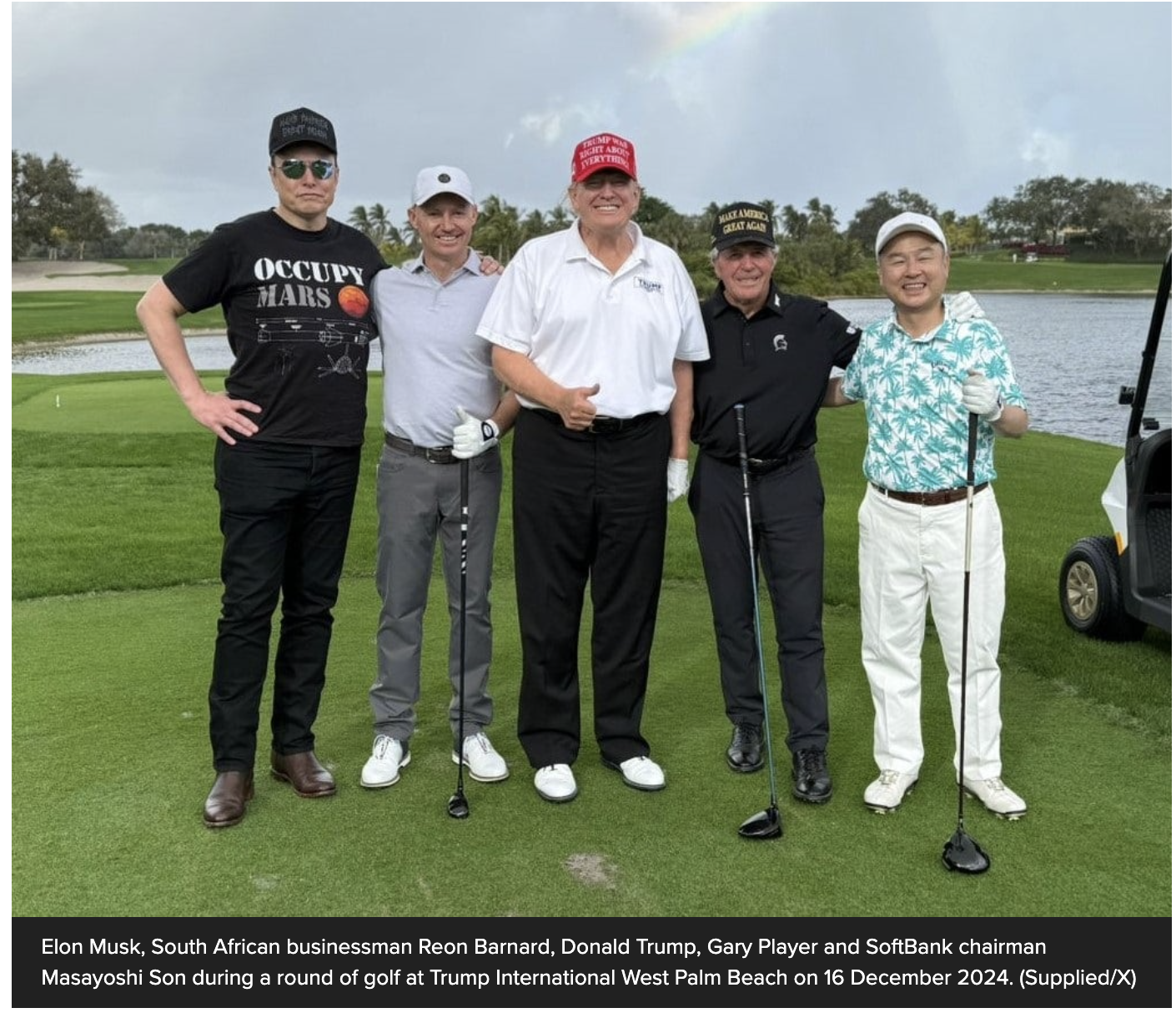
One photograph showed them together with other players at the first hole, before teeing off, and another was snapped at the tee for the eighth hole. Another picture was of Player and Barnard with Trump and Son, as well as Player’s manager Marc Tudhope, showing Barnard and Player dressed in more formal clothing apparently after the golf was finished.
Elon Musk, too, made an appearance in two of the pictures though, as he was not dressed in golf attire, it is presumed he was not playing.
From left: Player’s manager Marc Tudhope, Elon Musk, Reon Barnard, Donald Trump, Gary Player and Masayoshi Son on 16 December 2024. (Supplied/X)
Musk, who has been at the centre of intense media coverage for his unilateral shutdown of government agencies, including USAID as head of Trump’s unofficial Department of Government Efficiency, is also a member of the so-called PayPal Mafia.
According to the Financial Times, the PayPal Mafia is a group of Pay founders and early employees at PayPal, several of whom were born in South Africa and have gone on to invest in some of the biggest and most valuable technology companies in the world.
This includes David Sacks, who Trump appointed as the chair of the President’s Council of Advisors on Science and Technology, or more colloquially his AI and crypto currency czar.
It also includes Roelof Botha, now a partner at venture capital firm Sequoia Capital and former chief financial officer at PayPal.
Pieter Thiel, another member, also spent some time living in South Africa and Namibia.
Another influential voice in the room is Joel Pollak – the South African-born editor of alt-right publication Breitbart. Pollak is said to be in the running to be appointed ambassador to South Africa. He was also tipped as a possible candidate for the post during Trump’s first term.
“Pollak says that Trump’s seemingly out-the-blue tweet about SA on Sunday was not unexpected and that the new president has a coherent and long-standing desire to force change in SA,” News24’s Carol Paton wrote this week after an interview with Pollak.
Golf diplomacy
Golf played an important role in Trump’s previous presidency – whether his time on the course drew criticism, or for being a set-piece for diplomacy wins.
Trump has played with US policymakers, members of Congress, and world leaders, including the prime minister of Japan, Shinzo Abe, and the leaders of Saudi Arabia and Australia.
The rounds with Abe were hailed as a starting point for improved relations between the US and Japan, and in November 2024, news broke that the now-impeached South Korean president planned to dust off his clubs to play with Trump.
In a 2020 post on X (then Twitter) defending the amount of time he spent playing golf while president, Trump said he played very fast and got “a lot of work done” on the course. He is well known for agreeing to pose for a picture regularly with other players who approach him on the course.
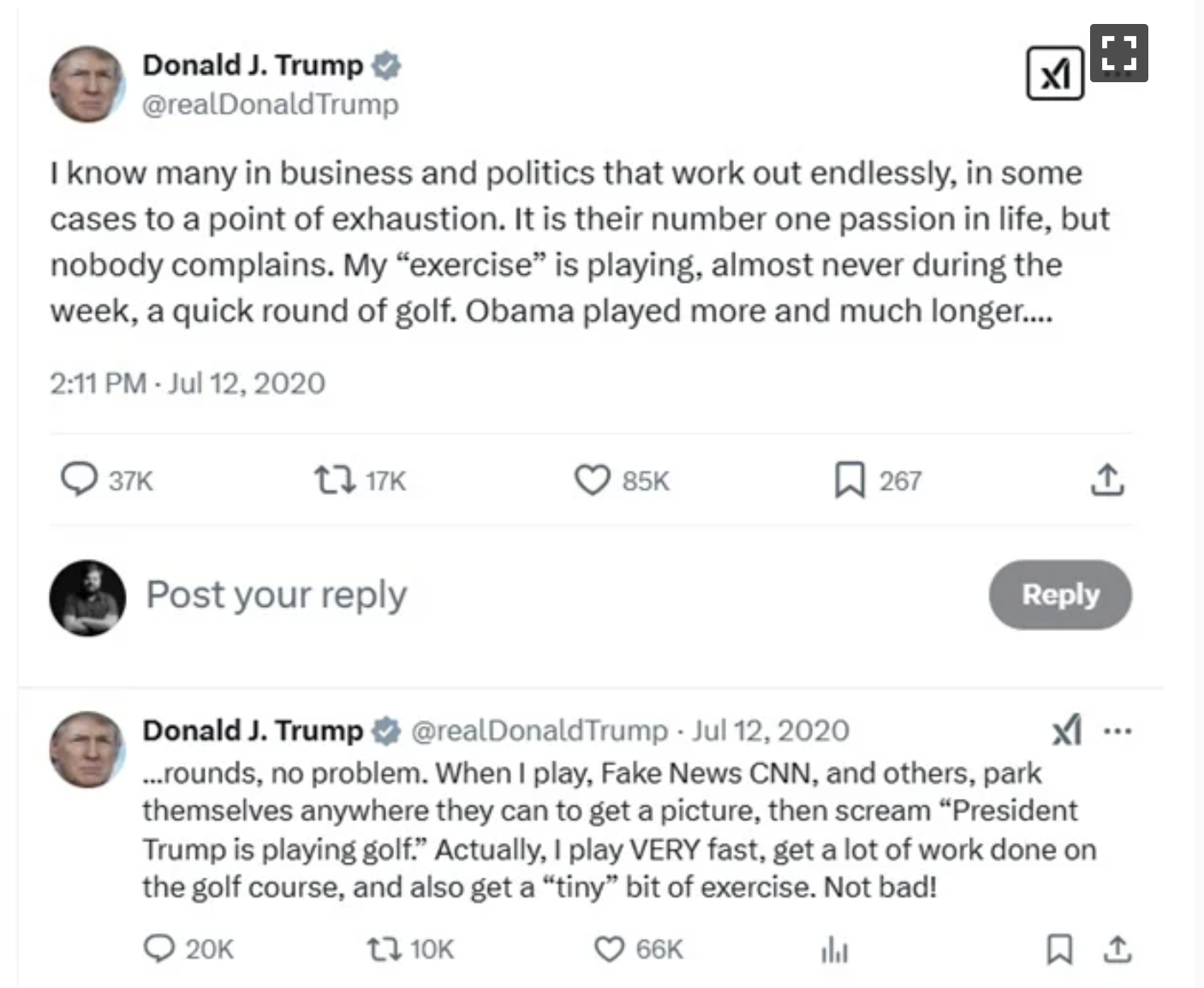
A 2020 post by Donald Trump defending the amount of time he spends on the golf course. (X/Screenshot)
While Player was insistent the conversation was purely social and related to golfing on the day, in a BizNews interview in January, he praised Trump, saying he was on course to be “the best president ever”, before launching into comments about South Africa’s open borders, echoing statements made by Trump over the US-Mexico border, drug flows and illegal migration, drawing parallels with South Africa.
“I have continued to enjoy the president’s company when I spend time in the USA, and I occasionally invite South African friends and colleagues to play with us,” Player told News24.
“As would be expected there were a lot of officials in attendance with the incoming president in December and we had the opportunity to briefly meet many of them… I have been an informal ambassador for South Africa for over 70 years and, while admitting that we have had and still have our problems, I continue to promote South Africa as a wonderful country to visit and to play golf,” Player said.
Musk has also been pointed out as the possible main conduit of misinformation being fed to Trump about South African affairs. Musk’s views on South Africa include the belief that the country had “openly racist ownership laws”, a perception he may have garnered from the requirement that his internet company, Starlink, must have at least 30% local, black ownership to be allowed to operate here.
Elon Musk accused South Africa of having openly racist ownership laws in this post on his platform, X.
Another group said to be influential in conservative US circles is AfriForum, the Afrikaner rights organisation that has since 2018 toured the US and Eastern Europe to spread messages that white South African farmers were being targeted in fatal attacks and to “spread the message” that the South African government intended to take away their land without compensation.
Notably, AfriForum has launched a petition and campaign in support of Musk’s Starlink locally, including providing written submissions and presentations at public hearings to the regulator, the Independent Communications Authority of South Africa.
READ | AgriSA rejects Trump’s claims of ‘land confiscation’, warns of disinformation
In a press statement issued on Thursday, AfriForum said it had given “farmers and rural communities a voice regarding Starlink” at the public hearings. The organisation has sought to challenge what they call racially discriminatory laws that have prevented Starlink from operating in SA, because of 30% local black economic empowerment regulations.
The press statement was accompanied by a link to a domain named “unblock Starlink”, which opens to a petition signing page topped with a slick graphic that proffers the question: “No satellite services for Starlink because they are ‘too white'”?
AfriForum said this week that its message has always been that those responsible, ANC politicians, should be punished, and not the citizens. In the face of Trump cutting off aid, and potential loss of AGOA membership, AfriForum has faced intense criticism over the past week.
“Our initial strategy was never to punish South Africa, although it will be hard to stop the train in the US. Kicking South Africa out of AGOA does not punish politicians, it punishes ordinary people. If they are going to punish, look at the specifics,” AfriForum’s Kallie Kriel told Daily Maverick’s Ferial Haffejee this week.
Ernst van Zyl, head of public relations at AfriForum, was also part of a trip to the US in July 2024 for the launch of The Afrikaner Foundation. They addressed a gathering of the New York Young Republicans and attended together with Ernst Roets, head of the foundation and director at the Solidarity Movement.
Roets was a guest speaker at the National Conservatism Conference. The pair also had “several discussions and meetings with opinion makers, politicians and organisations interested in the current state of affairs in South Africa”.
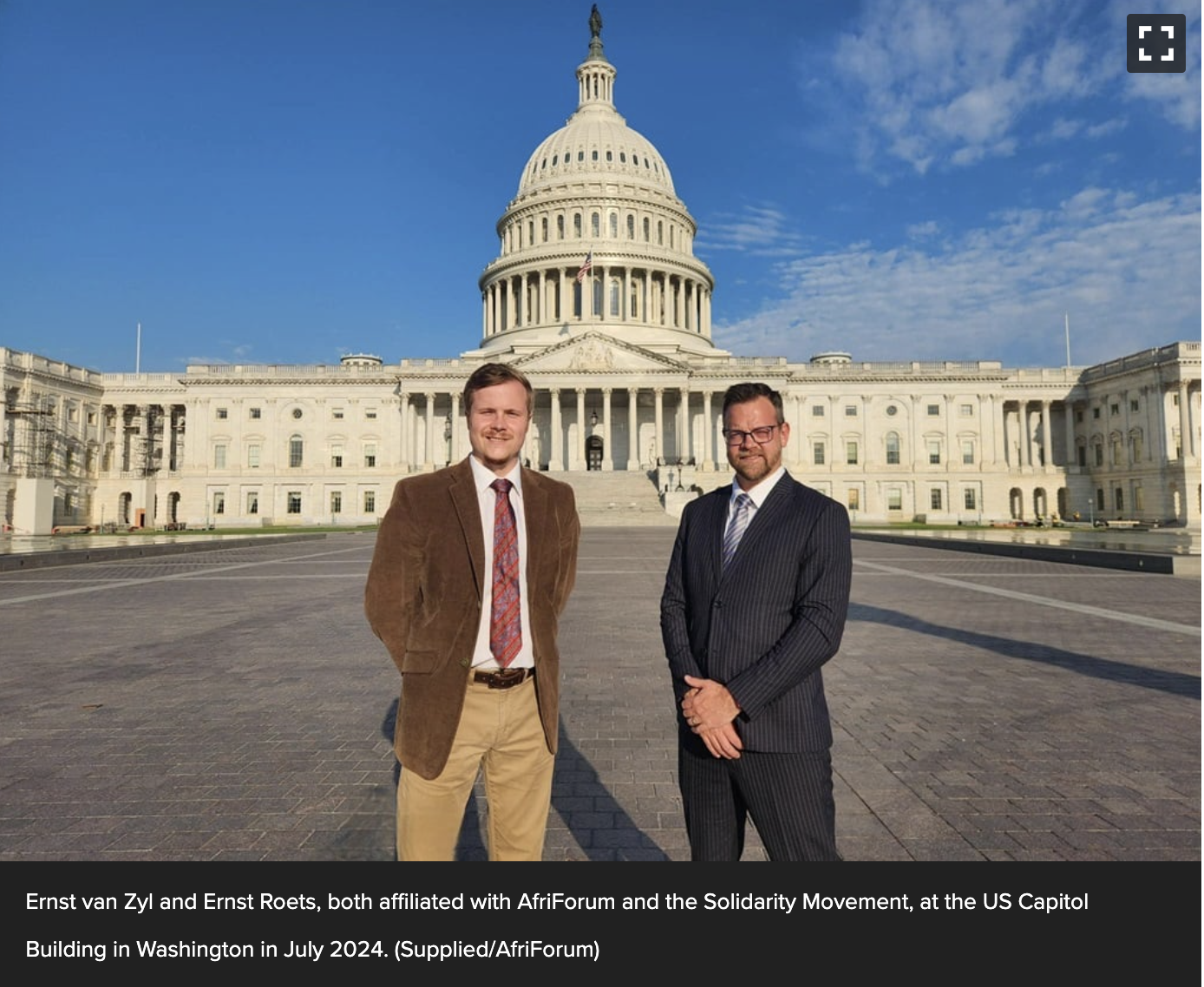
Ernst van Zyl and Ernst Roets, both affiliated with AfriForum and the Solidarity Movement, at the US Capitol Building in Washington in July 2024. (Supplied/AfriForum)
“Ten years ago, those we encountered internationally knew little about South Africa’s crises. Five years later, they became aware of some of the crises and wanted to discuss them in more depth. Today they are aware of the crises and their extent and now they are interested in our solutions,” Van Zyl said in a press release at the time.
This week, Van Zyl told Newzroom Afrika’s Stephen Grootes that he “hoped” the tour and messaging had a “massive impact”.
“Well, AfriForum has built up a massive list and database of friends and allies all across the world, particularly in the United States. As soon as the Expropriation Act was signed by the president, we all informed them about the facts here in South Africa. So, I do hope that we had a massive effect there. I mean, you can’t really see everything that happens behind the scenes, but I do think AfriForum had a massive impact,” Van Zyl said.
What’s the intellectual rationale behind Trump?
Source: Politicsweb
What this is all about
07 February 2025
Ramaphosa has shoved SA into the final phase of the NDR, and it seems as if only Donald Trump (of all people) is trying to stop him
EDITORIAL
Earlier this week US President Donald Trump declared in a post on Truth Social that “South Africa is confiscating land, and threatening certain classes of people VERY BADLY. It is a bad situation that the RADICAL LEFT MEDIA doesn’t want to so much as mention.” He went on to say he would be “cutting off all future funding to South Africa until a full investigation of this situation has been completed.”
This post was met with consternation across much of the South African media and political class. Trump, it was said, was falling to prey to “misinformation”. Not a piece of land had been touched (yet) under the Expropriation Act, recently signed into law by President Cyril Ramaphosa. AfriForum was accused of “treason” for briefing US conservatives about the situation in South Africa and blamed for the pause in US Aid. For a moment the DA seemed to completely lose its mind, as its ministers started jabbering on incoherently about how the Act was no threat to property rights after all. Yet, though delivered in Trump’s trademark style, whoever was behind the US President’s post had made sure it was both carefully phrased and accurate. It was rather Trump’s critics who seemed to have learned nothing, or forgotten everything, from the experience of three decades of ANC rule.
To start with, the driving impulse of the ANC (including its EFF and MKP offshoots) has always been to loot. Its animating ideology, the National Democratic Revolution (NDR), is one of “kleptocracism”: the belief that power brings with it an entitlement to (racial) plunder. The declared goal of the NDR is to “return” the “wealth of our country, the mines of our country, the factories and the land in our country” to “the people” (the black majority) from whom these had been “stolen” (by the white minority).
It is time consuming and ultimately futile to chase down the rabbit hole to try and pin down the historical legitimation for this assertion. It is a classic “accusation in the mirror” formulation whereby a party imputes to its enemy exactly what it is intending to do to them. You will find the same phrasing used in other countries, with quite distinct histories to South Africa’s, where revolutionary racial nationalists were seeking to dispossess productive but politically vulnerable minorities of their property. As we now know from hard experience the suggestion that the “wealth” being seized by the party would be passed over into the hands of “the people” was also misdirection.
This ideology inculcated an ethos within the ANC which meant that before state power was won it had great difficulty in restraining its leading cadres from looting the only resources then available, those of the movement itself. In the late 1980s and early 1990s the ANC was generously funded by the Nordic states and many cadres became expert in the dark arts of diverting and purloining donor funds. There were internal efforts to check this by some honest officials, but they proved largely ineffectual. Many of those caught embezzling money were not just let off the hook by the party’s leadership but were promoted onwards and upwards. One even eventually ended up as South Africa’s chief of police (and head of Interpol no less.)
During the Cold War the Soviet Union sponsored the ANC and South African Communist Party and supported and helped formulate their plans for mass confiscations of private property, after power was seized, primarily out of a desire to weaken the West. In the second half of the 1980s however the Soviets began winding down their proxy wars and began pressing a truculent ANC/SACP to walk back from their demands for wholesale nationalisation of the economy, as this was necessary for any negotiated settlement with the white minority.
In early 1992 the ANC finally agreed to drop nationalisation completely. But it did not abandon the NDR. Rather it decided that it would now have to be pursued through phases, over two-decades or so, with the final and most delicate phase the taking of privately owned property and land. In his memoirs the late IFP MP, Dr Mario Oriani-Ambrosini, recalled Cyril Ramaphosa telling him, not long after,“of the ANC’s 25-year strategy to deal with the whites: it would be like boiling a frog alive, which is done by raising the temperature very slowly. Being cold-blooded, the frog does not notice the slow temperature increase, but if the temperature is raised suddenly, the frog will jump out of the water. He meant that the black majority would pass laws transferring wealth, land, and economic power from white to black slowly and incrementally, until the whites lost all they had gained in South Africa, but without taking too much from them at any given time to cause them to rebel or fight.”
The first phase of the implementation of the NDR started with the ANC forcing out the (mostly white) incumbents from state and parastatal employment, many of whom had precious skills and expertise, so that these positions could be filled with ANC cadres (of all colours). Once the ANC had control over the state machinery, at all levels, it started to direct state and parastatal contracts to party ‘tenderpreneurs’.
The ANC had endless problems ensuring such ‘wealth extraction’ was sustainable, as when one avenue of accumulation was opened up, subtly at first, a feeding frenzy quickly followed, with nothing much left of the institution concerned at the end of it. As ANC Secretary General Kgalema Motlanthe would bemoan in early 2007 “this rot is across the board. It’s not confined to any level or any area of the country. Almost every project is conceived because it offers opportunities for certain people to make money.”
The ANC government also took ownership of all mineral rights in the country and then used control of mining and other licenses to force companies to disgorge a minority of shares to cronies in the name of so-called “Black Economic Empowerment.” This had the advantage of making many leading figures in the ANC rich beyond all dreams of avarice while not destroying these firms completely. It did however put an end to any further large scale capital investment in these areas of the economy.
To smooth implementation of the NDR, as it passed through each phase, ANC leaders would habitually provide placatory but insincere assurances. Perhaps the most fundamental deceit that had to be maintained was that the intentions of the ANC were fundamentally noble, and the project was aimed at “equality” and “empowerment,” not crass self-enrichment. The hard reality, that South Africa has yet to face, is that ‘State Capture’ did not begin with Jacob Zuma and the Gupta family. The ANC was orientated from the start towards using state power for wealth extraction, something well known and understood by the many foreign states who agreed to forge ‘mutually beneficial’ relationships with the ANC government.
With the formation of the Government of National Unity, and entry of the DA into cabinet, Ramaphosa had an opportunity to divert from the road to national destruction, as represented by the NDR, and turn onto a reformist path. Yet with his surprise signing of the Expropriation Act into law South Africa suddenly and unexpectedly finds itself thrown into the final stage of the NDR.
The Act allows for land to be expropriated in the “public interest”, not just as is usual for “public purposes”, and this is defined in a way that is clearly intended to enable the realisation of final phase NDR objectives. Dispossession or confiscation is a process – with the actual loss of property coming at the very end of it – and the starting gun has now been fired. The question of in what circumstances the Act allows “nil compensation” to be paid is also something of a diversion. Once a person has been issued with “a notice of intention to expropriate” by some or other dysfunctional state organ, their property rights will be in limbo, and keeping hold of that property, or securing adequate compensation for handing it over, will involve an arduous tug of war.
The idea that the convulated provisions of the Act, a judiciary packed with comrade judges, and ambiguously phrased constitutional provisions, will somehow be able to keep the ANC/ EFF/MKP’s worst tendencies in check is simply delusional. A locked door is secure but open it just slightly – to placate those banging against it – and it becomes useless against a gang of intruders. This is what happened with civil service appointments and state contracts. The law was changed just enough to make cadre deployment and tenderpreneurship possible, and very soon they became unstoppable. The Expropriation Act does not have to open the door completely, for the worst to happen, just enough to allow the cadres to force their way through.
What is genuinely remarkable about Trump administration’s effort to pressure the Ramaphosa government to close the door that the Expropriation Act is trying to open, is that it is the first time in living memory that a Western democracy has sought to check the ANC’s kleptocracism (as it enters its most deadly phase) rather than excuse, enable or profit from it.
 Martin Plaut
He is not speaking for 80% of white South Africans.