
A former soldier who was spirited to Eritrea shares his harrowing story of torture in training and a deadly attack
Source: New Lines
Mohamed Gabobe Mohamed Gabobe is a Somali-American journalist and photographer based in Mogadishu, Somalia.
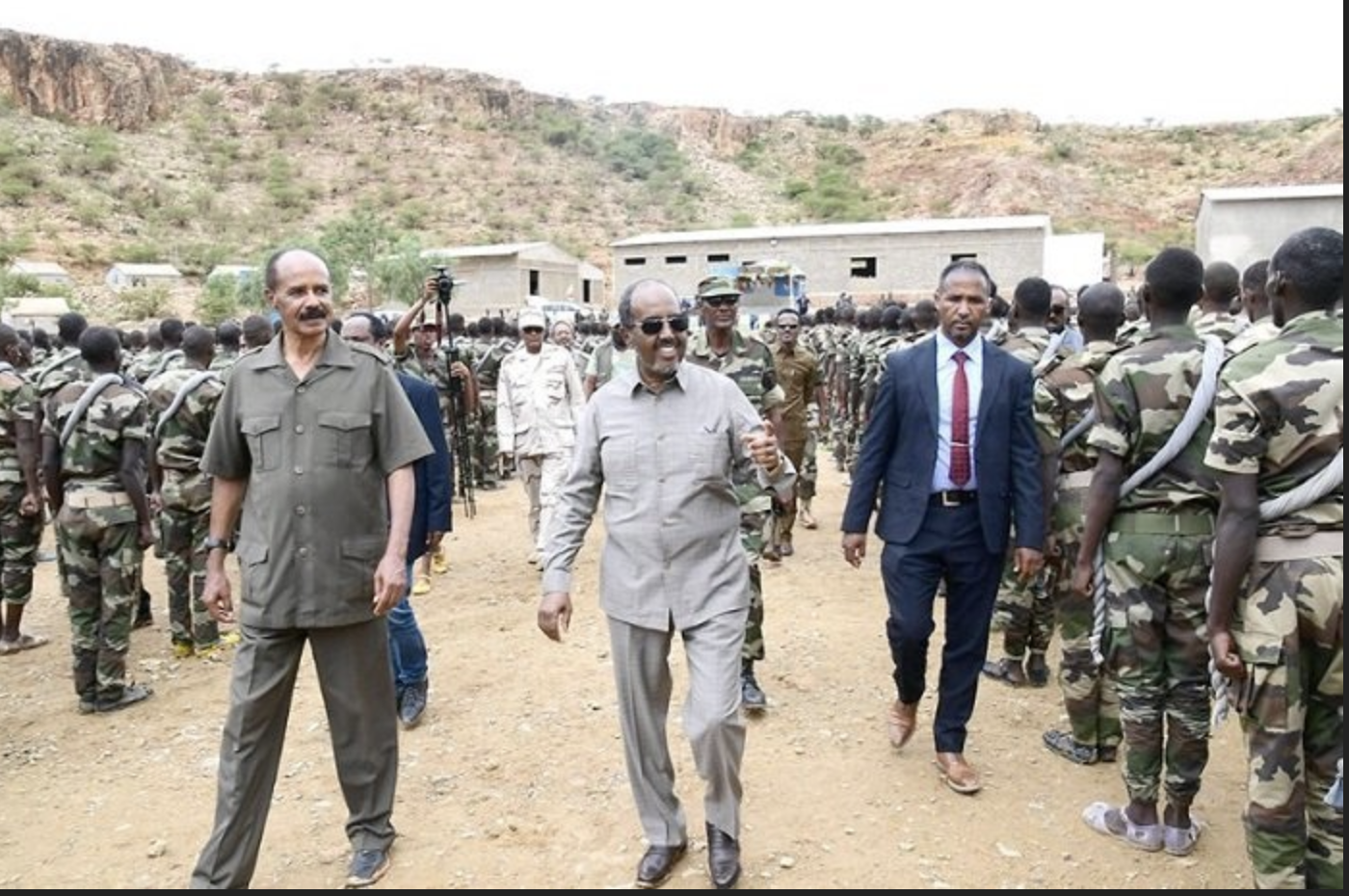
New Lines interviewed a survivor-turned-whistleblower from Somalia’s armed forces who took part in clandestine training and survived an al-Shabab attack that left over 100 government troops dead; the attack was then hidden from the public. This essay gives a glimpse into the complex nature of the ongoing conflict in Somalia, highlighting the lack of transparency in the war and the continuing threat of al-Shabab’s deadly attacks against government forces. The whistleblower’s name has been changed to protect his identity.
The sun was scorching in the Somali capital of Mogadishu as cars lined the busy junction to pass through the security checkpoint. It was 12:30 p.m. and worshippers left the local mosque in droves following the midday prayer. I made my way down a road near the Sanca junction into a residential neighborhood, where Sharmarke Hersi was waiting.
The slim young man with a baby face looked harmless. He sat in a plastic chair puffing cigarettes back to back as though he had been smoking for decades, staring at me as I walked his way. I knew he was expecting me.
I sat down next to him, and the traditional Somali custom of drinking tea followed. A woman, who I would later find out was his younger sister, approached us without making eye contact and poured us a cup of tea before making her way back into the house.
After we became acquainted, he began sharing his experiences as a soldier, both in Somalia on the front line against al-Shabab and in Eritrea, where he underwent a harrowing ordeal as part of a clandestine training program.
Hersi, who is the oldest of six children, drove a “bajaj” (“rickshaw”) in his late teens to provide for his parents and siblings. But two years in, at age 20, Hersi hung up the keys. The pay was low, and security forces regularly killed rickshaw drivers, he told me.
In June 2020, Hersi heard that new recruits to the military would be sent to Qatar to receive proper military training.
“It seemed like a good opportunity, where I could make enough money to support my family and also serve my nation at the same time,” he said. However, in the days and weeks that followed, Hersi would find out that nothing was as he expected when he signed up.
He soon found himself at the headquarters of the National Intelligence and Security Agency (NISA) in Mogadishu with his clan elder.
“I paid $50 to a clan elder from my clan that would vouch for me and take responsibility if anything went wrong,” Hersi said. “Others paid up to $100.” This in itself is a hefty sum for the average person in the war-torn country. According to findings published in a 2023 report by the Somali National Bureau of Statistics, over half the country’s population (54%) live below the poverty line, on about $2 per day.
According to the Somali custom called “xeer,” clan elders act as mediators and arbiters. They play a central role in the resolution of local and internal clan issues and secure opportunities for clan members, like the selection of a lawmaker who will represent their clan in Parliament. The elders might also secure jobs in the government or security apparatus for youth members of their clan. In essence, they are the decision-makers; nothing official takes place without their consent.
In contemporary Somali society, a person acquiring a government job or joining the armed forces needs the endorsement of a clan elder (“damaanad”), who confirms the person is from his clan (and part of his constituency). If anything goes wrong, the elder will be held responsible. Hersi needed this endorsement to be accepted for what both he and his clan elder thought would be military training facilitated by the Somali government in Qatar.
Vouching by clan elders has become a common practice in the country, which lacks state institutions and agencies capable of vetting individuals.
Somalia has been engaged in a civil war for 33 years. Al-Shabab, an al Qaeda-affiliated armed group, has been waging an insurgency for the past 18 years in a bid to topple the Western-backed government in Mogadishu. The Islamist rebels control large swaths of territory across rural Somalia.
“That’s when I had my photo taken by NISA agents and registered,” Hersi said. “The NISA headquarters was filled with plainclothes intelligence officers that oversaw the recruitment process. I would later find out the clandestine recruitment process first began in August 2019.”
Hersi encountered many young men around his age lined up waiting to be registered and photographed for what they expected would be military training in Qatar. He met new recruits from all over the Somali territories, including Hargeysa, Gaalkacyo and Jigjiga in the Ogaden region.
Afterward, Hersi and the recruits were taken into the NISA-run Shirbo camp, situated next to the agency’s headquarters, where they were held for two weeks. There were also rooms at the camp used as offices by NISA agents, Hersi said.
“During our time at the … camp, we were only fed twice a day and weren’t even allowed to shower,” he said. As the days progressed, Hersi and the others grew restless and demoralized. Some cadets, like Hersi, thought they would be flown to Qatar, while others believed they were there to train as plainclothes intelligence officers in Mogadishu.
“We felt like inmates instead of cadets as the days went by,” Hersi said. Ten days in, they attempted a mutiny; the NISA agents immediately quelled it.
“The NISA agents began beating several of the cadets and informed us that anyone who attempts to escape would be killed,” he said. This encounter struck fear into the hearts of many of the cadets, and after that, no one dared to resist or show any form of dissent while in NISA custody, Hersi told New Lines.
Two weeks later, buses arrived at the Shirbo camp to take the cadets to Mogadishu International Airport, where they boarded a plane and departed in the middle of the night. They would soon find out that their ordeal had just begun.
The route to Eritrea
Expecting to arrive in Qatar, Hersi and others were surprised to find themselves in Eritrea.
Situated on the Red Sea in the Horn of Africa, Eritrea has endured isolation and sanctions for decades. One-man rule has turned one of Africa’s youngest nations into a pariah state. Human rights organizations and international media are banned, and the country is often referred to as the North Korea of Africa. Its 6 million inhabitants find themselves living in a situation akin to an open-air prison where freedom of speech is nonexistent and dissent is outlawed. Outsiders often learn about life in Eritrea only from those lucky enough to escape the country.
“The first place we arrived at was a training camp in Gergera,” Hersi said as he chain-smoked his cigarettes. “The area was a mountainous terrain that was like a desert, and all we saw were Eritrean military personnel everywhere. My heart sank. That’s when I knew we’d been conned.”
Eritrea’s training camp – torture and death
Upon entering the training camp in Gergera, the Somali cadets were each given a piece of bread and soup, then herded inside. What followed was 18 months of harsh, nonstop military training.
Gergera, a town situated in Eritrea’s Debub region about 40 miles from the capital city of Asmara, hosts a military training camp for cadets at which international rights groups have documented abuses over the years. When the cadets made mistakes or got out of line, they would often face severe punishment, including head shaving, rifle beatings, walking barefoot in the scorching heat with a bag of sand on their backs and repeatedly climbing a hill the height of a five-story building. Many of the cadets became paraplegic, Hersi told New Lines.
Hersi’s experience corroborates a 2023 United Nations Human Rights Council report on the survivors of military conscription in Eritrea, which states that military cadets are subject to inhumane and degrading treatment for insubordination or mistakes. After eight months, frustrated by the harsh training and denial of health services, Hersi and his fellow Somali cadets staged a mutiny against the Eritrean military commanders. Like the one at Shirbo camp, it was short-lived.
“There were around 5,000 of us at Gergera during those 18 months. Dozens died due to being denied medical care after suffering from the abuses and torture while in military training,” Hersi said.
After the 18-month stretch in Gergera, Hersi and his fellow cadets were transferred to another military training camp in the town of Wia. Situated 21 miles from the strategic port of Massawa, Wia is one of the hottest places in Eritrea, with temperatures reaching 113 degrees.
“Gergera was nothing compared with Wia. The heat was unbearable and the abuses were far more inhumane,” Hersi said. “There were no proper meals. Every 12 hours we were given water. The training was excruciating and those [Somali cadets] that tried to escape were tortured and, in some cases, whisked away, and we never saw them again.”
As he uttered these words, the winds kept blowing dust our way and stray dogs trekked past. Soldiers were stationed at a nearby checkpoint. Despite all this, Hersi remained composed.
At first, I wondered how this could be. Hersi wasn’t frantic or emotional, at least not yet. But as our conversation continued, I would find out that the experiences he mentioned thus far were nothing compared with what he would reveal later on.
The Somali cadets informed the Eritrean commanders that they wanted to speak with the Somali government.
“We had a group of Somali troops in our ranks that spoke Amharic, and some of the Eritrean troops also spoke [it]. This is how we got our message across,” Hersi said. But their efforts were futile, so they took more desperate measures: They took off their long-sleeved tracksuits and began throwing rocks.
“That’s when we heard vehicle engines roaring in the distance,” Hersi said. “Two military vehicles entered the grounds of the military camp in Wia and a group of soldiers began opening fire on us indiscriminately with AK-47s.”
Once the smoke cleared, 14 Somali cadets lay dead in a pool of blood and 21 others were wounded, Hersi said. “I remember it so vividly. It was Nov. 9, 2021. When I’m by myself and think about it, I cry sometimes. They had no regard.”
New Lines tried to obtain a response from Eritrea’s Ministry of Information about the massacre and maiming of Somali cadets in Wia but received none.
Hersi went on to say, “An Eritrean military official known as Col. Jamal was the one who gave the order to call in the military vehicles before the shooting started when we staged the mutiny. He also was the one overseeing our training at Wia.”
Hersi’s revelations align with the findings of the U.N. Commission of Inquiry on Human Rights, published in 2016, which states that military cadets in Eritrea are punished for dissent, often violently, and medical treatment is denied to most.
“After the massacre, the lucky ones that were not struck by gunfire were all rounded up and beaten,” Hersi said. “The beating I received that day at the hands of the Eritrean military trainers led me to cough up blood nonstop for 28 days straight. I couldn’t even see my own spit due to the overwhelming blood I was coughing up. I thought I caught tuberculosis as a result of the brutal beating I received at the hands of the Eritrean soldiers. They beat me repeatedly with metal.”
Hersi’s health was so dire that he was treated at a medical facility called Kili Amhara.
Returning to Somalia
In December 2022, the first batch of Eritrean-trained Somali troops, including Hersi, returned to Somalia. They were divided into brigades, battalions and units, and taken by bus in groups of 300 to an airstrip in the coastal city of Assab.
“The airstrip in Assab did not look like a regular airstrip,” he said. “It looked like a military one.”
Again, New Lines contacted Eritrea’s Ministry of Information but received no response to questions about the treatment of Somali cadets in Eritrea.
The first wave of the Eritrean-trained Somali troops was sent to the General Gordon Training Center, in Mogadishu’s Hodan district. Assuming he would be able to reconnect with his family after a two-year separation, Hersi had his hopes dashed once again. The wary and demoralized troops attempted to desert, but Hersi and many others were prevented from doing so.
“We remained in General Gordon for a month. Then the government equipped us with the proper gear and arms, and then we were thrust onto the front line in the neighboring Middle Shabelle region,” Hersi said. During this period, Somalia’s government was leading a full-blown offensive against al-Shabab in the Hirshabelle and Galmudug states. The government was exhausting resources and manpower in an effort to eradicate the group.
Born and raised in the restive capital city of Mogadishu, Hersi has had his fair share of near-death experiences, but they were nothing compared to what he witnessed in the rural countryside, where the rules of engagement are often nonexistent.
“We were first deployed to the towns of al-Kowthar and Runirgood in the neighboring Middle Shabelle region, adjacent to Mogadishu, where we engaged in intense clashes with al-Shabab for control of these towns,” Hersi said. “It was the first time I got to use the combat I learned in Eritrea. Clash after clash, I became numb to the death around me. This is what war does to people.”
Hersi soon found himself going deeper into al-Shabab’s heartland.
The Somali government troops made it through the Middle Shabelle region and advanced into eastern parts of the Galguduud region — an area that has been an al-Shabab stronghold for over a decade and where the armed group has wielded immense military power and influence over the population.
“Eastern Galguduud was flat terrain. There were no mountains. The tree cover was limited because repeated droughts had devastated the region. It was just empty barren dry grasslands,” Hersi recounted. “So when we encountered al-Shabab, we had no place to take cover. It was either kill or be killed.”
They gained ground initially but, like the other troops fighting on behalf of the government, Hersi would soon find these gains to be temporary.
The local population had abandoned nearly every town or village they reached. Most often, the civilians had fled ahead of the government troops’ arrival and sought sanctuary with al-Shabab.
In the years following al-Shabab’s rise to power, the armed group has evolved from a rebel movement into a parallel government. The Islamists have created a de facto state within Somalia’s borders that outstrips the official government in numerous ways. This includes providing civilians under their rule with basic infrastructure, security and a functioning judicial system — all services that the Somali government has yet to fully put in place despite the billions of dollars it has received from the international community.
To put it simply, al-Shabab has been able to win hearts and minds by garnering grassroots support from communities in areas they control, as they navigate Somalia’s complex clan-based society, filling the void left by the government while steering clear of corruption. In contrast, the government has been ranked the most corrupt in the world for the past 18 years by Transparency International.
“As the conflict dragged on,” Hersi said, “I began to question whether this was a war of liberation or a continuation of the country’s never-ending cycle of violence.”
Over three decades of war, rebel groups took up arms against the state, resulting in its complete collapse and the rise of warlords. A U.N. peacekeeping mission meant to save lives and pacify warring factions failed. In the years that followed, the United States unleashed its global “war on terror” on Somali soil, sparking consecutive foreign military interventions. Most Somali youth, including Hersi, have never seen peace.
After Hersi and his comrades passed through several villages and found little sign of civilian life, the troops made their way into eastern Galguduud, where al-Shabab was far more embedded.
After a daylong journey through the plains of central Somalia, Hersi and his fellow Eritrean-trained cadets arrived in Masagawaa, a town in Galguduud, at around 8 p.m. About 100 soldiers, including Hersi, set up defensive positions at the front of the military camp, and the first three nights went without incident. Things changed on the fourth night.
“We [the troops] started to get very suspicious, and this is when the fear began to set in,” Hersi said. “Through what little remained of the local civilians, we started getting word that al-Shabab fighters were nearby and encroaching on our position.”
The troops saw this as a stern warning, and their superiors on the front line could sense it. In an effort to boost morale, one of the military commanders rallied the troops in Masagawaa with a motivational speech on the need to remain diligent and alert in such a hostile environment.
“He could sense our fear and had no choice but to egg us on,” Hersi said, “but in the long run we found out that those words wouldn’t be enough.”
Fighting al-Shabab
At around 4 a.m. on the fifth day, the sound of a large blast followed by bursts of gunfire at the periphery of the military camp caught the troops by surprise. In the pitch-black night, all Hersi and the troops could see were flares and flashes as the sound of gunfire ripped through the air. They tried to hold their positions but al-Shabab slowly overpowered and outgunned them.
Hersi fled with a group of soldiers and ran south of the military camp into a field of shrubs. As they fled, al-Shabab raided the army camp.
“We hid there until reinforcements arrived, but by that time it was too late,” he said. “Al-Shabab had overrun the base and seized everything inside. Some of my fellow comrades were even captured alive. I’ve never seen them since.”
When reinforcements eventually arrived in the area, the al-Shabab fighters had withdrawn. But the damage was done. Among the dozens of casualties, they had lost nine unit commanders. The wounded troops and those, like Hersi, who escaped unharmed were taken back to Mogadishu and given a month off. Hersi saw his family for the first time since being taken to Eritrea, but his relief didn’t last long.
After his one-month break, Hersi was back on the front line in the strategic town of Runirgood. This time, things took a drastic turn for the worse. Since the Somali government began its military offensive in the fall of 2022, Runirgood has switched hands on numerous occasions, as the government and al-Shabab have played a game of tug-of-war for control of the town.
“From there [Runirgood], we fought alongside pro-government tribal militias against al-Shabab in pitched battles,” Hersi said.
After his unit departed Runirgood, it made its way to Owsweyne, a small but strategic town in the neighboring Galguduud region that had been under al-Shabab rule for over 15 years. They drove deeper into no-man’s-land, a phrase Hersi uses to describe a desolate rural place where very few have ever ventured. In a bullet-scarred and barely populated region, al-Shabab lingers in the distance, and the rules of engagement are rarely, if ever, followed by the warring sides.
“The trip was bumpy. We were traveling on roads that hadn’t been renovated in decades,” he said. “Landmines and IEDs [improvised explosive devices] were another cause for concern. Shrubs in the grasslands surrounded us and civilian life was scarce. The region had been devastated by previous conflicts and droughts and advancing government troops, which now included our convoy. As we got deeper on our journey, I began to clutch my rifle even more. We saw nobody in the distance as we sped through the rural countryside, but I knew they [al-Shabab] could see us.”
Hersi’s fears came to fruition as the military convoy was ambushed. Several of Hersi’s comrades were killed in the attack.
When they arrived in Owsweyne, other government troops were stationed in the makeshift military camp, including troops who had been trained in Turkey and Uganda.
“But as we got settled at the military camp, we realized that none of the military vehicles and battle wagons had fuel in them. Not even a drop of fuel,” Hersi said. “This led to frustration and outright anger with us [the troops] and our commanders. To make matters worse, the troops were short on supplies, including ammunition.”
Deep inside an al-Shabab stronghold, fear gripped the battled-hardened soldiers.
Most of the civilians had fled the town following the brief seizure by government troops only four days prior, seeking refuge deeper in the bush with the al-Shabab fighters who had withdrawn — yet another reminder of how entrenched al-Shabab is within large segments of Somali society.
“Our stock of supplies was made worse by the fact that civilian life in the town was almost none. So we couldn’t purchase anything from anyone even if we wanted to,” Hersi said. “Whatever little sign of civilian life that remained in the town was met with staunch hostility and mistrust from the soldiers because we didn’t know who is and who isn’t al-Shabab.”
Hersi said that he and his comrades could not even trust the civilians enough to accept much-needed water from them when they offered. It was impossible, he said, to know which civilians might be carrying out the will of al-Shabab.
The day before the attack on Owsweyne, the troops began to get more restless and their morale was running low. The soldiers then staged a mutiny because of the dire circumstances they found themselves in.
“How could you send so many troops into an area surrounded by al-Shabab without proper supply of food, fuel and basic necessities needed to weather deployments on the front line?” Hersi asked me.
A popular and prominent commander named Mukhtar Hassan Tifow, commonly known as “Shaah Macabe,” tried to calm the mutinous troops by saying supplies and fuel were on their way.
“Shaah Macabe tried to raise our spirits and calm us down. He kept telling us to remain strong (mentally), to remain steadfast. At the time, I didn’t know it would be the last time I’d see him.” As he told me this story, Hersi began to sob uncontrollably. I patted his back and shoulder to comfort him, but it was no use. He kept on sobbing. Tears poured down his face and his eyes darted around as he sat.
A few onlookers glanced our way as they trekked past us, maybe wondering why this young man was crying profusely or why I kept patting him on the back. Some memories, no matter how difficult, stay with you forever and Hersi is living proof. He composed himself and continued.
Shaah Macabe was the commander of an elite Somali military unit known as Umar Bin-Khadab. He was well known within both military and public circles in the country.
He played a pivotal role in a popular anti-government uprising in Mogadishu in 2021, commonly referred to as “Badbaado Qaran,” in which the masses, along with military units, took up arms against the government, forcing then-President Mohamed Abdullahi Farmaajo to withdraw his decision to illegally extend his term in office. As a result, Shaah Macabe became a household name throughout Somalia.
Shaah Macabe trained in Uganda, Djibouti and Ethiopia, participating in the current government’s war effort against al-Shabab that initially began in 2022. However, the commander hasn’t been seen since the al-Shabab attack on Owsweyne, and his current whereabouts remain unknown. His disappearance was covered widely by media outlets in the country.
“After that motivational speech, a little after 6 a.m., as the sun was rising, we heard gunfire and explosions coming from all four corners of the military camp. My ears caught the sound of four back-to-back explosions. At the onset of the attack we didn’t eat anything and everyone was demoralized, but once the gunfire and explosions began, everyone fought with everything they had,” Hersi said.
As the attack ensued, the Somali troops attempted to repel the massive al-Shabab ground assault and called for reinforcements on multiple occasions, but to no avail. Their ammunition began to run out, and although they fought with the last of their bullets, they were ultimately no match for the al-Shabab fighters.
In desperation, Hersi and about a dozen of his comrades threw their guns into the bushes and began taking their military uniforms off as bullets whizzed past them.
“We stripped into our ‘macwises’ [Somali sarongs]. Those who didn’t have macwises or civilian clothes simply stripped into their tank tops and boxer shorts.” The group then started running away from the base into the fields, desperately trying to escape the al-Shabab attack. With each step, they were deeper into no-man’s-land.
Reminiscent of a scene out of the Hollywood blockbuster movie “Behind Enemy Lines,” in which a U.S. Navy pilot is hunted by Serb paramilitary troops in Bosnia’s wilderness after his plane is shot down in enemy territory, these Somali troops found themselves in unfamiliar terrain as they tried to elude al-Shabab fighters deep inside rural Somalia in the moments after their base was overrun.
“I felt my legs giving out but I knew I couldn’t stop running. We hid in the bushes, fields and anything that could provide cover to conceal us.” By that time, al-Shabab had seized the base and captured prisoners of war, and Hersi and his fellow comrades found themselves in the belly of the beast.
“We avoided any towns and civilians while hiding and running through the rural countryside out of fear of being spotted and the locals tipping off al-Shabab,” Hersi said. “If we saw livestock in the distance while hiding in the bushes, that meant local nomads were nearby, which meant we had to keep moving or risk being discovered.” The soldiers found themselves trekking for six hours without food and water. Though they were low on energy, their will to survive kept them going.
“We saw [government] helicopters hovering above. So we had to keep running deeper into the countryside to avoid the helicopters due to fear of being fired upon since we were in an area with a strong al-Shabab presence while wearing civilian attire and could be mistaken for al-Shabab,” Hersi said. He explained that it is an open secret among Somali soldiers that both foreign and government military aircraft rarely differentiate between civilians and al-Shabab. Hersi and his comrades did not want to be struck by friendly fire and killed by the very government they were serving as soldiers.
“We took a brief rest on a tree, and I was falling asleep before one of my comrades shook me to stay awake. I was exhausted and there was no help in sight.” They couldn’t keep hiding because it would have been a matter of time before they were spotted by al-Shabab, so the troops took the perilous journey back through the rugged terrain to attempt to reunite with any survivors or possible reinforcements at the Somali military camp in Owsweyne.
“We made it back to the camp and everything was destroyed and set on fire. But I couldn’t grasp what I saw next,” Hersi said. “Six military vehicles, which included battle wagons, were missing. The same vehicles from the day before that had no fuel in them for us to use had vanished. That’s when I sensed that al-Shabab had prior knowledge of our circumstances. And when they overran our base, there must have been fighters embedded in their ranks carrying fuel to take the vehicles and battle wagons.”
al-Shabab penetration
Hersi’s account of events detailing al-Shabab’s intelligence capabilities before the attack not only attests to the government’s negligence but also shows how advanced al-Shabab is, particularly when it comes to carrying out complex attacks as witnessed in Owsweyne.
A 2020 report by Africa Study Review highlighted the superior capabilities that al-Shabab’s intelligence wing — known as the Amniyat — had over NISA. Al-Shabab outperforms Somalia’s intelligence agency in the fields of military intelligence, information gathering and infiltration, the report said.
“I then picked up my assault rifle from the same bushes I threw it in earlier during the onset of the initial attack on the camp and then put on my discarded uniform. All the other troops that survived and hid with me in the countryside did the same.” As the corpses of government troops lay strewn across what remained of the military camp and its environs, the commanders at the scene ordered the troops to separate the wounded from the deceased soldiers.
“I was startled at first. Despite being a battle-hardened soldier, I was not ready to see so many dead men in uniform, including my own comrades I befriended during training in Eritrea. My mind hasn’t been right since. There isn’t any type of training or combat experience to prepare you for this,” Hersi said.
The troops were ordered to dig ditches and the bodies were then dumped in the shallow makeshift graves.
“One after another we kept throwing the bodies of fellow government troops into the ditches on the direct orders of our superiors, then soil would be poured over the ditches to conceal the bodies and the makeshift graves. Each ditch contained the bodies of 10 soldiers. We kept doing this nonstop until 10 p.m., as helicopters hovered from above providing cover.”
The reason for the helicopters, Hersi says, is because after the government troops regrouped in Owsweyne following the attack, the situation was still fluid. They were still in al-Shabab’s heartland, after all.
“What pains me the most is that none of the bodies we dumped into the ditches were ever given a proper Islamic burial. They were thrown into these makeshift mass graves as if they were trash,” Hersi said.
Hersi believes the tragedy that unfolded in Owsweyne wasn’t because of carelessness, but could have been prevented if the right precautions were taken prior to deploying troops into such a hostile environment.
“Even the bodies that were still intact and scattered across the remains of the base were not even checked for a pulse,” Hersi told me. He said what hurts most is that these orders came from the same government they were fighting for. “We were ordered to just toss them into the ditches with soil poured on top of them. Some of them could have been unconscious, and we couldn’t even tell.”
New Lines reached out to Somalia’s Ministry of Defense for comment but received no response.
The events in Owsweyne changed the trajectory of the war in favor of al-Shabab. Government troops abruptly abandoned five separate towns in the Galguduud region within 48 hours of the initial attack on Owsweyne. These developments reversed a year’s worth of gains in a matter of days, leaving the government troops demoralized and in a state of disarray.
Al-Shabab published photos on the same day of the Owsweyne attack, showing seized military vehicles, armaments and the dead bodies of government troops at the base, matching Hersi’s account of events.
This massacre in Owsweyne caused a firestorm for the current Somali government. The former president, Sharif Sheikh Ahmed, called for an independent investigation into the attack and urged the Defense Committee of the Somali Parliament to launch an investigation into what led to the casualties incurred by government forces in Owsweyne.
“After the events at Owsweyne, I returned to Mogadishu with other survivors,” Hersi said. The effects of the war, and in particular what had happened at Owsweyne, lingered.
“I fell into a state of depression and became very antisocial, even around my own family,” Hersi said. “My mother was trying to figure out what was wrong with me, but I couldn’t tell her what I went through. I don’t want to make her cry.”
There is a Somali proverb, “Dagaal wiil baa ku dhinta, ee will kuma dhasho,” meaning “In war sons are killed but none are born.”
“Picking up a gun was the worst decision I ever made. I have trouble sleeping at night. I have to whisper prayers just to get by,” Hersi said as he inhaled deeply on a freshly lit cigarette before looking down at the dirt beneath his feet.
This article was published in the Fall 2024 issue of New Lines‘ print edition.
Sign up to our mailing list to receive our stories in your inbox.
 Martin Plaut