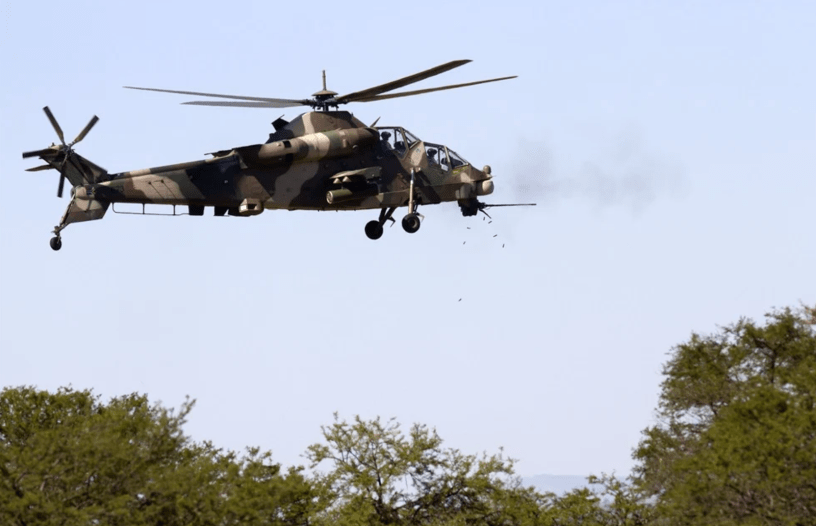
The South African Air Force has only two fighter jets, one helicopter and three fighter jet trainers as operable military aircraft...”The SANDF [defence force] has deteriorated to such an extent it cannot defend the country,” said Kobus Marais, a recently retired member of Parliament who was the DA’s shadow defence minister. “Major equipment is not working. There is no air force and no navy.”
Defenceless: Only six of 330 SA Air Force aircraft in working order
Sikonathi Mantshantsha

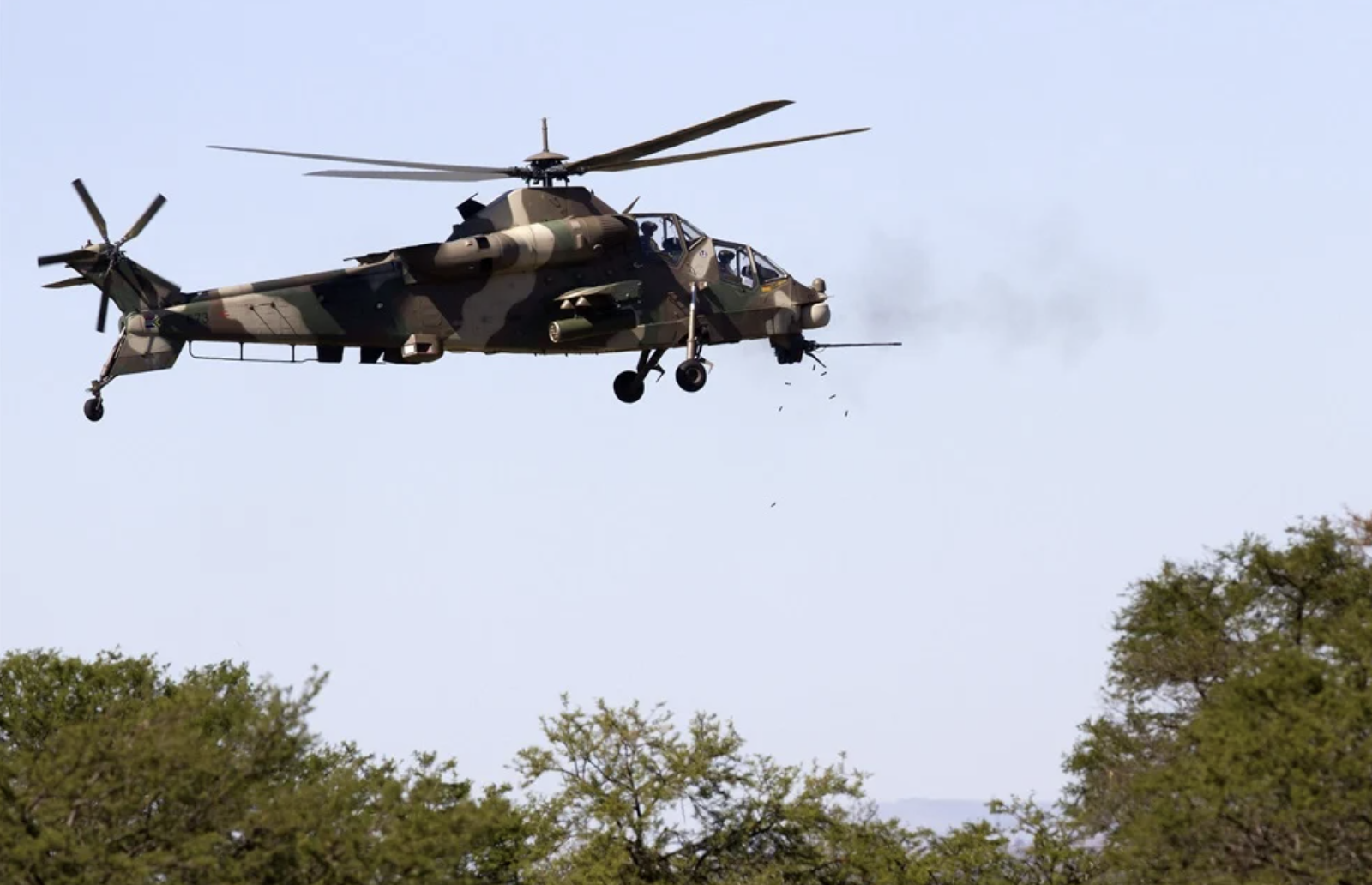
A South African Air Force Rooivalk helicopter. The SAAF has only two fighter jets, one helicopter and three fighter jet trainers as its operable military aircraft. (Gallo Images / The Times / Daniel Born)
- The South African Air Force has only two fighter jets, one helicopter and three fighter jet trainers as operable military aircraft.
- More than 330 fighter jets, helicopters and planes used to rescue wounded soldiers have been lying idle for years awaiting repairs.
- This has left troops on combat operations without any air support and the country’s airspace unprotected.
- For secure, anonymous communication with News24’s investigations team, click here.
The South African Air Force (SAAF) has all but collapsed, and has no fighting capacity left. It has only six operable military aircraft – 325 others have been left to rust because of crippling cash shortfalls.
The grounding of the military planes has left South African soldiers without any air support in combat operations. It has also left the country’s airspace unprotected, threatening the sovereignty of the republic.
Three years ago, then-defence minister Thandi Modise admitted in Parliament, in response to a question from the DA’s Kobus Marais, that 330 aircraft were grounded due to a lack of money to buy spares for maintenance.
At that point the SAAF had a total fleet of 388 aircraft, including four business jets reserved for the transportation of “very important persons”.

Grounded aircraft. (Graphic: Sharlene Rood)
Today, News24 can reveal the situation is more dire.
The SAAF has been transformed into a militarily irrelevant logistical service to ferry the president and senior government figures around in business jets.

Grounded military planes. (Graphic: Sharlene Rood)
Its current operable military fleet is made up of a single Oryx utility helicopter that returned to service in the third week of February, two Gripen fighter jets and three Hawk jet trainers.
The Gripens are the last of the 26 fighters bought in the 1999 Arms Deal. The rest have been broken for more than 10 years.
The country would have to rely on two fighter jets and land-based air defence systems should it need to confront incoming enemy aircraft.
The three Hawk trainer jets are also the last operable trainers of the 24 acquired in the arms deal.
In that rearmament programme, South Africa also acquired 24 AgustaWestland light utility helicopters. They have all been broken for more than 10 years.

Fighter jets. (Graphic: Sharlene Rood)
Only six Agustas were serviceable in October 2023.
The Agusta Westland is an eight-seater multi-purpose helicopter to support the South African Navy. Its grounding also means the navy is without air support or rescue helicopters when carrying out patrols at sea.
Asked about the state of the SAAF fleet, South African National Defence Force (SANDF) spokesperson Siphiwe Dlamini said the force was “not in a position to give you actual numbers as per your inquiry, due to security reasons”.
“However, it is public knowledge that the SAAF has faced numerous challenges related to the serviceability of its fleet.”
The alleged security reasons do not prevent the SANDF from conducting its business using the email addresses from Gmail and Yahoo!, American technology companies.
Dlamini was responding to a detailed set of questions on the status of the SAAF aircraft fleet, and said it was “seized with the matter” of bringing the fleet to an acceptable serviceability standard.
“The planned maintenance of the fleet is currently ongoing in phases until it reaches acceptable serviceability,” said Dlamini.
Even the VIP squadron is not immune to being grounded.
In November, the Civil Aviation Authority grounded the Inkwazi presidential jet for incomplete paperwork relating to its acquisition in 2002. Soon after its return to service early in February, it was grounded again.
That forced President Cyril Ramaphosa to take a commercial flight and miss the Cabinet meeting scheduled for the morning of the Budget.
“The SANDF has deteriorated to such an extent it cannot defend the country,” said Kobus Marais, a recently retired member of Parliament who was the DA’s shadow defence minister.
“Major equipment is not working. There is no air force and no navy.”
The DA’s Marais and three military experts revealed a dire picture of the collapse in the capabilities of the whole SANDF.
The experts included two people who work closely with the military but who spoke on condition of anonymity to protect relationships with the SANDF and with colleagues in the force.
READ | US interference could see South African troops in the DRC become M23 ‘hostages’
In the January 2025 battles for the cities of Sake and Goma in the eastern Democratic Republic of the Congo (DRC), the SANDF did not have any air support, the people said.
The result was a total defeat and humiliation of the SANDF, with 14 South African soldiers killed in battle with the M23 rebels who are allegedly supported by Rwandan troops.
The SANDF bases remain surrounded by the M23, with the troops’ movements strictly controlled by the rebel force that took Goma and other towns stretching far into the DRC from the Rwandan border.
“They (SANDF) had to rely on the Congolese Air Force for air support,” said one of the people who works with the military. “We do not have our own air force there. We do not have the money for spares to repair aircraft.”
Grounded military planes. (Graphic: Sharlene Rood)
Two Rooivalk assault helicopters had been lying broken at Goma Airport for two years before they were airlifted by a foreign chartered cargo plane to Waterkloof Air Force Base in December.
This contradicts Defence Minister Angie Motshekga’s response to a question in Parliament from the EFF’s Sinawo Tambo about whether the troops had sufficient military equipment during the battle.
“Yes, the SANDF contingent deployed in DRC under MONUSCO and SAMIDRC had sufficient military equipment (including ammunition and defensive capabilities) during the battle with the rebel forces,” said Motshekga.
She was referring to the United Nations and the Southern African Development Community peacekeeping forces in the DRC.
Motshekga also told Parliament there were no gaps or deficiencies in deployment procedures and that the SANDF’s combat readiness was adequate.
The situation on the ground, however, shows this to be untrue.
The Oryx and the Rooivalk assault helicopters were the backbone of the SANDF’s contribution to the peacekeeping mission since South Africa’s first deployment in 2003.
But none have been available for more than two years.
The M23 deployed sophisticated weapons allegedly obtained from Rwanda. These included anti-aircraft missiles and anti-radar weapons, said Helmoed-Römer Heitman, a defence analyst.
“No matter how good you are [as a soldier], without air support you are buggered,” said Heitman. He said South Africa was “defeated militarily, politically and diplomatically”.
Had the SANDF been properly equipped with the Rooivalk helicopter, it could wipe out the M23 anti-aircraft positions on the hills surrounding their base with the guided Mokopa missile, which has a 12km range, said Heitman.
The deterioration of the SANDF, and the dire state into which the SAAF had been plunged became clearer when South Africa had to wait at least two weeks to secure a foreign-owned chartered cargo aircraft to fly the remains of the 14 dead soldiers home for burial.
“In battle, you first rescue your wounded troops as soon as possible,” said one person who works with the military. “But in this case the wounded soldiers had to wait three weeks at the base in Goma, surrounded by the enemy and their movement totally controlled by the M23.”
The troops’ access to food and water is also totally dependent on the M23 rebels.
The SANDF first had to secure the passage of the remains of the dead soldiers through Rwanda and fly from its capital, Kigali. Rwanda is accused of fighting on the side of the M23 in the DRC, making it the enemy of the South African troops.
They finally landed in Pretoria on 13 February via Uganda, two weeks after the battles.
Rescuing the wounded soldiers followed a similar route. South Africa had to grovel in Kigali to gain passage for the wounded soldiers.
READ | Wounded SANDF soldiers repatriated from DRC, admitted to 1 Military Hospital
The last wounded troops were admitted to 1 Military Hospital in Pretoria on 26 February – a full month after the January battles.
Despite its own fleet of five Hercules C130 aircraft, the SAAF has relied on private, foreign-owned charter planes for the slightest movement of troops and cargo for more than a decade.
While only one C130 was operable in October 2023, all five have been grounded since then.
Lockheed Martin’s C130 is a medium-sized transport carrier that can seat at least 90 people and has a 3 800km range.
Had the fleet been available, the SAAF would have been able to airlift its troops with ease from the DRC.
South Africa’s misadventures highlight the desperate depths its armed forces have plunged to through funding cuts and management’s negligence regarding maintenance.
While on paper, the SAAF has a fleet of 39 Oryx multi-purpose helicopters, none have been in service during the past two years.
This robs the SANDF of any airlift and rescue capability when soldiers are wounded.
A multi-purpose medium carrier helicopter, the South African-produced Oryx became a source of pride when it carried out numerous sorties to save stranded Mozambicans in Sofala province in the Cyclone Idai floods of 2000.

The air force has only one serviceable Oryx helicopter. (Gallo Images/Die Burger/Jaco Marais)
Iconic images of its crew rescuing a woman who had just given birth atop a mango tree dominated global headlines for years. She had given birth while clinging to both her 2-year-old son and a tree branch to escape the raging waters below.
That little girl who was born that day is 25-year-old Rosita Mabuiango.
Should a similar tragedy strike again today, the SAAF won’t have the capacity to save any lives.
The last three operational Rooivalk attack helicopters that were deployed to the DRC have been grounded due to a lack of spares and maintenance since 2022.
Four of the helicopters are now waiting at a Denel Aerospace facility in Kempton Park for the SAAF to place orders and pay for the repairs.
Two years ago, eight Rooivalks were awaiting major repairs at an estimated cost of R1 billion.
The Rooivalk was built by Denel Aeronautics and 12 helicopters entered service with the SAAF in 1999, before Denel terminated the programme six years later due to a lack of orders after the SANDF acquired the Italian-made Agusta.
The Oryx played the role of air ambulance for troops wounded in combat while the Rooivalk played a decisive role in the defeat of the M23 rebels in 2012.
Back in 2023 there were still six Oryx aircraft in service, down from the previous year’s 17 operable helicopters.
The ANC’s Vusumuzi Cyril Xaba, then chairperson of the Joint Standing Committee on Defence, lamented the deterioration of the SANDF’s capability: “At the rate at which things are deteriorating, next year (2024) we will not have a single Oryx helicopter working.”
The single remaining helicopter was only released back to service in mid-February this year.
 Martin Plaut
Well they used to say a million monkeys clattering away at a million typewriters…one could produce a Shakespearian quality play. Guess not.
is there a valid excuse that they cant find parts for these older Helicopters ?
Denel not really functional anymore , so wouldn’t they just scrap the locally build ones ?