
By: Eyob Tilahun
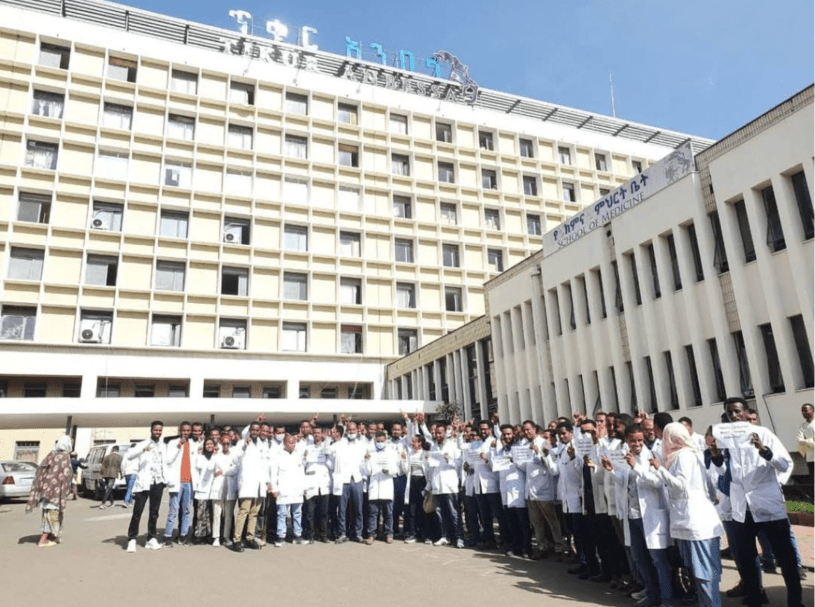
Health workers in Ethiopia have been on strike since 13 May 2025, demanding better wages, benefits, and working conditions. Sadly, a dictatorship responded by jailing health workers. The question of health professionals is straightforward and free of political influence.
The regime’s lack of peaceful reaction to public demands has led to the detention of medical personnel. The regime’s use of weapons to suppress popular protest demonstrates an incurable political deadlock. It might be the first time in Ethiopian history that health professionals experience a living crisis.
In addition to the usual services, health workers’ sacrifices during difficult periods, primarily during the COVID-19 outbreak, are unforgettable, and some even died during the fight against the epidemic; but the fortunate ones who survived are currently enduring hunger owing to the living situation. The regime is killing not only today but also people’s tomorrows.
The Abiy regime spends billions of dollars on war to kill its innocent people and the construction of a new private luxury imperial palace, depriving the wider public, including health professionals, of their ability to rescue lives. Health professionals who work tirelessly for the community are unable to feed themselves as a result of the regime’s failed policies.
In contrast, hundreds of governmental mouthpieces tasked with disseminating contentious, venomous, and hateful messages on social media are paid substantially more than health professionals. Medical professionals who deserve a better life struggle to survive, while those who contribute negatively to the country live lavishly.
Health professionals’ misery is not a concern for authorities because they are treated abroad in expensive hospitals at taxpayer expense. Criminal authorities intend to stay in power by gun and by starving everyone.
Authorities have stolen taxpayer money and transferred it into foreign accounts, as well as purchasing ultra-luxurious mansions in their and their families’ names, while others went hungry. Ethiopians must fight now against this dictatorial regime.
Ethiopia is a place of agony for millions while delivering an extravagant life for a select few, but others are considered rubbish. This is why Fano continued the armed struggle to overthrow the evil regime and establish a government that fairly serves all.
Using the living crisis of health professionals as a reference point, it is simple to visualise the severity of hunger in ordinary people, and it does not exaggerate that Ethiopia is under a national emergency of famine, in addition to its war against civilians, particularly in the Amhara region.
So, the regime must go quickly at any price that might be paid. So, backing Fano means cutting short the dictator’s life in power to establish a government by the people and for the people.
Ethiopia cracks down on striking health professionals
EST | EAST  APA -Addis Ababa(Ethiopia)08 May 2025 | 08:33

At least three medical doctors have been arrested in Ethiopia amid a 10-day ultimatum the Ethiopian Health Professionals Association has given to the government, demanding fair compensation.
Wednesday’s arrest came as thousands of medical professionals working in state-run hospitals across the country continue taking a rare and increasingly bold stance, calling for immediate government response to their long-standing grievances.
Eyewitnesses confirmed to APA that three general practitioners from Agaro General Hospital in the country’s Oromia regional state namely Dr. Alazar Kebede, Dr. Adamu Damtew, and Dr. Geda Sh. Hussen were arrested by police after sharing photos in support of the ongoing protest.
In a statement released Tuesday, the association underscored that doctors’ questions are “legitimate and urgent,” and that the government should respond before the issue escalates into a nationwide health emergency.
“Health professionals have raised these demands multiple times through legal channels, including communications with the Ministry of Health,” EHPA said.
“Yet no timely or appropriate responses have been provided. As a result, health professionals are now expressing their voices through other means,” it said.
The ministry of health has acknowledged the protests and stated it is working on solutions. Public Relations and Health Communication Director Dr. Tagene Regasa told local media that the ministry is drafting “short, medium, and long-term plans to address the professionals’ concerns,” including non-salary incentives for healthcare workers.
However, many in the medical community remain skeptical, citing years of unfulfilled promises and minimal engagement.
“Ethiopia’s healthcare system is already strained by under-funding, brain drain, and ongoing humanitarian challenges, including conflict-related displacement and frequent disease outbreaks.
In a letter seen by APA on Tuesday, the association outlined 12 demands and warned that legal action will follow if the government fails to respond by 11 May.
The gravity of the situation is compounded by Ethiopia’s severe shortage of healthcare workers. According to the World Health Organization, Ethiopia has approximately 0.76 physicians per 10,000 people — far below the WHO’s recommended threshold of 1 per 1,000. This means one doctor may be responsible for over 13,000 patients, a staggering and unsustainable ratio in any healthcare setting.
The Ethiopian Health Professionals Association recently gave a 10-day ultimatum to the Ministry of Health, demanding urgent reform, fair compensation, and dignified working conditions for the health professionals across the east African country.
The ongoing campaign, which has also resonated widely across the country through various social media, is serving as a digital rallying cry for a profession that has endured years of economic hardship and neglect.
MG/as/APA
 Martin Plaut