
It is a simple question. And it arises from the executive order President Trump issued on 7 February 2025.
In shocking disregard of its citizens’ rights, the Republic of South Africa (South Africa) recently enacted Expropriation Act 13 of 2024 (Act), to enable the government of South Africa to seize ethnic minority Afrikaners’ agricultural property without compensation. This Act follows countless government policies designed to dismantle equal opportunity in employment, education, and business, and hateful rhetoric and government actions fueling disproportionate violence against racially disfavored landowners.
Much of this is accurate. There are, indeed, “countless government policies” which use race as a marker to target help for one section of the population (black Africans) and discriminate against another (mainly whites, but Indian and Coloured people too.) This is just a fact. It is meant to compensate for apartheid when race based policies were designed to do just the opposite.
President Trump then ordered that:
The Secretary of State and the Secretary of Homeland Security shall take appropriate steps, consistent with law, to prioritize humanitarian relief, including admission and resettlement through the United States Refugee Admissions Program, for Afrikaners in South Africa who are victims of unjust racial discrimination.
So who is an Afrikaner?
This is where it gets tricky for Trump. You see, most Afrikaners are not white. Truly.
The largest group are what South Africans call “Coloured” (or mixed race) but there are a substantial number of black Africans who are first language Afrikaans speakers.
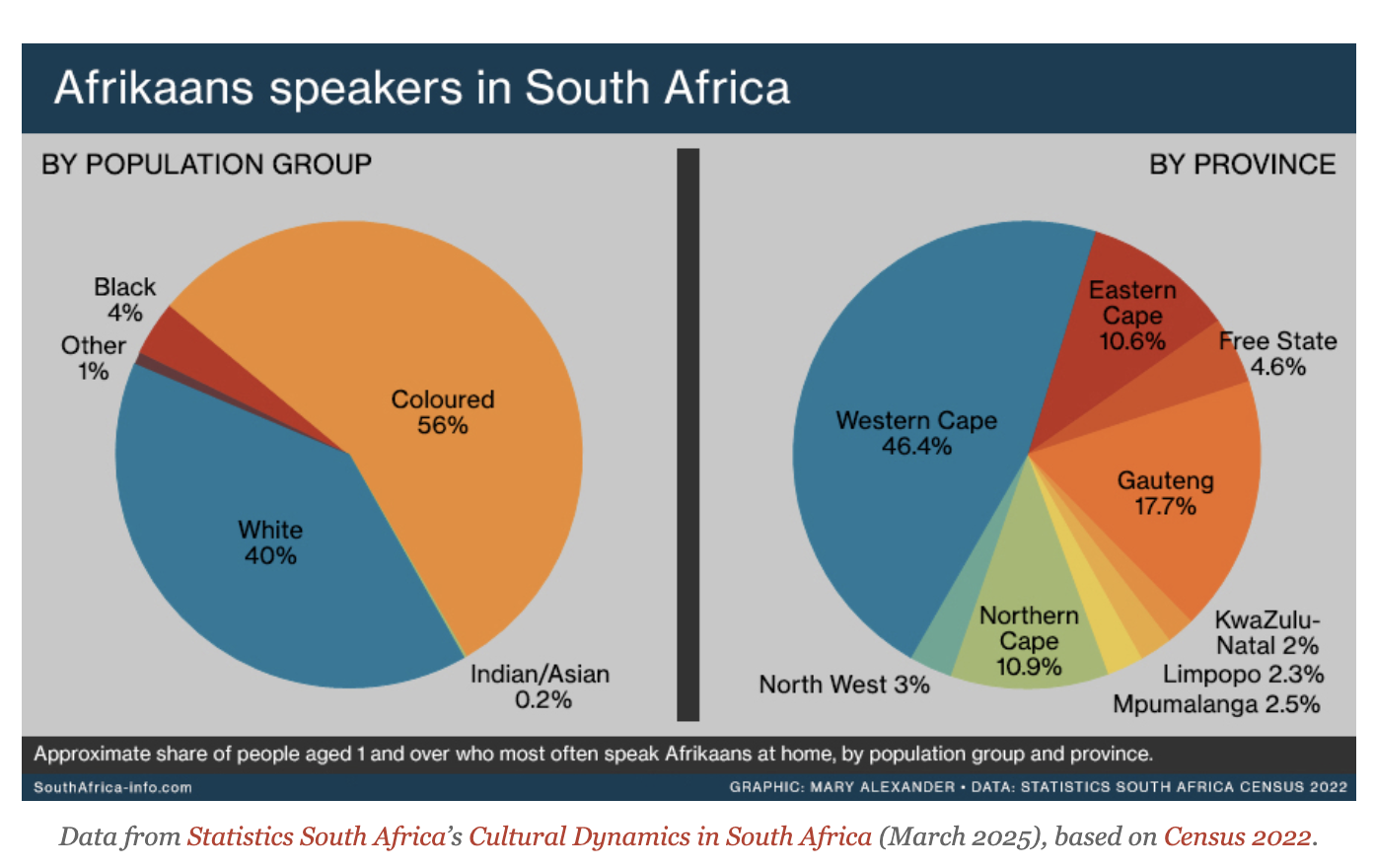
As you can see, whites are just 40% of all Afrikaners.
So will President Trump allow Coloured Afrikaners to come to the USA as refugees? Why not?
Some of the African National Congress’s laws discriminate against them, so they can claim to be “victims of unjust racial discrimination.”
When asked what the Trump administration meant by Afrikaners I was referred to a statement by Tommy Pigott, Principal Deputy Spokesperson for the Department of State.
In it he was asked about this issue, Tommy Pigott ducked questions about the ethnicity of the Afrikaners, simply saying:
Fundamentally, what we have seen are harrowing stories from those refugees. They have met the standard that is applicable by the – applicable for those refugees. We have seen that process play out. This has been a priority for the President. And again, just looking at this scenario, we have heard harrowing stories here. That is what is at issue here, the fact that these people have gone through certain conditions. We have seen that standard for refugees applied. They have gone through this process. It’s a priority from the President, and that’s why we’re seeing the actions that were taken.
MR PIGOTT: Well, again, as I said, the President’s been very clear about the issues that we have regarding South Africa. He’s been very clear on that continually. I have nothing further to add at this point.
QUESTION: But it’s a legal determination. It’s not a determination made by the President of the United States. That’s why we’re asking.
MR PIGOTT: Again, I addressed this issue. In terms of the President, he’s been very clear about the issues we’ve seen. From the State Department’s perspective, there’s a priority laid out by the President; we are fulfilling that priority. And again, the stories that we have heard are harrowing. And so we’re seeing the fact that these people have met that same standard for refugees and we’re seeing the State Department fulfill the executive orders of the President.
And that is about as clear as it gets.
One final point
In South Africa race used to be subject to a notorious system dreamt up under apartheid.
The government introduced numerous legislations based on racial classification. For example, the legislative basis for racial classification during apartheid was the Population Registration Act No. 30 of 1950. This Act divided the South African population into three main racial groups: Whites, Natives (Blacks), Indians and Coloured people (people of mixed race).
The South African Parliament repealed the Population Registration Act on 17 June 1991. But current legislation still uses racial classification to target benefits to “previously disadvantaged” groups. The only problem is there is no official definition of what the racial terms mean.
All the South African government has come up with is a single phrase.
“In this Act unless the context indicates otherwise ‘black people’ is a generic term which means Africans, Coloureds and Indians”
How are these terms defined? I have no idea.
 Martin Plaut
“When I use a word,’ Humpty Dumpty said in rather a scornful tone, ‘it means just what I choose it to mean — neither more nor less.’
’The question is,’ said Alice, ‘whether you can make words mean so many different things.’
’The question is,’ said Humpty Dumpty, ‘which is to be master — that’s all.”
― Lewis Carroll, Through the Looking Glass