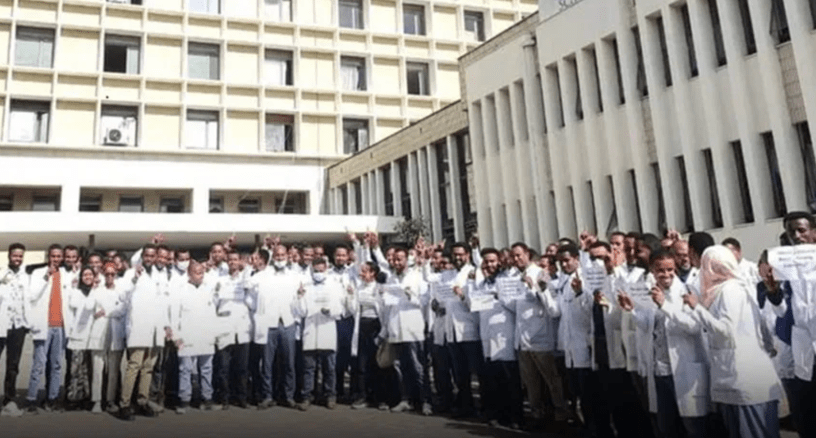
Given the economic pressure, recurrence of frustrations (open protests happen rarely!), and wider international support, the government is obliged to address the health workers protest and other social concerns in a peaceful and negotiated way.
Fitsum H. Gebre[*]
Background
Different authors wrote on civil disobedience and nonviolent action. The major ones that came to mind, I admit not the only ones, are Henry David Thoreau’s book (1849) on civil disobedience and Gene Sharp’s nonviolent action (1973).Thoreau contends that people’s first obligation is to do what they believe is right and doing passive resistance to the government authority that enables injustice. Sharp’s book on nonviolent action indicated that it could revolve around political, economic, social, or religious issues. Nonviolent action may involve i) acts of omission – refuse acts which they usually do, ii) acts of commission – perform acts which they do not usually do, or iii) a combination of both acts. The health (professional and) workers in Ethiopia are making their voices heard through non-violent means, in ways that both Thoreau and Sharp indicated, which is genuine exercises of their democratic rights as anchored in the Ethiopia constitution and international human rights that Ethiopia endorsed. In doing that, they partly served their normal working week because of serving the people is necessary and are undertaking full protest by stopping doing their normal services (to put pressure on the government) or undertaking a combination of both.
Health workers protest
The health workers started their protest demanding fair payment and compensation benefits stating their monthly payment is not adequate enough to pay and buy what is necessary given the cost of living is prohibitively high. It started through expression of individual workers’ (professionals) dissatisfaction of their payment when they met the Prime Miniter (PM) of Ethiopia six years ago, whose response was ridiculing it instead of understanding their concern. It has turned into initial partial and gradually widespread protests after six years. The protest aimed to establish the moral justice of the cause initially and responded to the lack of government responses to their questions later. The organization and conduct of the protest is a good example of how civil disobedience should be organized in Ethiopia. What health workers is protesting is not only health workers’ problems, it is part of the widespread social problems experienced by other citizens, but the government has managed to suppress it through its divisive and repressive means. It is a just and fair question, and it is the government’s responsibility to appropriately respond to it. Can the Abiy regime evade this protest through its usual approaches of intimidation, suppression and division or will it prelude to wider social unrest is a relevant question now than ever before.
Government’s response
The responses by the government, which is typical of a dictatorship regime, is characterized by mischief and deceptive behavior, and it went as far as crushing it out completely by imprisonment of health workers. TV responses by the Ministry of Health (MoH) characterized the protest as politically driven acts, including warning for punishing those taking part in pit (calling it an illegal act), and called it centered in self-interest with little concern to the society. The expression makes a little admission that the questions of the health workers is fair and timely, but it argues the government is addressing the questions as much as it could. A genuine response could have been open acceptance of the question, a huge social problem as it is, creating a forum for negotiation between the representatives of the health workers and the government. Now it is characterizing it completely unfair, to use the PM’s word, as selfish with no vision. More than two hundred health workers are in prison so far and human costs (death) appear to be manifesting as it goes on.
Now the government has come up with new deceptive mechanism orchestrated by the municipality government of Addis Ababa and Commercial Bank of Ethiopia (CBE), apparently a plan to build living houses for civil servants, which invites civil servants to save 25 percent of their monthly income and CBE providing 75 percent as loans for this means. It plans to build houses for forty-one thousand civil servants in the scheme. A simple calculation of the plan, as done by Ethio Forum, envisages a civil servant who earns on average ten thousand per month is expected to spend forty thousand in Ethiopian Birr (ETB), which is unrealistic. Civil servants are required to pay downpayment of one million ETB to start getting the loan to start building. Those granted loan have to start repaying the loans from CBE immediately, at 14 percent interest rate. They are envisaged to get a holiday of 1 year in repaying the principal. Overall. It is unrealistic venture which the government hutched to avoid further spread of this protest to teachers and other civil servants, which are expressing similar discomforts.
Wider reactions
There is wider support to health workers, public and solidarity movements, recognizing the fairness of the protest and importance of healthy population for national development. Teachers, civil servants, and the military might join the protest of health workers, potentially leading to wider political movement. Amnesty International has repeatedly called for the government to settle it peacefully through negotiated settlement. Similarly, international media and the Ethiopian Human Rights Commission (EHRC), an arm of the government, call for peacefully negotiated settlement, although so far not successful. Famous artists express the fairness of the question and personalities like Abo Taye Dendaa expressed their support for the protest and indicated the government has a duty to address it peacefully.
Economic policy reasons
This is part of mediocre performance of the economy during the last 6-7 years, conditioned by absence of implementable economic policy that aims to reduce poverty and food insecurity. The Abiy have orchestrated war in various parts of Ethiopia, in Oromia, Tigray and Amhara. The government’s war policy and ‘corridor development’ accompanied by International Monetary Fund (IMF)-led austerity measure have been the main triggering factor of the social malaise, leading to the protest of health workers. Although little debate is done about the appropriateness of economic policy of the government and local data are missing about the performance of the economy so far, a new report by ActionAid has revealed the devastating impact of austerity-driven budget cuts on health and education systems across six African countries, including Ethiopia. The study highlights a significant decline in public investment and the consequences it brings for both workers and communities. There is a dire shortage of affordable medical supplies and education sector is also under immense pressure. As a result, 97% of healthcare workers reported that their income no longer covers basic needs such as food and rent and teachers’ salaries have dropped by up to 50% over the past five years.
Unorganized stakeholders
The governing party has succeeded in disabling all the main opposition parties in the country, ensuring its dominance in the political scene. Few (and minor) political parties have expressed grave concern about the protest and called the government to solve it peacefully. The Ethiopian Civil Society Organizations Council (ECSOC) exists, but it works in tandem with the government. It is difficult to get impartial voices in the context of Ethiopia. It is surprising to see no expression of support from civil organization, as it names itself, on its website to this episode, for instance. The government-controlled mass media reflect the views of the government, only social and online medias have widely reported about this protest.
Rubber stamp parliament
The existence of weak legislative organ (expected to appropriately regulate the executive organ in a well-functioning democratic system) is the main cause of the presence of repressive political system in Ethiopia. The PM can make the parliament pass on any political decisions in parliament regardless of its legal and political basis (the resent law related to foreign ownership of urban houses is a case in points, just to mention an example), favored by the majority Oromia Democratic Party and its affiliates. The parliament and its members do not reflect on such serious social and political concerns. The parliament cannot install spending discipline, accountability, and rule of law of the government (including the PM). The PM has repeatedly made mockery of the parliament, to say the least.
What next?
Given the economic pressure, recurrence of frustrations (open protests happen rarely!), and wider international support, the government is obliged to address the health workers protest and other social concerns in a peaceful and negotiated way. The planned budget for the coming fiscal year characterized by meager public investment, hence, limited job creation and improvements in economic and social services, but huge allocation to defense and security is a good example of economic mismanagement. The absence of poverty and food security centered policies will aggravate the malice of social problems affecting the wider society, leading to other protests in the coming days. Considering the nature of the government, however, it may not be willing to properly respond to it and address it in a peaceful and negotiated manner. If this does not happen, the protest could be a prelude to a radical social movement, which may lead, unfortunately, to bloody encounter. Nevertheless, the government should understand that a peaceful settlement of social and economic issues is imperative. This should be the only way. Making recourse to deception, division and repression, as the government does, is outdated as examples in the world show.
[*] A freelance writer living in Toronto, Canada, can be reached at: f.hagos@gmail.com
 Martin Plaut