
Fano was never built to govern. But it has forced the government to face a deeper truth: a state that does not protect cannot command loyalty. In a fractured federation, resistance becomes its own kind of institution. When the state abandons its people, the people respond—first with prayers, then with poetry, and eventually, with weapons.
By Haimanot B. Atinkut, Freelance Contributor
Origins
The origins of Fano are not found in declarations or official commands. They are found in the dust of Adwa, where Ethiopia—led by Emperor Menelik II—defied colonial conquest in 1896. In that legendary battle, thousands of Amhara peasants, local landholders (balabbats), and Orthodox clergy converged to face Italy’s modern army. They did not call themselves Fano. But in their spirit, sacrifice, and decentralized defiance, they embodied everything the name would come to mean.
At the time, Ethiopia’s army was a patchwork of regional forces, mobilized under feudal obligations and spiritual duty. Amhara militias from regions like Gojjam, Wollo, and Shewa brought not just manpower, but a culture of resistance. They arrived not in uniforms, but in handwoven white gabi, carrying spears passed down from ancestors, and bearing wooden shields painted with holy symbols.
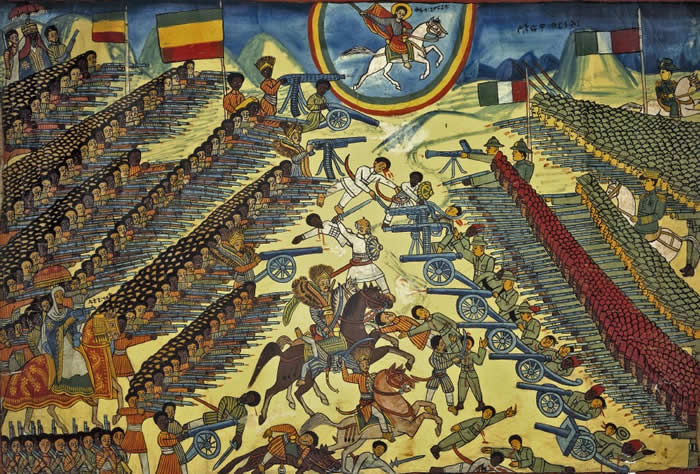
“They were not professional soldiers, but believers—marching to war with the blessing of saints and the cries of the land,” writes Raymond Jonas in The Battle of Adwa (2011).
Orthodox priests led the march, holding tabots—replicas of the Ark of the Covenant—high over the troops. Blessings were read aloud. Psalms were sung in Ge’ez. Men kissed the ground before charging Italian lines.
Many fighters fasted before the battle. Others carried handwritten prayers sewn into their clothing, believed to protect them from bullets. The militia wasn’t just a force of arms—it was a force of identity. The look, feel, and sound of this resistance were uniquely Ethiopian—and distinctly Amhara in cultural cadence.
Victory at Adwa wasn’t simply military—it was metaphysical. It validated the belief that a people armed with faith, land memory, and ancestral dignity could repel empire. It also laid the foundation for a recurring pattern in Ethiopian history: when the state falters, local communities mobilize—through culture as much as combat.
Bahru Zewde emphasizes the centrality of the Church: “The Orthodox faith provided not only moral but logistical mobilization. Churches fed fighters. Monasteries turned into command centers” (A History of Modern Ethiopia, 2001).
What they wore, how they moved, and why they fought all matter. These weren’t state troops—they were defenders of a civilizational memory, etched into mountains, rituals, and bloodlines. This ethos would resurface a generation later during the Italian occupation—then again under the Derg, and now, in the faces of young men who proudly call themselves Fano.
Fano Becomes a Name – Anti-Fascist Guerrillas (1936–1941)
When Mussolini’s fascist Italy invaded Ethiopia in 1935, the imperial army was quickly overwhelmed, and Emperor Haile Selassie fled into exile. But across the Amhara highlands—in Gojjam, Gondar, Wollo, and Shewa—a different kind of resistance took shape. It was decentralized, spiritual, agrarian, and unwavering. It was Fano.
The fighters who rose up were known as Arbegnoch—patriots—but in many villages, the word “Fano” was revived to describe local guerrilla bands who ambushed convoys, burned Italian depots, and passed intelligence through church networks. Their struggle was deeply embedded in terrain, faith, and cultural rhythm.
Among these resistance icons, Belay Zeleke stands tall.

Born in Gojjam, Belay emerged as a brilliant guerrilla leader during the Italian occupation. Charismatic and fiercely loyal to his homeland, he organized militias, coordinated attacks, and maintained parallel administration in large parts of Gojjam. His fighters, often barefoot and clad in traditional sheepskin, waged war with limited weapons but absolute resolve.
“He was not only a fighter—but a symbol of dignity and discipline,” writes historian Bahru Zewde. “Villagers obeyed his word more than the emperor’s.”
Belay’s Fano army was both feared by Italians and respected by locals. Priests blessed his campaigns. Monks hid his wounded. Songs were composed in his name.
When Haile Selassie returned in 1941 with British support, many expected Belay to be rewarded as a national hero. But the emperor, wary of his growing popularity and autonomous rule in Gojjam, summoned Belay to Addis Ababa, arrested him, and hanged him in 1945.
His execution marked a turning point—proof that even victorious Fano could be crushed by the state they helped restore.
“We fought the foreigner and paid with our blood,” Belay said during his trial. “Now we are punished for surviving.” (Trial testimony, cited in Sven Rubenson, 1976)
Belay’s story is not just one of rebellion. It is a moral riddle etched into the Amhara consciousness: What does loyalty mean when the state fears its defenders?
His legacy lives on in murals, oral history, and protest chants. In modern Fano circles, he is more than a martyr—he is a warning. The man who fought fascism but died by a rope from his own emperor became the patron saint of betrayed patriots.
Underground Resistance – Fano Beneath the Red Terror (1974–1991)
When Ethiopia’s imperial monarchy fell in 1974, the Derg—a Marxist-Leninist military junta led by Colonel Mengistu Haile Mariam—rose in its place. It promised land reform and equality. What it delivered was centralized authoritarianism, forced collectivization, and the brutal Red Terror (1977–78), during which tens of thousands were executed, exiled, or disappeared.
While the term “Fano” vanished from public language during this period, its essence persisted—in secret, in prayer, and in defiance.
In the Amhara highlands of Wollo, Shewa, and Gojjam, local resistance movements formed not as formal militias, but as a social undercurrent. Peasants refused collectivization. Monks hid religious artifacts. Elders buried the dead at night to avoid surveillance. In these acts, the Fano spirit endured.
“They did not carry guns, but they refused to obey,” recounts an oral testimony collected by Amnesty International (1989). “They hid Bibles under straw mats. They whispered prayers in the fields.”
The Derg viewed the Orthodox Church as counter-revolutionary, shutting down monasteries and executing outspoken priests. Symbols of faith—once proudly worn—were hidden under clothing or carved in secret. Religious education went underground.
In Gojjam, Wollo, and Gondar, resistance often began in ritual space: midnight vigils, coded sermons, and songs disguised as harvest chants.
“The Derg tried to burn tradition out of us,” says one survivor, quoted by historian Gebru Tareke in The Ethiopian Revolution (2009). “But we remembered who we were—in silence.”
More organized resistance coalesced by the late 1980s with the formation of the Ethiopian People’s Democratic Movement (EPDM)—largely composed of disillusioned Amhara youth, farmers, and students who rejected both monarchy and Marxism. Though EPDM would later become part of the ruling EPRDF coalition, its early units drew upon village-based networks and clandestine religious support, similar to earlier Fano structures.
Unlike the Arbegnoch who fought Mussolini, these fighters didn’t wear talismans openly. They didn’t march with church blessings. But in practice, many carried small icons, fasted before battles, and invoked saintly names under fire.
Their maps were drawn in ash. Their uniforms were patched with scripture.
Their mission was not just political—it was cultural preservation under siege.
Rebirth of Fano – Ethnic Federalism and the Silent Uprising (1991–2018)
In 1991, the fall of the Derg brought a sense of political renewal to many Ethiopians. The new ruling coalition, the Ethiopian People’s Revolutionary Democratic Front (EPRDF)—dominated by the Tigray People’s Liberation Front (TPLF)—introduced a novel governance model: ethnic federalism. For the first time, Ethiopia was divided along ethnic lines, each group granted a degree of administrative autonomy, linguistic recognition, and self-determination.
But for many in the Amhara region, this federal vision quickly translated into a sense of cultural fragmentation and territorial loss. Key ancestral areas such as Wolkait and Raya were reassigned to Tigray. In regions like Benishangul-Gumuz, Oromia, and Harari, Amhara communities reported growing discrimination, displacement, and political silencing. Meanwhile, narratives within official discourse and school curriculums increasingly painted the Amhara as historical oppressors—a framing that many felt erased their own history of resistance, sacrifice, and plural identity.
“Amhara were not given a voice in the new order,” writes political scientist Kjetil Tronvoll (War & the Politics of Identity in Ethiopia, 2009). “They were portrayed as relics of empire rather than participants in modern federalism.”
Out of this tension emerged a slow-burning cultural resurgence. In the early 2000s, and especially after 2014, Amhara youth—many educated, urban, and digitally connected—began invoking the name “Fano” once again. This time not as peasant militias, but as defenders of dignity, land, and collective identity.
Fano returned as symbol and structure. In towns like Bahir Dar, and Debre Markos, youth groups began organizing forest training camps, circulating nationalist songs, and posting photos of past martyrs. Some dressed in camouflage, others wore traditional clothing with Amhara flag patches. Many shared videos of elders recounting Arbegnoch stories, blending oral tradition with social media activism.
“We are the sons of martyrs,” reads a widely circulated 2017 Telegram post from a youth group in North Shewa. “Fano is not a group—it is a memory reborn.”
Martyr posters began appearing after deadly crackdowns on protesters. Local singers wrote anthems in Amharic celebrating “those who do not bow.” Telegram and Facebook channels began broadcasting Fano songs, slogans, and calls to resist EPRDF’s “silent occupation.” Political forums online debated the role of federalism, the concept of “land identity,” and whether self-defense was now a civic duty.
“Fano became a cultural response to political abandonment,” says researcher René Lefort in Ethiopia: Identity and Power in Flux (2016). “It wasn’t organized—it was organic.”
The Ethiopian state, however, viewed the rise of Fano as a threat. Between 2016 and 2018, as anti-government protests swept Oromia and Amhara regions, the federal government responded with arrests, surveillance, and military crackdowns. In towns like Gonder and Debre Tabor, suspected Fano members were detained without trial. In Bahir Dar, several student leaders were reportedly abducted or killed.
Yet every death seemed to spark a new song. Every arrest created a new martyr poster. And so, Fano wasn’t defeated—it was distributed. Not a single militia, but a decentralized cultural movement of resistance, rooted in Amhara memory, grievance, and spiritual pride.
It was during this politically silenced period that a new generation of resistance quietly emerged. One of its most emblematic figures was Asmare Dagne—a name still whispered with reverence in the hills of North Shewa, where he was born.
Asmare Dagne was not just an activist. He was a genuine Fano—a patriot in the classical sense, who stood against both foreign manipulation and internal betrayal. Known for his fiery speeches, local organizing, and refusal to align with the ethnic power games of the time, Asmare became, in the eyes of many, a “medicine to the OLF secessionist threat” and to those who attempted to destabilize the Amhara homeland under the pretense of federal pluralism.
He built young defenders before the word Fano was fashionable again.”
In the 1990s and early 2000s, Asmare coordinated clandestine forums, documented human rights abuses, and helped form community-based defense awareness units. While he carried no formal rank, he was a strategist in both intellectual and tactical spheres.
His sharp opposition to OLF incursions, especially in contested areas of North Shewa and border zones of Oromia, earned him enemies not just from rival groups, but from within the EPRDF administration. Arrested and tortured multiple times, he continued to speak through smuggled notes, underground sermons, and symbolic acts of resistance. In the rural towns of Shoa Robit, Antsokiyana Gemza, and Ataye, his legacy remains etched into stone fences and whispered in Orthodox chants: “መድኃኔ ነበረ” — “He was the cure.”
Today, Fano songs often include his name beside Arbegnoch from the Italian resistance. His quotes appear on Telegram banners and protest signs. For many, he is the forgotten bridge between the patriots of the past and the defenders of today.
“He gave shape to the anger we carried,” a former Fano organizer said in 2018. “He told us that defending Amhara identity is not extremism—it’s memory in motion.”
The Hero Moment – Fano in the Tigray War (2020–2022)
In November 2020, the fragile calm of Ethiopia’s federal system shattered. The Tigray People’s Liberation Front (TPLF)—formerly dominant within the EPRDF—launched coordinated attacks on northern federal military bases. What began as a dispute between the TPLF and Prime Minister Abiy Ahmed’s Prosperity Party quickly escalated into a full-blown civil war.
While the national army—the Ethiopian National Defense Forces (ENDF)—was reeling in the early stages, Fano fighters from the Amhara region moved swiftly. They didn’t wait for orders. They didn’t have a command structure. But they mobilized in mass, driven by duty, trauma, and memory.
“The federal army was not ready,” says one resident of Gashena, interviewed by BBC Amharic in 2021. “But the Fano were already in the mountains.”
These were the sons of farmers and priests, many of whom had grown up hearing stories of Wolkait and Raya. Others had already protested during the 2016–17 uprisings. Now they picked up rifles—some inherited, some donated—and headed to defend cities like Dessie, Kombolcha, and Woldia, where the TPLF was advancing.
Fano became frontline actors. In places like North Wollo, Wag Hemra, and South Gondar, they held territory, gathered intelligence, and coordinated logistics. Videos circulated showing barefoot fighters singing war chants, receiving blessings from Orthodox priests, and burying comrades with national flags wrapped around them.
“They became folk heroes overnight,” says researcher Alex de Waal in The Tigray War and Ethiopia’s Crisis of Federalism (2022). “In the eyes of many Amhara civilians, Fano were not rebels—they were redeemers.”
The federal government temporarily embraced Fano. State media praised their sacrifice. Public officials stood alongside them in rallies. Telegram groups with names like Fano of Gondar and Guardians of Dessie gained tens of thousands of followers, spreading images of resistance and martyrdom. Songs praising “the sword of Wollo” and “the lion of Kobo” became hits on TikTok and local radio.
Their aesthetic was raw but symbolic: camouflage pants, Orthodox crosses carved into rifle butts, boots taken from fallen enemies, and red-green headbands symbolizing blood and land. They were warriors—but also cultural icons.
“We’re fighting for our ancestors,” said a young Fano commander in a video later verified by Addis Standard in December 2021. “If we fall, it means they’ll erase our history again.”
But heroism has a cost. Fano fighters took heavy casualties. Many were buried quietly in village cemeteries. Others disappeared into frontline rotations with little recognition or reintegration.
And by 2022, as peace talks between the federal government and the TPLF began to unfold, the tone changed. Fano was now too powerful, too autonomous, too unpredictable.
What the government had briefly celebrated was now described as a “militia problem.” What civilians had cheered as protectors were now being accused of destabilization.
From Ally to Outlaw – Fano vs. the Prosperity Party (2022–2025)

When the guns began to fall silent in Tigray, a new front quietly emerged—not between ethnic rivals, but between former wartime allies. The Prosperity Party (PP), under Prime Minister Abiy Ahmed, turned its focus from the battlefield to centralizing control. And that meant dismantling what had become the most powerful non-state actor in the country: Fano.
The same Fano fighters who had been praised as heroes in 2021 were, by 2023, labeled as “rogue militias,” “illegal combatants,” and “threats to national unity.” The federal government launched a sweeping disarmament campaign targeting armed groups outside the state structure. While some disarmament efforts were rolled out in Oromia, Somali, and Afar regions, enforcement was swiftest—and most violent—in Amhara.
“It felt like betrayal,” said a Fano fighter interviewed by Deutsche Welle Amharic in August 2023. “We fought their war. Then they came for us.”
In towns like Shewa Robit, Gondar, Ataye, and Debre Tabor, clashes erupted between federal troops and Fano units. Drone strikes, house raids, and mass arrests followed. The government declared a state of emergency in Amhara in August 2023, shutting down internet access and enforcing curfews.
Meanwhile, attacks on Amhara civilians in Oromia and Benishangul-Gumuz continued. Human Rights Watch and the Ethiopian Human Rights Commission documented massacres, targeted killings, and mass displacement in areas like Wollega, Arsi, and Hararghe—often attributed to OLF–Shene (Oromo Liberation Army). In the eyes of many Amhara civilians, the federal government was either unable or unwilling to respond.
“Sixteen Amhara-majority towns were attacked in under two years,” wrote the Amhara Association of America (AAA) in its 2023 report. “Federal troops were deployed not to protect—but to suppress.”
For many, the disarmament campaign wasn’t about peace—it was about power. With Fano weakened, communities feared they were being left defenseless in the face of ongoing ethnic violence. Protests broke out in Debre Markos, Dessie, and Bahir Dar. Some were peaceful. Others turned into street battles.
Graffiti began appearing on government buildings: “Fano Will Rise Again.” Murals of martyrs were taken down by security forces—then repainted by locals the next morning. New Telegram channels emerged: Fano Resists, Voice of North Wollo, Amhara Defense Telegram.
“We’re not a militia. We’re a memory,” said one anonymous Fano organizer to African Arguments in late 2023. “When the state fails, the people remember how to protect themselves.”
The Prosperity Party claimed Fano groups were obstructing peace. But critics said the government’s actions revealed the limits of Ethiopia’s ethnic federalism—a structure that enabled local empowerment, only to later criminalize it when autonomy became inconvenient.
What Now? Between Self-Defense and Self-Destruction
Fano began as a whisper of resistance—a spirit, a symbol, a local instinct to fight back when the state couldn’t or wouldn’t protect its own. Today, Fano is many things: a decentralized militia, a folk memory, a movement without a map.
To some Amhara civilians, Fano remains the last line of defense in a state that has failed them. To others—including government officials—it has become a dangerous, unregulated force undermining the fragile post-war recovery of Ethiopia.
And yet, both views are true. Fano represents a contradiction that defines the Ethiopian crisis itself: when the legitimacy of the center collapses, the periphery arms itself—and often does so in the name of protection, dignity, and ancestral right.
“Fano is a symptom of a deeper fracture,” writes René Lefort in “The Ethiopian State Under Strain” (2024). “It is born from perceived abandonment—then punished for filling the void.”
The modern Fano has no single leader, no headquarters, no party. Yet its message travels fast—from forest camps in Gojjam to chat groups in Addis, from exile communities in the U.S. to Orthodox churches in Shewa. Its core vocabulary—land, memory, justice, survival—resonates across a generation of young Amhara men and women who feel they were born into a federation that does not see them.
A priest in Wollo summed it up to The New Humanitarian: “They are not rebels. They are orphans of the state.”
But the cost of this identity is steep. Clashes between Fano and federal forces have radicalized the movement. No longer just local defenders, some groups are now targeting state officials, blocking military routes, and issuing manifestos. Civilians are caught in the middle—between distrust of federal neglect and fear of unchecked militia control.
This is where the Fano dilemma sharpens: resistance becomes militarization, and self-defense begins to look like rebellion.
The state, too, is caught in contradiction. It claims to pursue peace—but continues to selectively disarm some groups while tolerating others. It invokes national unity—but fails to respond to massacres in places like Metekel, Wollega, and Anger Guten—leaving communities to defend themselves.
And so, Fano endures. Not because it is organized—but because it is organic. It rises wherever there is silence, fear, and the memory of abandonment.
Epilogue – The Patriot’s Dilemma
In every generation of Ethiopia’s modern history, a certain type of fighter has emerged—rural, deeply rooted in land and tradition, acting outside the state but in the name of the people. That fighter has worn many names: Arbegna, Kifletor, EPDM, and now—Fano.
But what happens when yesterday’s patriot becomes today’s problem?
Fano began in the shadows of occupation, in the monasteries and mountains that resisted Italy. It reappeared beneath the Derg’s terror, whispering survival through prayer and song. It returned as a grassroots memory in the EPRDF era, and it stood, guns raised, beside the army in the Tigray War.
Now it stands against that same army—still in the name of protection.
“In our grandfather’s time, Fano fought Italians. Now we fight our own government,” says Dawit M., a displaced youth from Shewa, in a recorded oral history shared with the Amhara Historical Archive in 2024.
Fano is not just a militia. It’s a narrative device—a way to say: we are not being seen; we must see ourselves. It is resistance as identity. Defense as a form of historical continuity.
But this is also where the dilemma sharpens.
The very thing that gives Fano its legitimacy—grassroots formation, popular sympathy, cultural memory—also makes it a threat to formal governance. The more the state tries to disarm or delegitimize it, the more mythic it becomes. The more martyrdoms accumulate, the more Fano’s roots deepen.
“You can’t arrest a memory,” said a priest in Gojjam, quoted by Minority Africa in late 2024. “You can try. But next season, it blooms again.”
For Ethiopia, Fano is no longer just a local issue. It is a signal, flashing in red across a fragile federal structure: Who gets to defend themselves when the state no longer functions as protector?
For Amhara civilians—especially those who’ve seen neighbors slaughtered in Wollega or buried family after drone raids in Gojjam—Fano is not the aggressor. It is the compromise between life and oblivion.
For the federal government, Fano is an existential problem: proof that local actors can out-organize the center, disrupt security narratives, and challenge the monopoly on violence. It’s a reality that threatens the very logic of statehood.
What Comes Next – Scenarios, Risks, and the Future of the Ethiopian State
Fano has evolved from a legacy of resistance into a living fault line in Ethiopia’s political future. It is now a test case for the limits of ethnic federalism, grassroots defense, and post-war legitimacy. How the state responds—urgently, intelligently, or indifferently—will shape not just Amhara’s future, but the country’s cohesion as a whole.
The road ahead splits into multiple paths. Each has its own momentum. Each has its risks.
Scenario 1: Co-optation Without Justice
In this version of the future, the federal government attempts to absorb or neutralize Fano by integrating some fighters into the Amhara region’s special police or administrative bodies. The narrative of “bringing them into the fold” dominates state media. The disarmament campaign slows.
But beneath the surface, no real justice is served. Land disputes remain unresolved. No credible investigation is launched into the killings of Amhara civilians in Oromia and Benishangul. Displacement camps remain overcrowded and invisible. The structural grievances—the memory of betrayal—go unaddressed.
Scenario 2: Full Militarization and Insurgency Spiral
Here, the government escalates its disarmament drive. Arrests increase. Drone strikes return. Public mourning is banned. Martyr posters are taken down by soldiers. Simultaneously, ethnic violence against Amhara civilians continues—unacknowledged or dismissed.
The result? Fano fighters no longer see themselves as guardians, but as insurgents. Communication between units in North Wollo, Shewa, and Gojjam becomes formal. Coordinated sabotage operations begin. Political manifestos emerge from Telegram channels. Clashes become deliberate.
Scenario 3: Negotiated Local Sovereignty
In the most constructive scenario, the federal government—under internal pressure and international scrutiny—recognizes that it cannot erase what it refused to protect. It initiates quiet negotiations with moderate Amhara elders, clergy, and former Fano fighters.
Rather than dissolving the movement, it legitimizes local defense under regulated frameworks—perhaps akin to regional guard systems in Nigeria or the community-based security councils in South Sudan.
The Orthodox Church acts as a moral broker. Independent investigations begin into mass killings. Cultural space is reopened for grieving and truth-telling. In exchange, Fano units agree to conditional deactivation or professional absorption.
Key Risks to Watch
Without charts or policy jargon, here are the pressure points already visible:
- Amhara displacement continues with little state response, deepening Fano’s recruitment pool.
- Selective disarmament creates a narrative of targeting one group while tolerating others (especially in Oromia).
- Diaspora advocacy now funds grassroots defense networks, amplifying resistance without command control.
- Religious legitimacy remains a double-edged sword: the Orthodox Church may act as a peace broker—or spiritual firewall.
- The memory of Wolkait, Raya, and Metekel becomes the emotional spine of a new generation of Fano. It’s not politics—it’s personal.
Conclusion: The Shape of the Future
Fano was never built to govern. But it has forced the government to face a deeper truth: a state that does not protect cannot command loyalty. In a fractured federation, resistance becomes its own kind of institution. When the state abandons its people, the people respond—first with prayers, then with poetry, and eventually, with weapons.
Whether Fano becomes Ethiopia’s unsolvable crisis or its hard-earned reckoning will depend on whether power can finally listen to pain—before pain chooses its own justice.
“If the state wants loyalty, it must remember the names of the dead,” said a former Fano commander to African Arguments, 2024. “We haven’t forgotten. Why should we stop fighting?”
Sources
Addis Standard, Reports on Fano Mobilization and Regional Response, 2021–2022
African Arguments, “Ethiopia’s New Civil War: The Fano Front?”, December 2023
African Arguments, “Fano and the Phantom State”, 2023
- Alberto Sbacchi, Ethiopia Under Mussolini, Red Sea Press, 1985
Alex de Waal, The Tigray War and Ethiopia’s Crisis of Federalism, World Peace Foundation, 2022
Amhara Association of America (AAA), “Betrayal of the Patriots” Report, November 2023
- Amhara Association of America, Documenting Pre-2015 Resistance Networks, 2020
Amhara Historical Archive, Recorded Testimonies from IDPs and Clergy, 2024
Amnesty International Reports on Ethiopia (1980–1990)
- Bahru Zewde, A History of Modern Ethiopia, 2nd Edition, Ohio University Press, 2001
Bahru Zewde, Society, State and History: Selected Essays, Addis Ababa University Press, 2008
BBC Amharic, Eyewitness Accounts from North Wollo, 2021
Christopher Clapham, Transformation and Continuity in Revolutionary Ethiopia, Cambridge University Press, 1988
Deutsche Welle Amharic, Coverage of State of Emergency in Amhara, August 2023
Ethiopian Human Rights Commission, Civic Reports on Fano Clashes and Civilian Displacement, 2023–2024
Gebru Tareke, The Ethiopian Revolution: War in the Horn of Africa, Yale University Press, 2009
Harold G. Marcus, A History of Ethiopia, University of California Press, 1994
Human Rights Watch, “We Let You Down Again”: Ethnic Violence in Wollega and Benishangul, 2022–2023
Human Rights Watch, Ethiopia: Atrocities in the Amhara–Tigray Frontlines, 2021
Human Rights Watch, Evil Days: Thirty Years of War and Famine in Ethiopia, 1991
- Human Rights Watch, Fuel on the Fire: Human Rights Violations in Ethiopia’s Oromia and Amhara Regions, 2017
- International Crisis Group, “Ethiopia’s Civil War: Scenarios for the Future”, 2022
International Crisis Group, “Militias and the Future of Federalism in Ethiopia”, 2023
- Interviews collected by the Amhara Association of America (AAA), 2016–2018
- Kjetil Tronvoll, The Ethiopian Guerrilla Warfare Tradition, 2009
- Kjetil Tronvoll, War & the Politics of Identity in Ethiopia, James Currey, 2009
Minority Africa, “When Memory Arms Itself: Fano and the Politics of Loss”, 2024
Minority Rights Group International, “Armed Identity and the Crisis of Protection”, 2024
- Oral archives from the Institute of Ethiopian Studies, Addis Ababa University
- Oral interviews from Shoa Robit and Antsokia residents, Amhara Memory Project, 2018
- Raymond Jonas, The Battle of Adwa: African Victory in the Age of Empire, Harvard University Press, 2011
- Regional historical pamphlets archived at Debre Berhan University Library
René Lefort, “Memory, Federalism and the Armed Citizen”, Horn of Africa Bulletin, 2024
- René Lefort, Ethiopia: Identity and Power in Flux, CEMAf, 2016
- Sven Rubenson, The Survival of Ethiopian Independence, Heinemann, 1976
- Tamerat Gebru, The Amhara in the Federal Era, 2019
- Tekeste Negash, Italian Colonialism in Eritrea and Ethiopia, Uppsala University, 1987
The New Humanitarian, Interviews with Amhara Clergy and Displaced Families, 2023–2024
William Davison, Crisis Group Interviews: Amhara Region, 2023–2024
- William Davison, International Crisis Group Reports on Ethiopia’s Political Unrest, 2015–2018
 Martin Plaut
FANOs are freedom fighters. They are fighting for Ethiopia where every citzen can move and work in every corner of the country without any limit based on their ethnic identity and religion. They are struggling for a country where employment and promotion is based on merit, not ones ethnic identity. But, these rights are unthinkable or are heavily limited by the current constitution. Therefore removing the current constitution and replacing it with a new constituion that recognizes and implements these and other related rights in Ethiopia is the main objective of FANO.