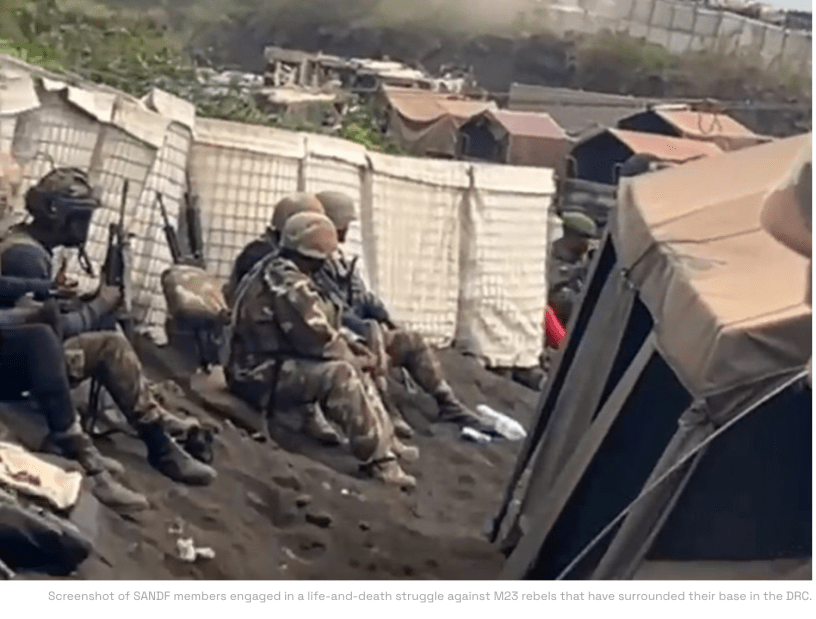
With only 15-20% of its aircraft serviceable, ageing radar systems leaving airspace exposed, and a single seaworthy frigate as well as several inshore patrol vessels to guard 2,798 km of coastline, the SANDF is crumbling.
Source: DefenceWeb
SANDF in crisis – A defence force on its knees
Dr Joan Swart – 26th June 2025

The South African National Defence Force (SANDF), once a beacon of regional strength, faces a crisis that jeopardies the nation’s security and global standing.
With only 15-20% of its aircraft serviceable, ageing radar systems leaving airspace exposed, and a single seaworthy frigate as well as several inshore patrol vessels to guard 2,798 km of coastline, the SANDF is crumbling. Its budget, with 68% consumed by salaries, leaves little for equipment, maintenance, or training, crippling its ability to defend borders, secure trade routes, or support African peacekeeping.
This article, grounded in open-source intelligence, exposes the SANDF’s dire state, from its collapsing assets to failing deployments. South Africa’s sovereignty and economic stability hang in the balance, demanding urgent attention to address this alarming decline.
The Collapse of SANDF’s Weaponry and Resources
The SANDF’s physical assets, essential for safeguarding South Africa’s sovereignty and economic interests, are in a state of near collapse. The South African Air Force, the world’s second oldest independent such service, is a shadow of its former self. It has 199 aircraft in its inventory, but only 15-20% are serviceable at any given time. Ageing radar infrastructure that the SANDF cannot afford to upgrade leaves South Africa’s airspace exposed. This vulnerability exposes the nation to risks ranging from unauthorised incursions to smuggling, undermining a core mandate of any defence force.
The Navy’s plight is equally dire. Tasked with securing a 1.5 million km² exclusive economic zone, critical for trade and resource extraction, it operates just one frigate and one Multi-Mission Inshore Patrol Vessel (MMIPV) at present, out of a fleet of four frigates and three MMIPVs, although additional MMIPVs are entering service. This leaves maritime routes, carrying 80% of South Africa’s GDP, exposed to piracy, illegal fishing, and trafficking. The economic impact is profound: maritime trade disruptions could cost billions, threatening industries like shipping and fishing. Ground forces fare no better, with African rebel groups reportedly better equipped, highlighting outdated weaponry and a lack of modernisation. This disparity leaves soldiers vulnerable in conflicts, further eroding the SANDF’s effectiveness.
These deficiencies have far-reaching consequences. Without air or naval capabilities, South Africa cannot protect its borders or economic assets, risking both national security and foreign investment. The SANDF’s decline also weakens its role in stabilising Africa’s volatile regions, a responsibility South Africa has long championed. How can a nation afford to leave its defences in such disrepair when its economy and influence depend on security?
Budget Mismanagement and Salary Dominance
Financial mismanagement is part of the SANDF’s crisis. Of its budget, 68% is allocated to salaries, leaving scant resources for equipment, maintenance, or training. This imbalance has persisted despite years of budget cuts, with personnel costs ballooning while capabilities erode. The result is a defence force unable to fly its aircraft, sail its ships, or adequately arm its soldiers, undermining its ability to secure trade routes, support domestic stability, or lead regionally.
This salary-heavy budget reflects a systemic failure to prioritise modernisation over an oversized workforce. South Africa’s economy, growing at best just 1-2% annually, cannot sustain current personnel levels while neglecting assets critical for sovereignty. The lack of funds for radar repairs or ship maintenance hampers airspace and maritime security, both vital for economic stability. For example, a single piracy incident could disrupt trade flows, costing millions in losses. Inadequate training budgets also leave soldiers unprepared for domestic crises, such as the 2021 riots that required SANDF intervention, or peacekeeping missions abroad.
Why does this imbalance persist? Political reluctance to reduce headcount, often driven by fears of job losses, and weak oversight have allowed inefficiencies to fester. Reallocating resources is not just a financial necessity but a strategic imperative to restore the SANDF’s ability to fulfil its constitutional mandates, from border protection to disaster response.
Struggling Deployments in Africa
The SANDF’s role as a regional leader in African peacekeeping is central to South Africa’s diplomatic influence, yet its deployments, particularly in the Democratic Republic of Congo (DRC), are faltering. Funding shortages and outdated equipment hinder troops supporting MONUSCO, the UN peacekeeping mission. Soldiers lack vehicles, communications, or adequate weaponry, with rebel groups often outgunning them. This weakens South Africa’s credibility in the African Union and Southern African Development Community, where leadership is expected.
Overextension in the DRC, despite limited resources, reflects poor strategic planning. These deployments divert funds from domestic priorities like border security or disaster response, straining an underfunded force. The human cost is significant: soldiers face dangerous conditions without proper support, eroding morale and mission effectiveness. For instance, poorly equipped units struggle to maintain peace in volatile regions, risking South African lives. Regionally, a weakened SANDF cannot counter threats like Mozambique’s insurgency, which could spill across borders and destabilise Southern Africa.
Can South Africa sustain overseas missions when its own defences are crumbling? This question underscores the need for reform to align deployments with capacity and restore regional influence.
The Urgent Need for Action
The SANDF’s collapse, with limited operational prime mission equipment, and failing deployments, threatens South Africa’s security and African influence. Public concern is rising, with demands for accountability growing louder. Economic constraints, with 1-2% GDP growth, and regional instability make reform critical. The next article (Part 2) explores why South Africa needs a capable defence force and outlines a practical plan to rebuild it, offering a path to secure the nation’s future.
Dr Joan Swart is a psychologist, author, politician, and researcher who is currently serving as the chief of staff of the Referendum Party (RP). She is an exco member of the Cape Independence Advocacy Group (CIAG).
Rebuilding the SANDF – Why South Africa needs a strong defence force and how to achieve it
Dr Joan Swart – 26th June 2025

South Africa’s security and influence hinge on a capable National Defence Force, yet the SANDF’s collapse, as detailed in Part 1, leaves the nation vulnerable. A robust defence force is essential to protect sovereignty, secure 80% of trade through maritime routes, support domestic stability, lead African peacekeeping, and counter emerging threats like cyberattacks.
This article explores why South Africa needs a strong SANDF, the financial barriers to reform, and a practical plan to restore its capabilities. Drawing on open-source intelligence, it outlines urgent steps to rebuild a defence force that safeguards South Africa’s future, ensuring it can meet both current and evolving challenges.
Why South Africa Needs a Strong SANDF
South Africa’s strategic position demands a functional defence force. Its 2 798 km coastline and 1.5 million km² exclusive economic zone are vital for trade, contributing to a $405 billion GDP. Without naval or air capabilities, these assets risk piracy, illegal fishing, and trafficking, threatening economic stability. For instance, a single piracy incident could disrupt shipping, costing industries millions and deterring investors. Sovereignty also requires secure borders and airspace, currently exposed with limited radar and jets, leaving South Africa vulnerable to smuggling or unauthorised incursions.
As a leader in the African Union and Southern African Development Community, South Africa must support regional stability, particularly in conflict zones like the Democratic Republic of Congo (DRC). A weakened SANDF undermines this role, reducing influence compared to powers like Nigeria or Ethiopia while leaving it vulnerable to destructive regional forces. Domestically, the SANDF supports police during crises, such as the 2021 riots, and aids disaster response, like flood relief. Emerging threats, including cyberattacks that could target critical infrastructure (for example the Transnet cyberattack of 2021) or climate-driven conflicts over resources like water, demand modern capabilities.
Without a strong SANDF, South Africa cannot deter threats, protect trade, or maintain its global standing in a multipolar world.
Financial Barriers to Reform
The SANDF’s 2025/26 budget of R55.94 billion, up R400 million, provides a mere 0.21% real-term increase, insufficient to address its crisis or fund reforms. With 68% (R38 billion) allocated to salaries, only R17.94 billion remains for equipment, maintenance, and operations, far short of needs for aircraft repairs, radar restoration, or naval modernisation. Democratic Republic of Congo (DRC) deployments, costing R5 billion over three years (R1.8 billion in 2025/26), further strain resources. Doubling the budget to R100-110 billion, as some suggest, is unlikely with South Africa’s 1-2% GDP growth and competing priorities like health and education.
Reforms, estimated at R10-15 billion over five years for repairs and drones, exceed current discretionary funds. Without a VAT increase for 2025/26, alternative strategies are critical to bridge the gap:
Financial Accountability: Transparent budgeting with public audits, overseen by a parliamentary committee, can curb salary bloat and prioritise maritime security.
Merit-Based Appointments: Select leaders with military expertise, like the UK’s recruitment model, to improve asset prioritisation decisions.
Oversight: A defence oversight board, modelled on police accountability reforms, with civilian and military experts, can prevent mismanagement.
Minister with Military Knowledge: Appoint a minister with defence experience, as seen with cybersecurity-focused leaders, to align policies with operational needs.
Interdepartmental Cooperation: Share resources with Home Affairs (R13.9 billion budget) and Police (R120.8 billion) for border security and domestic stability.
Non-Aligned Partnerships: Collaborate with the Southern African Development Community for training and cost-sharing, as discussed with the DRC. Engage non-aligned nations like India for affordable technology, preserving neutrality.
Streamlining personnel and leveraging partnerships can fund reforms within the R55.94 billion budget, ensuring the SANDF meets its strategic roles.
Corrective Action Plan
To restore the SANDF’s ability to protect sovereignty, secure economic interests, support domestic stability, lead regionally, and counter future threats, a five-point plan is proposed:
1. Budget Reallocation
Shift 20-30% of the budget to equipment and maintenance within five years through voluntary retirements and hiring freezes, as R17.94 billion non-salary funds are inadequate. Public-private partnerships, like those discussed at the 2025 PPPS for Defence and Security Conference, can fund radar and naval repairs, securing 80% of South Africa’s trade. These steps ensure economic stability and sovereignty.
2. Asset Modernisation
Repair aircraft and ships, targeting 50% operational capacity in three years to protect borders. Invest in cost-effective drones and modular radar for affordability. Phase out obsolete equipment for versatile platforms, safeguarding trade routes and airspace critical for economic security.
3. Deployment Reform
Prioritise high-impact DRC missions to restore regional leadership. Partner with the Southern African Development Community to share costs, reducing strain, as discussed with the DRC. Enhance training to improve pre-determined and measurable outcomes, aligning with South Africa’s African Union role and strengthening diplomatic influence and regional security.
4. Governance and Accountability
Form an independent oversight committee to align spending with goals like economic security. Publish annual readiness reports to build public trust. Hold leaders accountable for mismanagement, addressing demands for reform.
5. Long-Term Strategy
Develop a 10-year plan for cyber capabilities to counter emerging threats and climate-resilient systems for future conflicts. Launch a youth reserve programme to ensure sustainability for domestic and regional roles, preparing for evolving challenges.
These reforms, supported by accountability and partnerships, will rebuild a SANDF capable of securing South Africa and leading in Africa.
Call to Action
The SANDF’s collapse threatens South Africa’s sovereignty, economy, and influence. Reforms, backed by accountability, merit-based leadership, and strategic partnerships, can restore a defence force to secure trade, support stability, and counter threats like cyberattacks. Policymakers, citizens, and the defence community must act urgently to rebuild a resilient SANDF for South Africa’s future.
Dr Joan Swart is a psychologist, author, politician, and researcher who is currently serving as the chief of staff of the Referendum Party (RP). She is an exco member of the Cape Independence Advocacy Group (CIAG).
 Martin Plaut