
Source: Sahan, Issue 290 | July 8, 2025
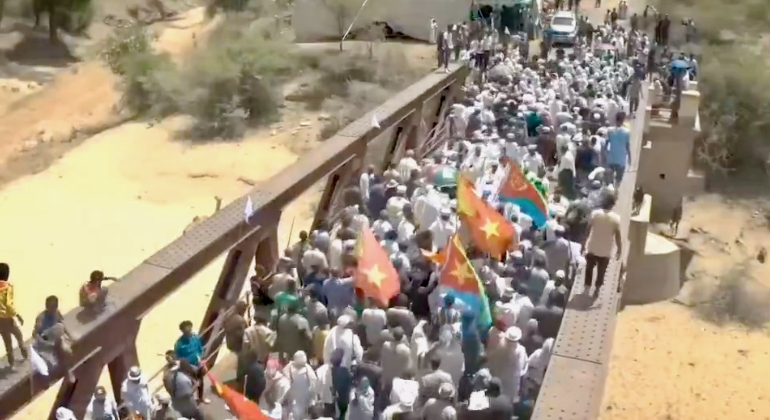
In mid-June, a highly choreographed show of bonhomie was organised at the Mereb Bridge in Tigray, which connects Ethiopia’s northernmost region to Eritrea. Waving Eritrean and Tigrayan flags, communities seemingly came together in an attempt to display a buried hatchet at the local level, over two years on from the calamitous war that left hundreds of thousands of Tigrayans dead. These bizarre images, rather than reflecting any genuine move towards reconciliation or justice and accountability, are instead part of the deepening ties between the dominant faction within the Tigray People’s Liberation Front (TPLF) in Mekelle and Asmara. Behind the warming relations, however, are eerie similarities with the current rhetoric of Mekelle, Addis, and Asmara, and that of the months leading up to November 2020 and the outbreak of war.
The amping up of bellicose language by senior Tigrayan, Eritrean, and Ethiopian politicians has been hard to miss in the past weeks, with each responding in kind to their opponents’ latest salvos. Most prominent has been Ethiopia’s federal government, which, while promising that it intends no harm to its “neighbours” and seeks peaceful access to the Red Sea, has continued to insist that it will defend its national interest by any means necessary and that sea access is a matter of survival. In a lengthy diatribe to US Secretary of State Marco Rubio, Ethiopia’s Foreign Minister Gedion Timothewos accused Eritrea of preparing a “major offensive” with a faction of the TPLF and other armed groups, timed to coincide with the rainy season. The letter further asserted that Eritrea is sponsoring armed proxies– the disparate Fano insurgency in the Amhara region– as well as occupying Ethiopian territory and freezing Ethiopian Airlines assets. It was a thinly veiled casus belli, and a letter perhaps designed to draw the level of US resistance to an Ethiopian invasion. On 3 July, PM Abiy Ahmed then addressed the federal parliament, carefully couching his rhetoric in the language of peace and as a regional dealmaker, he nonetheless warned of “worse and uncontrollable” consequences if fighting resumes, and subtly laying any return to conflict at the Tigrayan’s door– and with the support of the Eritreans. In response, Eritrea’s Ministry of Information has accused Ethiopia of pursuing a “long-brewing war agenda” and that it intends to seize the country’s ports “legally if possible, militarily if necessary.”
Though the TPLF has asserted that it has “no desire or preparation for war,” senior party officials also continue to warn of grave consequences if the Ethiopian government does not fulfil its mandate to implement the Pretoria agreement. Further, an Addis-backed Tigrayan militia clashed with the Tigray Defence Force (TDF) troops in southern Tigray last week, near the border with the Afar region. Though all badly weakened by the previous bout of war between 2020 and 2022, Addis, the TPLF, and Asmara all appear trapped in a spiral towards war. The Tigray Interim Administration (TIA) finds itself in a particularly unenviable position, with the dogmatic old guard of the TPLF having reasserted itself within the region and Addis keen to use various proxies to undermine the implementation of Pretoria. But TIA President Tadesse Werede has warned that “no provocation or act of war should be initiated from Tigray’s side under any circumstances” and that “misguided decisions imposed from outside must not drag the region into another conflict.”
With Ethiopia seemingly intent on seizing Assab and establishing a claim on the Red Sea, it likely estimates that the most straightforward route lies through regime change in Asmara. But that is easier said than done, particularly with the federal government having ceded so much of its influence in Tigray with the deposition of allied TIA president Getachew Reda. Clearly, the shortest supply lines would run through Tigray to Asmara, but with the TDF’s loyalty– still some of the best-trained and most effective fighting forces in the country– far from clear, Addis is stuck in a trap of its own making. The fraught political situation in Tigray is likely one of the only dynamics that has prevented Ethiopia from already attempting to seize Asmara, Assab, or both. The federal government would also dearly like to count on the TDF’s support, as the army has been bogged down in Amhara since August 2023, with the fighting with the increasingly cohesive Eritrean-backed Fano militias remaining highly attritional.
It is difficult to fully envisage the consequences of such a war. However, if history and modern wars in the Horn of Africa are any indication, this would likely be a regional conflict, and all but certain to drag in many of the same actors and dynamics that have played out in the destructive conflict in neighbouring Sudan. At its heart, the civil war in Sudan is also a proxy conflict with the Arab capitals of Cairo, Riyadh, and Abu Dhabi backing their favoured belligerent, and all three capitals are likely to play a role in any war between Ethiopia and Eritrea as well. Egypt, in particular, maintains a strategic priority of denying Ethiopian access to the Red Sea as part of its enduring dispute with Addis over the Nile water basin, including the Grand Ethiopian Renaissance Dam (GERD). Just last week, announcing its near-completion during his parliamentary address, PM Abiy Ahmed invited several Arab countries–including Egypt– to its launch in September, promising that Africa’s largest hydroelectric dam, which sits upon the Blue Nile, poses no threat to downstream countries.
This has, unsurprisingly, immediately triggered a forceful response from Cairo, and its allied Sudanese army in turn. During a meeting last week, Egyptian President Abdel Fattah al-Sisi and Sudanese Armed Forces (SAF) Commander Abdel Fattah al-Burhan announced their opposition to “any unilateral measures” regarding the Nile. Though Sudan has oscillated over GERD, the war has consolidated the Sudanese army’s position behind Cairo’s due to its dependence on Egyptian military and material support. But it is not just GERD that could likely draw Sudan into any conflict between Ethiopia and Eritrea, but the contested fertile border territory of Al-Fashaga as well, where Ethiopian militias have been accused of displacing farmers in recent days by military-aligned Sudanese officials. It may be that the SAF are too bogged down in its conflict to divert any significant manpower to the war, but it certainly could help facilitate weapons and supplies for any Eritrean forces or proxies through its lengthy border with Ethiopia.
If a war erupts and the beleaguered Ethiopian army is unable to capture Asmara– and fast, a flood of weapons from the Gulf akin to the Sudan war could inundate the primary belligerents. Sudan’s internal war has been shaped by the belligerents’ own distinct relationships with the Gulf, as well as the contours of decades of conflict in its peripheries. Consequently, a different set of issues is at stake in any conflict between Addis and Asmara. However, Emirati financial and military support for Addis is also likely to play a key part in its decision-making process, as does the level of support from Saudi Arabia and Egypt that Asmara can count on.
The last direct conflict between Ethiopia and Eritrea over a sliver of contested land in the late 1990s was extremely bloody, leaving tens of thousands dead and Asmara an international pariah. The stakes today are higher, with the potential for much more to go calamitously wrong. Furthermore, a major conflagration between the two could essentially create a stretch of armed conflict extending from the Libyan border with Sudan all the way to the Ethiopian border with Djibouti. Such a war could have untold consequences, not least for potentially millions of civilians in Eritrea and Ethiopia teetering on the edge– or consumed– by simmering humanitarian emergencies. Such a conflict between Ethiopia and Eritrea could even trigger the collapse of not just one but both fragile states.
Many expect that it is simply a matter of time before armed conflict breaks out. With Eritrea and Ethiopia having mobilised significant forces and with such abundant triggers, there is not much needed to push the volatile region over the edge into full-scale conflict. But if Ethiopia and Eritrea become bogged down in the brutal, attritional warfare of the Tigray conflict, and fuelled by their own respective Arab patrons, the conflict could simmer for years to come. And with a host of competing proxy actors, the likelihood of another indefinite war in the Horn is inching closer.
The Somali Wire Team
 Martin Plaut