By Ephrem B Hidug
When I was a child, I had the privilege of listening to tales and folklores shared by elders—at home, in the community, and at school. These stories gave me a lens through which to observe injustices critically and helped clarify my views on oppression and aggression. Many of these folklore centered on how the weak and vulnerable are exposed to injustice and the ways they seek remedies against tyranny, whether political or otherwise.
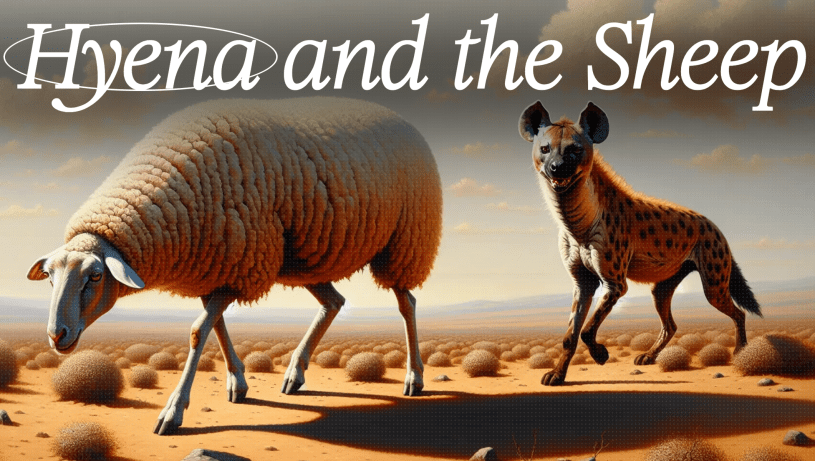
I do not deny the existence of patriarchal and abusive folklore, but here, I focus on those that highlight social hardships and themes of human justice. I have chosen the fable of The Hyena and the Sheep, with modifications to reflect recent developments in Ethiopia—such as the government’s plan for a second round of war in Tigray and the ongoing conflicts in the Amhara and Oromia regions. This fable, a tale of deception, power, and resilience, mirrors the political tragedy unfolding in Ethiopia. Beneath its animal characters lies a deeper reflection of the country’s fragile peace, weaponized narratives, and the slow unraveling of justice.
The Allegory
Once, after a long and bitter struggle for survival, a hyena and a sheep signed a peace agreement. They promised never to harm one another in the presence of lions—the guardians of order and justice. As part of the truce, they agreed to drink from the river at different spots: the hyena from upstream, the sheep from downstream.
One clear morning, both came to the river to drink. The hyena, spotting the sheep downstream, suddenly grew angry.
“You’ve spoiled the water!” the hyena growled. “Your presence downstream has made it unclean for me upstream.”
Startled, the sheep replied, “But I am downstream. The water flows from you to me. How could I spoil the water you’ve already drunk?”
Their argument reached the lion’s court.
The lion asked the sheep, “Where exactly were you when you drank the water?” 2
“I was far below the hyena,” the sheep answered. “In fact, I avoided drinking from a nearby spring near my home just to honor our agreement and avoid tension. I feared the hyena might see it as a threat.”
Then the river itself testified:
“That morning, the sheep was far downstream. At the top of the river, a tiger was bathing. Below him, you, noble lion, were washing. Then came the hyena. Only after them all came the sheep. I saw it.”
The sheep turned to the lion and asked, “So where is my fault?”
The lion looked thoughtfully at the sheep and replied,
“Do your best to live in peace with the hyena. But never forget—he is a carnivore.”
The hyena, however, grew even more enraged. Embarrassed by the court’s findings and still hungry for power, he called a secret meeting of his fellow hyenas.
“My kin,” he said, “we deserve the finest meat. That sheep stands in our way. I told a story about spoiled water to justify our anger before the lion. The lion said, ‘A carnivore remains carnivorous’—to me, this is permission. Let us hunt the sheep.”
The hyenas roared in agreement and launched an attack. But to their surprise, the sheep defended themselves fiercely—so fiercely, in fact, that the hyenas were forced to retreat.
Defeated and confused, they returned once again to the lion’s court.
“Your Excellency,” said the lead hyena, “the sheep have changed. They fought like beasts. They have become lions. We need your help.”
The lion, calm and unwavering, replied, “The quiet line of a sheep often hides the anger of time.”
Puzzled, the hyena asked for an explanation.
The lion said, “A carnivore remains a carnivore—even when it dresses like a sheep. But a sheep, when cornered, may roar like a Tiger.”
Still confused, the hyenas pleaded again.
The lion looked at them and asked, “Have you been hungry while you saw a sheep by the river?”
The lead hyena blinked. “Yes…..never had a fine meet for couple of days.”
The lion replied, “Then understand this: your vision always blurs when you’re hungry, clouded by foggy dreams of your appetite. You must realize—seeing with your imagination is not the same as seeing reality. You imagined a sheep where there was only a Tiger. But what you faced was simply the truth. Still, a carnivore remains a carnivore—even when it blames others for its hunger.” The Lion king continued “Take this as your foremost lesson: never mistake your opponent, and never provoke the wrong creature. Remember this well—for next time, the outcome may not be so merciful.”
The Political Reality behind the Metaphor
In recent years, the Ethiopian government has repeatedly framed resistance in the north—especially from Tigray, but also increasingly from Amhara and Afar regions—as irrational, aggressive, or separatist. The official narrative casts the state as the guardian of order, portraying any opposition as a threat to peace.
The northern conflict—specifically the war in Tigray that began in 2020—was initially described by the government as a “law enforcement operation.” Officials claimed provocation, echoing the parable of the hyena accusing the lamb of muddying the water upstream: a justification as flimsy as it was familiar. However, as the operation escalated into a full-scale war—marked by blockades, famine, mass displacement, and widespread civilian suffering—the initial rationale quickly fell apart.
Now, testimonies from insiders who were involved in launching and sustaining the war reveal a broader political and military conspiracy. Some describe the war as an orchestrated campaign aimed at subjugating—or even eliminating—the Tigrayan people.
In recent interviews, several high-profile figures have come forward. Among them are Mr. Taye Dendea, a former senior official in the Prosperity Party and Deputy Minister at the Ethiopian Peace Ministry; Mr. Gedu Andargachew, a senior Prosperity Party figure and co-founder of the controversial OROMARA movement, which played a central role in undermining TPLF leadership; Jawar Mohammed, a leading activist whose protests contributed to the resignation of former Prime Minister Hailemariam Desalegn and helped pave the way for Abiy Ahmed’s rise, later becoming a key figure in propaganda and advisory roles during the Tigray conflict; as well as Milkessa Midega, a member of the Oromia Prosperity Party central committee, and Lidetu Ayalew, a respected opposition leader known for his persistent critiques of government narratives.
Together, these voices challenge the official account—particularly the claim that the TPLF launched an unprovoked attack on the Northern Command of the Ethiopian Defense Forces. Instead, they describe a calculated conspiracy by Prime Minister Abiy Ahmed and his allies that plunged the Tigray, Amhara, and Oromia regions into devastating war.
A key issue they raise is the Prime Minister’s use of the COVID-19 pandemic as a pretext to postpone constitutionally mandated elections. They argue this delay was part of a broader strategy to politically neutralize the TPLF and consolidate authoritarian control—akin to forging an empire ruled with an iron fist.
Like the hyena in the fable, the state has played the roles of both accuser and aggressor—employing justifications that, upon closer scrutiny, no longer hold water.
Yet the rhetoric continues. Rebels are labeled “terrorists.” Peace agreements are declared and quietly broken. Communities once peaceful are pushed to desperation. The sheep, once silent, begin to resist—not out of a love for war, but because survival demands it.
Weaponized Narratives and the Collapse of Truth
Just as the hyena lied about the water, the Ethiopian state has been accused of spreading disinformation, silencing the press, and co-opting state media to control public perception. Meanwhile, the lion—symbolizing justice or international diplomacy—often remains silent, reluctant to intervene meaningfully.
Recently, the government initiated dialogues with various sectors—artists, musicians, opposition leaders, scholars, businesspeople. Yet, the tone of these discussions has been interpreted by some as a veiled call for a second round of war in Tigray.
It is deeply ironic to hear members of Tigrayan opposition parties now advocating for federal military intervention. Some who once defended Tigray during the 2020 war have shifted their stance, urging government troops against their own community.
Many who previously demanded the TPLF’s reinstatement as a legitimate political entity have reversed course—dismissing it as irrelevant and denying its central role in the Pretoria Peace Agreement. Alarmingly, those who once condemned atrocities by Ethiopian troops, Eritrean forces, and Amhara militias now call for a second round of violence—and potential atrocities—against the very people they once sought to defend.
The lion’s words in the fable ring chillingly true:
“A carnivore remains a carnivore—even when it blames others for its hunger.”
This captures the tragedy of Ethiopia’s political elite: a ruling class addicted to power, feeding off fear, division, and control, all while speaking the language of peace.
The Strength of the Sheep
Perhaps the most important twist in the fable is not the hyena’s deception, but the sheep’s transformation. When attacked, the sheep defend themselves with surprising strength. They do not become monsters—they become aware of their power.
This resilience is evident in civil resistance, diaspora advocacy, humanitarian networks, and the growing demand for federal reform, truth, and accountability. It is reflected in the struggle and perseverance of the Tegaru people amid oppression.
The so-called “sheep” of Ethiopia are not weak; they have been patient. But patience must not be mistaken for submission. Miscalculations and ill intent—especially from those in power—risk 6
plunging the country or region into lasting chaos, potentially leading to state collapse or prolonged struggles for independence.
Final Reflections
The lesson of the fable—and of Ethiopia today—is clear:
- Peace that only protects the predator is not peace.
- False narratives cannot silence real suffering forever.
- When injustice pushes communities to the edge, they will find their voice—and their strength.
The hyena may twist truth to justify his appetite, but eventually, the roar of the sheep will be heard. And when it is, the Tiger—whether justice, law, or international conscience—must choose whom it truly serves.
Author’s Note: This article is a political metaphor. “Hyena,” “sheep”, “Tiger”, and “lion” are symbolic figures, not literal references to any ethnic or political group. The goal is to provoke thoughtful reflection, not incitement
 Martin Plaut