
Source: Borkena
Editor’s Note : Views in the article do not necessarily reflect the views of borkena.com
Isaias Afwerki, one of the most ruthless dictators of the 21st century, often invents specialised jargon to manipulate his population while secretly preparing his military and political allies for the future. Having grown up in a war-torn environment, he is often preoccupied with conflicts and frequently focuses on conflicts, promoting division and outsourcing guerrilla fighters to serve his interests. His focus rarely shifts to planning or implementing development projects. Instead, in a lengthy interview with the country’s only television station, Eri-tv, he prefers to discuss everyday expenses, such as water, milk, eggs, lamb, and goats, seldom mentioning large-scale projects that could support his people’s livelihoods and bring radical change to the standard of living of the population.
During the liberation era, Isaias promoted a distorted version of the ‘Nehnan Elemanan’ Manifesto, which emphasised ‘We and our objectives’.’ This played a key role in fuelling political divisions between Christians and Muslims, eventually leading to a bloody civil war between ELF (Jebha) and EPLF (Shabia). After independence, he provoked border skirmishes under the pretext of redefining borders with neighbouring countries, including Yemen, Sudan, Ethiopia, and Djibouti. Following the end of the No War No Peace period with Ethiopia, Isaias used the phrase ‘Game over,’ targeting his main adversary, the Tigray Liberation Front. During the Northern Ethiopian conflict, he called on Eritreans both inside and outside the country to stay resilient (መክት) and prepare for any outcome. That outcome came as the Eritrean regime strategically rebranded itself, using the new term Tsmedo (ጽምዶ), to signify a change in its relationship with the former enemy, the TPLF.
Tsmedo: Triggered a Split in Eritrea’s Internal Politics
The current project, ‘’Tsmedo,’’ is unique because its main character is not Isaias, but a boy raised in Cinema Roma in Asmara. With his artistic talents, the Asmara regime crafted a new figure to appeal to younger audiences. His name is Awal Seid. The so-called president’s office directly funds the project, and according to Awal, the primary goal is to build people-to-people relationships. He even mentions the names of the groups that must be included in this effort, namely Afar, Amhara, Eritreans, and Tigrayans. Additionally, the sub-goals supposedly are to prevent the war that Abiy Ahmed seeks to start in pursuit of Red Sea access and overthrow the Eritrean regime. The project effectively began when the Prime Minister of Ethiopia, Dr. Abiy, gave his blessing to the former President of the Tigray Interim Administration, Getachew Reda, to meet with Eritrean regime officials. According to reports, Getachew met with Isaias’s senior advisor, Yemane Ghebrab and Foreign Security Service Head Colonel Gaim Tesfamichael. After that, the project accelerated with the involvement of Facebook activists, followed by both TPLF and PFDJ political and Military officials.
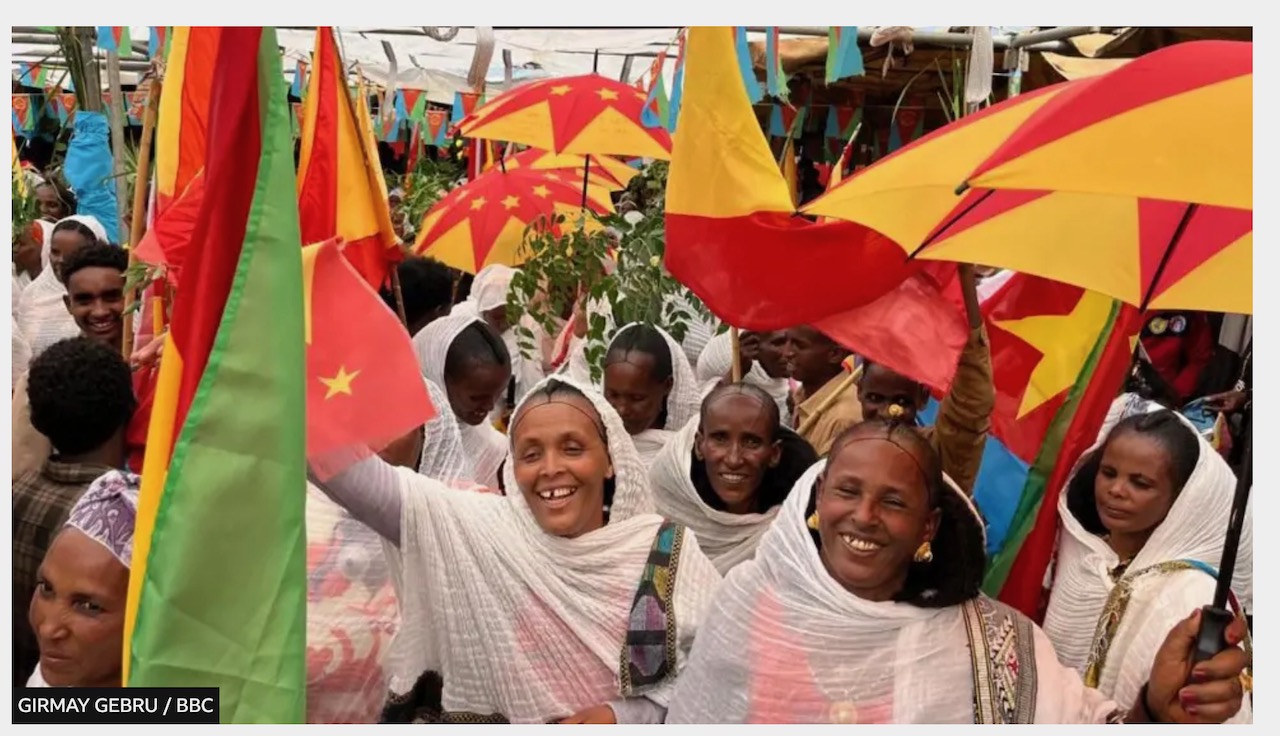
Starting at the Eritrea-Ethiopia border, particularly around the Tigray region, with a series of coordinated tent setups, the Eritrean regime faced unexpected opposition from diaspora supporters. These supporters were angry because they were unprepared to engage with the TPLF (Woyane), whom they had long viewed as the enemy of the state. Some accused their government in Asmara of underplaying the state’s significance and of secretly planning to create a new nation, the Tigray-Tigrinya Republic, in the Horn of Africa. To address these intense feelings, the Asmara government quickly expanded the project to include the Afar people in Eritrea, along the Red Sea coast, and the next step is to extend the Tsmedo to the Sudan border. The regime aims to make the Tsmedo a unifying national agenda that could unite Eritreans first and then the neighbouring countries and selected communities within those states. With Sudan, particularly with the border communities of Beni Amir, Hadandawa, and Habab, Isaias Afeworki may face a challenge to overcome. Isaias, who has a fear of these communities, will cautiously manoeuvre and may seek direct involvement from the Al Bourhan government in Port Sudan.
The Afar Vs Tsmedo
The “Tsmedo” project, which retains its Tigrinya name, has reached Harsile Village, 20 km from Assab city, with the intention of strengthening ties between the Afar communities in Eritrea and Ethiopia. The Afar from both countries reacted furiously because they have no grievances, fears, or atrocities between themselves, nor do they see any need to organise a dramatic-style Tsmedo, which is foreign to their area. It is a misplaced misnomer, and PFDJ’s performative actions are merely decorative without offering real benefits to the people. Instead, the Afar people prefer to use Toobokiinu (Brotherhood) rather than the political term Tsemdo (Alliance) when discussing their own affairs, calling each other’’ Nanu tooboko’’ in Afar Afa, meaning ‘ ‘we are brothers’’.
The Eritrean regime’s regrettable decision to include Afar figures in this project — such as Sultan Abdulkadir Dawud from Rahayta, Assab City traditional chief Shek Omar Mohamed, both from Eritrea, and Hajji Ibrahim Osman Aliyu, a recent defector from Ethiopia’s Afar Regional State — raises concerns. These respected individuals may be involved without their consent, as the regime does not tolerate dissent or questioning of its motives. The Afar representatives delivered a concise, positive message, emphasising the importance of strengthening relationships and avoiding conflict. The concept of Tsemdo, rooted in Isaia’s preferred language and culture in Eritrea, is unfamiliar to Afar. An unspoken message from the event was that the Afar do not need lectures to unite; they prefer Toobokinnu (Brotherhood) over the political term Tsemdo (Alliance), with each speaker clearly using “Toobokinnu. ” Reportedly, there was a plan to organise another event on the Djibouti border, inviting a political figure from Djibouti, but they couldn’t find a suitable guest speaker, leading to the event’s postponement.
The regime in Asmara is unable to take decisive actions, such as opening borders and permitting the free movement of people and goods. Since independence, the Eritrean regime has transformed the Afar land into a military zone, with its people subjected to systematic embargoes. The military considers anyone moving between Eritrea and neighbouring countries a legitimate target for arbitrary killing.
The great irony is that Eritrea’s regime portrays Tsmedo as a mirror of the Pan-Afar assembly held during the Haile Selassie era, which involved Sultan Ali Mirah from the Awsa sultanate, Shek Yasin Mohamoda from Dankalia, and Ali Aref Borhan from the French territory of the Afar and Issas, now known as the Djibouti Republic. No one ever believed that Isaias would host the Afar gathering, even symbolically endorsing such tacit support for the Afar uniting in one tent and speaking freely without interference from the oppressive rulers in Asmara.
Amid the Ethiopian government’s claims about Afar suffering in Eritrea, Isaias and his associates actively seek to promote Afar culture through Eritrean media, remixing songs in Afar-Tigrinya and repeatedly endorsing the so-called Dancing democracy across various modern communication platforms. This coordinated effort, led by the cultural affairs of the ruling party, symbolises a Faustian pact between the Tsmedo organisers and the Junior Afar PFDJ members to attract the Afar population and use them as cannon fodder for Isaias’s anticipated adventure. It is also noteworthy that the Asmara regime is making extensive preparations to prepare Afar in the coastal areas for the perceived Ethiopian threat. The move involves a sole focus on the Afar by re-employing cadres, reinstating military officers, unfreezing officials, organising indoctrination programmes in the Afar language, and utilising traditional leaders to regain legitimacy.
Ugugumo: A strategic Tsmedo Partner or Isaias’ latest Bogyman to terrify Prosperity Party
Hajji Ibrahim Osman, a key figure and member of the Military command post responsible for halting the TPLF forces’ invasion of Afar during the Northern Ethiopian conflict, defected to Eritrea in April 2025. He took a Toyota vehicle and two bodyguards with him. As a cabinet member and close friend of the Afar Regional State President Hajji Awal Arba, his defection was a notable development.
The defector took little time to release a series of audio clips on social media criticising the regional government leadership for grand corruption, embezzlement, nepotism, ambiguous peace agreements with the Somali region and warmongering. The centre of his attack was allegedly the President of the regional government, whom he views as the one who overlooks the misdeeds and wrongdoings. These audio clips caused a significant uproar in the Afar region and led to a flood of youths crossing the border into Eritrea. Among those who followed him were militia commanders, former Ugugumo leaders, police officers, activists, and others. Initially, the youths were from the border areas, but later the movement expanded to the entire region. With support from the federal government, regional authorities attempted to calm the population by organising public conferences and community-led discussions, particularly in the northern zone of the Afar region.
After some time, Hajji Ibrahim declared the start of an armed struggle, calling his organisation Ugugumo, a popular name in Afar memory. This movement, which was established in the 1970s in his birthplace, Berhale, was given clear objectives by the new leader: to leverage this name to gain broad support from the Afar community. Initially, Hajji Ibrahim’s host regime was reportedly displeased, as it seemed unprepared for an Ethiopian group that could send a powerful message to Addis Ababa, signalling that the regime was seeking confrontation. The well-known strategy of the Asmara regime is to avoid direct conflict with Ethiopia and instead support opposition groups to attack from other fronts as a proxy.
The sad reality is that the Prosperity Party’s response to these serious allegations in the Afar region was to fight fire with fire instead of establishing an enquiry or team to investigate the alleged claims. Among the allegations made by the Ugugumo leader were those supported by statistical figures, project names, and practices of maladministration. The correct approach was to refute those claims with factual data, thereby reducing confusion and inaccuracies. However, regional authorities continued to arrest politicians, activists, clan leaders, and anyone they suspected of supporting the group.
It remains uncertain whether the Eritrean regime considers the Ugugumo group a strategic partner due to historical grievances and Afarphobia rooted in Isaias and his generals’ mindset. However, their primary strategic asset appears to be the TPLF group, not Ugugumo. Given this context, Isaias might exploit this group as a bogeyman to threaten the Prosperity Party.
Nevertheless, the federal government must prioritise the needs of the regional state and its inhabitants. Unlike other regions experiencing armed conflicts, the Afar region shares borders with Eritrea and Djibouti. It also serves as a vital economic corridor for Ethiopia. Additionally, its social and cultural fabric is intricate, and if conflict breaks out, it could result in severe and unpredictable consequences.
Ethiopia and the Red Sea Afar leadership are softening their relationships
Ethiopia’s increased rhetoric about the Red Sea and Assab Port has ignited intense debate in the Horn of Africa. This appears to be a strategic move by the Prosperity Party government to keep these issues at the forefront of the national agenda for years to come. Recent notable examples of Ethiopia’s leadership’s sharp remarks about the Red Sea are led by the Prime Minister and two senior military officials, who explicitly emphasise access to the sea via Assab. For known reasons, Eritreans, including those opposing the current regime in Asmara, strongly oppose Ethiopia’s territorial claims or sovereign access to the sea.
Meanwhile, the Red Sea Afar community, which faces a real threat from Eritrean authorities, has shown mixed reactions. Some members are wary, believing their ongoing struggle aims to bring change in Eritrea without territorial ambitions from Ethiopia. Others have reactivated their organisational efforts and secretly begun discussions with Ethiopia. This suspicion stems from the belief that Ethiopia’s goal is to expand its borders without considering the voices of the oppressed Afar people in Eritrea. After months of testing the waters, Ethiopia’s security officials successfully invited the leadership of the Red Sea Afar Democratic Organisation to Addis Ababa/Finfinnee for discussions on various issues. Led by its chairperson, the organisation was able to secure support, though the specifics remain unclear. Reports suggest that RSADO’s leadership was satisfied with the meeting, with some even claiming that the current Ethiopian government has a better understanding of the situation in Eritrea than the EPRDF-TPLF. It is unknown how far the Ethiopians will go in supporting the Afar groups; whether they see the group as a reckoning force is too early to assess, but the mentality of the elites in Addis Ababa, considering the Afar in Eritrea are insignificant in numbers and unlikely to bring change in Eritrea, seems to have changed.
The Red Sea Afar groups seem to need time for reflection, but their future remains uncertain due to disunity, which undermines their legitimacy. Furthermore, their lack of vision, heavy dependence on the host country, and strategic leadership failures are some of their main weaknesses. To make matters worse, there are ambulance chasers from within and outside who are playing a destructive role under the guise of promoting reconciliation among the groups without proper moral or political insight. This must end, and the relevant bodies should take a leading role in calling for a unity convention for the Red Sea Afar people from around the world to strengthen their struggle and form a strong organisation that can represent their legitimate political cause to address the existential threat facing their people in Eritrea. Otherwise, their fate will not differ from that of the Meskerem Brigade, which the Derg regime established before its demise.
Concurrently, the Red Sea Afar groups need to continue engaging with Ethiopian authorities to understand better the matters that matter most. The main unresolved issue is the goal of the current Ethiopian government regarding access to the Red Sea. It remains unclear what exactly Ethiopia seeks from Eritrea. Several questions require clarification, including whether they require sea or port access, Sovereign rights, or ownership of ports. Additionally, questions arise about their focus on the Red Sea Afar. Are they considering claiming the Afar land in Eritrea based on the argument that a referendum was held there in 1993, but with flawed procedures? Or do they intend to seize the city of Assab, like how Vladimir Putin approached Crimea? What is their stand on the inalienable right of the Red Sea Afar people for Self-determination?
Conclusion
From the outset, the idea ”Tsemdo” appears straightforward, sincere, and a notable victory for the border communities that have endured ongoing conflicts for decades. However, after examining all the details, Tsmedo appears to be Isaias’s new doctrine, which merges cultural, military, and public diplomacy into a single strategy, preparing for another war in the Horn of Africa. The willingly absent Eritrean forces, who oppose the dictatorial regime in Eritrea, must proactively engage with the Ethiopian government and have an honest discussion about what the latter considers a matter of survival. These forces must understand that the current Ethiopian government is not the enemy of the Eritrean people, and the actual threat that needs to be overthrown is in Asmara.
To sum up, Prime Minister Abiy’s administration needs to carefully manage its dealings with Isaia’s regime, drawing lessons from the 2018 Peace Agreement to prevent another unstable and inflexible relationship. Support should be strategically directed towards Eritrean opposition groups, helping them to unify and develop a concrete plan for removing the authoritarian regime and establishing a democratic, inclusive government that fosters peace, stability, and prosperity.
 Martin Plaut