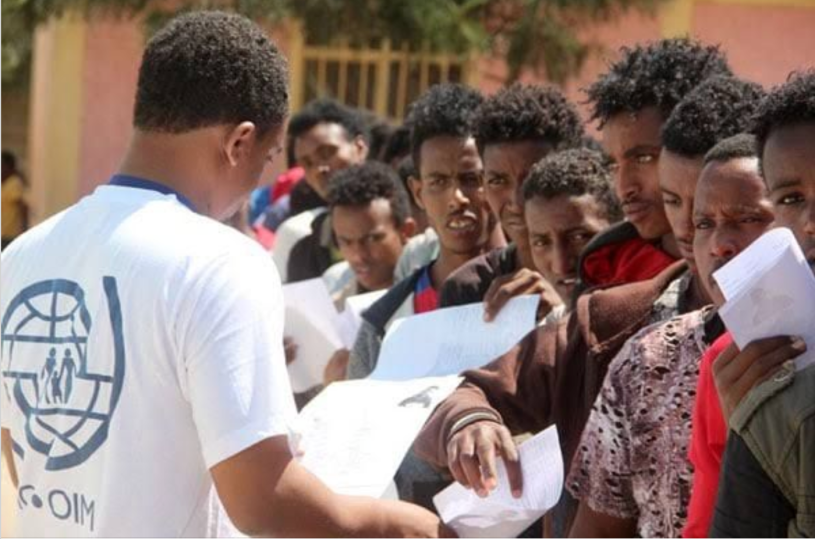
It is no secret that Eritreans want to flee from the dictatorship, even if it means enduring months, if not years, of hardship. They leave their bones in the Sahara; their bodies are washed up on the beaches of Italy. But increasingly it is becoming next to impossible to find sanctuary. This is true in Europe, but also in the USA, Kenya and Uganda. The stories below explain why.
Martin
Uganda bars new Somali, Eritrean and Ethiopian refugees as aid funding falls
Source: Hiiraan
Uganda has stopped granting refugee status to asylum seekers from Somalia, Eritrea and Ethiopia, saying those countries are no longer considered to have active armed conflicts and that dwindling donor funding has made it difficult to support new arrivals.
Uganda’s Minister for Relief, Disaster Preparedness and Refugees, Hilary Onek, said he has instructed officials not to issue refugee status to citizens from those countries, even as Uganda continues to receive hundreds of refugees daily from the Democratic Republic of Congo and South Sudan, where fighting is ongoing.
“There is no war happening in Eritrea, Ethiopia or Somalia, so we are not granting refugee status to people from those countries,” Onek said. He added that the decision will not affect those who were previously granted refugee status, but new applicants from those countries will no longer be processed.
Uganda, which currently hosts nearly two million refugees, the largest number in Africa and third largest globally, has seen a rise in daily arrivals from active conflict zones in South Sudan, the Democratic Republic of Congo, and Sudan. Kampala says it is struggling to sustain its open-door policy as international support falls.
Uganda’s refugee system, recognized internationally as a progressive model under the Self-Reliance Strategy and the Comprehensive Refugee Response Framework, allows refugees to work, move freely and access public services such as education and health care. However, funding has dropped from $240 million last year to less than $100 million, with only $18 million received in 2025 to support nearly two million refugees, according to Ugandan officials and UNHCR estimates.
The minister said Uganda spends more than 2 billion shillings annually supporting refugees. With funding cuts, basic services such as food assistance, schooling and health care are increasingly strained. UNHCR recently warned that emergency services could be cut further, affecting shelter, food distribution and protection programs, especially for vulnerable groups like children, survivors of gender-based violence and unaccompanied minors.
“This situation is dire, and it is our people who shoulder those costs, which the UNHCR used to handle,” Onek said.
Somalis represent an estimated 51,845 refugees in Uganda, about 3.3 percent of the total refugee population. Many settled in Kampala’s Kisenyi neighborhood and in Nakivale settlement, having arrived in successive displacement waves since the collapse of the Somali state in 1991, and later following the Islamic Courts Union conflict of 2006 and the 2011–2012 drought.
Uganda has historically maintained close ties with Somalia, including its long-standing role in African Union peacekeeping missions, where Ugandan troops have been central to fighting al-Shabaab insurgents. This diplomatic and military cooperation, along with Uganda’s flexible asylum practices, helped make Uganda a preferred destination for some Somali asylum seekers seeking documentation, mobility and economic opportunities.
Onek noted that Uganda is holding talks with governments in conflict-affected countries, urging them to pursue political agreements that would allow refugees to return home voluntarily.
Kenya: Court blocks ban on Eritrean, Ethiopian refugee registration
Source: The Standard

The High Court has stopped the government from implementing a directive that suspended registration and key services for asylum seekers from Eritrea and Ethiopia.
Justice Chacha Mwita issued conservatory orders barring the Commissioner for Refugee Affairs from enforcing the directive contained in a notice dated July 31, 2025, pending the hearing and determination of a constitutional petition filed by five human rights and refugee advocacy bodies.
“A conservatory order is hereby issued prohibiting the Commissioner for Refugee Affairs (the 1st respondent) or any other person acting under his instructions and/or directions from implementing the directive issued and dated July 31, 2025, suspending registration of asylum seekers of Eritrean and Ethiopian nationalities,” Justice Mwita ordered.
The judge temporarily suspended the policy restricting Eritrean and Ethiopian refugee registrations, ruling that the move poses a real risk of violating the Constitution and international refugee law.
The directive had also suspended exemption applications for processing change of address and data transfer that allow refugees to reside outside designated camps, and suspended the registration of so-called onward movers.
The case has been filed by Refugee Legal Networks, the Kenya National Commission on Human Rights, Refugee Consortium of Kenya, Kituo Cha Sheria and Sanctuary Foundation.
They argue that the directive is discriminatory, unconstitutional and exposes asylum seekers to arbitrary arrest, detention, deportation and refoulement.
The petitioners told the court that the directive discriminates against refugees and asylum seekers of Ethiopian and Eritrean origin living in Kenya on the basis of race, and that it undermines their ability to lawfully update their status and access rights guaranteed under the Constitution, the Refugees Act and international law.”
They maintained that the suspension, which is in place for an indeterminate period, is not anchored in the Refugees Act or subsidiary legislation.
“They also risk being returned either directly or indirectly to countries where they face persecution, armed conflict or serious human rights violations,” they claim.
The court was also told that asylum seekers from the two countries are increasingly being treated as trafficking victims and removed without proper refugee status determination.
The petitioners complained that many present themselves at Kenya’s borders seeking protection.
“We are instead branded as victims of alleged human trafficking… apprehended and transported to police stations where they are placed in custody… later repatriated or removed from the country without due process in violation of the principle of non-refoulement,” the court papers states
They pointed to a Kapenguria court ruling in which the magistrate directed that 104 Eritrean and Ethiopian nationals should not be deported, removed or repatriated unless their refugee status had been assessed and formally communicated to them in writing.
In response, the State, through a replying affidavit by Mwasaru Mercy, defended the directive as a lawful administrative measure aimed at curbing abuse of the asylum system by traffickers and smugglers.
The government argued that the notice was issued pursuant to the commissioners’ mandate under sections 7 and 8 of the Refugees Act and is in line with international conventions and protocols to which Kenya is a signatory, regional practice and is not subject to public participation.
They further insisted that the measure is not a blanket ban on registration of Eritrean and Ethiopian asylum seekers.
The directive is applied on a case-by-case basis and, therefore, does not exclude genuine asylum seekers from the two countries,” Mwasaru informed the judge.
They also maintained that under Article 33(2) of the Refugee Convention, state parties reserve the right to apply such internal and administrative measures as may be necessary in ensuring that the asylum process is not used by organized crime perpetrators.
However, in his ruling, Justice Mwita found that the petitioners had met the threshold for conservatory orders by demonstrating an arguable case and a real danger of prejudice if the directive remained in force during the pendency of the petition.
The judge stressed that at this stage the court was not required to reach conclusive findings on the legality of the directive, but only to assess whether the petition raises serious constitutional questions.
He noted that the petitioners had pointed out with reasonable precision the rights and fundamental freedoms in the Bill of Rights which they allege have been denied, violated or infringed or are even threatened including the right to equality and freedom from discrimination and the right to fair administrative action.
“It is the finding of this court, that considering the issues raised in the petition and without attempting to make definitive findings over the petition, the petitioners have disclosed arguable issues for consideration at the trial,” Justice Mwita said.
“In short, it cannot be said that the issues raised in the petition are frivolous or unarguable.”
She Tried to Leave America. She Entered an Immigration Hall of Mirrors.
Rahel Negassi squeezed her 11-year-old son’s hand as they turned their backs on Buffalo and faced the Peace Bridge. In the distance, they saw the Canadian flag waving from the building ahead.
An ICE agent bent down to remove her ankle monitor. “Good luck!” he said. “We would love for you to stay in the United States — but legally,” she recalled him saying.
“You will never see me again,” she replied.
It was June 27. Rahel had been under a deportation order from the United States for 22 years, ever since she fled her native Eritrea and entered the U.S. with a fake British passport. But because the U.S. does not deport people to Eritrea, she had been allowed to stay in the country.
Around regular visits with U.S. Immigration and Customs Enforcement, she married, had two children, went to college and became a nurse. She led a model life.
But when Donald Trump won the 2024 election, she understood that the immigration system was about to drastically change. Her ICE case agent made this clear in March when she fitted her with an ankle monitor and told her she needed to find another country. “We don’t want you or your children to suffer,” she recalled her saying. “You need to leave, now.”

Canada, where one of her brothers lived, was the obvious choice. The United States and Canada have an official agreement that people who have applied for asylum in one nation cannot apply in the other, but there are a few exceptions. Having a close relative in Canada is one of them.
Now Rahel clutched a manila envelope containing the documents she would present to the Canadian border officers: A copy of her Eritrean birth certificate. Her U.S. work permit. Her bachelor’s degree in nursing and her certificate to practice. A DNA test proving her connection to her brother.
She took a seat across from the Canadian Border Services agent and handed her the envelope. Her son watched TV in the waiting room. He didn’t quite grasp his mother’s predicament; he thought they were just visiting his uncle.
Then the 11-hour grilling began. It was just the beginning of a monthslong ordeal that would see her separated from her children, handcuffed and put on planes and held in three different lockups. Canada had seemed close, but it was actually very far away.
‘God Knows Where They’ll Deport Me To’
Interviews with lawyers and nongovernmental organizations suggest that since President Trump took office in January, Canadian border agents have been coming up with new, unwritten protocols to prevent asylum seekers in the United States from entering the country. Harsher questioning is more common, and agents are quickly — sometimes in just hours — handing asylum seekers back to ICE, giving lawyers and family members little time to react.
Rahel, who had spent years living in Michigan and later Maryland, seemed to be caught up in this phenomenon.
Her interview at the border turned sour fast. The agent didn’t seem to know much about the conditions in Eritrea and seemed reluctant to acknowledge that U.S. immigration enforcement had changed since Mr. Trump returned to office. (The Times obtained a transcript of the interview.)
After five hours, the agent went to a different room and called Rahel’s brother, Medhanie, who had become a naturalized citizen years ago. He was waiting anxiously just outside the border building with Rahel’s husband, a U.S. citizen. (Most of Rahel’s family members asked not to be named in this article in order to protect their privacy.)
Medhanie quickly realized something was wrong. “It was her tone,” he said of the agent. He offered to come inside the building and meet in person, but she insisted they speak by phone.

The agent ran through questions about their family — the same questions she had been asking Rahel. Medhanie was eight years Rahel’s junior. She had helped raise him before they both left Eritrea, but they had fallen out of touch, and now Medhanie stumbled over questions about family members he barely remembered. Within moments the call was over and his anxiety grew. He tried to calm himself: “She has the DNA test, what else is there to say?”
Rahel was called back in for more questioning. She told the agent that she faced immediate deportation from the United States, but the agent didn’t seem to believe her.
“If they haven’t deported you in 20-plus years, why do you think they’ll deport you now?” the agent asked.
Rahel explained that ICE had been ready to arrest her at her most recent check-in just days earlier in Maryland; she’d been allowed to leave only because of her appointment in Canada, she said. The officer asked for written proof from ICE, but Rahel didn’t have any. It wasn’t something ICE wrote down.

Family photos of Rahel Negassi, some from when she and her family lived in Eritrea.Credit…Mark Abramson for The New York Times; Ian Willms for The New York Times; Haiyun Jiang/The New York Times
At the end of the day, the agent rejected the evidence that Rahel was Eritrean, despite the copy of her birth certificate. She rejected the DNA test proving Medhanie was Rahel’s brother because she didn’t have an accompanying administrative document. She told Rahel, flatly, that she would be sent back to the United States immediately.
Rahel began to sob. “God knows where they’ll deport me to,” she cried.
The boy was shocked, but he held Rahel and tried to comfort her. “Mommy, you’ll be OK,” he said.
Rahel was certain that ICE would separate her from her son, so she tried to prepare him during the short drive back to the U.S. border.
“I didn’t do anything wrong,” she told him. “The only thing I’ve done is that I am Eritrean,” she said. “You need to believe in God, it will be fine.” The boy sat silently, holding her hand as she cried in the back of the car.
A Consequential Decision
When Rahel was born, in 1975, Eritrea was still part of Ethiopia. It became independent in 1993 after a guerrilla war led by Isaias Afwerki, who established a hermetic, brutal dictatorship and remains president today.
He made universal mandatory conscription a permanent policy and required a special visa for anyone to leave. The regime kidnapped perceived opponents off the street and targeted religious minorities. Today, Eritreans are routinely one of the top nationalities to gain refugee status across the developed world, in recognition of the regime’s litany of human-rights abuses.
Rahel fled in 2001, paying a smuggler who eventually got her to Britain, where she bought a fake British passport. This decision would later undermine her efforts to get asylum in the United States.
Five of Rahel’s seven brothers and sisters now live all over the world, but at the time she had a younger brother and older sister in the United States, and she thought they would be able to help her. When she entered the United States in November 2003, agents immediately recognized her passport as counterfeit and placed her in detention.
She appeared before an immigration judge in April 2004. Her brother and sister would be at the hearing, she thought, and her lawyer said they would be important for her case.
But Rahel didn’t know at the time that her brother Biniam had just been called to active duty with the U.S. Navy in Bahrain. Her sister, who was still not a U.S. citizen, had decided not to come, fearful that testifying could hurt her own prospects.

It was a particularly difficult time to be seeking asylum, as U.S. officials prioritized security in the immediate aftermath of 9/11. The judge, citing the fake passport and absence of relatives to vouch that Rahel was Eritrean, not only rejected Rahel’s asylum application but designated it “frivolous” — a devastating characterization that bars a person from ever holding legal U.S. immigration status.
Rahel was taken back to detention and soon faced one of the most consequential decisions of her life: would she accept the ruling, or appeal it?
According to Rahel, the judge told her that, if she waived her right to appeal, she wouldn’t be deported.
Her lawyer asked for more money to appeal, but she had spent her savings to hire him. She accepted the ruling, and was released as a paroled undocumented migrant, which meant that her deportation was postponed indefinitely.
She moved in with her sister in Michigan and started searching for a college where she could study nursing. She trusted that if she checked in with ICE as required, a stable life would be possible. And for a long time, it was. Rahel married an American and had two children. She got her nursing degree on scholarship and found work. She became active in the Eritrean diaspora resistance and joined an evangelical Christian church, finally free to practice the religion that got one of her siblings left behind in Eritrea jailed.
She lived that way for more than 20 years. Then came the 2024 election.
‘Remember, Mommy Is a Fighter’
Inside the holding pen in Buffalo, Rahel’s mind raced: Maybe ICE would release her with an ankle monitor again. She’d get a Canadian lawyer, and try again. The key was to spend as little time as possible away from her son.
As a U.S. national he wasn’t supposed to be detained with her, but the immigration officers would not release him to her husband, who is the boy’s stepfather. It would be 48 hours before the boy was allowed to go home with his sister.

“You need to go because you are American,” Rahel told him. “I will stay here because I am Eritrean.” She smiled weakly, trying to put on a brave face for him. “Remember, mommy is a fighter and she’s going to fight,” she said.
Rahel was moved from one place to the next until eventually she boarded a plane, its destination unclear. She realized that, if there were an emergency, she would not be able to reach the oxygen mask with her shackled hands.
She complained to an ICE officer.
“Nothing we can do,” she said he told her. “These are the rules.”
She couldn’t stop imagining that the cabin would experience air loss and she would die trying to reach her mask.
When the plane landed, Rahel saw that another detainee had begun menstruating and blood had seeped through her clothes and onto her seat. She would remain like this, blood drenching her clothes, as she moved from the plane to buses and walked in front of dozens of officers.
“How can this be happening in America?” Rahel thought.
In the Final Stages of Deportation
Rahel was transported to a detention center in El Valle, Texas, where she would spend three months. Government records obtained by The New York Times show that she was booked as a “bag and baggage” case, the designation used by the Department of Homeland Security for an immigrant in the final stages of deportation.

As she arrived, the U.S. Supreme Court ruled that immigrants could be deported to a country other than their own. Rahel’s husband panicked. Was she headed for South Sudan?
He had hired a Canadian lawyer, Heather Neufeld, and she was working to get Rahel back in front of Canadian immigration officers, knowing that Rahel could be deported at any time.
Rahel knew her deportation was likely imminent, but in regular video calls from detention, she tried to tell her family she was strong and optimistic. The family put on the same brave face. Her son poked fun at his stepfather’s cooking — “We are watching YouTube videos to improve his recipes,” he joked — and promised his mother he was reading his Bible.
Rahel became the detention center librarian, putting together photocopy packages for other detainees going to court.
Then, at the end of the summer, an email from the Canadian Justice Department landed in Ms. Neufeld’s inbox: On Sept. 2, Rahel would get a second chance to argue her case in front of a Canadian officer. ICE, the email informed her, had agreed to transport her from Texas back to Peace Bridge.

At last, the breakthrough everyone had been praying for. Ms. Neufeld scheduled a call with Rahel for the following day to brief her.
But the next day a guard at El Valle called Ms. Neufeld.
“I’m sorry, your client won’t make your scheduled meeting,” he said. “She’s been deported.”
A Second Chance in Canada
For 24 hours, Rahel’s family assumed the worst.
Then, in the middle of the night, Rahel called her husband. She had been transferred to a prison in Ohio, she said. Rahel didn’t have any other information, but at least she was still in the country. He had to believe she would show up, as planned, at 11 a.m. on Sept. 2 at the Canadian Border Services agency.
He drove with her son back to the agency. Medhanie met them there, as did Ms. Neufeld and a colleague. Together, they walked into the building and sat in the waiting room.
In the corner was a little toy kitchen. The movie “Avatar” played on the television set. The boy watched, enthralled. The others waited, as 11 a.m. passed and Rahel did not arrive.
Finally, three hours later than planned, ICE again drove Rahel to the Canadian side of the border and dropped her off.
“What will you do if they reject you again?” one of the officers asked. “Will you come back?”
“I will not entertain this kind of negativity,” she said, smiling at them. She got out of the car and walked into the waiting room.
Her husband was so overwhelmed he could not stand up to greet her. But her son rushed to her, holding her close. When he finally pulled back to look at her, he was surprised by how much she had changed. He had never seen the roots of her hair grow gray. And her skin had turned much darker than usual, as she spent stretches outside under the Texas summer sun.
Then the interviews began, this time in the presence of Ms. Neufeld, who was allowed to observe, but not intervene.

Both women sensed that this Canadian officer was competent and professional. He seemed to know more about Eritrea’s history. He reviewed the DNA test and accompanying documents and called the laboratory with follow-up questions. He interviewed Medhanie in person.
But then came the question that had long haunted Rahel’s immigration efforts. Why, asked the officer, did one of her U.S. documents say she was Ethiopian? She had to get this answer right, but Ms. Neufeld, seeing how tired Rahel was after sleepless nights in detention, worried that she wouldn’t be able to explain it clearly.
When she was born, Rahel explained, Eritrea was a part of Ethiopia. All of her other U.S. documents, including her work permit, noted she was Eritrean.
“If I had been Ethiopian, the U.S. would have deported me there 20 years ago,” she added.
“That makes sense,” the officer said. Ms Neufeld exhaled audibly.
Finally, the officer said he had made his decision; he just needed his supervisor to approve it.
“Do you have any questions?” he asked Rahel.
“Yes,” she replied. “Can you tell me what your decision is?”
The officer smiled. “I’m sorry, I’m afraid I can’t.”
Minutes after 10 p.m., the door to the building opened. Rahel held her son’s hand as they stepped out into the warm night and walked to her husband’s car, parked on the Canadian side of the border. She had been searching for a country to claim as her own for more than two decades. Finally, it seemed, she had found one.
 Martin Plaut