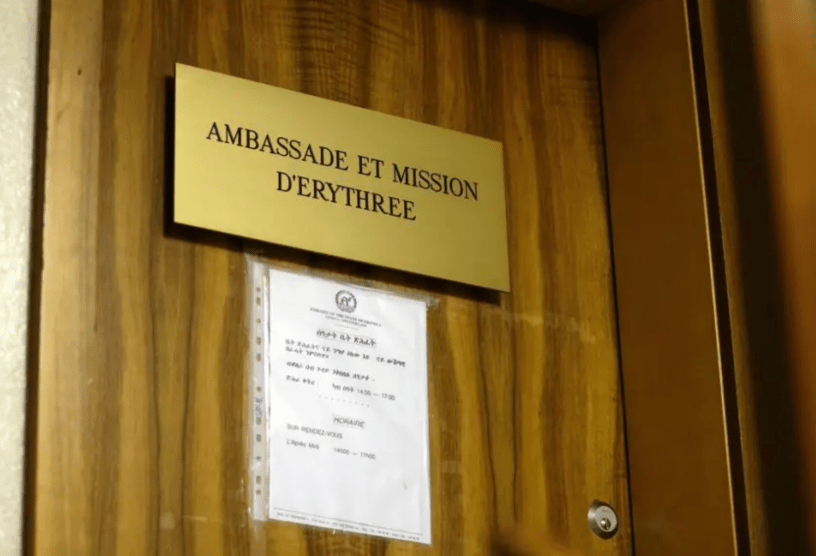
The Federal Court (Swiss Federal High Court in Lausanne) has ruled that the requirement imposed by the Eritrean consulate to sign a letter of regret in order to obtain the identity documents necessary for the granting of a residence permit on grounds of hardship is illegal. The OSAR (Swiss Organisation to Assist Refugees) and all other NGOs in Switzerland have long recommended that the SEM stop requiring travel documents to be obtained through the embassy in order to protect Eritrean nationals from the risks of arbitrariness and repression.
In its ruling 2C_64/2025, published on 20 November 2025, the Federal Court considered that it was not justified to require the signing of a letter of regret at the Eritrean consulate in Switzerland in order to obtain a B permit on grounds of hardship. In this case, the person who made the request met all the conditions for obtaining a residence permit on grounds of hardship and thus having their F (preliminary) permit replaced by a B (permanent) permit. In the Court’s view, the letter of regret that the Eritrean authorities require applicants to sign in exchange for the granting of an identity document constitutes a self-incriminating statement that is contrary to Swiss law and international guarantees. Requiring such an admission in order to obtain a residence permit is therefore disproportionate, has no direct link to the verification of identity and violates the principle of non-incrimination. This means that it will no longer be necessary to present an Eritrean passport in order to obtain a B permit on grounds of hardship.
The main instrument of the Eritrean authorities (embassy) to extort fees, to collect family datas from Eritreans seeking refugee status in Switzerland and to sign letters of regret, etc. becomes more difficult with this very important decision of the highest court in Switzerland.
 Martin Plaut