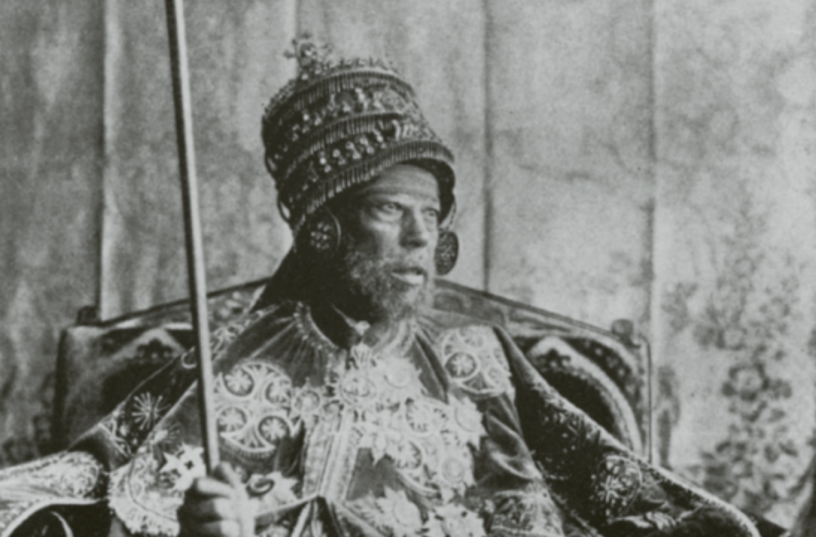
I recently published a Tweet in response to an article in the Guardian. The article was headlined: “African leaders push for recognition of colonial crimes and reparations.”
Algeria’s foreign minister, Ahmed Attaf, was quoted as saying: “Africa is entitled to demand the official and explicit recognition of the crimes committed against its peoples during the colonial period, an indispensable first step toward addressing the consequences of that era, for which African countries and peoples continue to pay a heavy price in terms of exclusion, marginalisation and backwardness.”
It was worth reading and I posed this question: “Will African leaders also call for recognition of the crimes of Ethiopian emperor Menelik and the Sultan of Sokoto? Both engaged in colonisation and both exported their enslaved peoples.”
The Tweet received considerable attention and a lot of comment, some of it angry and some of it racist. But just as Britain must face its uncomfortable past, given its role in the Trans-Atlantic Slave Trade and the role it played in its empire, so must Ethiopia. We cannot deny, or ignore, the past.
Menelik expands the empire
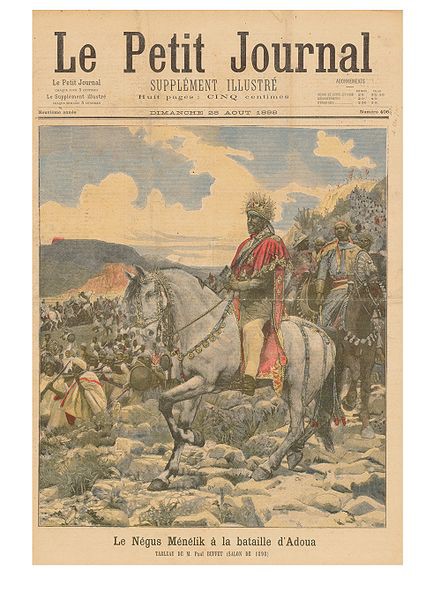
So what is the record in Ethiopia and what role did Menelik II play? His Wikipedia entry describes him as:
“king of Shewa from 1866 to 1889 and Emperor of Ethiopia from 1889 to his death in 1913. A member of the Solomonic dynasty, Menelik expanded the Ethiopian Empire to its greatest historical extent and defeated Italian colonial forces at the Battle of Adwa in 1896. He is widely regarded as the founder of the modern Ethiopian state.
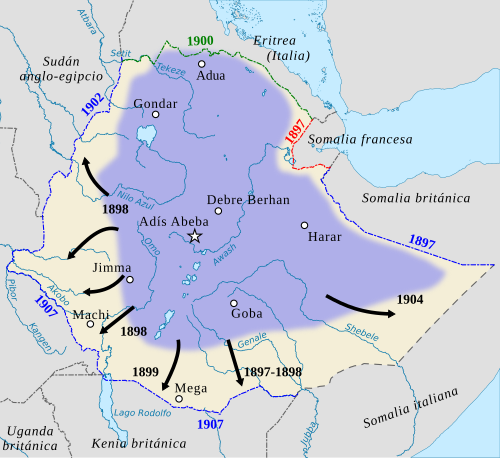
I do not disagree with any of this. The emperor did indeed defeat the Italians. He also expanded the Ethiopian empire, as these maps, also provided by Wikipedia, show in some detail.
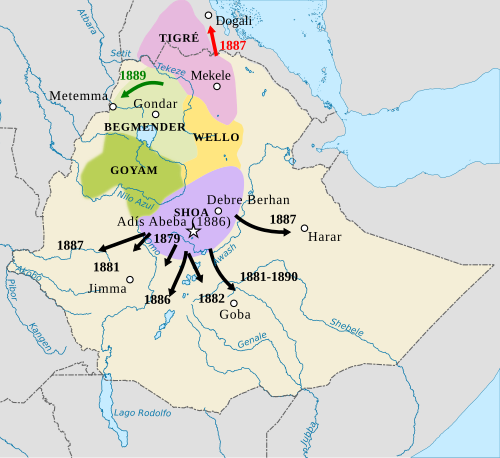
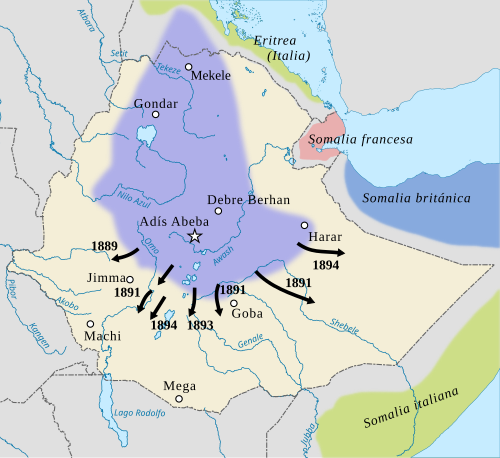
Menelik also engaged in slavery, as Wikipedia points out.
The League of Nations in 1920 reported that after the invasion of Menelik’s forces into non-Abyssinian lands of Somalis, Harari, Oromo, Sidama, Shanqella, etc., the inhabitants were enslaved and heavily taxed by the Gabbar system leading to depopulation.
Later in the entry, Wikipedia point out that:
From 1906, for all intents and purposes, Taytu Betul ruled in Menelik’s stead during his infirmity. Menelik and Taytu Betul personally owned 70,000 slaves. Abba Jifar II is also said to have had more than 10,000 slaves and allowed his armies to enslave the captives during a battle with all his neighboring clans.
None of this should come as a surprise to anyone.
A history of slavery that endures
The Ethiopian kingdom (subsequently an empire) has, like so many other African states, used slaves from the earliest times. The practice was linked to the conflicts which afflicted the people of the Horn of Africa down the centuries. Richard Pankhurst, among the most eminent Ethiopianists, offered this summary.[1]
“Warfare, which in the Ethiopian region dates back to the dawn of history, led to the capture of slaves of many ethnic groups. A significant proportion of the men, women and children thus seized were taken, however, from the less powerful communities of the periphery of the state, notably from what is now the borderlands of the Sudan, from peoples who, being in many cases culturally distinct, were regarded as morally easier to enslave than other inhabitants of the area.”
The experience of slavery remains deeply ingrained.
The Gumuz suffered slavery until the second half of the twentieth century, well into the reign of Emperor Haile Selassie and possibly even longer.[1] The Amhara were by no means the only ethnic group to participate in this practice. John Young recalls Gumuz explaining to him that “Oromos were taking slaves until 1993 and that students had to carry weapons to school to defend themselves.”[2] Gumuz elders continue to relate the deprivation they suffered well beyond this; describing the confiscation of their property, their eviction from their lands and their enslavement.
They are by no means the only ethnic group with these memories. On 5 November 2021, during the war launched by Ethiopia and Eritrea against Tigray, an alliance was formed between the Tigray Peoples Liberation Front and eight other ethnic groups.[3] In a live feed from the National Press Club in Washington, where the alliance was signed, the Oromo representative declared bitterly: “I have been treated like a slave all of my life.”[4] The wounds of enslavement in Ethiopia run deep and have not been expunged.
[1] Wondim Tiruneh Zeleke, Centralization effort and local Gumuz response in North Western Ethiopia, op. cit. p. 49
[2] John Young, Along Ethiopia’s Western Frontier: Gambella and Benishangul in Transition, Journal of Modern African Studies, Vol. 37, No. 2, 1999, p. 336
[3] Voice of America, Tigray, Other Groups Form Alliance Against Ethiopian Leader, 5 November 2021
New York Times, Eight Groups Join Tigray Rebels Vowing to Oust Ethiopia’s Leader
Accessed 20 October 2023
[4] Author’s recollection of the Press Conference
[1] Richard Pankhurst, The history of Bareya, Sanqella and other Ethiopian slaves from the borderlands of the Sudan, Sudan Notes and Records, Vol. 58, 1977, p. 1
 Martin Plaut
Hi my dear, First of all the suffering caused by African Slave owners including Ethiopians is not comparable to what was done by British and French colonial powers. unless it is politically motivated. Secondly, what is the significance of talking about past wounds while slavery is still existing in different versions as one can witness severe problems related to social evils such as human trafficking, drug trafficking selling organs, commercial sex works and the like which are the outcomes of socio economic injustices engineered by Anglo American alliance?
I think one would have to ask the enslaved about the degree of their suffering. I make no judgement on this. Don’t forget that hundreds of thousands of Ethiopians were exported to Oman and Saudi Arabia over many centuries. A large number were then sent onwards to India, where they served as military slaves. Others were taken to Iraq where they drained swamps. It was brutal work. In my book I make clear what took place in the Trans-Atlantic trade. I do not deny any of these social evils.