While Uganda’s President said his talk of war was rhetorical, there are real fears in the region of conflict over coastal access. – Viewpoint by Mohamud A. Ahmed
Uganda’s President Yoweri Museveni recently hinted that tensions with Kenya could lead to war, before swiftly clarifying that his comment was metaphorical.
“Some of the countries have no access to the sea, not only for economic purposes but also for defense purposes… How do I export my products?” Museveni said, adding, “I am entitled to that ocean. In the future, we are going to have wars.”
Despite its brevity, the comment provoked an unusually strong regional reaction; not because conflict was seen as imminent, but because it tapped into broader unease.
At a time of strained maritime routes, shifting alliances, and heightened sensitivity to political messaging, statements by regional leaders carry increased weight.
In today’s Horn of Africa, even figurative remarks are scrutinized closely, as language itself has become a measure of strategic intent.
Unsteady Ground
Uganda and Kenya have long maintained a stable pattern of cooperation, grounded in decades of joint security initiatives, cross-border trade, and closely linked political histories.
Beneath this stability lie structural asymmetries. Kenya’s access to the sea and Uganda’s reliance on it have shaped their economic relations; most of Uganda’s fuel, manufactured goods and imported staples enter through Mombasa.
The corridor is more than logistical; it reflects the degree of exposure attached to dependency.
That unease surfaced when Uganda abandoned the Lamu pipeline project in favor of Tanzania’s Tanga route. The shift signaled an attempt to reduce reliance on Kenyan infrastructure.
It was against this backdrop that Museveni’s remark was made. His swift clarification eased immediate concern, but the reaction revealed a heightened sensitivity shaped by deeper maritime tensions.
Maritime Tensions
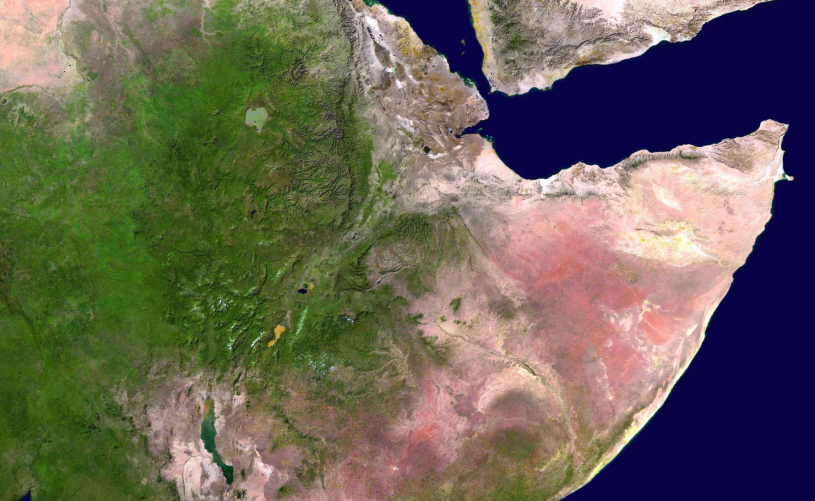
To understand that sensitivity, it is necessary to consider the wider maritime context. The Horn of Africa is increasingly defined by coastal exposure.
The Red Sea and the Gulf of Aden have become strategic corridors for external military and commercial actors, from US and Chinese warships to Gulf logistics projects.
Pirate networks have re-emerged amid economic deterioration and political fragmentation. Houthi attacks have disrupted shipping, rerouted commercial traffic, and forced reassessment of insurance risk.
Political statements now gain significance not just for their content, but their timing in a region where maritime competition is intensifying.
This intersects most directly with the region’s most influential and vulnerable state: Ethiopia. Landlocked since Eritrea’s independence, Ethiopia’s lack of direct sea access has long shaped its economic and security posture.
Prime Minister Abiy Ahmed’s recent assertion that access to the sea is an existential need caused unease; not because the logic was disputed, but because it implied that longstanding assumptions may no longer hold.
Ethiopia has explored alternatives—Berbera, Lamu, Port Sudan, continued reliance on Djibouti—yet none fully resolve the issue. The port of Assab, in Eritrea, remains the unspoken core of the internal debate.
Assab carries historical weight. It was not lost through war but through political transfer during a period of contested authority. Some senior Ethiopian officials argue the decision lacked constitutional grounding and remains legally open.
While diplomacy is emphasized, they maintain that alternative measures cannot be excluded. For neighboring states, this reasoning is understood but regarded with caution.
The Regional Ripples
Ethiopia’s maritime posture now shapes how regional actors interpret strategic positioning. Its pursuit of access influences port development, diplomatic alignment, and regional negotiation dynamics.
Kenya expands Mombasa and Lamu; Tanzania upgrades Dar es Salaam and Tanga; Somaliland develops Berbera with Gulf partners; Djibouti consolidates its logistical role. Uganda diversifies; Somalia prioritizes stability; Eritrea seeks leverage; Sudan navigates state survival.
Uganda–Kenya tensions, when viewed through this lens, are not about bilateral friction alone—they reflect how structural maritime anxiety permeates economic decisions and amplifies the sensitivity to political rhetoric.
Communication Stakes
In this context, political language carries growing weight. Rising inflation, currency depreciation, exposure to external shocks, and domestic pressure have narrowed the policy space of regional governments.
Stability has become a central strategic objective, increasingly influenced by how leaders communicate.
Museveni’s clarification did more than calm immediate tensions, it underscored a shift. Statements by senior officials are now read against changing geopolitical conditions.
Geography no longer buffers states from the implications of rhetoric. Maritime proximity and international involvement have reduced tolerance for ambiguity.
Words travel faster—and often have more strategic consequence—than vessels navigating these waters.
The region’s trajectory will hinge on whether leaders cooperate and plan maritime access collectively rather than pursue unilateral strategies with unintended risks.
Museveni’s remark may soon fade, but the reaction it triggered points to a defining shift.
The Horn of Africa is defined by rapid port expansion and military buildup along its sea lanes. Alliances are shifting, and historical disputes remain unresolved.
In this environment, public statements are closely scrutinized for underlying subtext.
The environment demands precision and restraint in a region where economic pressure and geopolitical exposure have raised the stakes of even a single word.

About the author.
Mohamud is a political analyst and researcher based in Ethiopia’s Somali Region.
 Martin Plaut
T.A.D.E, UK -BR TDA House 211 Clapham Road London, SW9 0QH UK
Email:MeketeTigrayUK2020@gmail.com
Website: https://meketetigrayuk.org
Mr. D. *Lammy MP MR. Marco Rubio Ambassador Warren A. Stephen
Your Honourable Messieurs:
We believe that the whole world has heard of the genocidal war in Tigray (northern Ethiopia); however, the active (political/humanitarian) sections of the international community have not given due consideration to this deadliest war of the 21st century. On the magnitude of this devastating war there is overwhelming documented evidence, which we can provide on request or can be accessed from sources such as UN-HRC, New Line Institution, Mr. Martin Pault ’s EEPA Reports, APGC (led by Lord D. Alton) Amnesty International, Al-Jazeera, even BBC World Service & The Guardian (no matter it may be scanty), CNN Reports, EU Report (esp. presented by Mr. Pekka Haavisto & MPE Mike Wallace), Ethio-Forum, Zara Tigray Media Network, GSTS etc.
Thus the Tigrian academic living & working in the UK , in collaboration with various community groups have been impelled to release this reminder communique on behalf of the Tigrian Diaspora in the UK. We are obliged to bring this matter to our respective MPs for the following reason:
1. Almost all members of the Diaspora have lost either a close/distant relative or a friend/ neighbour; as well as a relative/s/ who is/are a victim/s/ of rape (used a weapon of war).
2. As a result of these atrocities befell/still befalling on our roots, has affected our individual performance in the UK socio-economic performance, be it in teaching, or medical profession or super-market management.
3. As concerned citizens and proven solid allegiances to the Kingdom, we do not want to be an additional burden to the NHS, the pride of this society. We say this based on information our medical folks told us the frequency & the number of Tigrians visiting various of our hospitals has increased exponentially, as a result of the depression induced by the ongoing barbarity of their respective families in Tigray.
4. As taxpayers and active members of this society, we strongly believe that our government has the social & moral obligation to maintain the sanity and stability of its citizens. If necessary, we are more than happy to provide any additional information, although there are plenty of documented sources of facts & figures on this genocidal war that devoured over 1,500,000 people, either by hot-battles or by the aftermath of the war. Needless to say, but worth mentioning is the fact that it should be apparent that the nearly 5,000,000 displaced people are the potential immigrants to the Western hemisphere unless they are helped to return to their original abodes and villages. This is because nothing can stop them from attempting any possible means of survival, as their deprivation of the minimal basic necessities are compounded by war & natural calamities, specially those who are sheltered in tattered tents within the Sudan borders.
In this light, we would like to appeal earnestly to the good conscience of our MPs and the active international at large, including the media, to air out our shared concern and put the necessary pressure to our government in order to take the necessary measures, as it did in various troubled countries of the world, with collaboration other international stakeholders, such as UN & EU.
May we take this opportunity to express our heart-felt appreciation and gratitude to those who approached Col. A.A. Ali to avoid the genocidal war in 2020. The list we have long however for just a sample we like to mention here: ex- president Thabo Mbeki, President P. Kagame ex-president, Ex-president Ellen Jonson, Yoweri Museveni. On the other side of the coin, we would like also to remember those who directly/indirectly encouraged this genocidal war, that wiped out over 1,000,000 citizen, that used over 120, 000, female folk as a battle ground, that displaced over 3 to 5,000,000 people, and that intentionally destroyed 80 % of the Tigray civil infrastructures.
The ‘past is passed’ but what we would like to appeal to all anti-war sagacious people like Mr. Thabo Mbeki and if there are repenting pro-war elements to help us thwart the currently looming war between Eritrea & Ethiopia, whereby both are intending to use Tigray as a battle ground.
With great anticipation, we remain.
TADA-UK, Mekete -UK, TWA-UK, TYA-UK
Tigray Academic Diaspora in Europe,_UK-Branch
On behalf of Community of Tigrian Diaspora in the UK
London, UK.
11th Nov. 2025