By: Eyob Tilahun
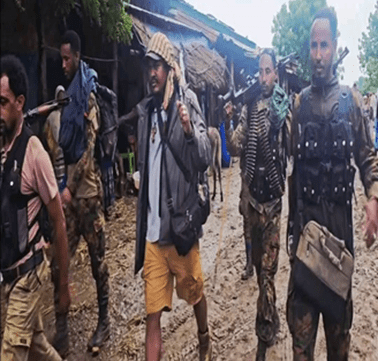
The rise of the Fano force and its fight for survival against Abiy Ahmed’s regime in Ethiopia has significantly changed the security landscape of the Horn of Africa by acting as a deterrent to larger conflicts.
Fano’s fight for survival
Abiy’s regime launched a disastrous war in the Amhara region in 2023, aiming to disarm the Amhara people. However, the campaign backfired, plunging the regime into a quagmire characterised by repeated battlefield defeats by Fano forces.
Conversely, Fano forces, who initially employed conventional weapons and embarked on a scattered struggle for survival, gradually captured advanced weaponry from government forces, trained themselves into a large and elite unit, established a chain of command, and repeatedly delivered devastating defeats to government troops across the Amhara region.
Notably, Fano forces have demonstrated compliance with international law, including human rights protections enshrined in the Geneva Conventions, unlike the regime’s failure to meet these obligations. The recent visit by the International Red Cross, Fano’s humane treatment of surrendered government troops, and their calls for international custody highlight adherence to the law. In contrast, government forces have brutally killed and mutilated Fano fighters.
Fano is fighting solely for the survival of the Amhara people, who face an existential threat posed by Abiy’s regime. While some point to Abiy’s apparent betrayal in the Pretoria Agreement as a factor, the underlying cause remains the existential threat to the Amhara.
Fano’s struggle acts as a deterrent to bigger conflicts.
Fano’s resistance compelled the Abiy government to reconsider and postpone plans for conflict with neighbouring nations, as Fano served as an effective deterrent to Abiy’s broader regional war ambitions within the Horn of Africa’s security environment.
Fano’s resistance delivered a sharp blow to Abiy’s reckless regional war plans. Had the Fano resistance not emerged, Abiy likely would have started a regional conflict in the Horn of Africa, involving multiple parties. Fano is maintaining the security balance in the Horn of Africa.
Fano forces mounted considerable resistance, causing Abiy’s regime to concentrate on internal conflicts and wars to maintain its hold on power, thereby restricting its ambitious plans for conflict with neighbouring countries, particularly Somalia, Djibouti, Eritrea, and Sudan.
The regime is accused of indirect involvement in Sudan’s war by backing the Rapid Support Forces (RSF), which have carried out brutal attacks on civilians. It has set up a military training base in Ethiopia’s Benishangul region to train RSF troops. If the Fano resistance does not step in, Abiy’s regime could host RSF in the Amhara region.
Some international media and powerful states have expressed concerns about a potential war between Ethiopia and Eritrea. However, these fears are exaggerated, as Abiy’s regime, domestically constrained by Fano, cannot fire a single shot at Eritrea unless Eritrea responds militarily to Abiy’s rhetoric. Fano’s ongoing struggle for survival has effectively blocked Abiy’s regional war ambitions, indirectly helping to maintain peace and security in the Horn of Africa.
Widespread Abuses in Amhara
Since hostilities erupted in the Amhara region, government forces have carried out ruthlessly brutal killings, characterised by extreme cruelty and a blatant disregard for human life. Civilians, including the elderly, women, and children, have been massacred across the region. Government forces have weaponised sexual violence against the population.
Government forces have deliberately targeted hospitals, schools, humanitarian routes and personnel, residential areas, places of worship, markets, and farms. Human rights observers have recorded these actions as serious violations of international humanitarian law, including the Geneva Conventions.
Abiy’s gambling cards
The regime engages in both domestic and international gambits, utilising regional and internal issues to distract from mounting domestic tensions, public outrage over its brutal war against the population, and rising living costs caused by its failing governance.
The regime uses ethnic conflicts, boundary disputes, corridor and resort projects, the Grand Ethiopian Renaissance Dam (GERD), and access to the sea as political tools. It manipulates these issues to distract the public and sustain its hold on power.
To divert attention from its crimes against civilians and its military and diplomatic failures, the regime continues to spread rhetoric and threats of war over gaining access to the sea. However, such actions are unlikely, given that its military capacity has been severely weakened. Abiy’s regime has no genuine intention of securing sea access for the benefit of the people.
Following Abiy’s regime’s false-flag tactics and persistent rhetoric, such as threats regarding access to the sea, Ethiopia is now widely regarded as aggressive and an adversary by neighbouring countries, particularly Somalia, Djibouti, Eritrea, and Sudan. These nations do not engage in constructive diplomacy with Ethiopia due to ongoing instability, provocations under Abiy’s leadership, and the regime’s disregard for the rule of law.
The Way Forward
If international law and universal human rights apply universally without precondition, the international community, especially the UN Security Council and influential states, must exert meaningful pressure on Abiy’s regime using all available measures and ensure accountability for its serious crimes committed against the people of Amhara.
The International Criminal Court, in consultation with the UN Security Council, should also issue arrest warrants against individuals within Abiy’s regime responsible for these crimes, utilising the mandate of the UN Security Council established by the resolution that allows the ICC to issue arrest warrants for non-member states such as Ethiopia.
Moreover, organisations and influential individuals who value human life, human rights, and international law must speak out and apply pressure against Abiy’s war-driven leadership, which is committing violence against its own population and destabilising the Horn of Africa.
Unless a robust deterrent is imposed on Abiy’s regime and accountability for atrocity crimes is established, Abiy and other dictatorial regimes will be further emboldened. In Ethiopia, the lack of punishment and accountability for past violations continues to cast a shadow over the present and will endure unless it is firmly addressed.
 Martin Plaut