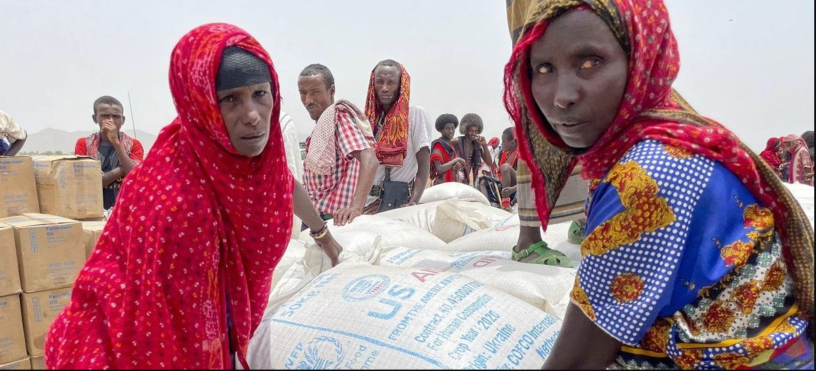
Famine is a political choice, not an inevitable act of nature. The Ethiopian Government’s Weaponization of Hunger is a Crime against Humanity
By Ephrem B Hidug
The most fundamental duty of any government is to ensure the survival of its citizens. When a state not only abdicates this duty but actively turns the necessities of life into instruments of control, it shatters the social contract beyond repair. This is not a theoretical proposition; it is the grim reality unfolding in Ethiopia today. Under the leadership of Prime Minister Abiy Ahmed, and executed through officials like Shiferaw Teklemariam, Commissioner of the Disaster Risk Management Commission, hunger has been systematically weaponized as a tool of political strategy. This is not a tragic failure of logistics or a mere humanitarian crisis born of drought. This is a calculated, slow-motion atrocity—a crime against humanity unfolding in real time.
Let us begin with the evidence, for the government’s strategy relies first on obscuring it. While Shiferaw Teklemariam, dismisses reports of starvation in the Hitsats IDP camp as “fake” and politically motivated, the facts scream otherwise. The UN Office for the Coordination of Humanitarian Affairs (OCHA) details millions in acute need. World Food Programme’s latest assessment for Tigray shows nearly half the population facing severe food shortages. Independent analyses, including from the Chicago Council on Global Affairs, have meticulously documented a campaign of siege: the deliberate blocking of humanitarian aid, the destruction of farmland, the slaughter of livestock, and the looting of agricultural supplies. These are not the hallmarks of a government overwhelmed by circumstance; they are the tactics of one orchestrating deprivation.
The government’s defense is a masterclass in bad faith. It points to the complexities of conflict and the challenges of drought. This is a smokescreen, and a historically ignorant one at that. Ethiopia has conquered drought before. Under previous administrations, the nation implemented the Productive Safety Net Programme, which successfully shielded millions from the devastating 2011 Horn of Africa drought and became an international model. That achievement proved a seminal truth: famine is a political choice, not an inevitable act of nature. The current administration has not simply failed to uphold this legacy; it has actively dismantled it. To plead helplessness in the face of a problem you have deliberately made worse is not an excuse—it is an admission of guilt.
This brings us to the heart of the argument: the sinister persona of Shiferaw Teklemariam. He is not a mere bureaucrat out of his depth. He is a key member of the ruling Prosperity Party placed in charge of disaster management. His role is therefore dual: to manage the mechanics of aid while enforcing the politics of denial. When he labels images of emaciated children as propaganda from “TPLF-aligned outlets,” he is not assessing evidence; he is issuing a political directive. His statements serve to chill reporting, intimidate aid workers, and provide diplomatic cover for the ongoing blockade. For the victims, his words are as lethal as the withheld grain. They translate a policy of starvation into a gas lighting campaign that tells the dying their suffering is an illusion.
Consider the profound moral inversion this represents. The taxes paid by a starving farmer in Tigray help fund the salary of the official who denies him food. The state’s resources, meant as a collective trust for the public good, are wielded as a tool of punishment against a segment of the public. This perversion is the very definition of tyrannical governance. A government that uses its monopoly on power and logistics not to feed but to starve has ceased to be a legitimate authority. It has become a predatory entity, violating the most basic covenant imaginable.
The international community’s response has been, to date, a catastrophic failure of moral clarity. Treating this engineered famine as a “complex humanitarian emergency” requiring delicate diplomacy is to be complicit in the crime. It mistakes the symptom for the cause. The cause is not a lack of food in the global system; it is a political decision in Addis Ababa to prevent that food from reaching specific populations. Endless rounds of quiet dialogue, while aid convoys are turned back at checkpoints, only normalize the abnormal. It tells the architects of this policy that there is no real cost, only temporary diplomatic friction.
What, then, constitutes a meaningful response? First, we must strip away the euphemisms. These are not “internally displaced persons”; they are civilians imprisoned in open-air concentration camps, sentenced to death by starvation. This is not “food insecurity”; it is state-sponsored mass killing through deprivation. Language matters, for it shapes policy. As long as we use the soft lexicon of development reports, we will never muster the political will for the hard actions required.
The necessary actions are clear and non-negotiable:
- Immediate and Unconditional Humanitarian Access: A coalition of nations, led by the UN Security Council, must demand and enforce a complete, verifiable, and lasting lifting of all blockades on food and medicine to Tigray, Amhara, Afar, and all affected regions. No more negotiations. Access must be a precondition for any further diplomatic engagement.
- Targeted Personal Accountability: The network of officials executing this policy must face consequences. Shiferaw Teklemariam should be the first. He must resign immediately and unconditionaly. The message must be that orchestrating famine is a career-ending, life-altering crime.
- A Shift from Aid to Justice: The international focus must pivot from merely funding humanitarian response (which treats the symptom) to funding and supporting mechanisms of justice (which address the cause). This includes robust support for independent investigations by the UN Human rights Commission. Starvation as a method of warfare is a war crime.
- Conditionality on All Assistance: Every dollar of budgetary support, every loan from international financial institutions, and every form of non-humanitarian assistance to the Ethiopian government must be tied to tangible, verified progress on ending the weaponization of aid. The era of blank checks for a government engaged in crimes against its people must end.
The moral calculus here is simple. A state that chooses to starve its people to achieve political obedience has declared war on the very idea of the state itself. It has no moral right to sovereignty, to foreign aid, or to a seat at the table of civilized nations. The people dying in the dust of Hitsats are not casualties of a distant war; they are canaries in the coal mine of a global order that still too often privileges state sovereignty over human survival.
History’s judgment is already being written in the hollow eyes of starving children. It will record not only the perpetrators but also the bystanders—the diplomats who urged patience, the donors who feared rocking the boat, the global public that looked away. To break Ethiopia’s cursed cycle of famine, we must first break our own cycle of complicit silence. This is not merely Ethiopia’s crisis; it is a test of our collective conscience. We must choose: will we be the generation that finally said “never again” and meant it, or will we be the one that perfected the language of excuse while the world’s oldest nation consumed itself? The time for argument is over. The time for unyielding, confrontational action is now.
About the Author:
Ephrem B Hidug is a former Ethiopian Diplomat with over 20 years’ experience in International Legal Affairs, Domestic Law and diplomacy
 Martin Plaut