From Yemen and Sudan to Israel and Somaliland, the UAE has built a wide network of allies, investments, and security ties aimed at countering political Islam and shaping regional power dynamics.
Source: Jerusalem Post

Supporters of the UAE-backed separatist Southern Transitional Council (STC) wave flags of the United Arab Emirates and of the STC, during a rally in Aden, Yemen, December 30, 2025.(photo credit: REUTERS/Fawaz Salman)
ByREUTERS, JERUSALEM POST STAFF DECEMBER 31, 2025 16:48
The United Arab Emirates has pursued an assertive foreign policy and carved its own sphere of influence across the Middle East and Africa, a strategy in the spotlight after a rare military escalation with Saudi Arabia in Yemen this week.
Abu Dhabi has used alliances with states or proxies, military intervention, and financial support mainly to counter what it views as the destabilizing threat of political Islam, specifically from groups linked to the Muslim Brotherhood.
Senior Emirati officials have described the strategy as strengthening nation-states against extremists, though UN experts and Western officials have asserted that the approach has at times fueled conflict, a charge the UAE denies, and critics say it bolsters authoritarian leaders.
Details of the UAE’s involvement in key countries
Yemen
The UAE announced a withdrawal of its troops from Yemen in 2019, but has maintained influence through the Southern Transitional Council (STC), a separatist group it trained and equipped.

It said the decision came after a comprehensive assessment following recent developments, state news agency WAM reported, citing a statement from the ministry.
The move comes after a Saudi-led coalition carried out an airstrike on the southern Yemeni port of Mukalla in what Riyadh said was an attack on a UAE-linked weapons shipment.
It views the STC as a bulwark against the Islah party, a key faction in the Saudi-backed government of Yemen that the UAE regards as a Muslim Brotherhood offshoot, and as a partner in securing maritime access.
Israel
In 2020, the UAE broke with decades of Arab consensus by normalizing relations with Israel under the US-brokered Abraham Accords, a move Saudi Arabia has declined to follow without a path to Palestinian statehood.
The pact formalized a strategic alignment against shared adversaries, specifically Iran and Islamist terror groups like Hamas.
While the Israel-Hamas War has cooled public engagement, with Emirati officials frequently criticizing Israeli military conduct, Abu Dhabi has maintained its diplomatic ties, viewing the relationship as a critical lever for regional influence and a unique channel to Washington.
Saudi Arabia
Riyadh issued a strongly worded statement against the UAE in the falling-out between the neighbours, who once cooperated in a coalition against Yemen’s Iran‑aligned Houthis but whose interests in Yemen have steadily grown apart in recent years.
Additionally, Saudi Arabia said on Tuesday its national security was a red line, hours after an airstrike on Yemen’s southern port of Mukalla by a Saudi-led coalition, and gave UAE forces 24 hours to leave, in Riyadh’s strongest language against Abu Dhabi yet.
Yemen’s Saudi-backed government coalition conducted a “limited” air strike on two ships in the Yemeni port city of Mukalla early Tuesday morning, Saudi state-owned outlet Saudi Press Agency (SPA) reported.
In Washington, the US State Department said Secretary of State Marco Rubio spoke with the Saudi and UAE foreign ministers about tensions in Yemen and other issues affecting security in the Middle East.
Egypt
Abu Dhabi has been Cairo’s most important financial backer since Egypt’s President Abdel Fattah al-Sisi led the military overthrow of the Muslim Brotherhood government in 2013, viewing a secular Egypt as a firewall against an Islamist resurgence.
UAE wealth fund invests $35b. in Egypt’s coastline
In 2024, Emirati sovereign wealth fund ADQ signed a $35 billion deal to develop a prime stretch of Egypt’s Mediterranean coast – a vital injection of hard currency while Cairo was strapped for cash.
Their shared distrust of the Muslim Brotherhood anchors their political alliance, which has seen them coordinate the 2017 boycott of Qatar and oppose Turkey’s influence in Libya.
Turkey’s ruling AK Party has close ties to the Brotherhood.
Sudan
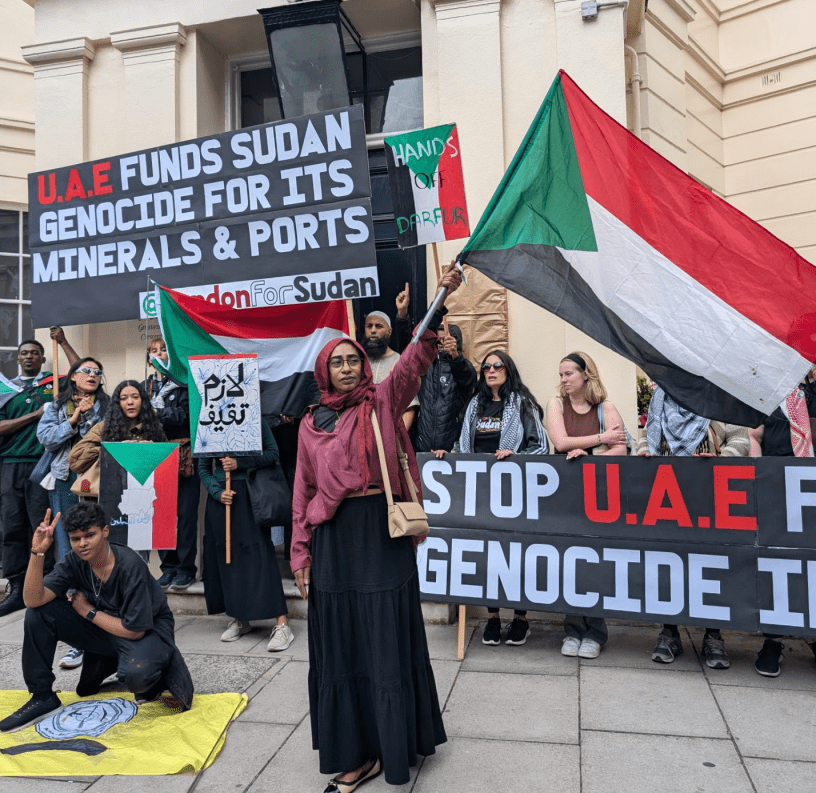
UN sanctions monitors have described what they deemed credible allegations that the UAE provided military support to Sudan’s paramilitary Rapid Support Forces (RSF) led by Mohamed Hamdan Dagalo, known as Hemedti, in the civil war against the Sudanese army.
Analysts have said the UAE distrusts the Sudanese Armed Forces chief, General Abdel Fattah al-Burhan, due to the presence within his ranks of Islamists from the regime of longtime former Sudanese strongman Omar al-Bashir, viewing Hemedti – a former partner in Yemen – as a counterweight.
The RSF has been accused, including by the US and rights groups, of committing crimes against humanity and ethnically motivated mass killings in Darfur.
The UAE has strongly denied supplying arms to the RSF, stating in letters to the UN that the allegations lack evidence, and emphasizing that its role is strictly humanitarian.
Chad
The UAE has strengthened security and economic ties with Chad’s transitional President Mahamat Idriss Deby, signing a military cooperation agreement in 2023 and supplying armored vehicles to the Sahelian state, which it views as a buffer against Islamist insurgents.
Attention has focused on the remote Amdjarass airport near the Sudanese border, where Reuters reported a surge in cargo flights.
While the UAE says it operates a field hospital and delivers aid for Sudanese refugees there, UN sanctions monitors and Western officials have alleged that the airstrip serves as a key logistics hub for supplying weapons to the RSF.
The UAE denies the charges, maintaining its operations are purely humanitarian.
Libya
The UAE was the primary foreign backer of the east Libya-based commander Khalifa Haftar, providing air support and equipment to his self-styled Libyan National Army (LNA) during a 2019 offensive on Tripoli, according to UN experts.
The intervention aimed to topple the Tripoli-based, internationally recognized Government of National Accord, which included Muslim Brotherhood-affiliated factions and was supported militarily by Turkey.
While the civil war has been in a fragile stalemate, the UAE remains a key power broker, maintaining close ties to eastern factions and the Haftar family while engaging in diplomatic efforts to shape a government free of what it terms “extremist militias.” However, Haftar’s own coalition includes hardline Salafist factions.
Somaliland
The UAE has cultivated deep economic and security ties with the self-declared republic of Somaliland, as Abu Dhabi has frequently viewed the federal Somali government in Mogadishu as being too close to Qatar and Turkey.
The centerpiece of this strategy is DP World’s $442 million investment to develop and operate the Port of Berbera, creating a strategic alternative to Djibouti on the Gulf of Aden.
In 2017, Somaliland’s parliament voted to allow the UAE to build a military base in Berbera. While the base was later designated for civilian use, the UAE continues to train Somaliland’s security forces while maintaining a consulate-level presence in Hargeisa.
Last week, Israel became the first nation to officially recognize Somaliland’s independence, a diplomatic breakthrough that was facilitated by Abu Dhabi, according to an Axios report that cited Israeli officials.
 Martin Plaut